



About this worksheet
This Grade 1 printable guides children through an informative paragraph about a familiar topic: where they live. Part A selects words that make sensible facts, and Parts B and C turn those ideas into complete sentences and a closing. The work supports CCSS W.1.2 by naming a topic, supplying facts and providing closure. The key includes sample responses because children may live in different places.
Aligned to W.1.2
Which words make useful facts?
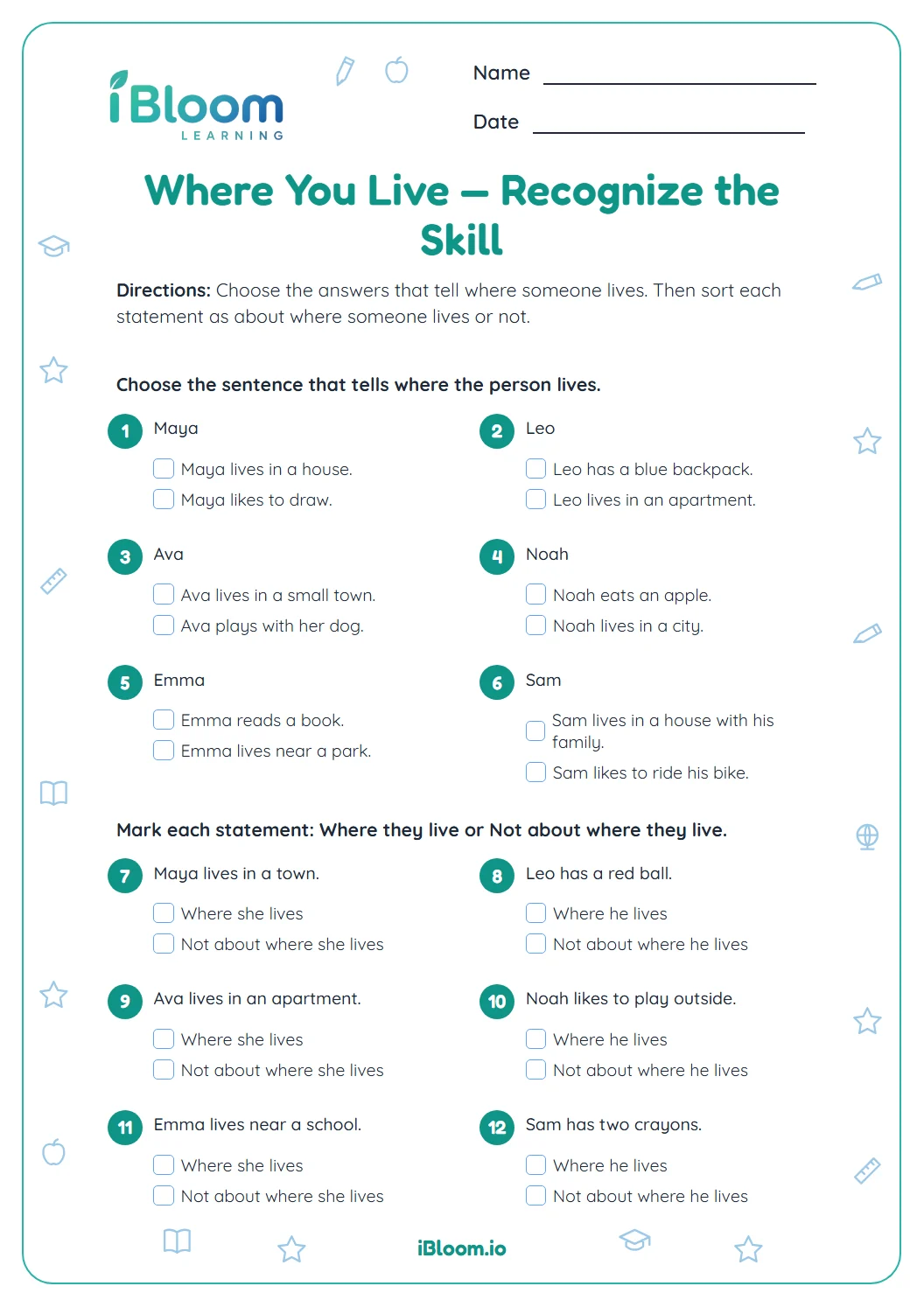
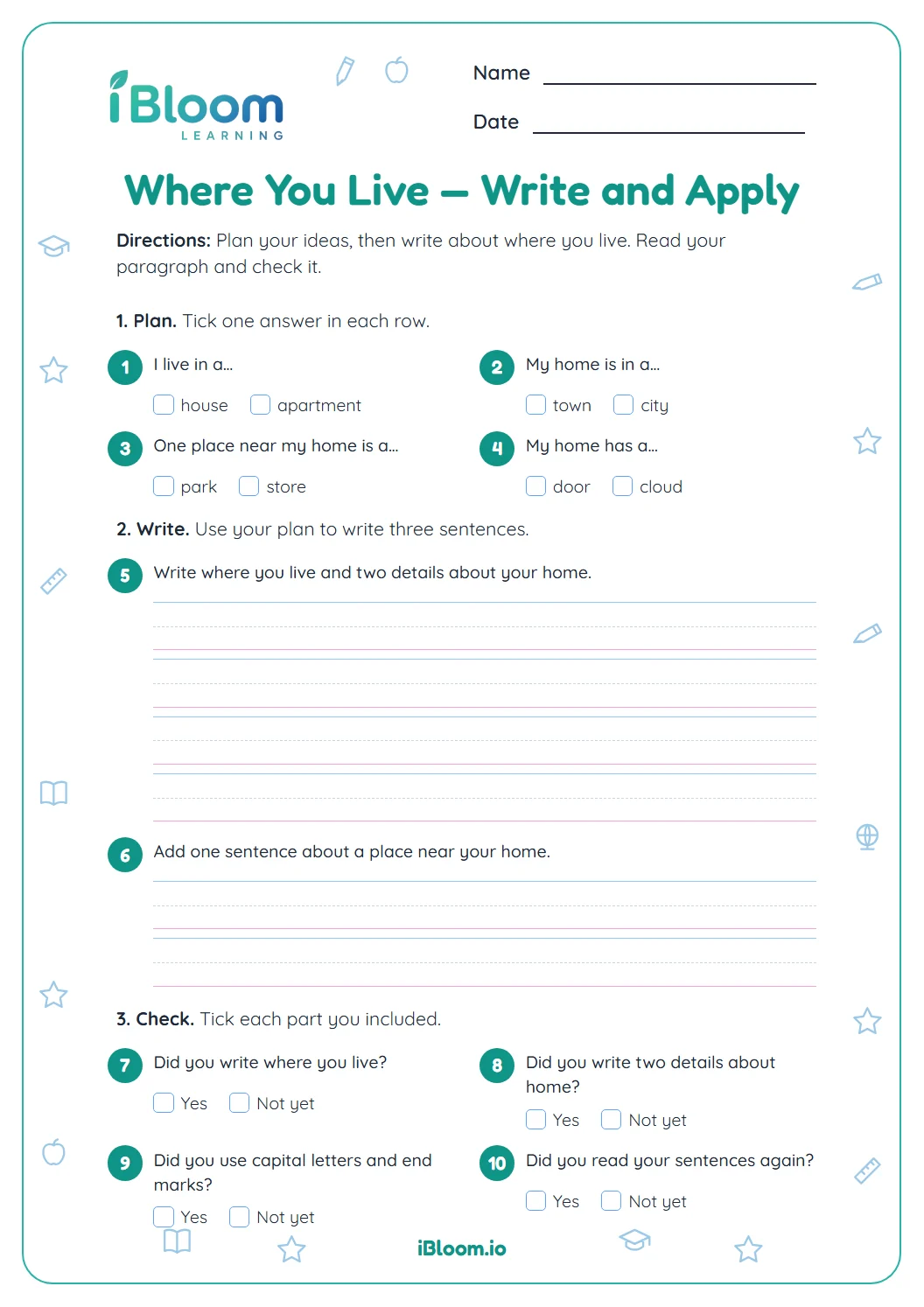
Part A offers three words for each question. Choose the word that gives a clear place, object or action related to a home or neighborhood.
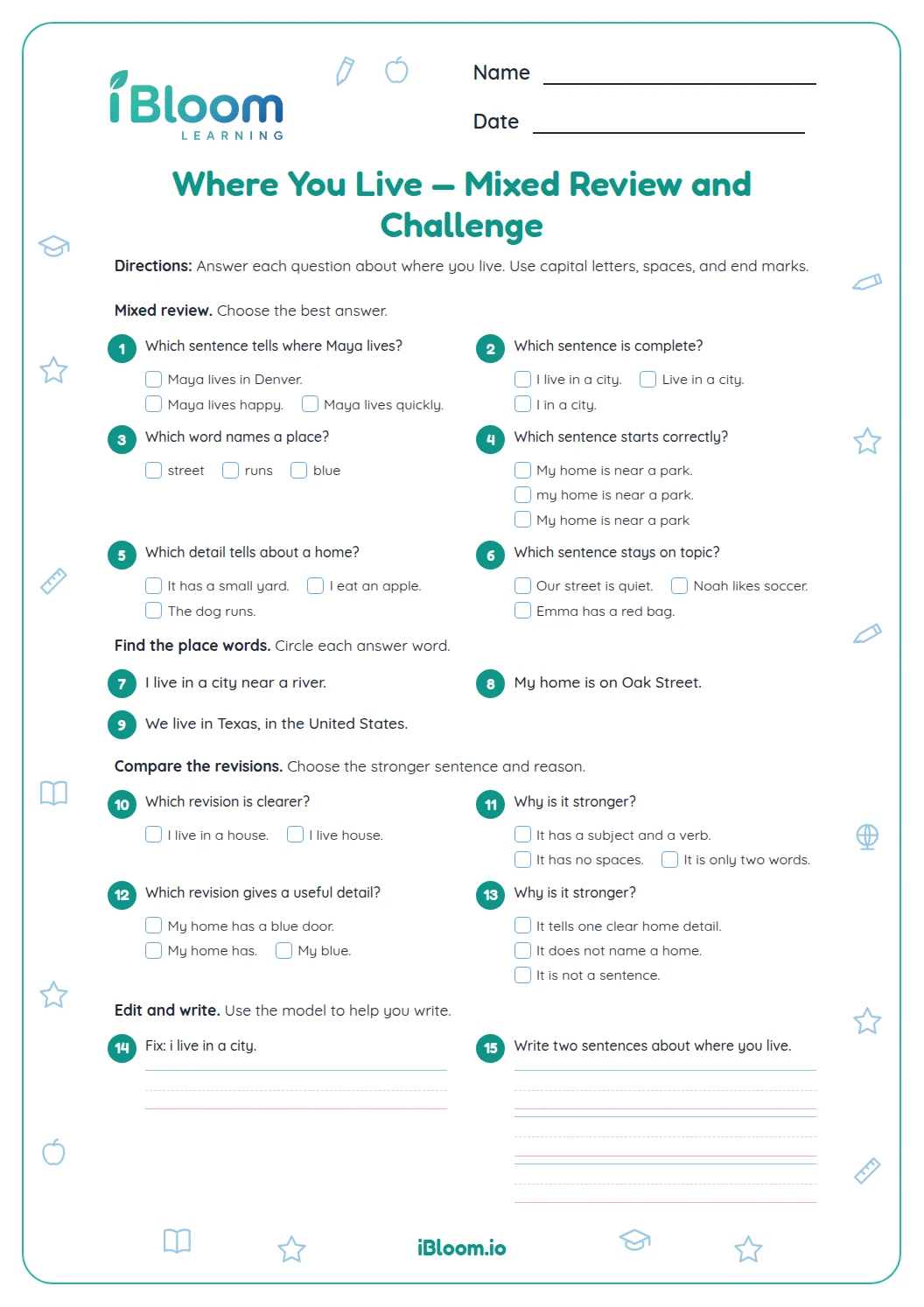
- 1Question 1: “Which word can name a place where someone lives?” → town.
How do the prompts build a paragraph?
Parts B and C move from one sentence at a time toward a short paragraph. Each sentence should stay on the topic and add a related detail.
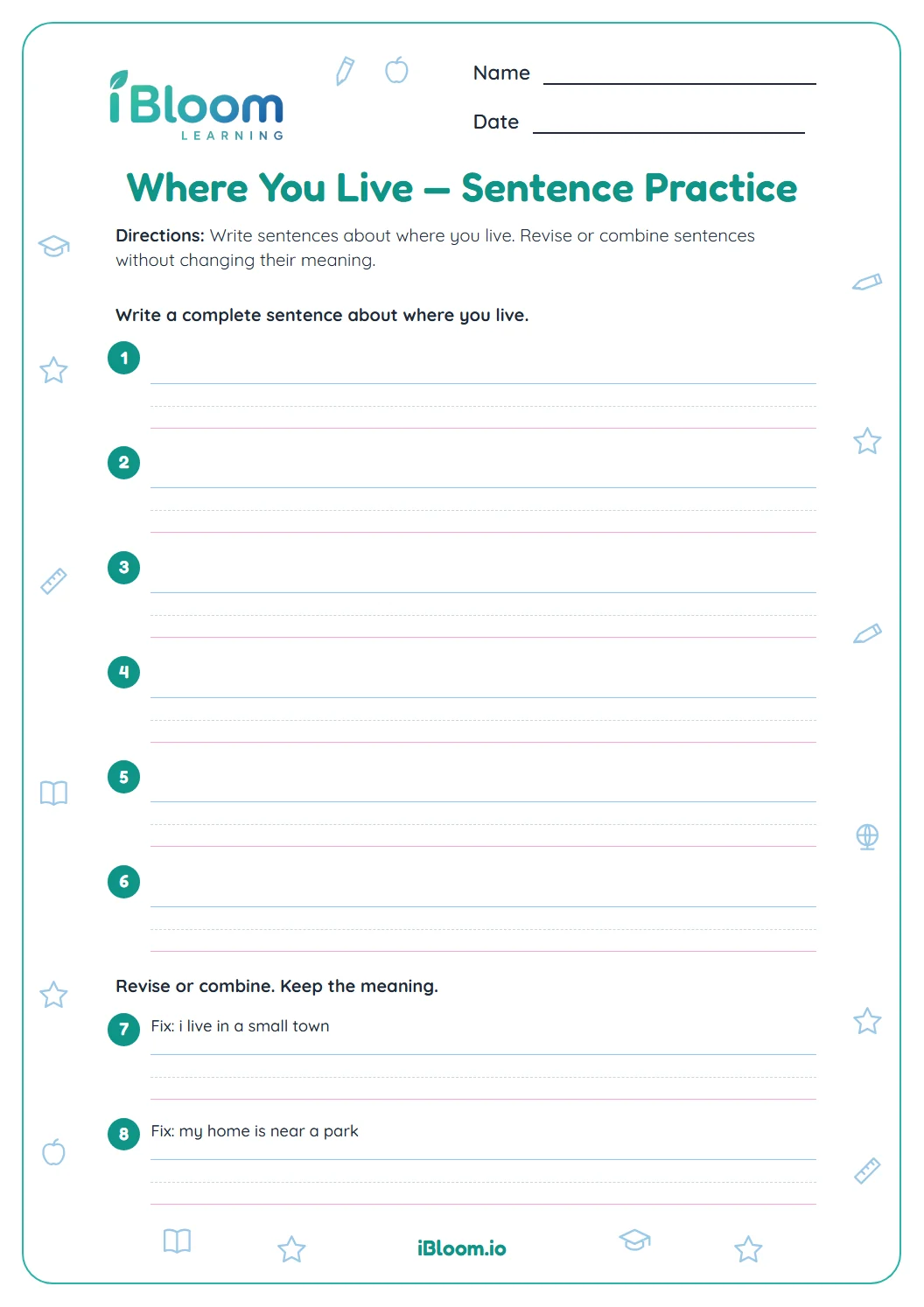
- 1“Write one complete sentence naming a place near where you live.” → “A park is near my home.”
What makes a useful closing sentence?
A closing sentence gives the paragraph a finished feeling. It can share a simple thought about the place without adding a new, unrelated topic.
How to use this worksheet
- 1Read the topic and word choices together.
- 2Choose a word that makes a true, complete idea.
- 3Write each response as a sentence that starts with a capital letter and ends with punctuation.
- 4Use the prompts in order to collect details about one neighborhood.
- 5Reread the last sentence to see whether it feels like an ending.
Common mistakes and fixes
The mistake
Writing a fragment such as “near the park.”
The fix
Add who or what the sentence is about: “My home is near the park.”
The mistake
Adding a detail that changes the topic.
The fix
Check that each sentence tells something about the home or neighborhood.
The mistake
Stopping without a closing.
The fix
Add one last sentence that sums up how you feel about the place.
Common Core alignment
This page practices the reading and writing skills named below.
Name a topic, add facts and details, and close with a final sentence.
On this sheet: Students complete topic details and a closing sentence, then combine them into an informational paragraph.
Show the official wordingHide the official wording
Write informative/explanatory texts in which they name a topic, supply some facts about the topic, and provide some sense of closure.
What to practice next
Make more practice
Further reading
Questions parents and teachers ask
What does guided completion mean here?
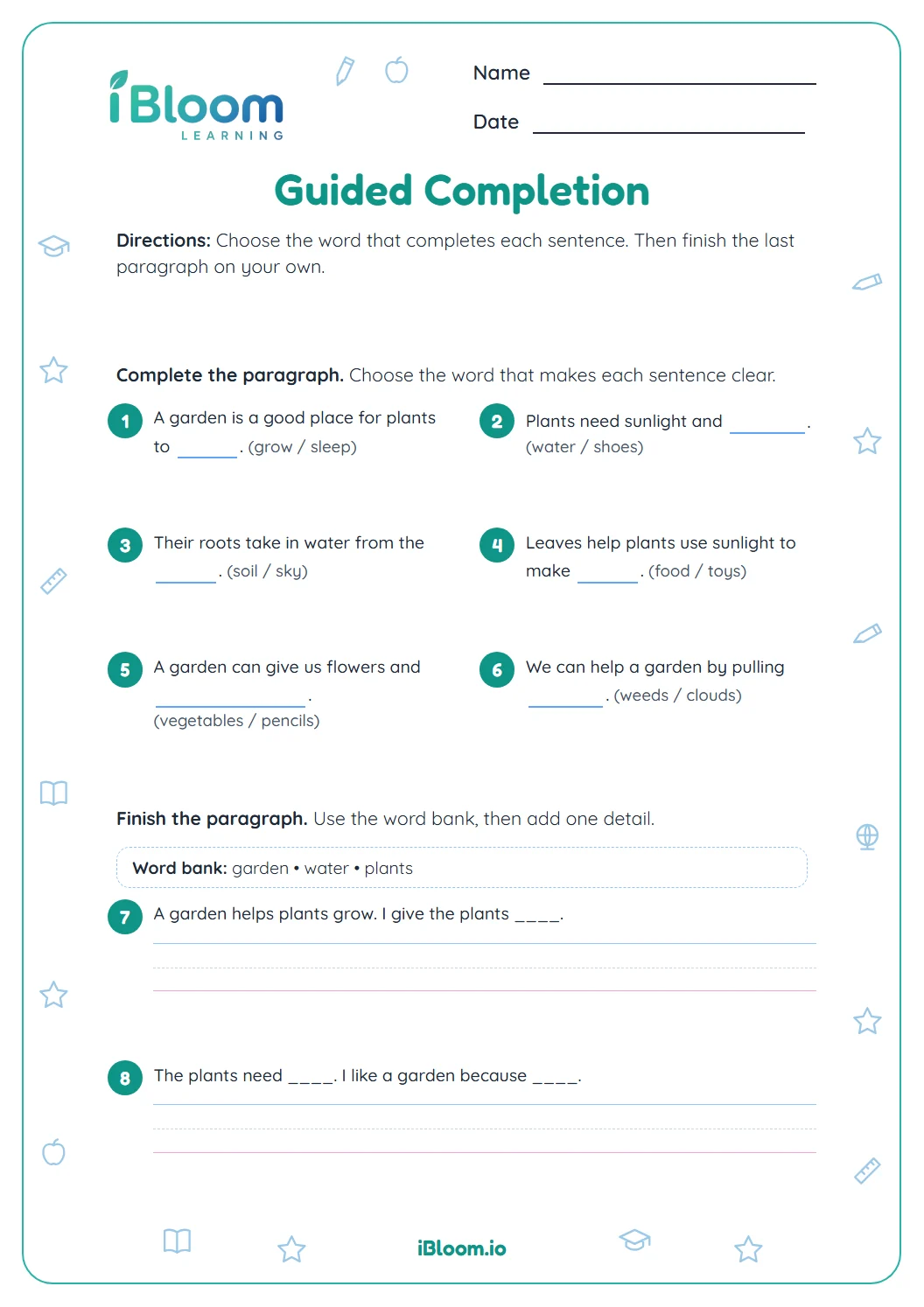
Here, guided completion means the page breaks paragraph writing into small choices and sentence prompts. Children first select useful details, then write sentences about a nearby place, what they see and what people do, before adding a closing sentence.
Can answers differ from the key?
Yes. The key gives sample wording, but children may describe different real places and details. Accept a sentence that answers the prompt, stays on the neighborhood topic and uses a complete idea. For the multiple-choice questions, the listed word is the intended answer.
What is a complete sentence?
A complete sentence tells a full idea and begins with a capital letter. It ends with punctuation. For example, “A park is near my home.” tells where the park is in relation to the writer’s home. The prompt supplies a familiar subject to help them begin.
How many details should the paragraph have?
The page asks for several related sentences, including a nearby place, a detail, an activity, a joined sentence and a closing. Use the prompts in order to build a short paragraph; a child can choose details that are true for their own neighborhood.
Should a child write about a real address?
No. The prompts ask about a nearby place and neighborhood details, not a street address. A child can write about a park, trees, neighbors or another familiar feature without naming where the family lives. A general description of a nearby place is enough for this activity.
How do I check the paragraph?
Check that each sentence answers its prompt and stays on the topic of home or neighborhood. Look for a capital letter and end punctuation, then see whether the last sentence gives the paragraph a clear ending. An adult can read prompts aloud while the child writes.