



About this worksheet
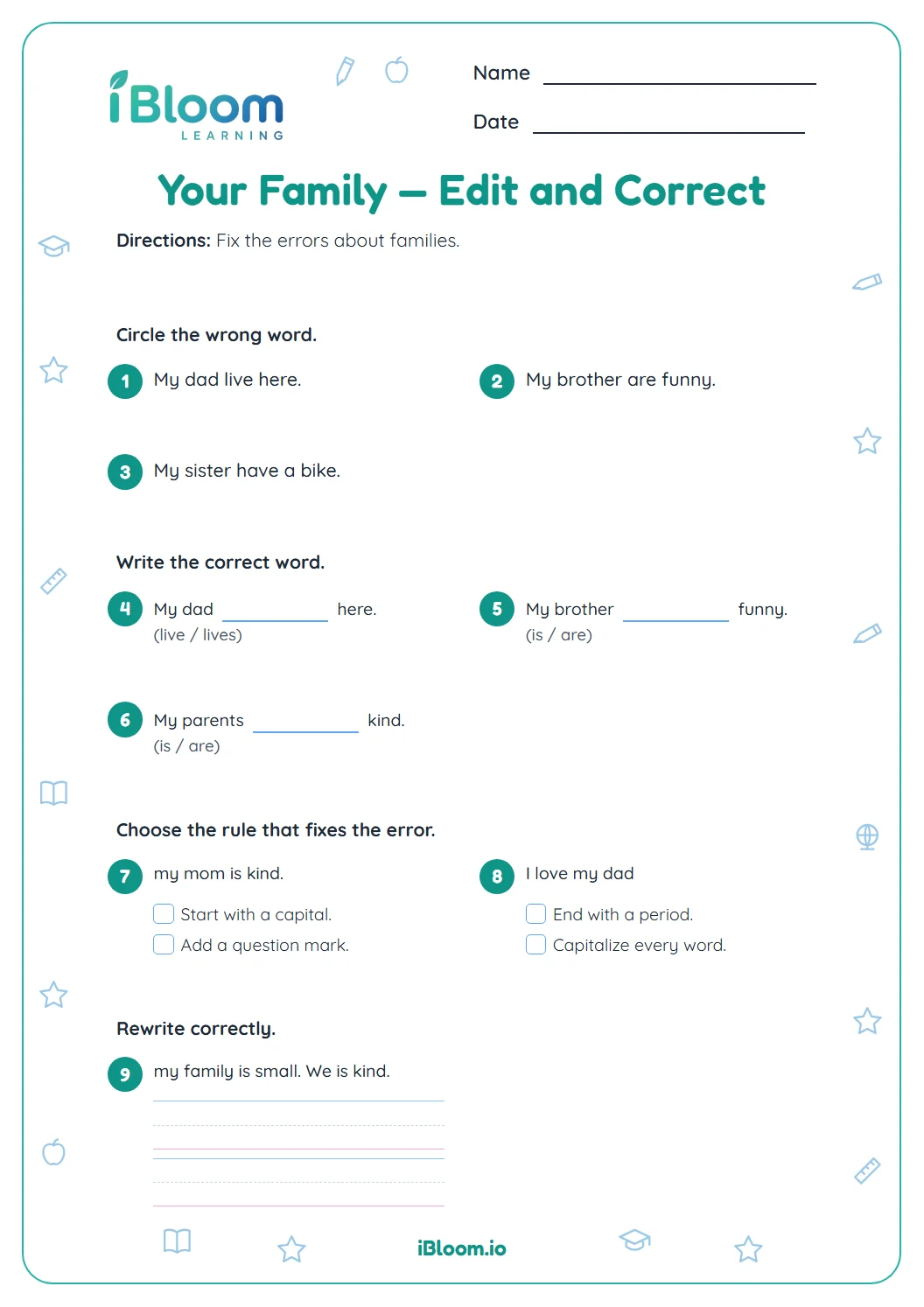
This Grade 1 writing worksheet gives children a clear editing routine: repair sentence beginnings and endings, improve short paragraphs, and write brief explanations of familiar topics. The page begins with sentence corrections before moving to original two-sentence writing. It aligns with Common Core W.1.5, which calls for focusing on a topic and adding details with adult support. A separate key offers examples for open responses.
Aligned to W.1.5
What should a child check when editing?
Read the sentence aloud. Check that the first word begins with a capital letter and that the sentence ends with a period, question mark or exclamation point. Then read it once more to make sure the words express a complete idea.
Question 1 begins “we see birds.” A corrected version is “We see birds.” The capital marks the sentence start, and the period shows where the thought ends.
- 1we see birds
- 2We see birds.
- 3Capital at the start; period at the end.
How does a sentence become a paragraph?
A short paragraph keeps its sentences on one topic. Each sentence can add a fact or explain the first fact. For example, a paragraph about a plant can name what it needs and then tell what one part does.
What will children write on this sheet?
The 16 questions progress from editing single sentences to revising two-sentence paragraphs and composing brief explanations. Open writing answers can vary, so the key gives one possible response.
- Part A: repair capitals and end marks in five sentences
- Part B: edit three short paragraphs
- Part C: write eight two-sentence explanations
- Use the answer key as one example, not the only possible wording.
How can an adult support this practice?
- 1Read the full sentence before changing anything.
- 2Capitalize the first word and the pronoun I.
- 3Choose an end mark that matches the sentence.
- 4For a paragraph, keep both sentences focused on the same topic.
- 5Add a fact that helps explain the topic.
- 6Reread the finished work aloud.
Common mistakes and quick fixes
The mistake
Adding a period after every line even when an idea continues.
The fix
Read the words together and finish a complete thought before placing a period.
The mistake
Forgetting to capitalize I.
The fix
Check the pronoun I every time it appears.
The mistake
Writing two facts about different topics.
The fix
Name the topic first, then make both sentences explain that same topic.
Common Core alignment
The editing and supported writing tasks connect to Grade 1 writing expectations.
Focus on a topic and add details while improving short explanatory writing.
On this sheet: Children revise sentence and paragraph writing with adult guidance.
Show the official wordingHide the official wording
With guidance and support from adults, focus on a topic, respond to questions and suggestions from peers, and add details to strengthen writing as needed.
What to practice next
Make more practice
Further reading
Questions parents and teachers ask
What should a child look for when editing?
Check for a capital letter at the start, a complete thought, and a fitting end mark. Then reread the sentence aloud. The first section gives children repeated practice with those visible checks before asking them to revise a whole paragraph.
Does the worksheet include original writing?
Yes. The final eight items ask children to write two short explanatory sentences about familiar topics. The answer key gives sample responses, but a child may use different accurate details as long as the sentences stay focused on the prompt.
How is a paragraph different from a list?
A paragraph groups sentences about one topic. The sentence that follows should add information about the same subject instead of changing to a new one. On this worksheet, children edit short examples and then practice writing two connected facts.
Should adults correct every spelling choice?
Start with the editing target on the page: sentence starts, end marks and clear ideas. If a child asks for help spelling a word, offer support, then invite them to reread the whole sentence and decide whether it communicates the intended fact.
Why does the answer key say “Sample”?
Several writing prompts have many good answers. The key shows one clear two-sentence response for each prompt so an adult can see the expected length and focus. Accept other responses that answer the question and use complete sentences.
How can an adult help without writing the answer?
Ask the child to read the sentence aloud and point to its first and last word. Ask what one more detail could teach the reader about the topic. These questions guide a revision while leaving the child responsible for choosing and writing the words.