



About this worksheet
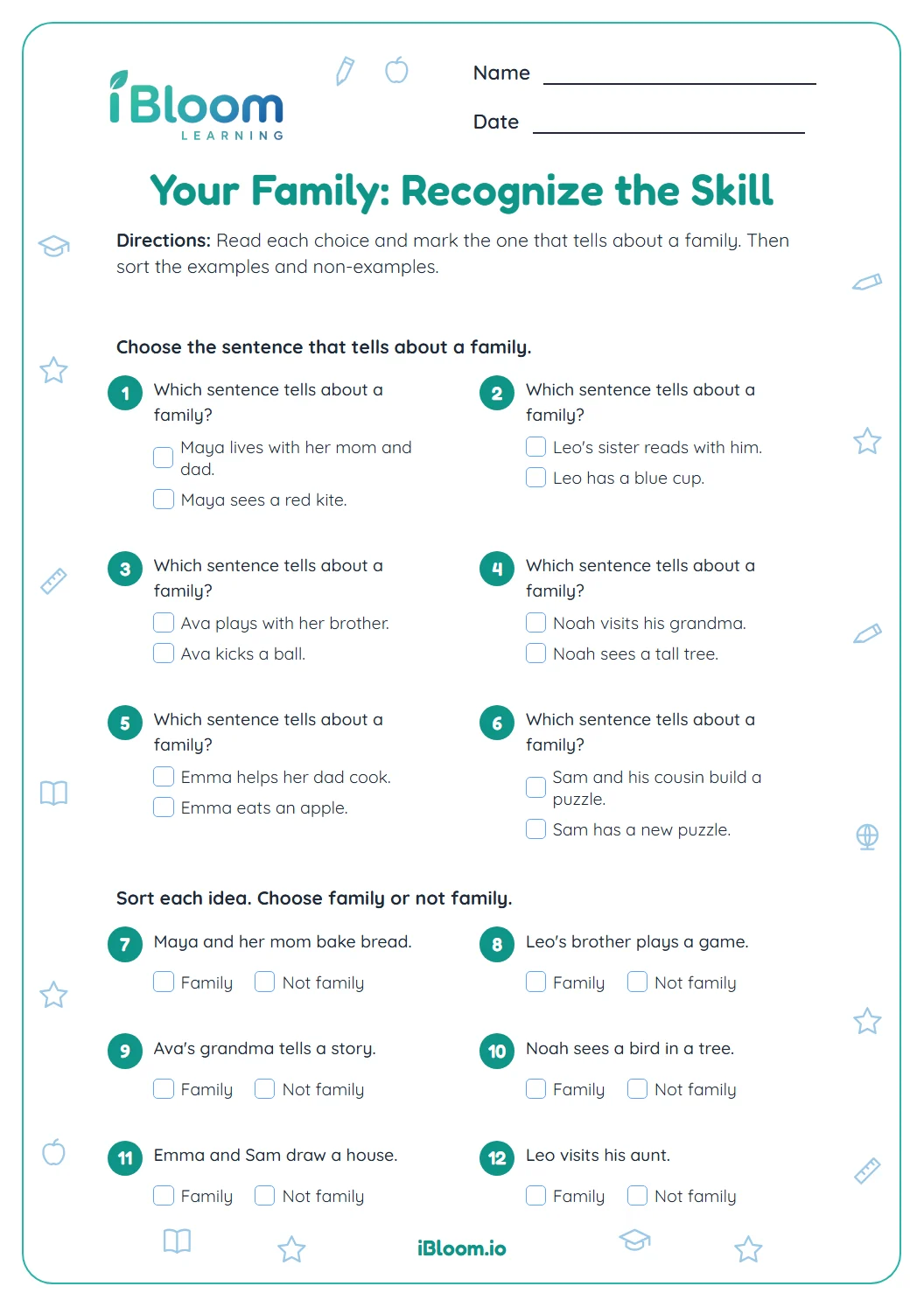
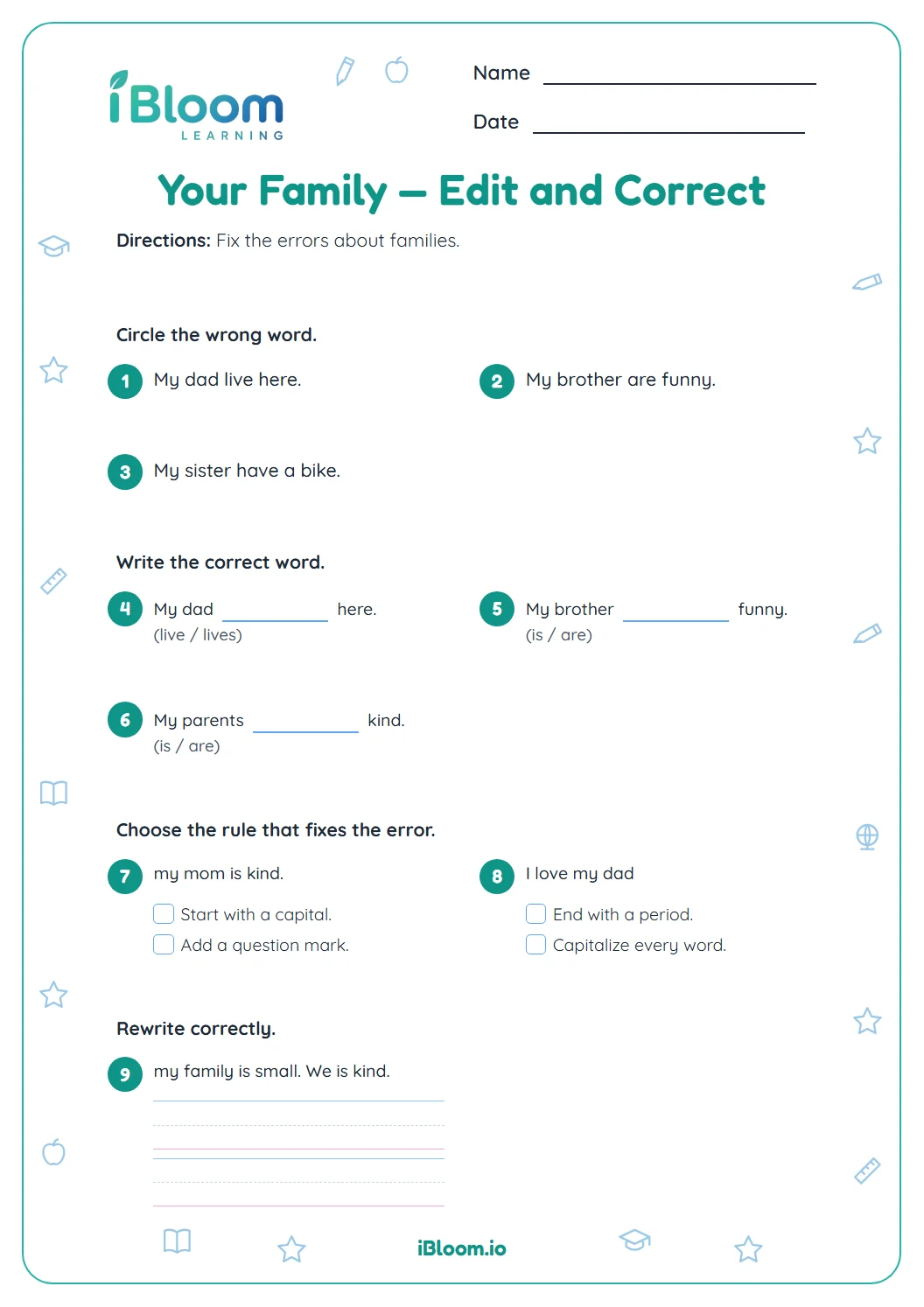
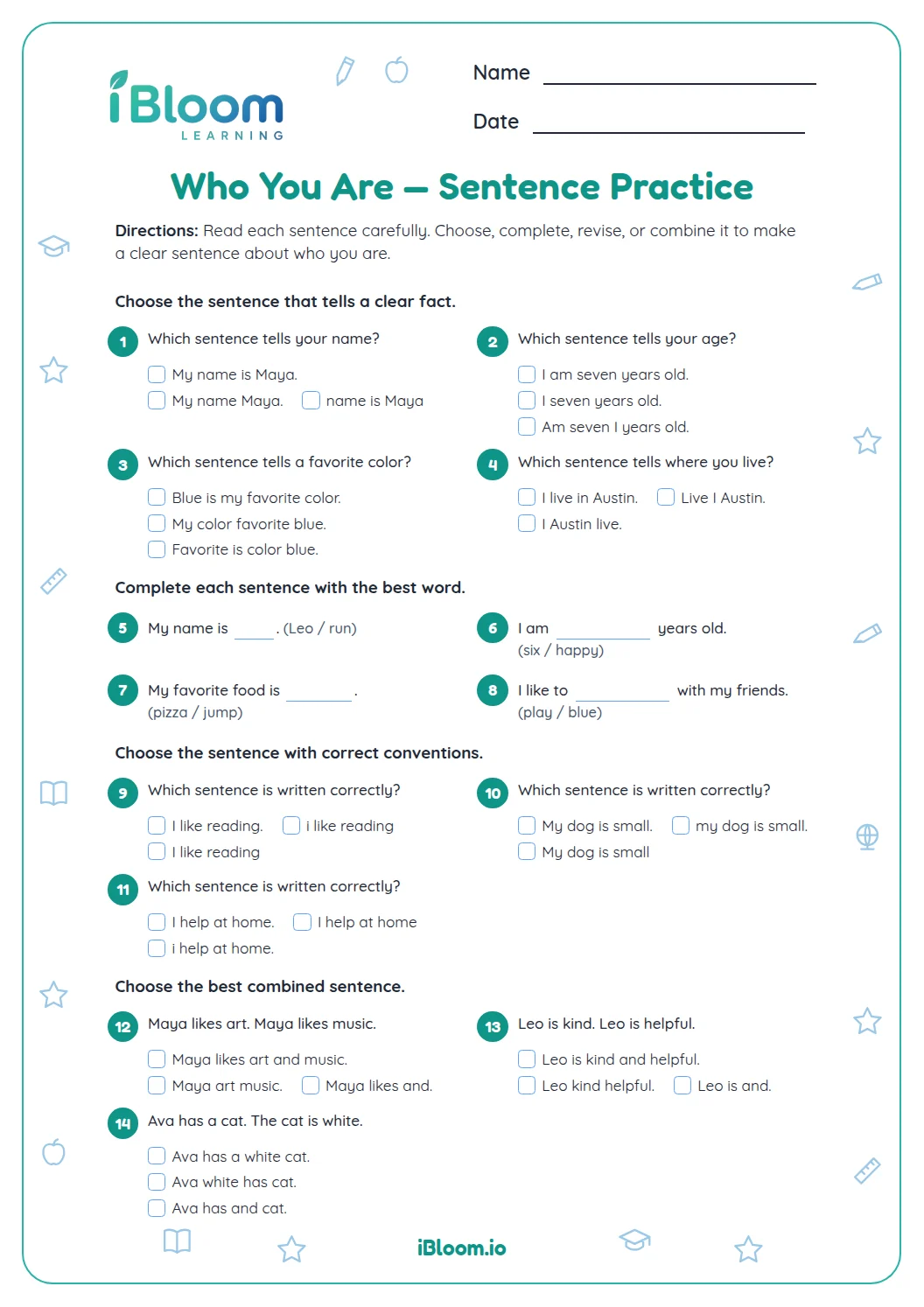
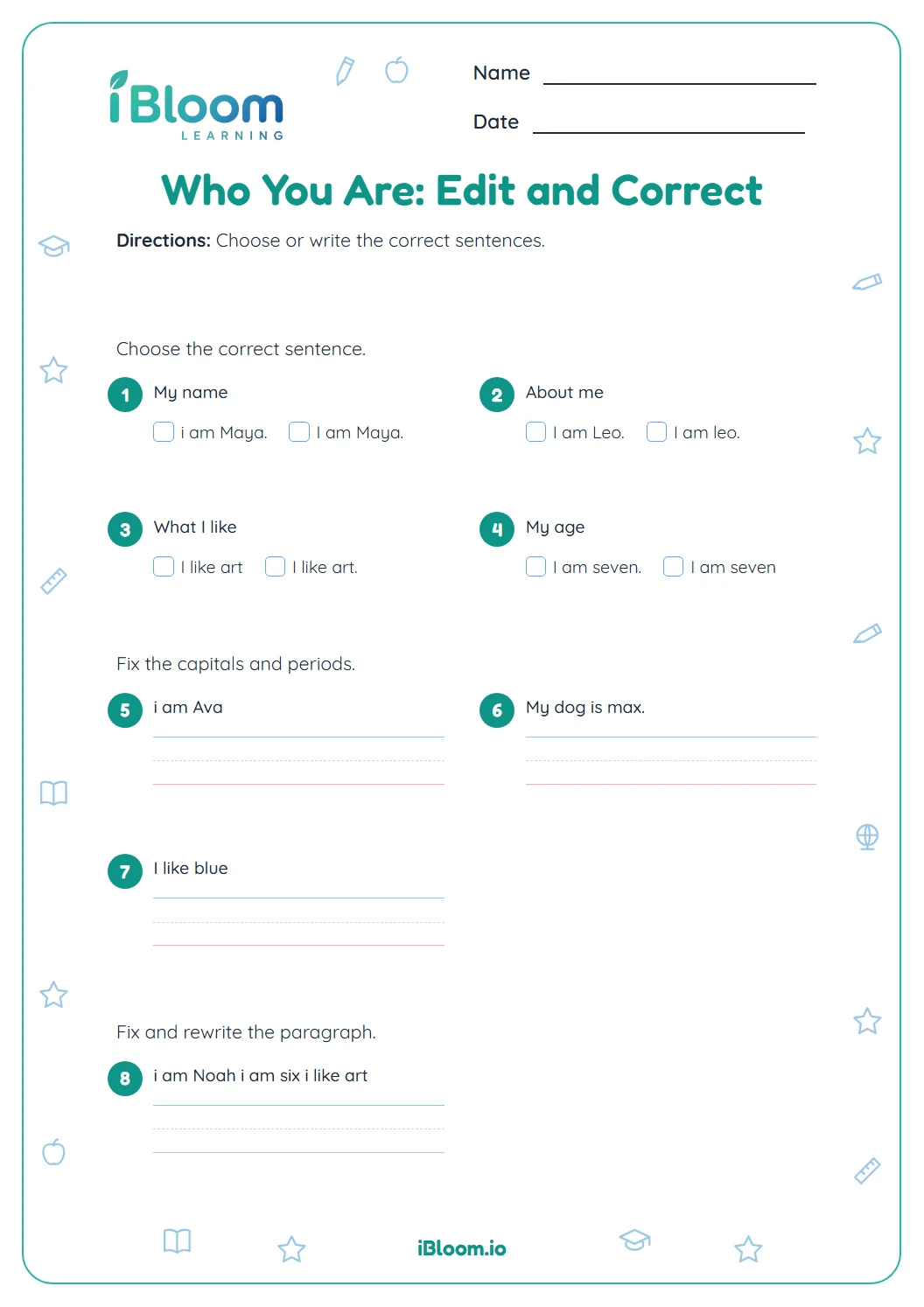
This free printable Grade 1 worksheet builds complete sentence skills and introduces a short paragraph about family. Children choose complete sentences, revise capitals and punctuation, join ideas with and, and select an opening, supporting detail, and closing for a family park paragraph. The separate key supplies the sentence blanks and marks the paragraph choices.
Aligned to L.1.1j
What makes a family sentence complete?
A complete sentence tells who or what it is about and says something about that person or thing. “My aunt is Ana” gives a complete thought. Children choose complete family sentences before practicing how ideas join and how a paragraph stays on one topic.
How does and join two ideas?
Some questions ask children to join two supplied sentences with and. “We sing and dance” keeps both actions in one complete sentence. Another item combines two people doing the same action: “Dad and Mom cook.”
- 1We sing. We dance.
- 2Both sentences tell what we do.
- 3Join the actions: We sing and dance.
How can children build a short paragraph?
A paragraph keeps related ideas together. An opening sentence names the topic, supporting details tell more, and a closing sentence wraps up the thought. Children choose an opening, a matching detail and a closing for a family park visit, then write one possible opening sentence.
Children can arrange the ideas in a sensible order and combine related actions. The key gives one possible opening; accept other clear topic sentences that introduce the family park visit.
- 1The topic is a family park visit.
- 2Choose an opening sentence that names the topic.
- 3Sample: My family visits the park.
How to use this worksheet
- 1Choose a real or imaginary family for the open-ended prompts.
- 2Rehearse each response aloud as a complete sentence before writing.
- 3Choose sentences that keep both original ideas when joining them.
- 4Use the choices to revise a sentence and plan a paragraph.
- 5Write an opening sentence for the park visit and compare it with the sample key.
Mistakes to notice and fix
The mistake
Writing only a name for question 1.
The fix
Help turn the name into a complete thought, such as “My aunt is Ana.”
The mistake
Dropping one action when joining “We sing. We dance.”
The fix
Point to both actions and keep each one: “We sing and dance.”
The mistake
Changing pet to dog without adding a describing word in question 9.
The fix
Keep pet and add a word that tells what it is like, such as small or playful.
Common Core alignment
Write, combine and expand complete sentences about a family.
On this sheet: Children write six sentences, join two pairs with and, and add a describing word to a sentence.
Show the official wordingHide the official wording
Produce and expand complete simple and compound declarative, interrogative, imperative, and exclamatory sentences in response to prompts.
What to practice next
Make more practice
Further reading
Questions parents and teachers ask
Must children write about their own family?
No, children may describe a real or imaginary family in the open-ended prompts. They can choose people and activities they feel comfortable discussing. The worksheet asks for complete sentences rather than private details. The sentence choices later in the sheet use supplied examples about singing, cooking and a park visit.
How much independent writing is required?
Children write six family sentences and one paragraph-opening sentence. Seven choices ask them to join sentences, revise a sentence, and identify parts of a paragraph. This sequence moves from a complete thought to related sentences about one topic, with a sample key for checking.
Is there only one way to join each pair?
No, different complete sentences can keep both original ideas and use and correctly. For question 7, “We sing and dance” and “We sing, and we dance” both work. Ask the child to check that neither action disappears when the two sentences become one.
Are the sample answers the only correct answers?
No, most responses can vary. The key gives sample family facts, possible joined sentences and an example of a describing word. Accept alternatives that follow the prompt and make complete sentences. For question 10, check the capital W and a suitable ending mark.
How can these sentences become a paragraph?
The paragraph choices include an opening, a detail that belongs with it and a closing thought. Children also write an opening sentence for a family park visit. Together, these prompts help them keep related ideas centered on one topic.