


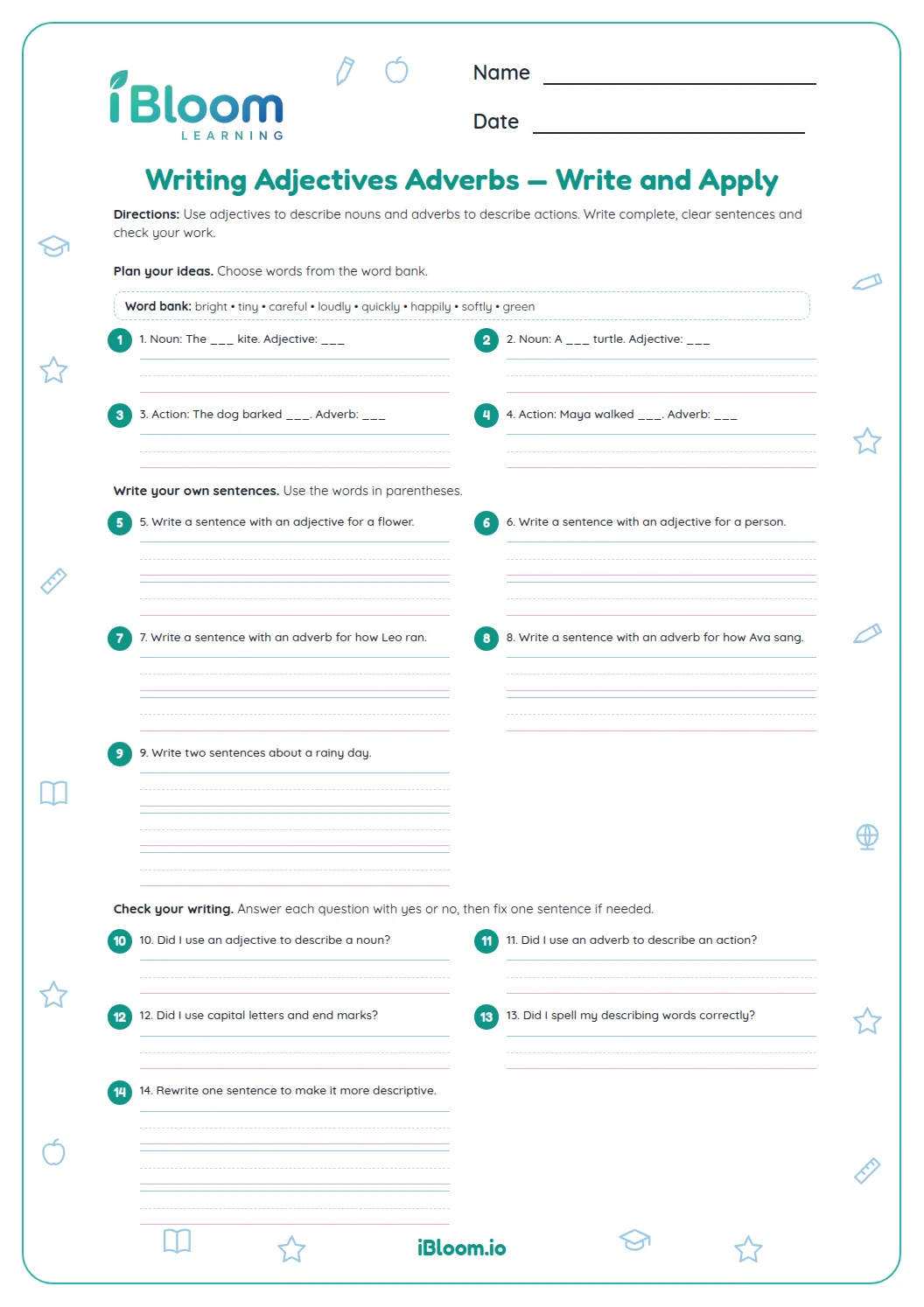
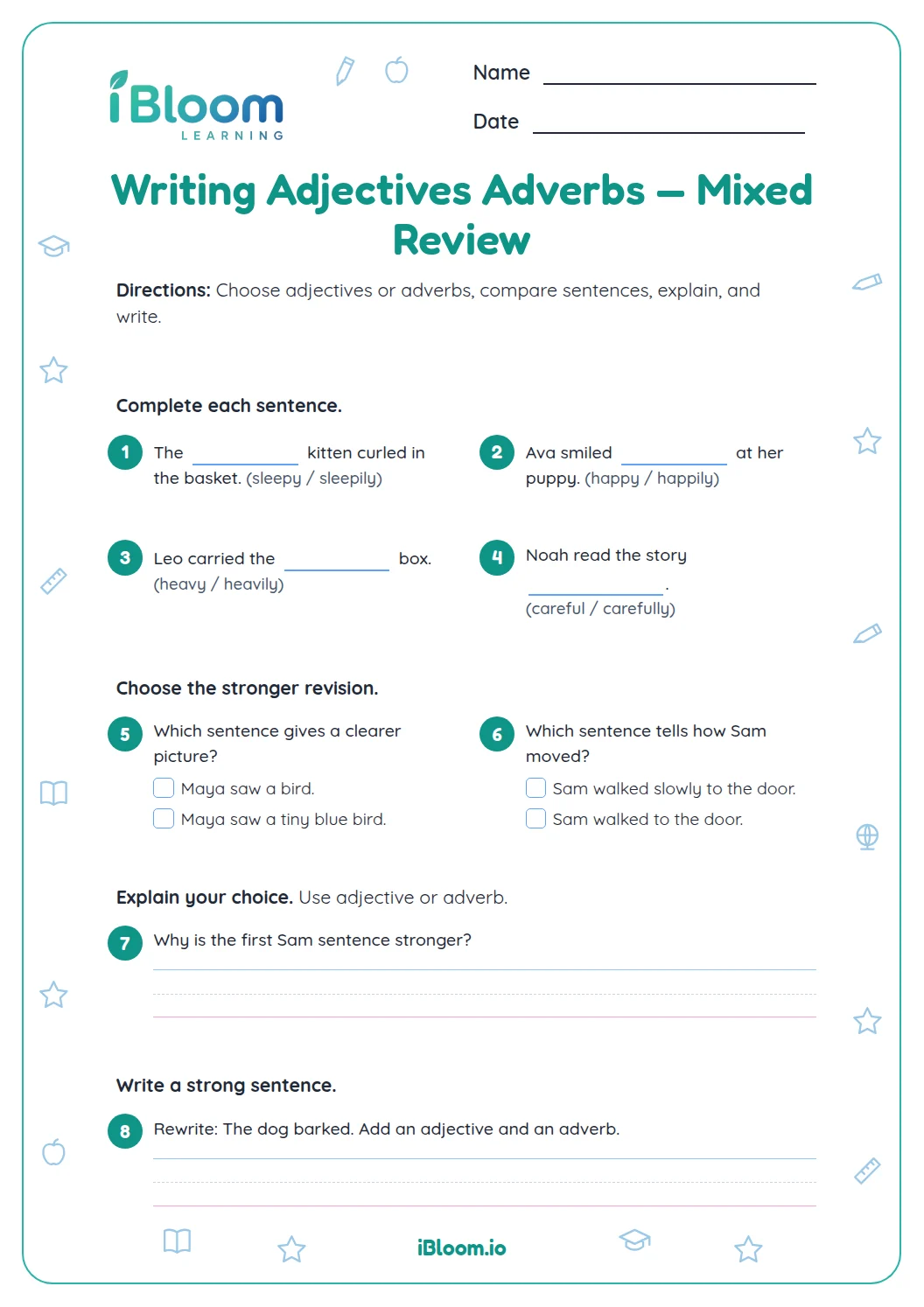

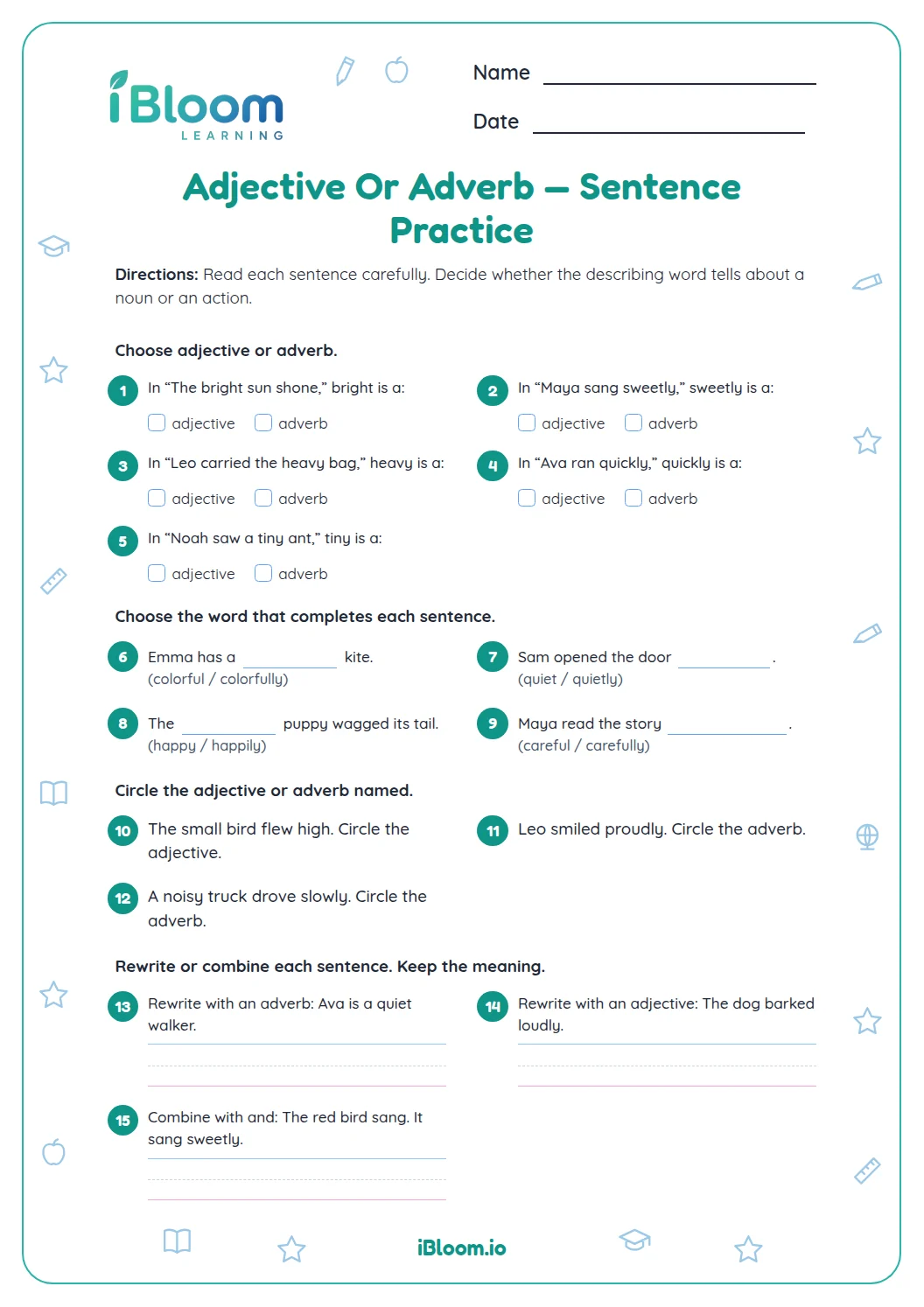
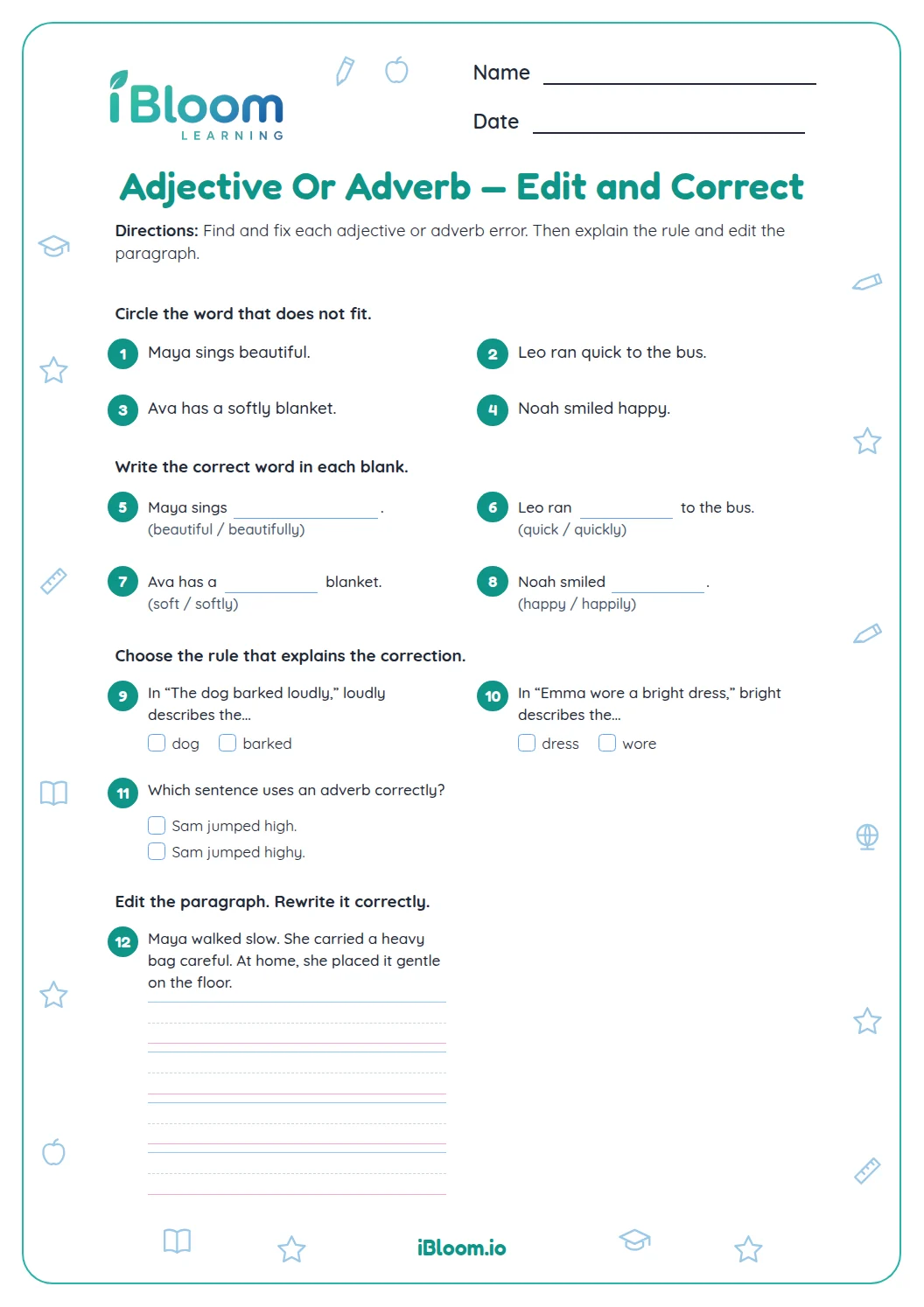


About this worksheet
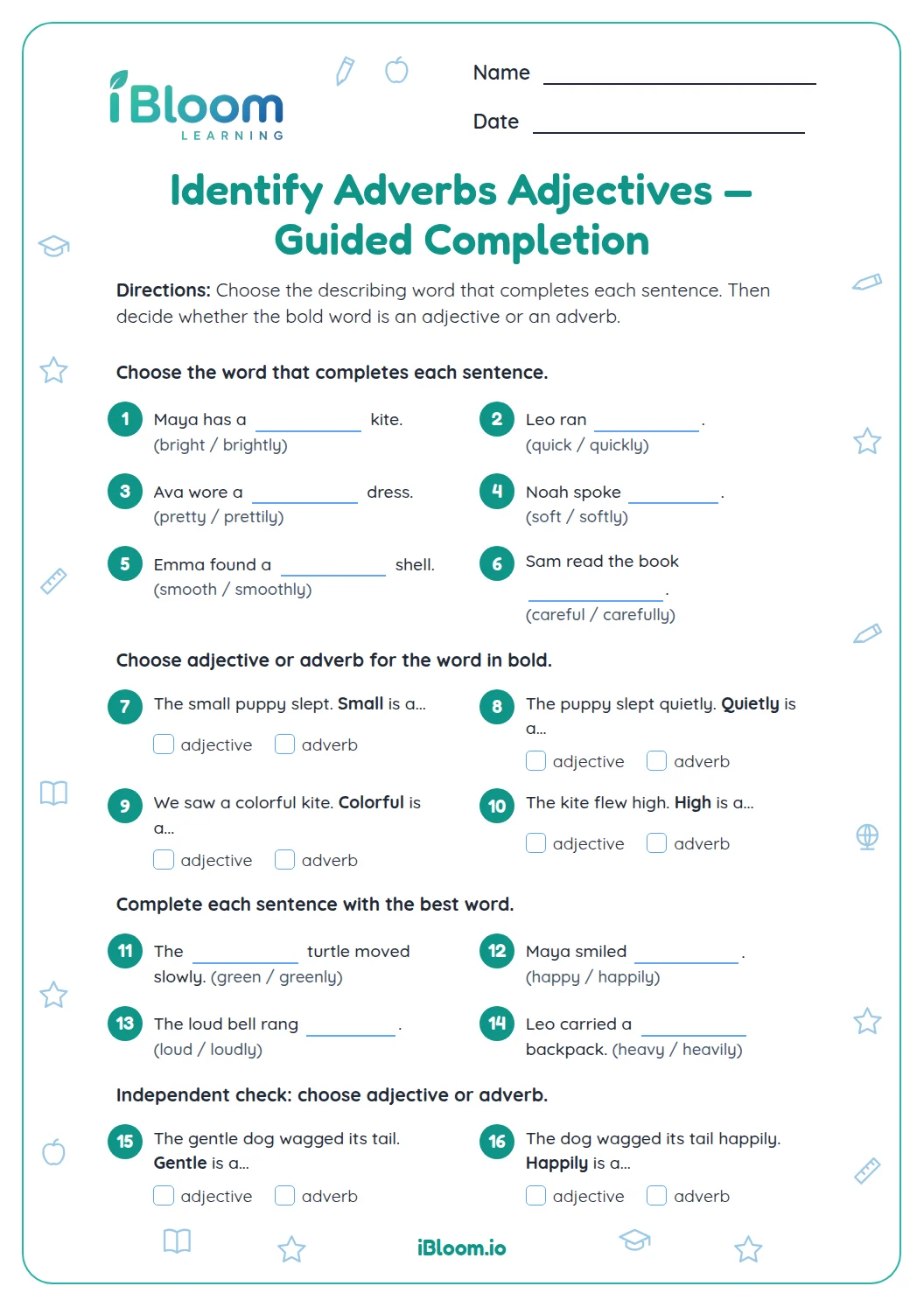
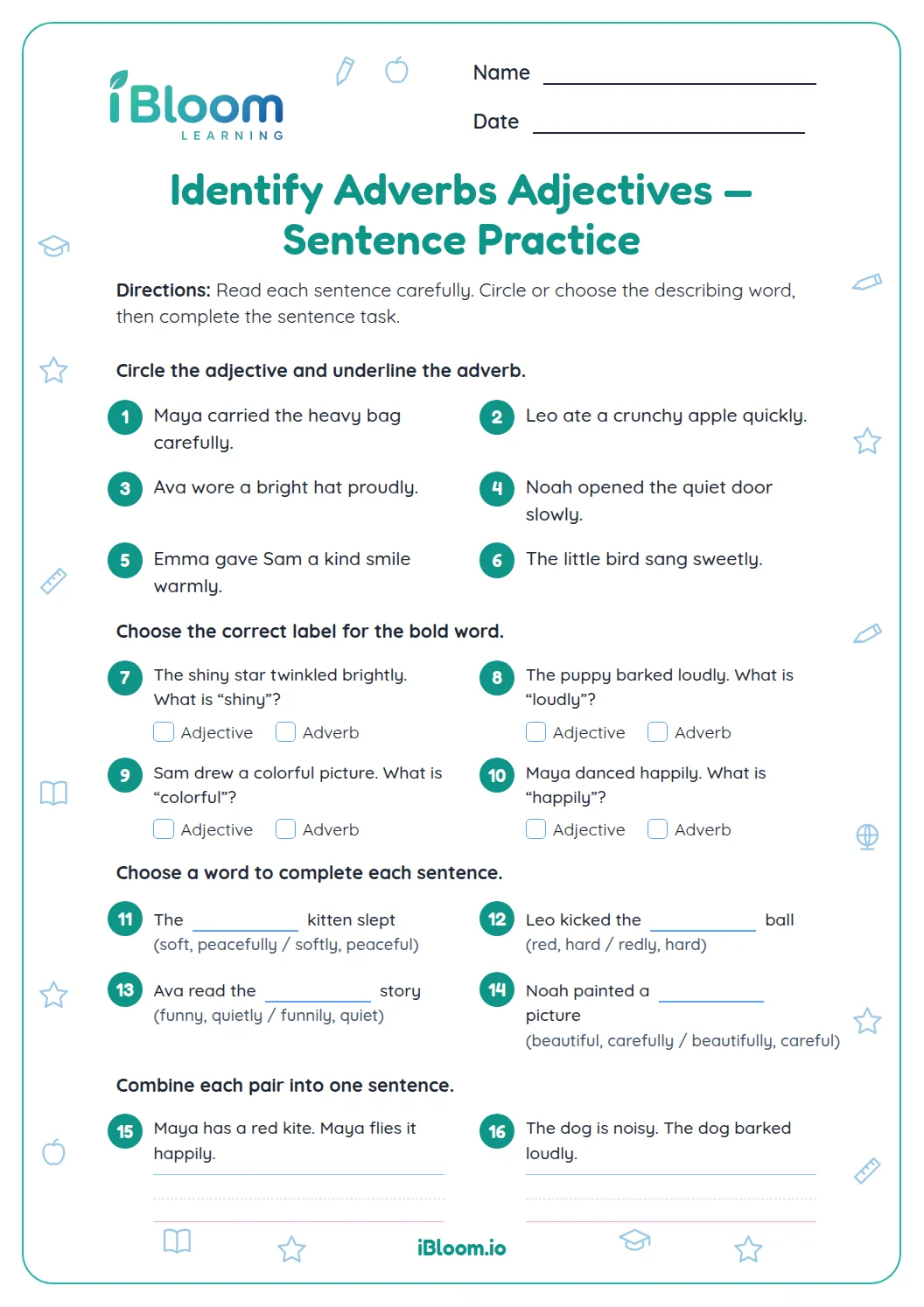
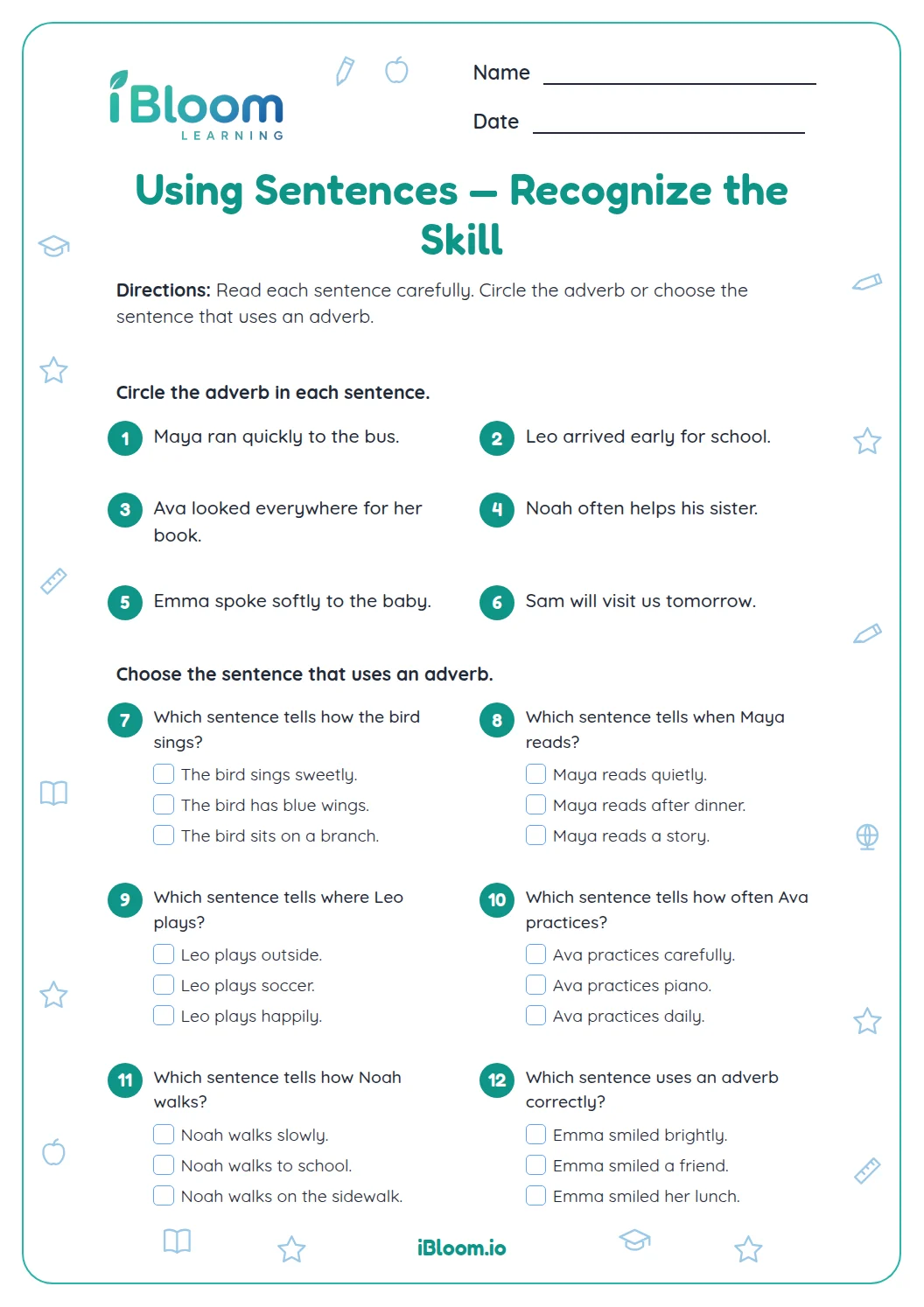
This Grade 2 grammar worksheet helps students recognize adjectives and adverbs in short sentences. Students identify words that describe nouns or tell how an action happens, then choose adjective or adverb forms to complete sentences. The 16 items are organized into three parts, with an answer key for each selection.
Aligned to L.2.1.e
What does an adjective describe?
An adjective gives information about a noun. In “The quiet mouse hid,” quiet tells what the mouse is like. Part A asks students to locate describing words in short, familiar sentences.
How does an adverb add information?
An adverb can tell how an action happens. In “Mia sang softly,” softly tells how Mia sang. Many adverbs end in -ly, but students should pay attention to the job a word does in the sentence, too.
- 1Mia sang softly. Which word tells how Mia sang?
- 2Answer: softly. It tells how the action happened.
How do you choose an adjective or adverb form?
Read the whole sentence and identify the word being described. A noun needs an adjective, as in “a sleepy kitten”; an action may be described by an adverb, as in “spoke kindly.” Part B gives two forms so students can match the word to its job.
How to use this worksheet
- 1{'step': 'Read the complete sentence.', 'detail': 'Find the noun or action that gets more detail.'}
- 2{'step': 'Ask what the describing word tells.', 'detail': 'Does it describe a person, place, thing, or action?'}
- 3{'step': 'Choose the word form that fits.', 'detail': 'Match the word to its job in the sentence.'}
- 4{'step': 'Read the sentence aloud.', 'detail': 'Check that it sounds clear and complete.'}
Common mistakes and quick fixes
The mistake
Calling every -ly word an adverb without reading the sentence.
The fix
Ask what the word describes and what information it adds.
The mistake
Using an adjective to tell how an action happens.
The fix
For an action, try an adverb such as gently or carefully.
The mistake
Using an adverb before a noun.
The fix
Use an adjective to describe the noun, as in a gentle breeze.
Students choose adjectives and adverbs by identifying the words each one modifies.
Students choose adjectives and adverbs to fit the words they modify.
On this sheet:
Show the official wordingHide the official wording
Use adjectives and adverbs, and choose between them depending on what is to be modified.
What to practice next
Further reading
Questions parents and teachers ask
What is an adjective?
An adjective describes a noun, such as quiet in “the quiet mouse” or warm in “warm soup.” Students can ask which word gives more information about a person, place, animal, or thing. The worksheet includes examples with familiar people, animals, and objects.
What is an adverb?
An adverb can tell how an action happens. In “Mia sang softly,” softly tells how Mia sang. Some adverbs also tell when an action happens, such as early in “The bell rang early.” Students identify these jobs in complete short sentences.
How many questions are on this worksheet?
There are 16 questions in three parts: six multiple-choice items, four sentence completions, and six more multiple-choice or word-choice questions. The answer key lists the correct adjective or adverb for every item so students can check each selection. Read the noun or action in context to check the word form.
Do all adverbs end in -ly?
No. Many adverbs use -ly, such as softly and carefully, but students should read the sentence and identify the word’s job. Early can tell when something happened, while some adverbs do not use the -ly ending. The worksheet uses context to make the distinction.
What if my child writes a different adjective or adverb?
The worksheet gives choices for every item, so students select the word that fits the sentence and requested job. For example, soft describes the blanket, while smoothly tells how the bird flies. Read the noun or action with the chosen word to check that the sentence makes sense.