





About this worksheet
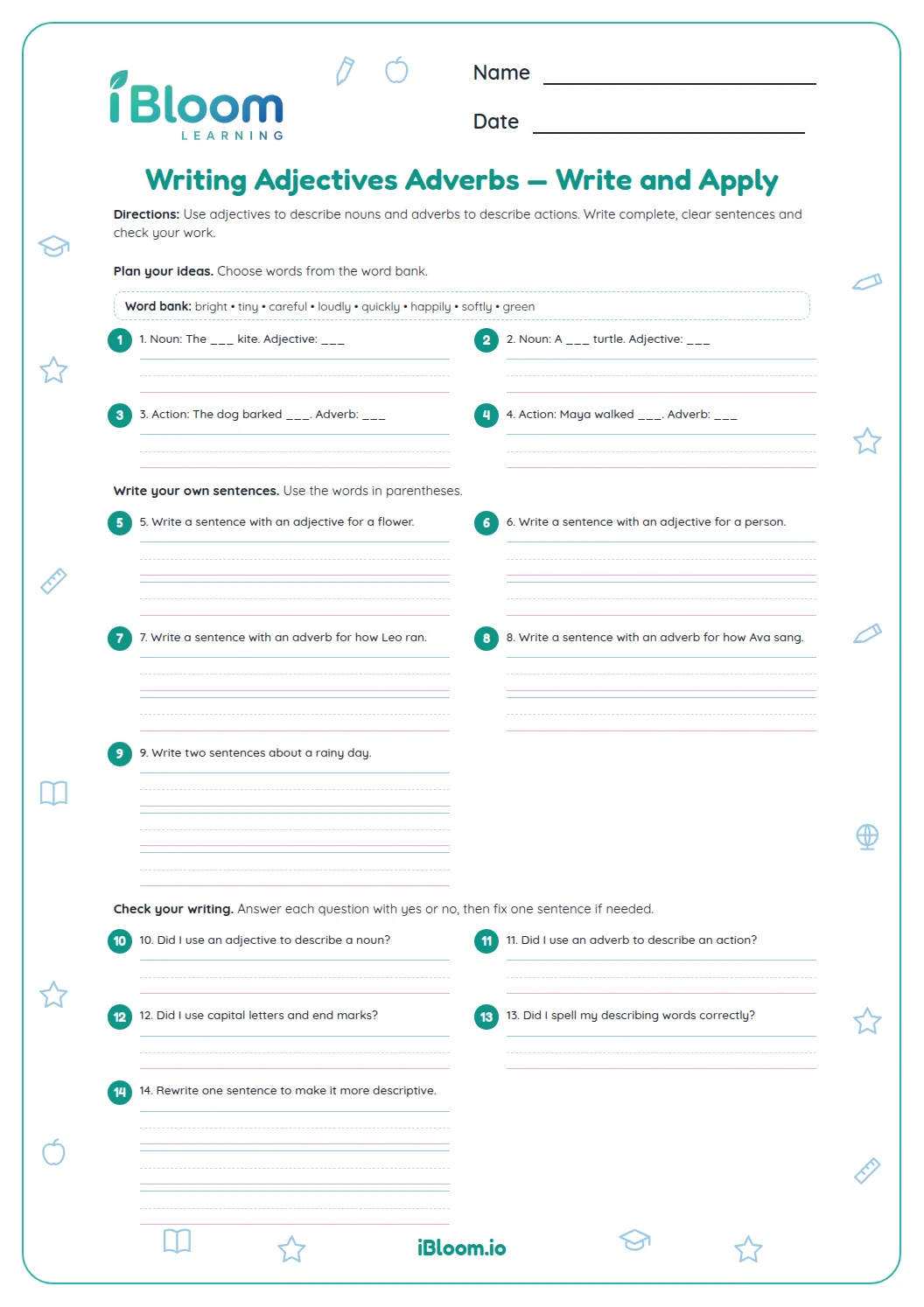
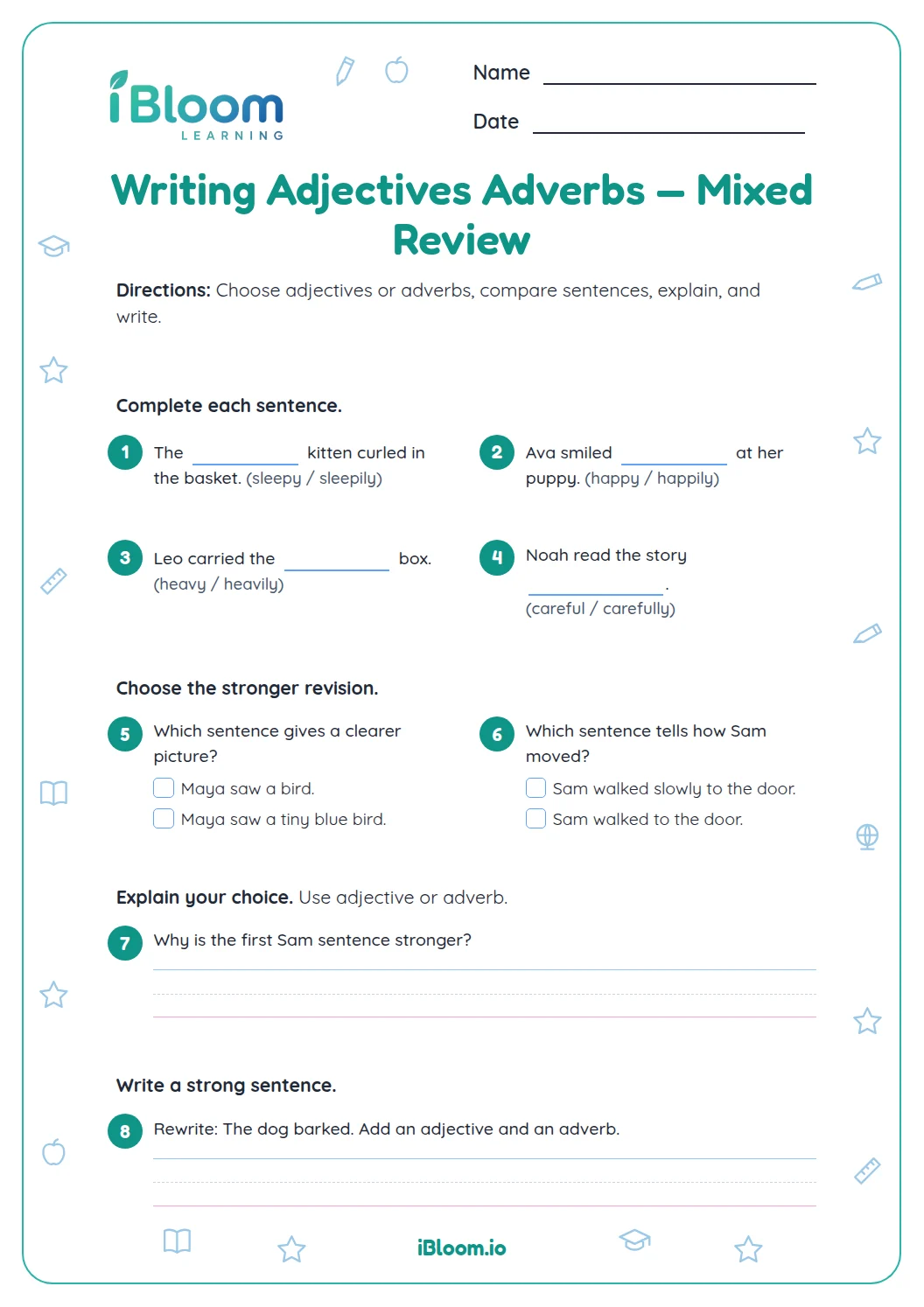
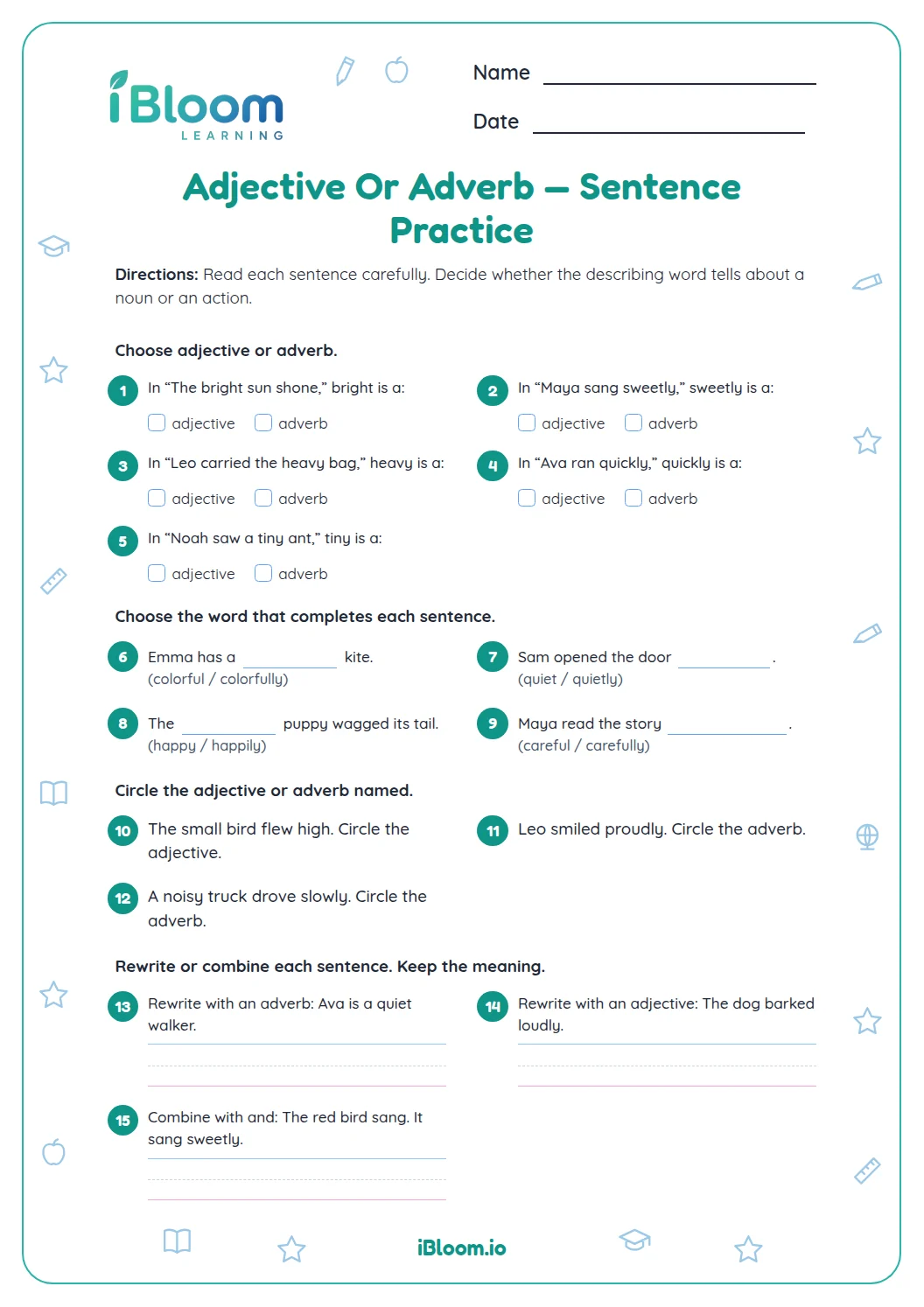
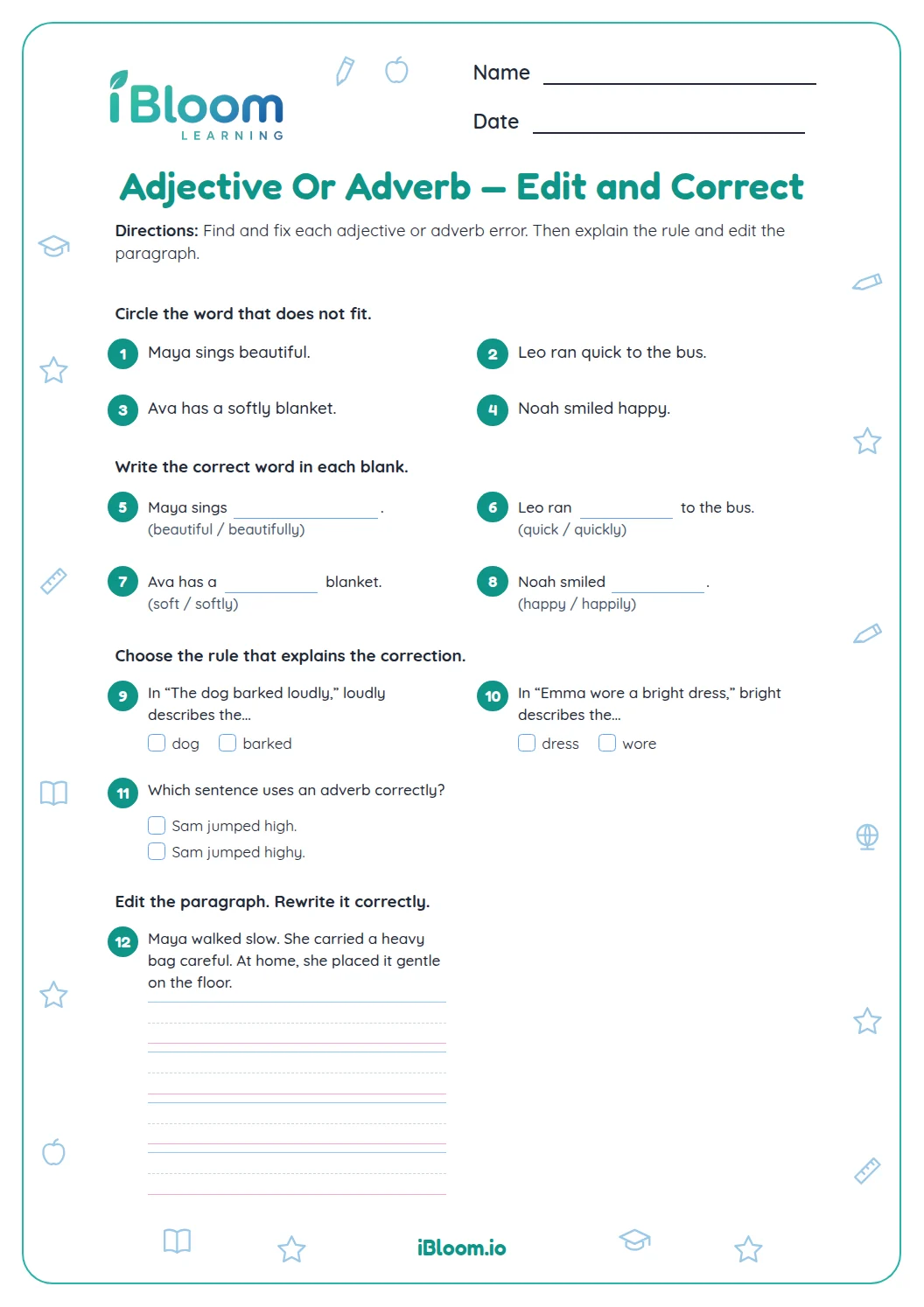
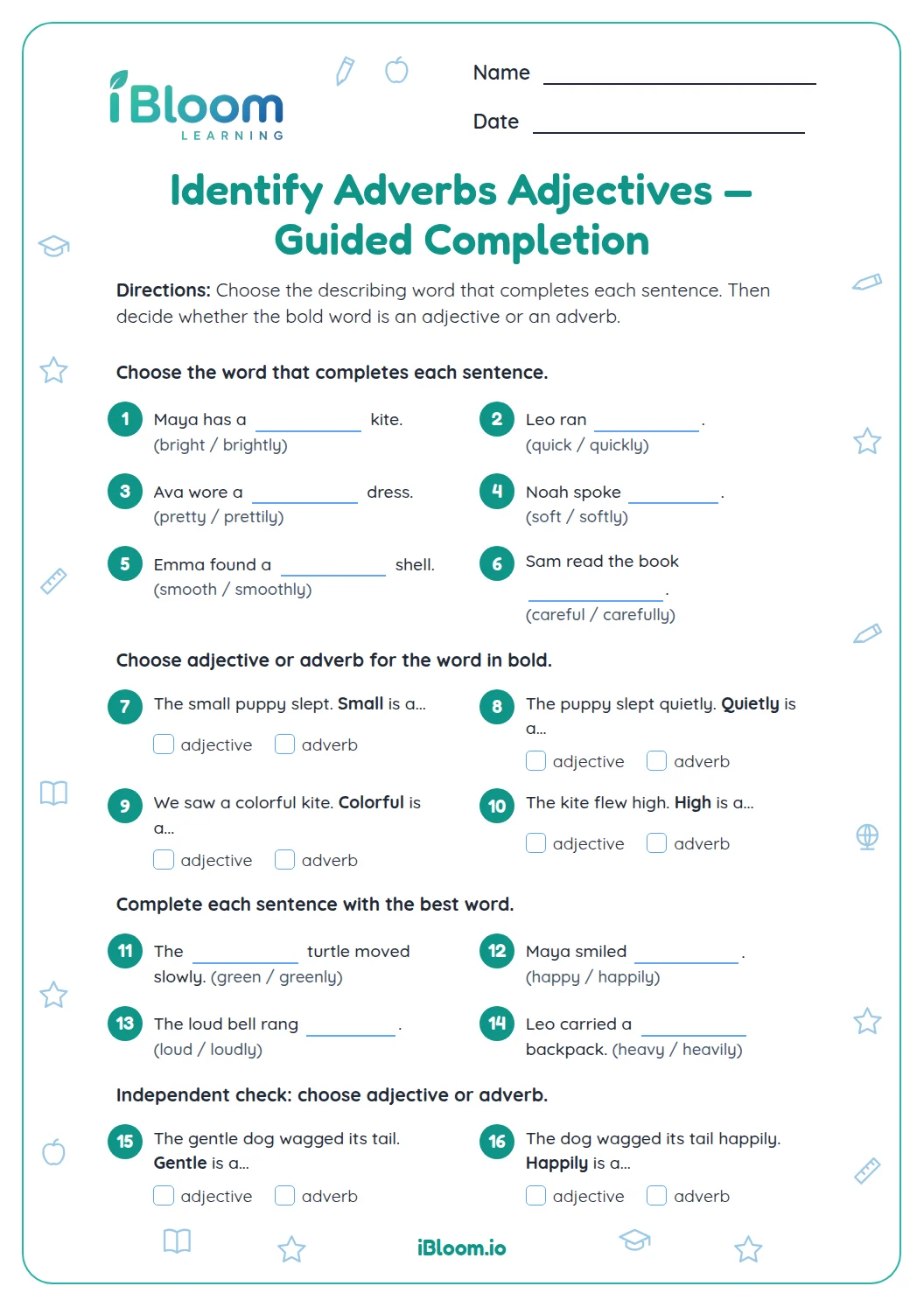
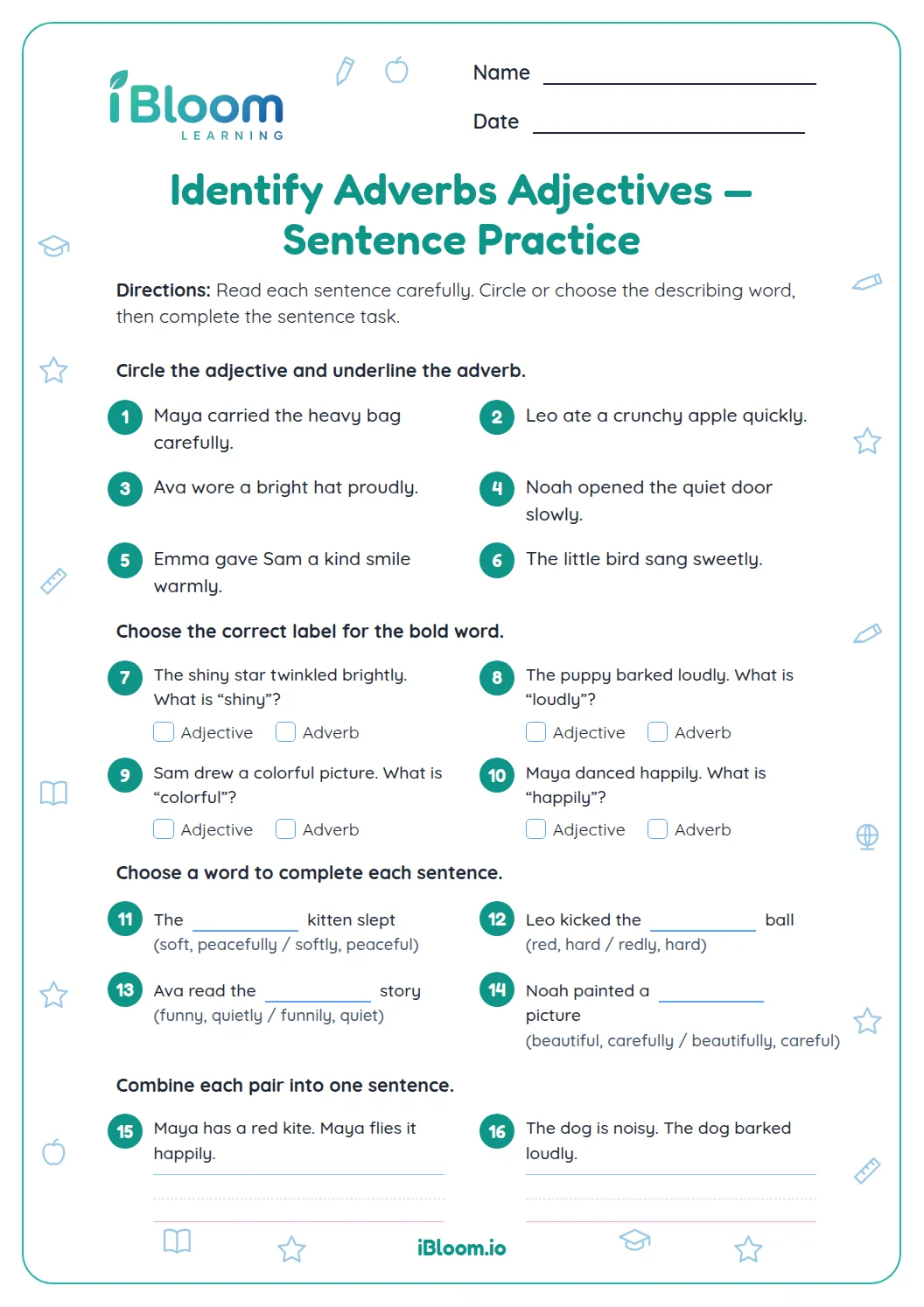
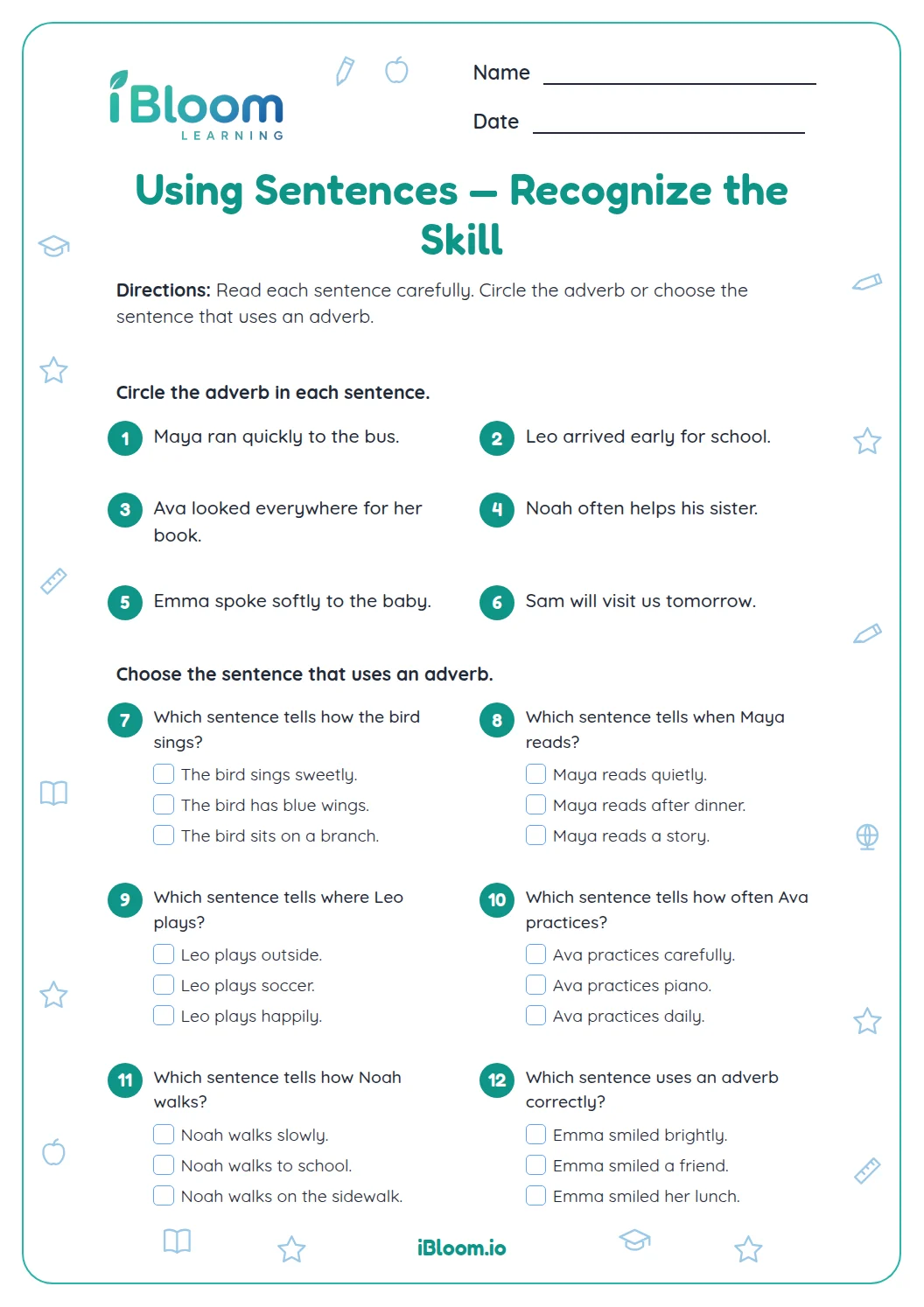
This free printable Grade 2 worksheet turns adjective and adverb choices into sentence writing. Children first complete ten sentences using paired words such as quiet and quietly. They then rewrite two sentences with a supplied adjective or adverb, combine two sentence pairs and write two original sentences using given word pairs. The tasks support Common Core L.2.1e: choosing adjectives and adverbs according to the words they modify. An adjective tells about a noun; the adverbs on this sheet tell how an action happens. The answer key provides exact choices and sample sentences to help adults review writing that can vary.
Aligned to L.2.1e
How do children choose the right describing word?
Have children find the noun or action that needs a detail. A quiet mouse is a mouse described by an adjective. A mouse that moves quietly has an action described by an adverb. The two words share a meaning, but they have different jobs.
Part A puts quiet/quietly, careful/carefully, playful/playfully, gentle/gently and happy/happily into paired contexts. Children choose the form based on what is being described. Both members of each pair appear as correct answers.
How does adding one word change a sentence?
Part B keeps the sentence’s main idea and adds a specific detail. Children use the word printed in parentheses and rewrite the whole sentence. For the adverb tasks, more than one placement can work if the action is still described clearly.
- 1The turtle walked. (slowly)
- 2The action is walked.
- 3Slowly tells how the turtle walked.
- 4The turtle walked slowly.
How do children combine ideas and write their own sentences?
Part C combines two sentences into one. “Emma has a dress. The dress is green” becomes “Emma has a green dress.” In the next question, children turn loud into loudly to describe how the dog barked.
Each Part D prompt gives an adjective and an adverb. Children write one complete sentence using both. A sentence with tiny and quickly might describe a tiny crab that runs quickly. The adjective must describe a noun, and the adverb must describe an action.
Check the two words’ jobs before checking the capital letter and ending punctuation. The sample key gives one possible sentence for each prompt; a different sensible sentence can be equally correct.
How to use this worksheet
- 1Read the first two sentences together and compare quiet with quietly.
- 2Let your child complete all ten choices, naming the word each answer describes.
- 3For Part B, keep the original sentence and insert the supplied describing word.
- 4In Part C, combine both ideas into one sentence using an adjective or adverb.
- 5For Part D, plan who or what the sentence will be about, then choose an action.
- 6Read each new sentence aloud and check both describing words, the capital and the period.
Mistakes to check together
The mistake
Writing “The quietly mouse hid.”
The fix
Mouse is a noun. Use quiet to describe the mouse.
The mistake
Writing “Nora folded the paper careful.”
The fix
Folded is the action. Carefully tells how Nora folded.
The mistake
Writing “Tiny quickly” as the whole response to question 15.
The fix
Add a noun and an action, such as “The tiny crab ran quickly.”
Common Core alignment
Choose adjectives for nouns and adverbs for actions, then use both in sentences.
On this sheet: Children choose adjectives and adverbs, expand and combine sentences, then write sentences using both word types.
Show the official wordingHide the official wording
Use adjectives and adverbs, and choose between them depending on what is to be modified.
What to practice next
Make more practice
Further reading
Questions parents and teachers ask
How much writing does this worksheet require?
Children choose words in ten multiple-choice questions and write six complete sentences. Part B has two sentence expansions; Part C combines two sentence pairs. Part D asks for two original sentences using word pairs. You can complete the choices together and save the writing for another sitting.
Must every adverb end in -ly?
No, but the adverbs selected here end in -ly. Quietly, carefully, playfully, gently and happily appear in the choices; slowly, loudly, quickly and neatly appear in the writing tasks or model answers. Ask which action each adverb describes instead of relying only on its ending.
Can the adverb go in a different place?
Yes, accept a natural placement that clearly describes the action. For question 12, “The turtle slowly walked” and “The turtle walked slowly” both work. The printed key gives one example. Ask your child which word slowly describes; the answer should be the action walked in either sentence.
What counts as correct in Part D?
A correct response is a complete, sensible sentence using both supplied words in their intended jobs. For tiny and quickly, “The tiny crab ran quickly” works because tiny describes crab and quickly describes ran. Other animals, people or objects are welcome when the sentence uses both words correctly.
How can I help without writing the sentence for my child?
Ask your child to say a sentence aloud before writing. Point to the adjective and ask what it could describe, then point to the adverb and ask what action could happen that way. After your child writes, read it together and check that both supplied words appear.