






About this worksheet
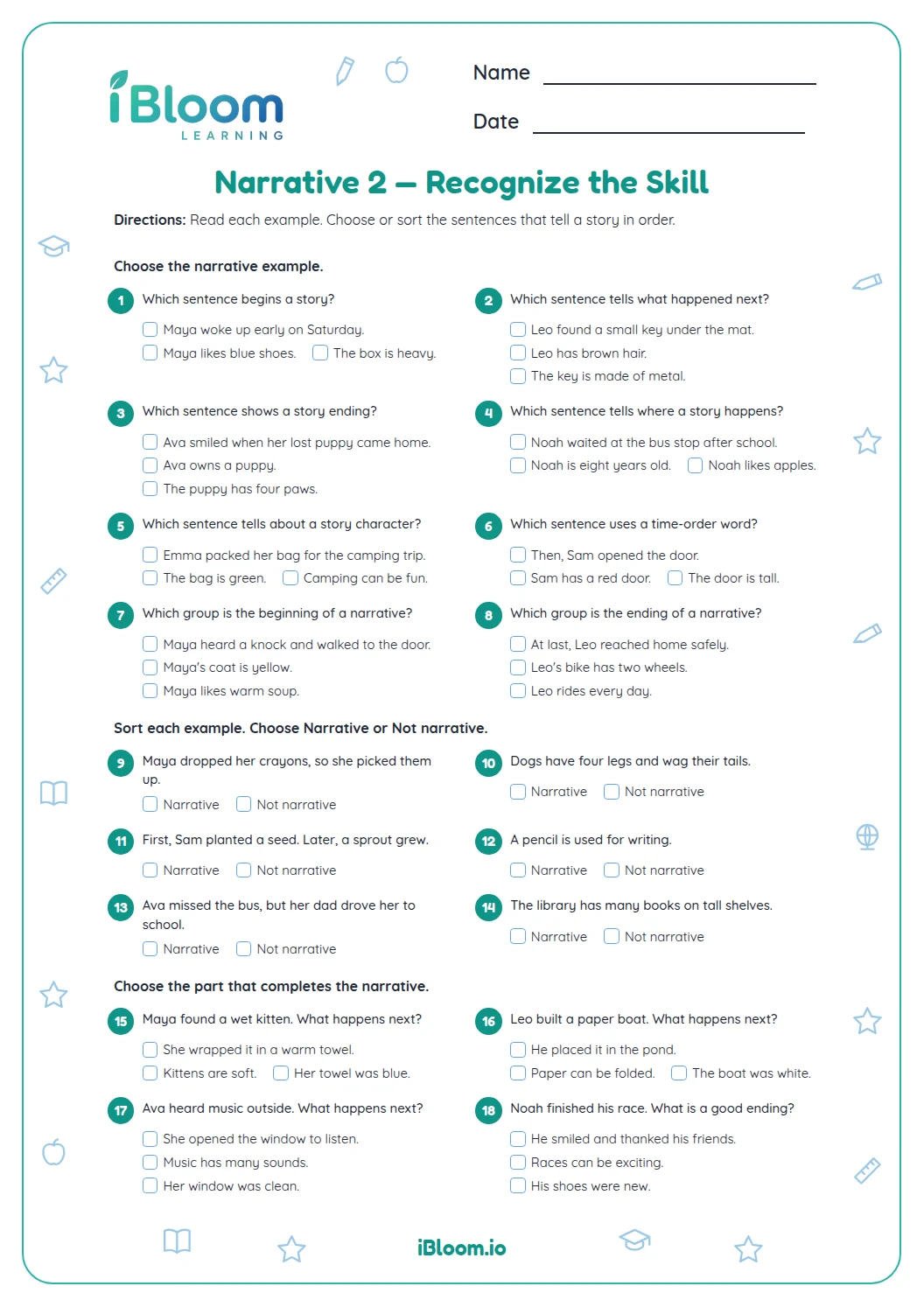
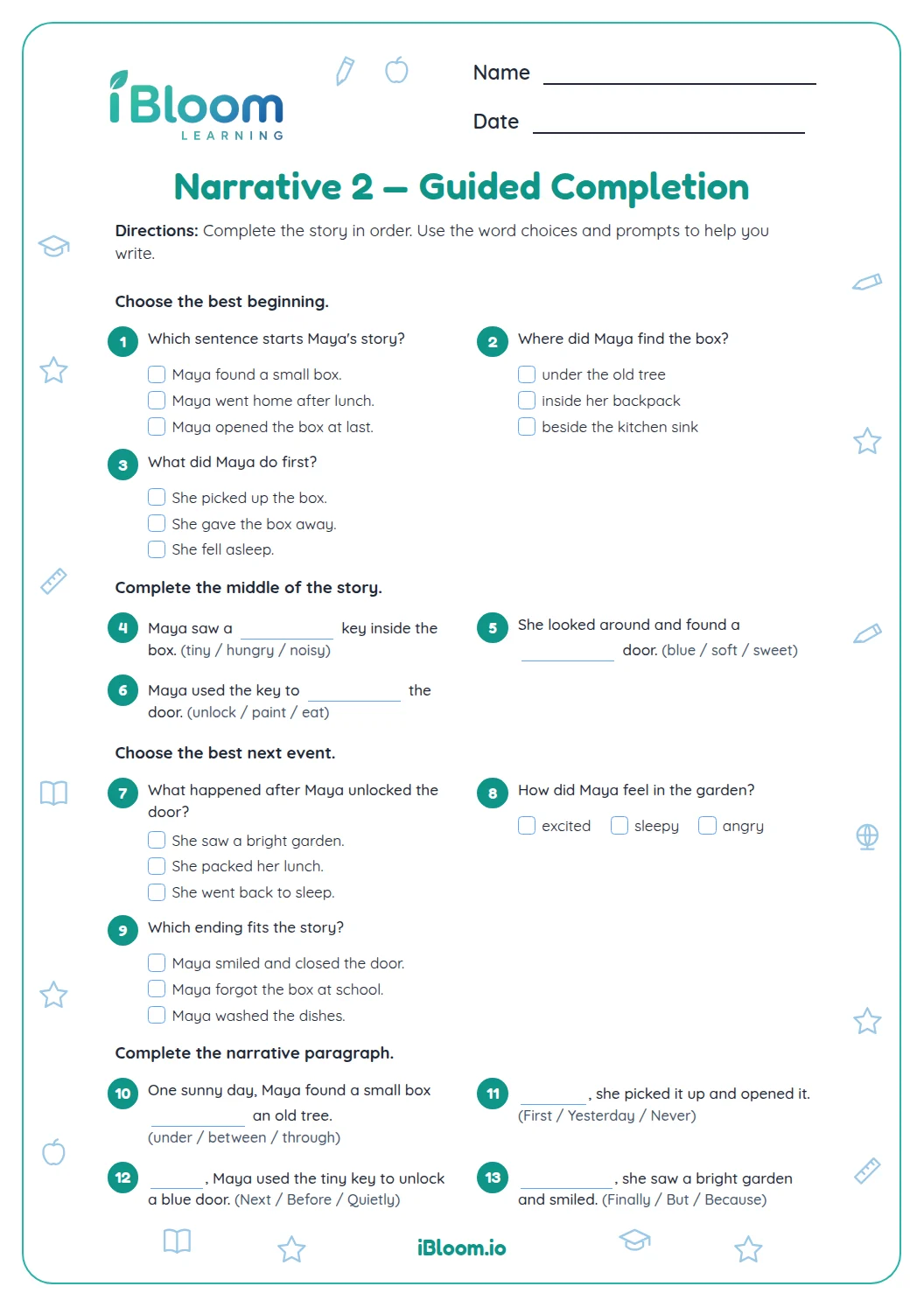
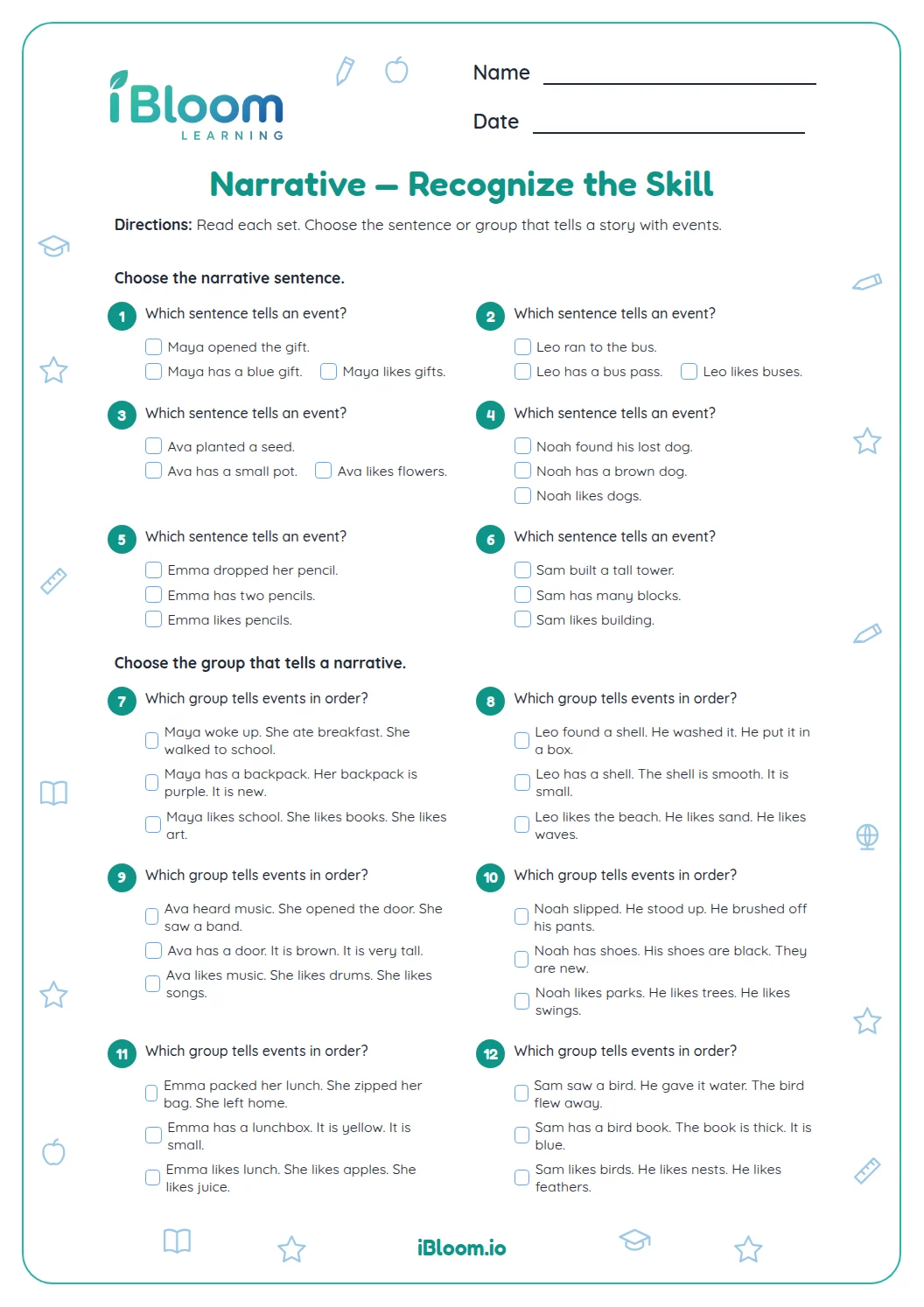
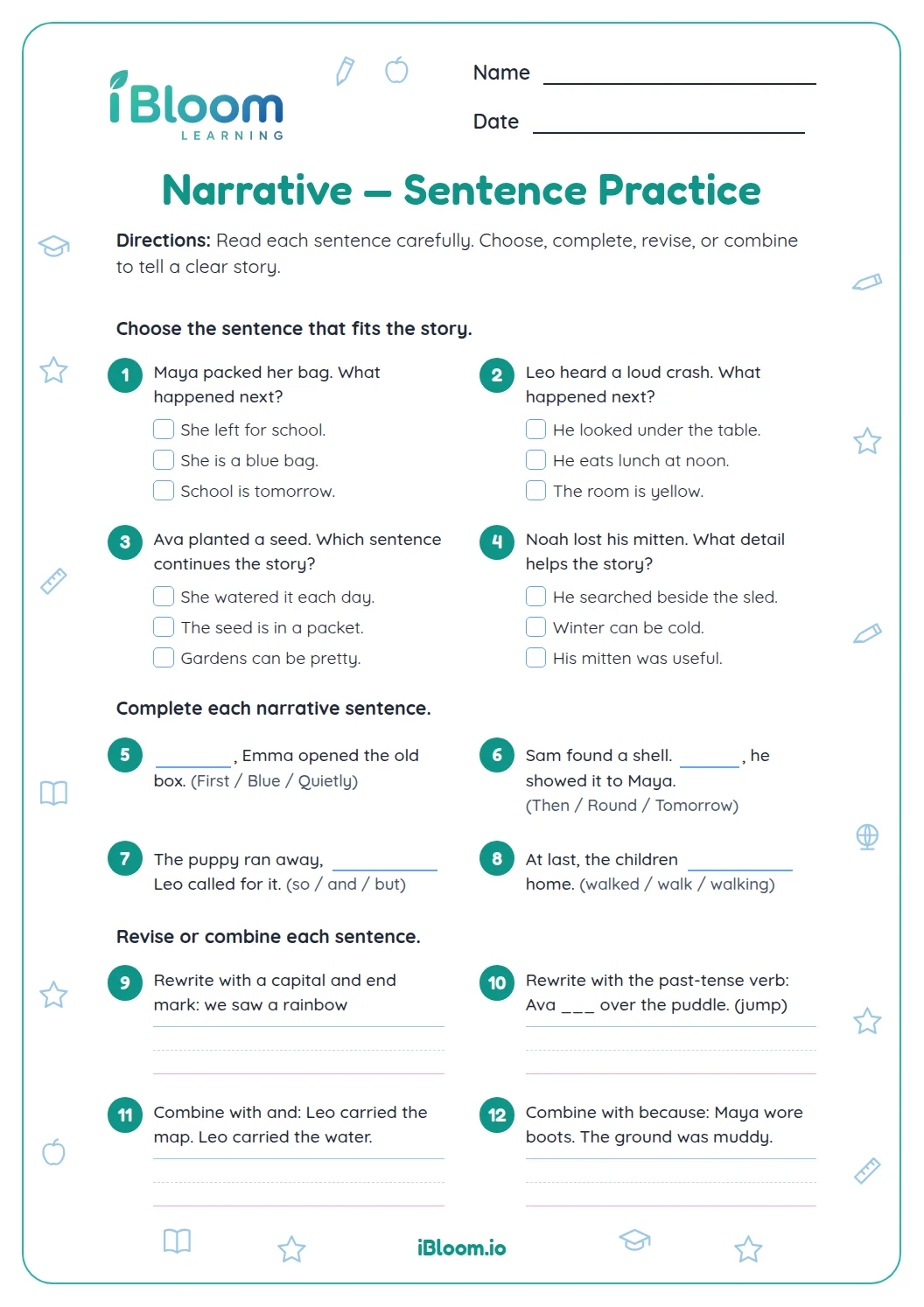
This Grade 2 narrative review worksheet moves from recognizing story details to writing them. Children choose sentences that show events, feelings, sequence, and closure, complete five connecting phrases, and write five short narrative responses. The prompts ask for actions, thoughts, feelings, order words, and a problem-solving ending. A separate key gives the selected answers and sample responses. The writing practice aligns with CCSS W.2.3.
Aligned to W.2.3
Which details help a story feel complete?
A narrative tells what happened and gives the reader clues about a character. Actions move the event forward, while thoughts and feelings show how the character experiences it. A final sentence can show that the problem is solved.
Question 2 gives a feeling through an action: “His hands shook as he held the note.” The reader infers that Ben is nervous from the detail.
- 1Detail: His hands shook as he held the note.
- 2The action helps the reader understand a feeling.
How do time and connecting words help?
Words such as first, then, and at last show when events happen. Words such as but and because connect ideas in a sentence. In question 6, “Then” moves the story from finding the shell to showing it to a sister.
How can a short response include enough story detail?
Use one clear event and one detail that helps the reader picture it. Question 11 asks for the next event after Nora finds the kite; the written prompts then move from event order to a clear ending. The answer key offers a sample, but a child’s wording can differ if it includes the requested parts.
What makes an ending feel finished?
Closure shows what happened to the problem or character. A story does not need a long ending; it needs a final detail that feels connected to the event. Question 15 ends when the kite is down and Max carries it home safely.
How to use this worksheet
- 1Read the job named in the multiple-choice question before comparing choices.
- 2Look for an action or detail that a reader can picture.
- 3Choose a time word that puts events in a sensible order.
- 4For writing prompts, include every requested part in one or two clear sentences.
- 5Reread the last sentence and check that it feels like an ending.
Common mistakes and quick fixes
The mistake
Choosing a fact about a topic instead of an event.
The fix
Ask whether the sentence says what a character did in a particular story.
The mistake
Using “then” when the event order is unclear.
The fix
Say the events aloud in order, then choose the word that shows that order.
The mistake
Ending with a new problem instead of closure.
The fix
Finish by showing what happened to the problem or what the character did next.
Curriculum alignment
The listed Common Core standard connects to the specific reading or writing work on this page.
Use actions, thoughts, feelings, time words, and closure to develop a short narrative.
On this sheet: The final writing prompts ask for narrative actions, inner thoughts, event order, and an ending.
Show the official wordingHide the official wording
Write narratives in which they recount a well-elaborated event or short sequence of events, include details to describe actions, thoughts, and feelings, use temporal words to signal event order, and provide a sense of closure.
What to practice next
Make more practice
Further reading
Questions parents and teachers ask
What is a narrative?
A narrative tells events in an order that a reader can follow. This sheet asks students to choose story events and details, complete sentences with time or linking words, and write two short pieces using event order and a clear ending. The answer key gives examples for the writing prompts.
How can a child show a character’s feelings?
A writer can name a feeling or show it through an action. In question 2, Ben’s shaking hands suggest he is nervous. In a new story, a detail such as “Mia smiled and waved” can show happiness without naming the feeling.
What are temporal words?
Temporal words tell when events happen or which event comes next. First, then, and at last are examples. Question 6 uses “Then” to move from finding a shell to showing it to a sister, making the order easy to follow.
How long should each written answer be?
Most prompts can be answered in one or two sentences. Include the pieces named in the prompt: an action and feeling, a thought, a character and place, ordered events, or a solved problem. The sample key is a guide rather than the only possible wording.
What does closure mean in a story?
The page has 15 questions and a separate answer key. Students choose among five sets of story sentences, complete eight narrative sentences, then write two short responses. The key shows the selected answers and sample responses; a different response can work when it follows the prompt and makes sense.
Can my child change details in the sample answers?
Yes. The key’s written responses are samples, so a different answer can be correct when it follows the prompt and makes sense. For question 14, for example, the child may choose different events as long as “first” and “then” put them in order.