





About this worksheet
This free printable Grade 3 worksheet practices narrative writing through story clues, event order, character details, and a short ending students write themselves. It includes 15 questions, from story vocabulary to a three-sentence continuation about Maya and a hidden path. The answer key offers expected terms and one sample ending. It aligns with W.3.3, which asks students to develop experiences with descriptive details and clear event sequences.
Aligned to W.3.3
What makes a narrative easy to follow?
A narrative gives a reader a character, a place, and events that connect. Specific actions and transitions help show what happens first, next, and at the end. A useful ending lets the reader see what happened to the problem.
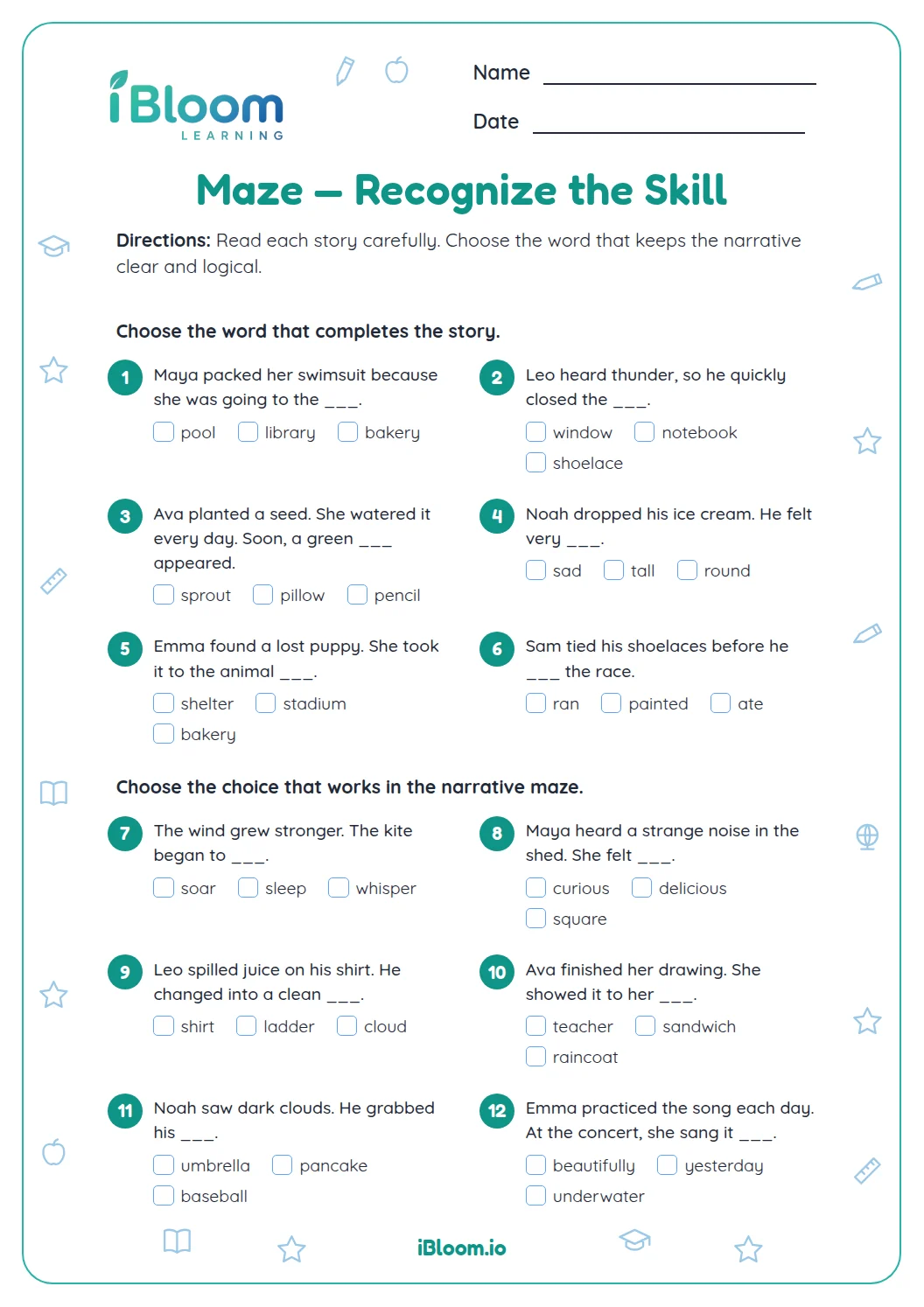
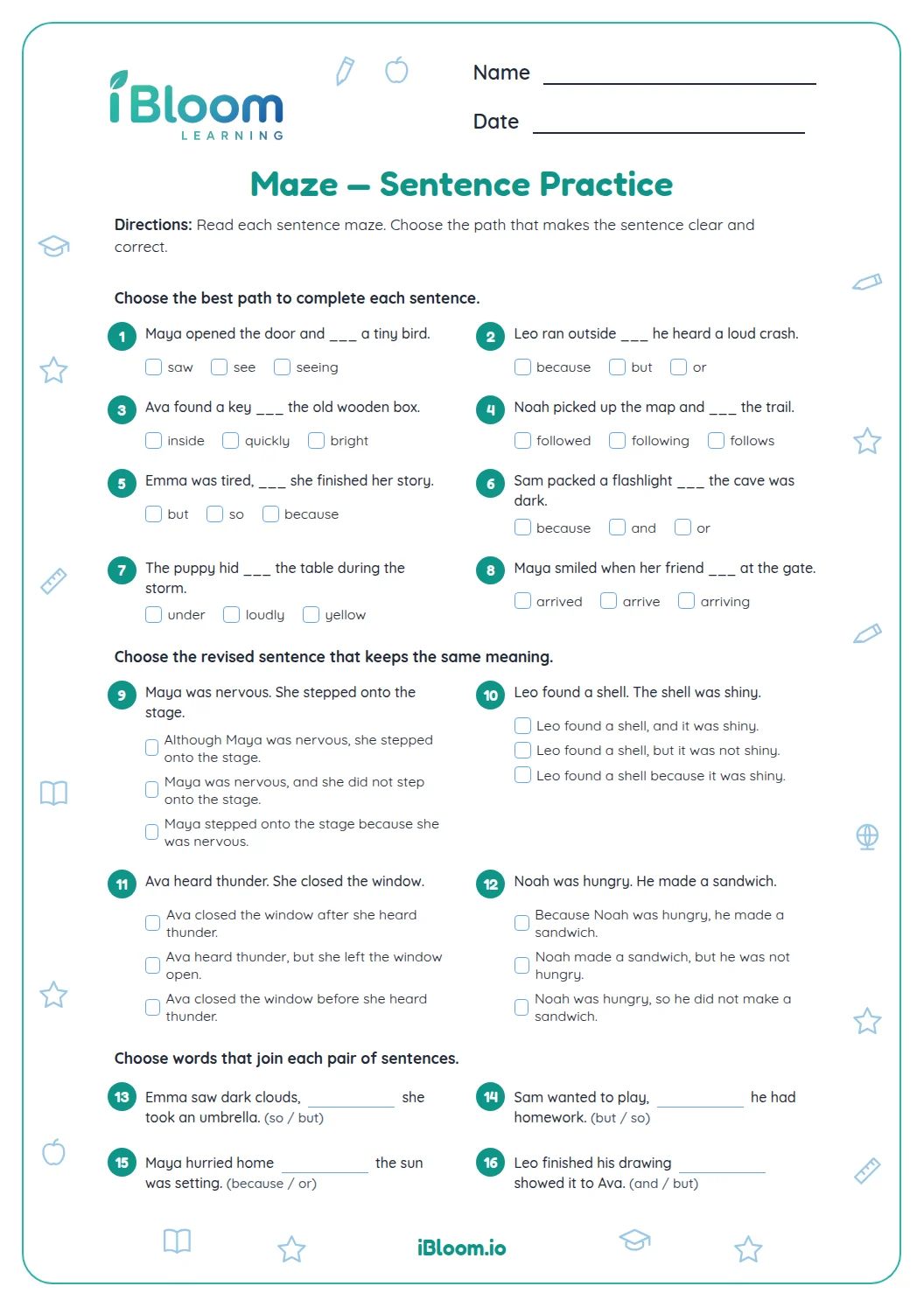
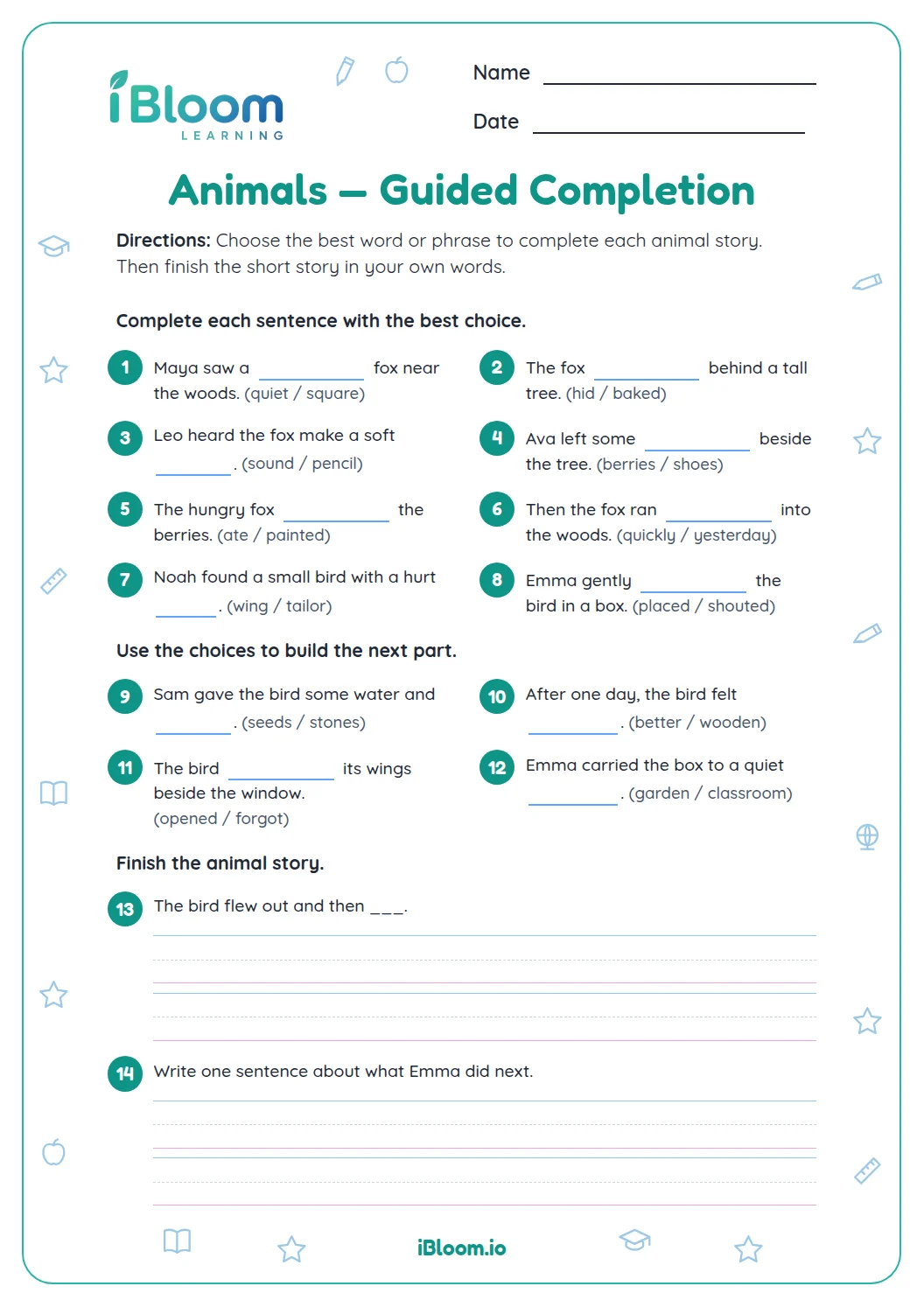
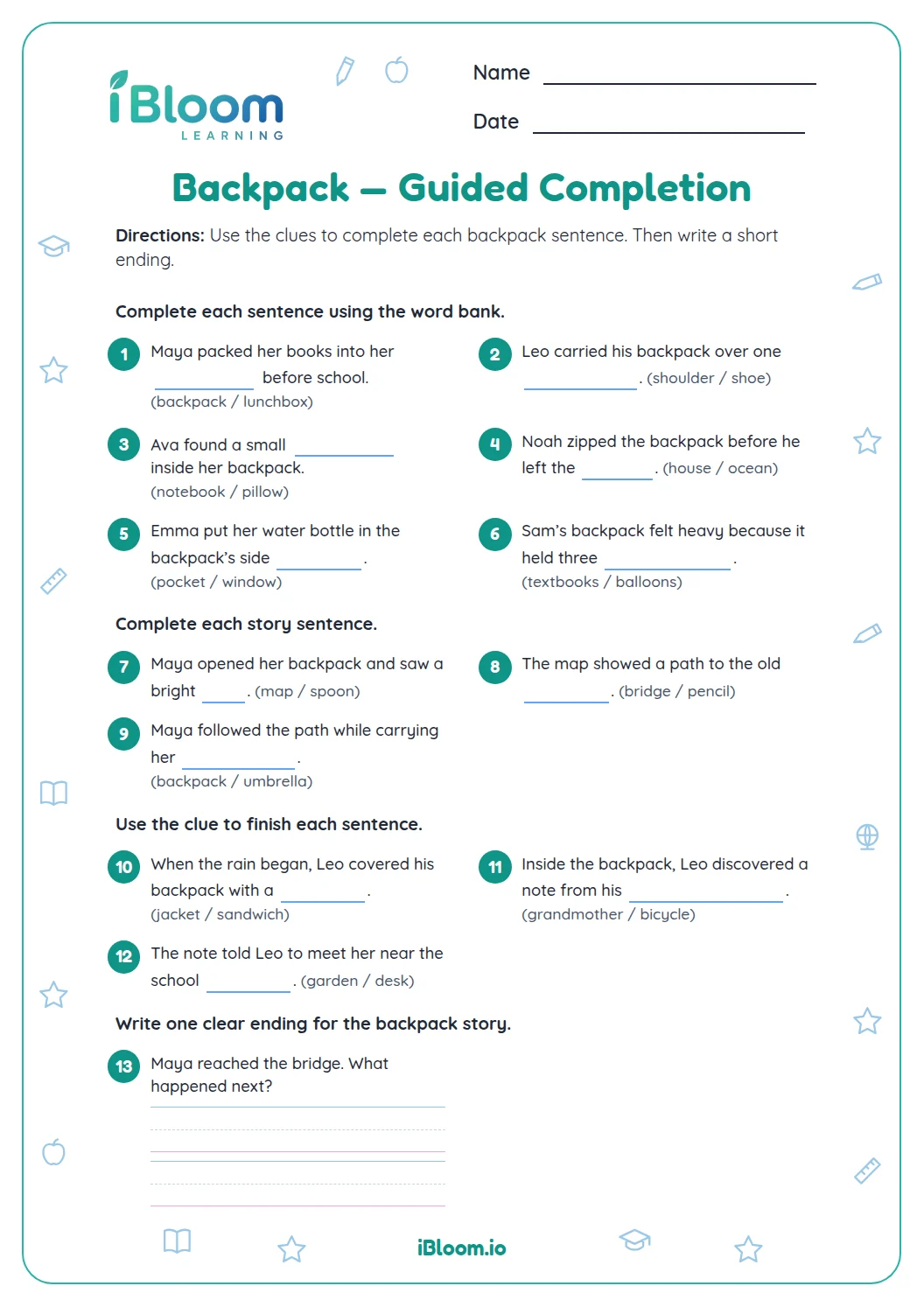
This Grade 3 review asks children to complete short sentences about characters, settings, event order, and endings.
How can a child connect story events?
Check whether each event follows naturally from the one before it. A transition can signal order, while an action can reveal a character’s feeling.
- 1First, Jay heard a thump. Next, he opened the closet.
- 2“Next” signals the event that follows the first one.
- 3The next detail should continue the same moment.
What narrative skills appear in the questions?
Part D asks the child to continue Maya’s map story with three connected sentences and a clear ending.
How to use the narrative review
- 1Read each story clue from beginning to end.
- 2Name whether it asks about a character, setting, event, or ending.
- 3Use the specific detail in the prompt to complete the sentence.
- 4Check that the completed sentence makes sense aloud.
- 5Write an ending that solves the problem, then compare its story elements with the sample key.
Narrative writing mistakes and quick fixes
The mistake
Listing a story part without checking how it helps the reader.
The fix
Ask whether the detail introduces a character, sets a scene, connects events, or resolves a problem.
The mistake
Putting events in an order that makes a character’s action confusing.
The fix
Reread the sequence with first, next, and finally to check the order.
The mistake
Ending a narrative before the central problem has a result.
The fix
Name what happened to the problem so the reader can tell the events are complete.
Curriculum alignment
This worksheet practices the named grade-level skill through explicit questions and answer checking.
Write narratives with effective technique, descriptive details, and clear event sequences.
On this sheet: The final response asks students to finish a narrative with connected events and a clear ending.
Show the official wordingHide the official wording
Write narratives to develop real or imagined experiences or events using effective technique, descriptive details, and clear event sequences.
What to practice next
Make more practice
Further reading
Questions parents and teachers ask
What skill does this narrative writing worksheet practice?
The worksheet helps children make a story clear for a reader. They choose an opening, add details about a setting or character, put events in order, and recognize a problem and a satisfying ending. Short written responses let them practice adding their own story details.
How many questions are on the printable?
There are 15 questions. The first sections review story parts, details, and event order; the final item asks the child to write a three-sentence ending for Maya’s map story. The prompt includes the setting and problem needed to continue it.
Is an answer key included?
Yes. The key gives the expected story words and a sample three-sentence ending. A child’s ending can differ if it follows Maya’s discovery and provides a clear result. Look for connected events and a resolution to the locked-gate problem.
How long should this worksheet take?
Set aside about 20 to 25 minutes to complete the 15 items and look at the answer key. A child can take extra time on the written details, then read the sentence aloud to check whether the event or character reaction makes sense.
How can I support a child who gets stuck?
Ask what happens first, next, and at the end. Then check whether a character’s actions connect to the problem and its solution. Transition words and specific details, such as a sound or a setting clue, help a reader picture the events in order.