




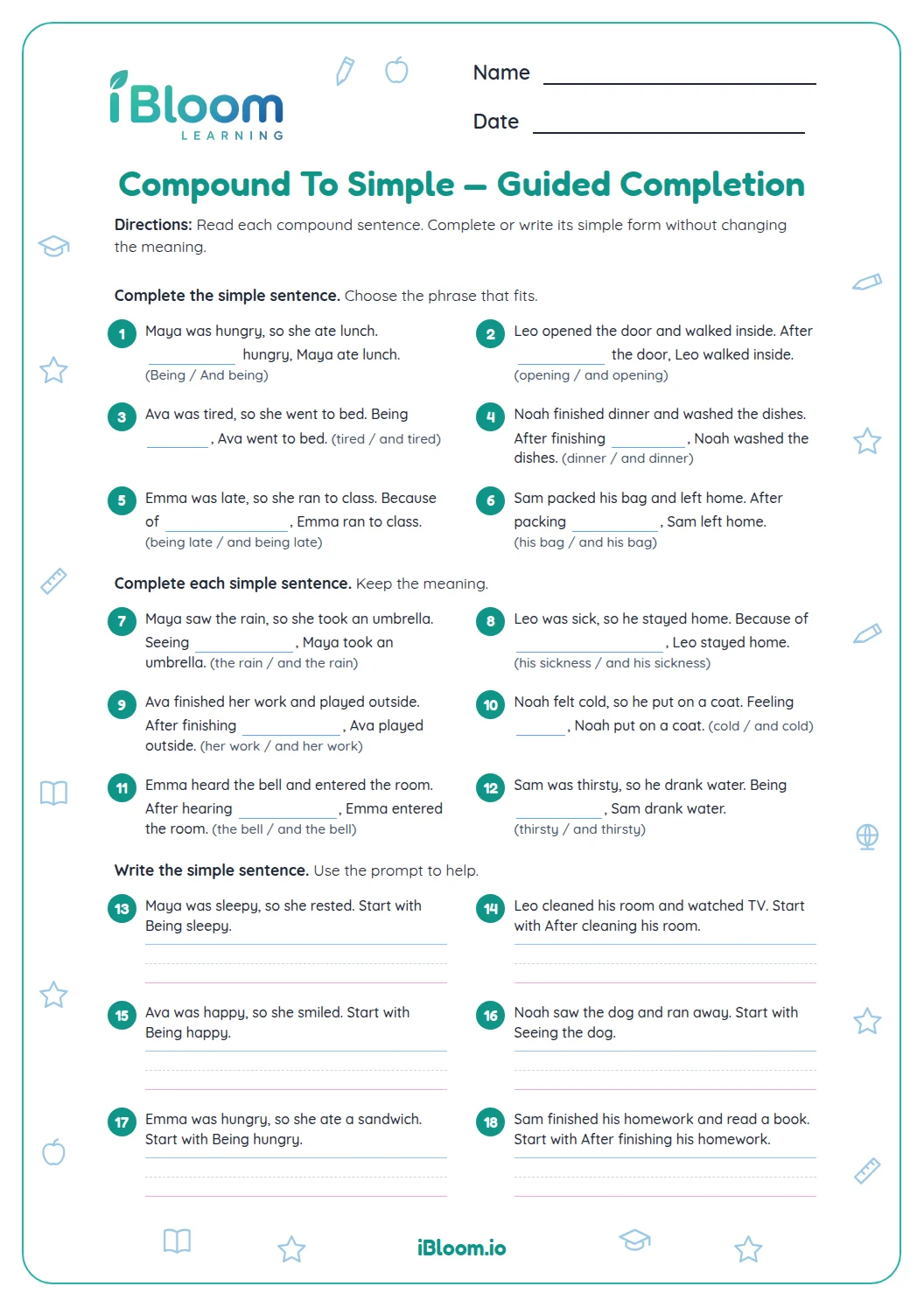

About this worksheet
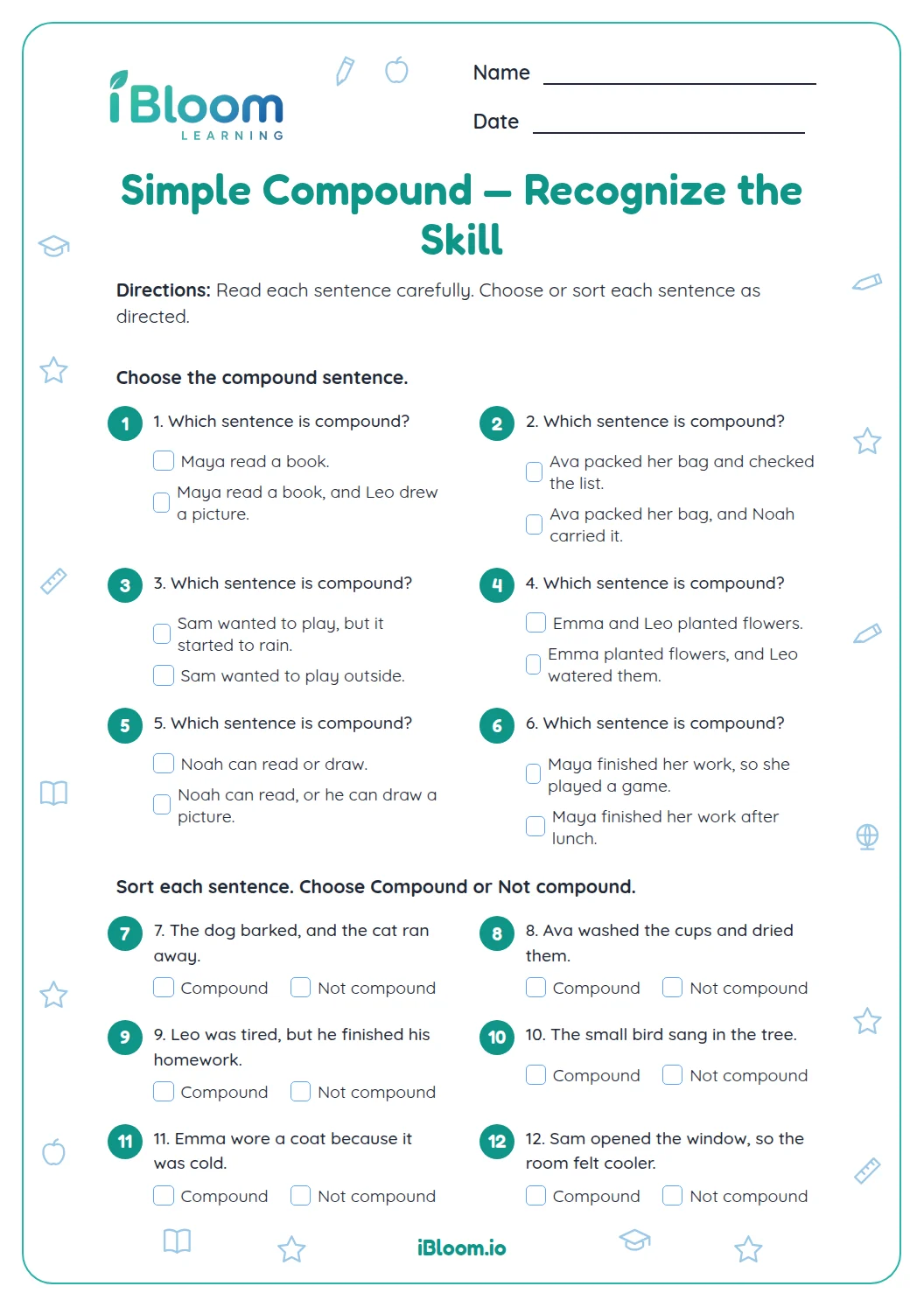
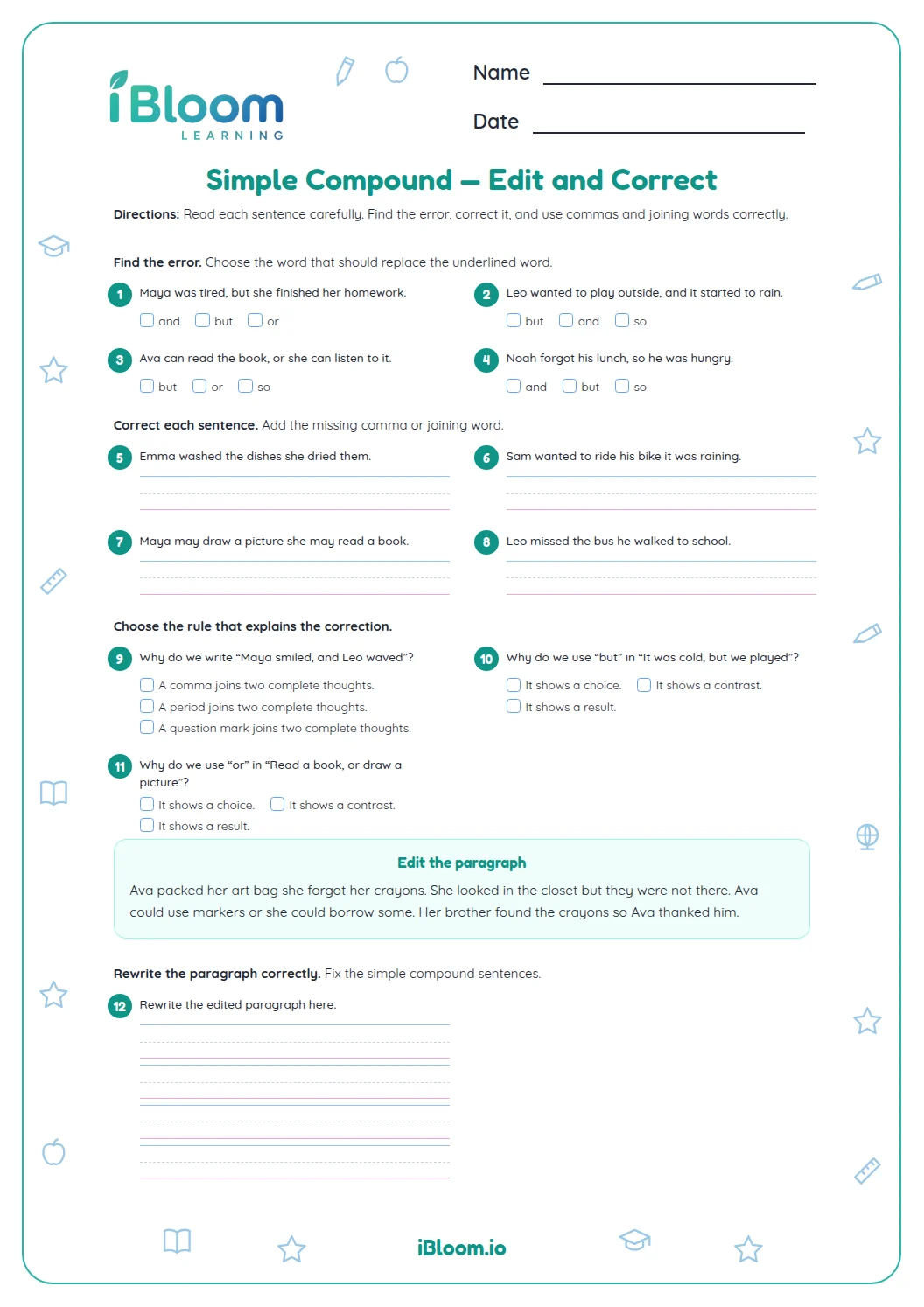
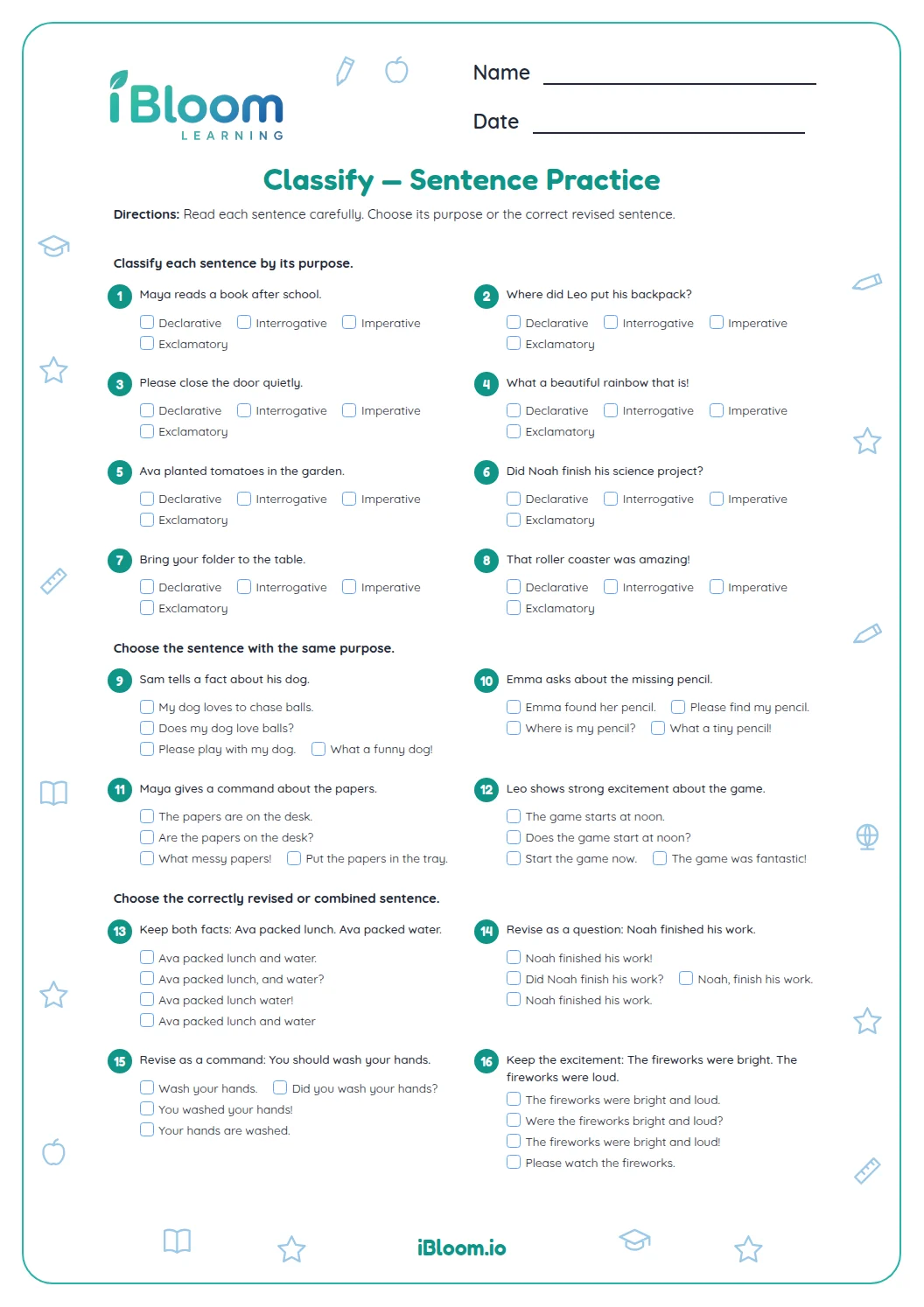
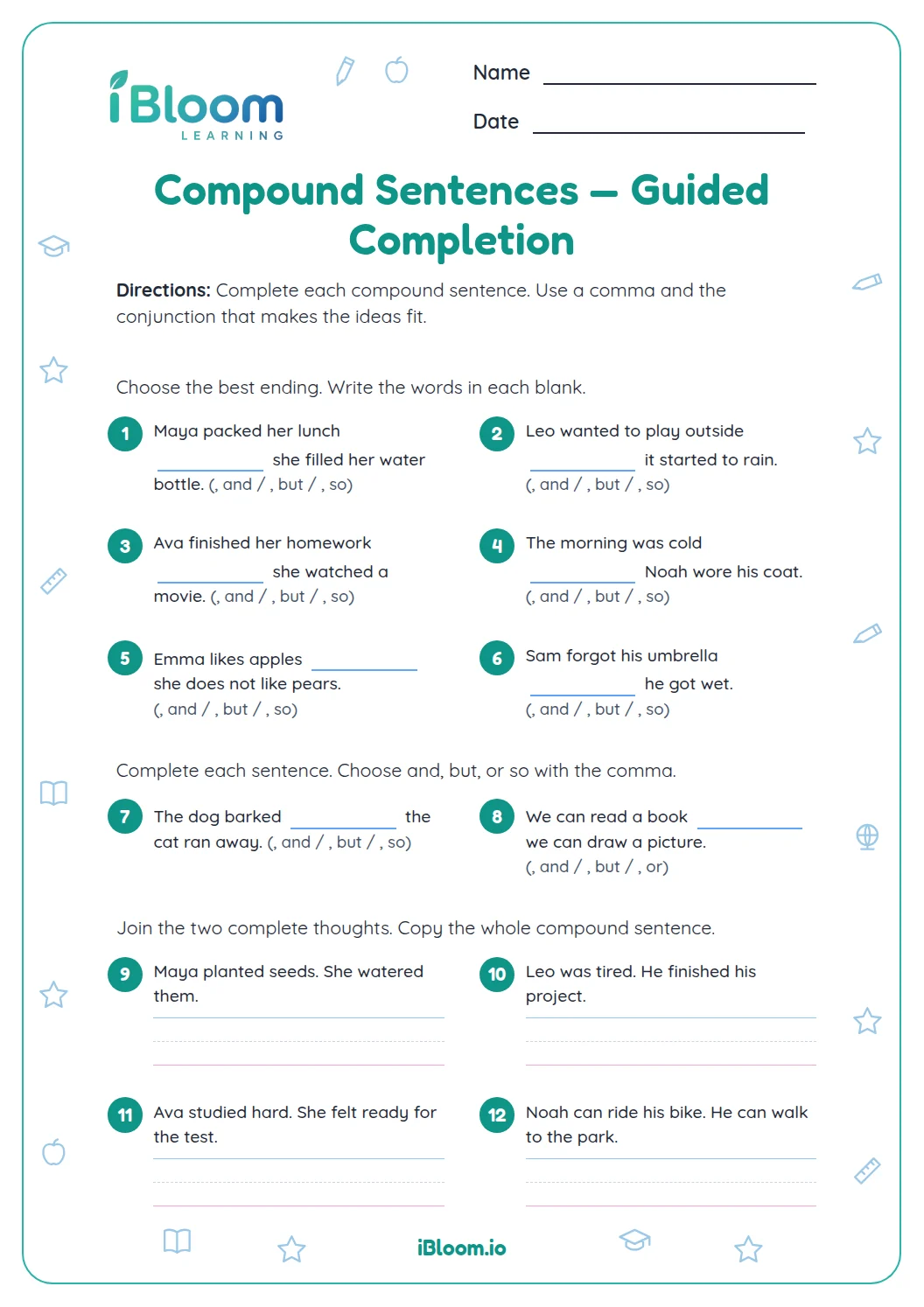
This free Grade 3 worksheet moves from selecting conjunctions to writing simple and compound sentences. Students join two complete thoughts with and, but, or, and so, then write their own examples and check punctuation. It practices CCSS L.3.1.i, which calls for producing simple, compound, and complex sentences. A separate answer key gives sample responses for open-ended writing.
Aligned to L.3.1.i
What will students write?
Part A selects a joining word based on how two thoughts relate. Part B joins given thoughts. Part C asks students to write sentences and review them for complete thoughts and punctuation.
How do you join two complete thoughts?
A compound sentence combines two independent thoughts with a comma and a coordinating conjunction. Choose the conjunction that shows whether the ideas add, contrast, offer a choice, or show a result.
- 1Maya likes apples. Maya does not like pears.
- 2The ideas contrast, so use but.
- 3Maya likes apples, but she does not like pears.
How can a student check a compound sentence?
Read each side of the conjunction by itself. Each side should have a subject and a verb and express a complete thought. Then check the comma before the conjunction and the final punctuation.
How to use this worksheet
- 1Read both thoughts before choosing a conjunction.
- 2Decide whether the ideas add, contrast, offer a choice, or show a result.
- 3In Part B, keep both complete thoughts and add a comma before the conjunction.
- 4Write original sentences with clear subjects and verbs.
- 5Use the review checks to reread capitalization, commas, and ending marks.
Sentence writing slips to check
The mistake
Joining two thoughts without a comma.
The fix
Place a comma before and, but, or, or so when they join two complete thoughts.
The mistake
Using a conjunction that changes the meaning.
The fix
Choose but for a contrast, or for a choice, and for an added idea, and so for a result.
The mistake
Joining a complete thought to a fragment.
The fix
Check for a subject and verb on both sides before calling the sentence compound.
Common Core alignment
The worksheet develops sentence construction through modeled conjunction choices and original writing.
Produce simple, compound, and complex sentences.
On this sheet: Produce simple, compound, and complex sentences.
Show the official wordingHide the official wording
Produce simple, compound, and complex sentences.
What to practice next
Make more practice
Further reading
Questions parents and teachers ask
What is a compound sentence?
A compound sentence joins two complete thoughts, often with a comma and a conjunction such as and, but, or, or so. Each side has a subject and verb and can stand as a sentence. Students can pause after each part and use the key to review both the answer and the reasoning.
How many questions are on this worksheet?
There are 12 prompts in three parts. Students choose conjunctions, combine given thoughts, and write or review sentences. The separate key gives sample responses for open-ended writing, while the review items ask students to check their own punctuation and sentence structure.
When should a student use but?
Use but when the second thought contrasts with the first. For example, “I wanted to play, but it started raining” shows two ideas that do not go as expected together. Students can pause after each part and use the key to review both the answer and the reasoning.
Does every answer need to match the answer key exactly?
No. The joining and writing prompts may have more than one correct response. The answer key gives sample sentences; students’ answers should include the requested conjunction and preserve complete thoughts. Students can pause after each part and use the key to review both the answer and the reasoning.
What should students check before finishing?
Check that each thought is complete, the comma appears before the conjunction, the first word is capitalized, and the sentence has an ending mark. The final part prompts students to perform those checks. Students can pause after each part and use the key to review both the answer and the reasoning.