





About this worksheet
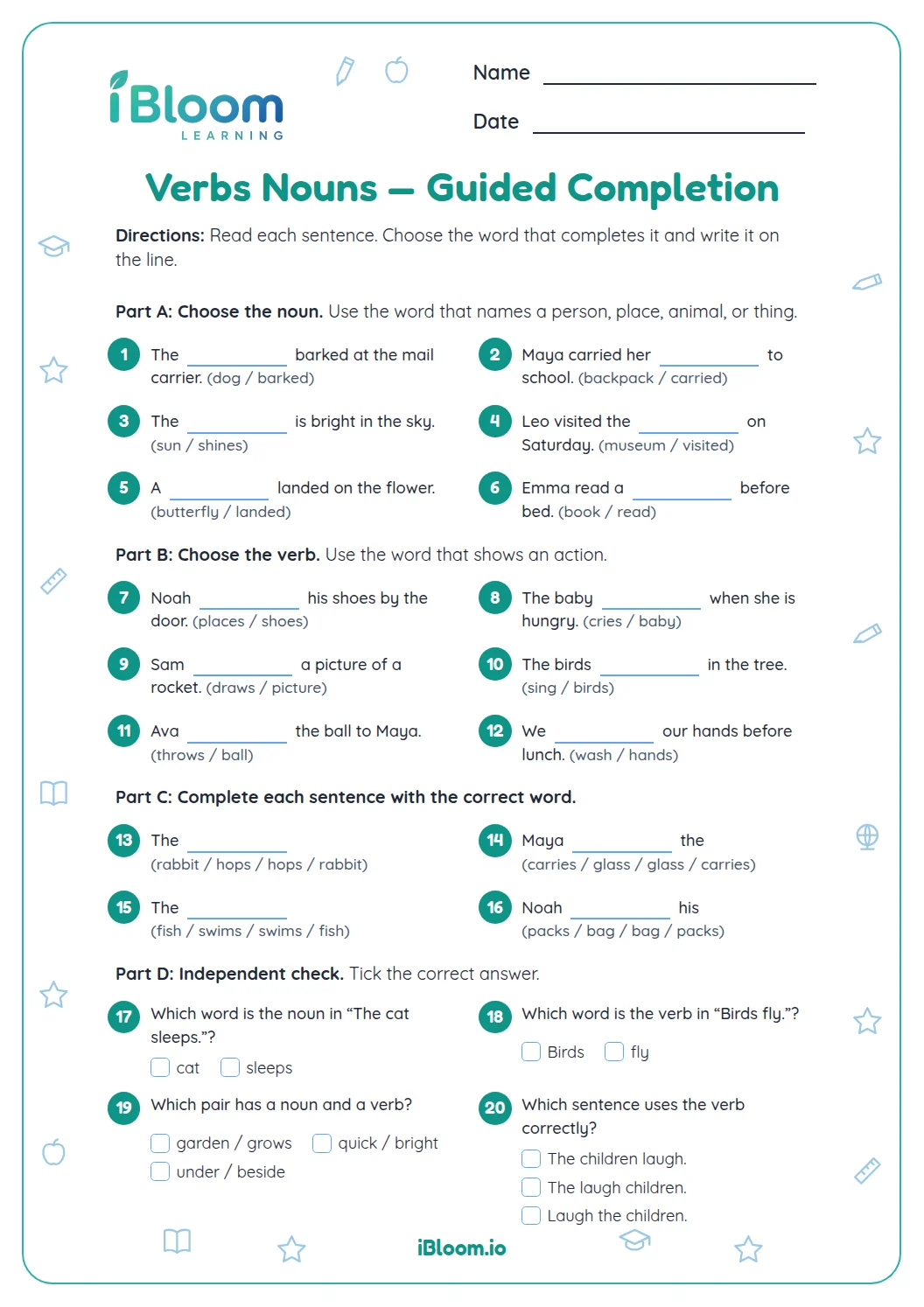
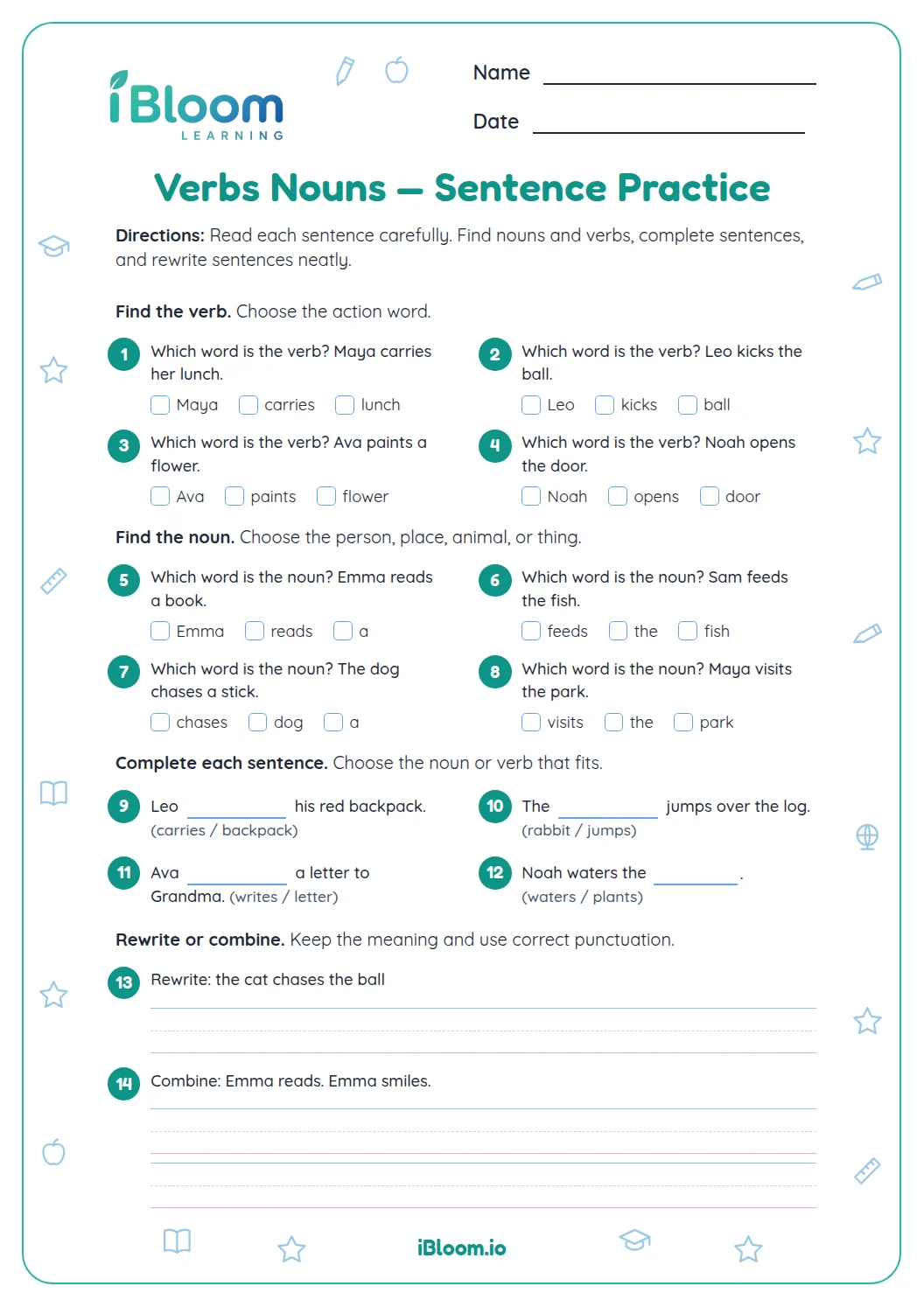
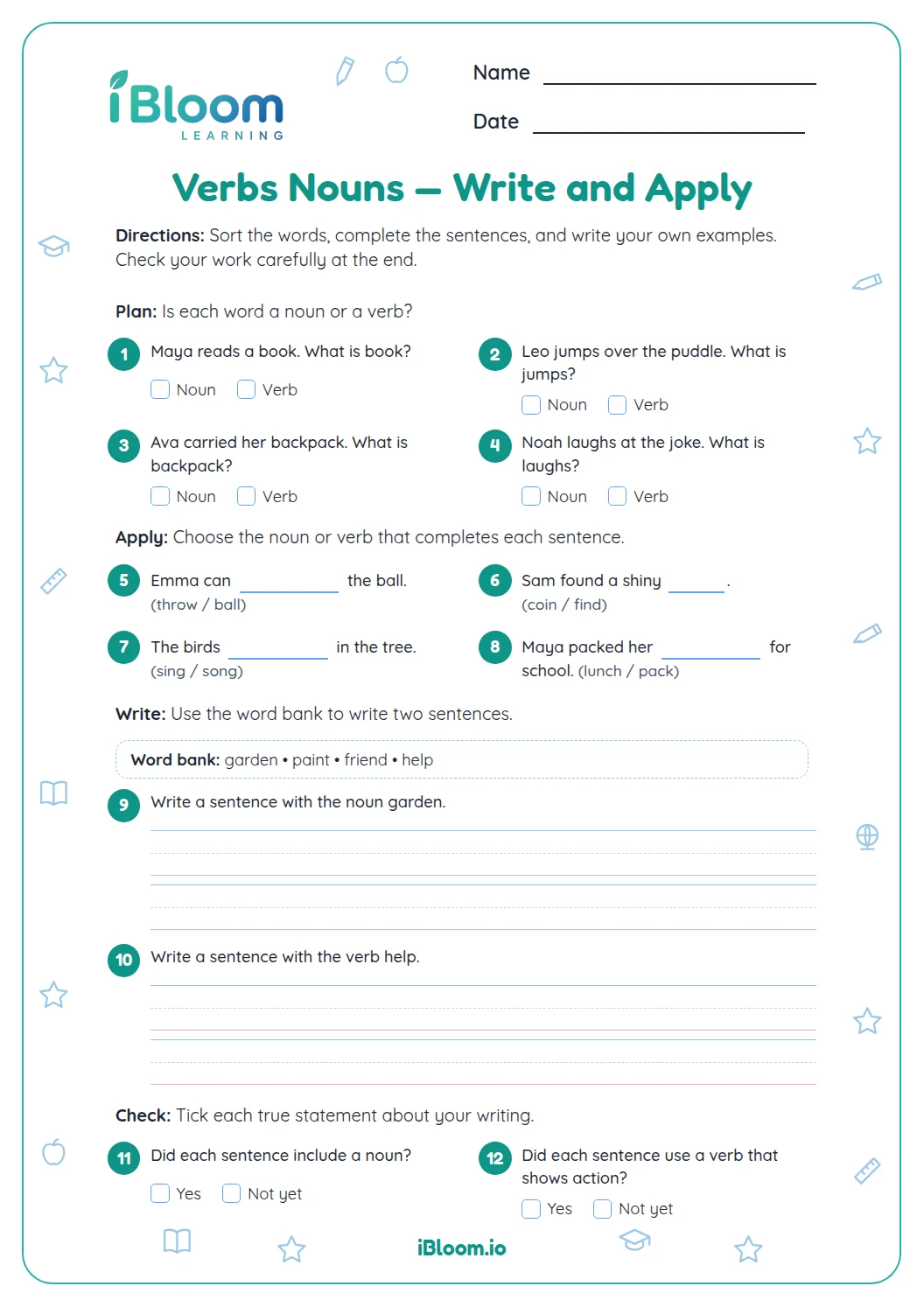
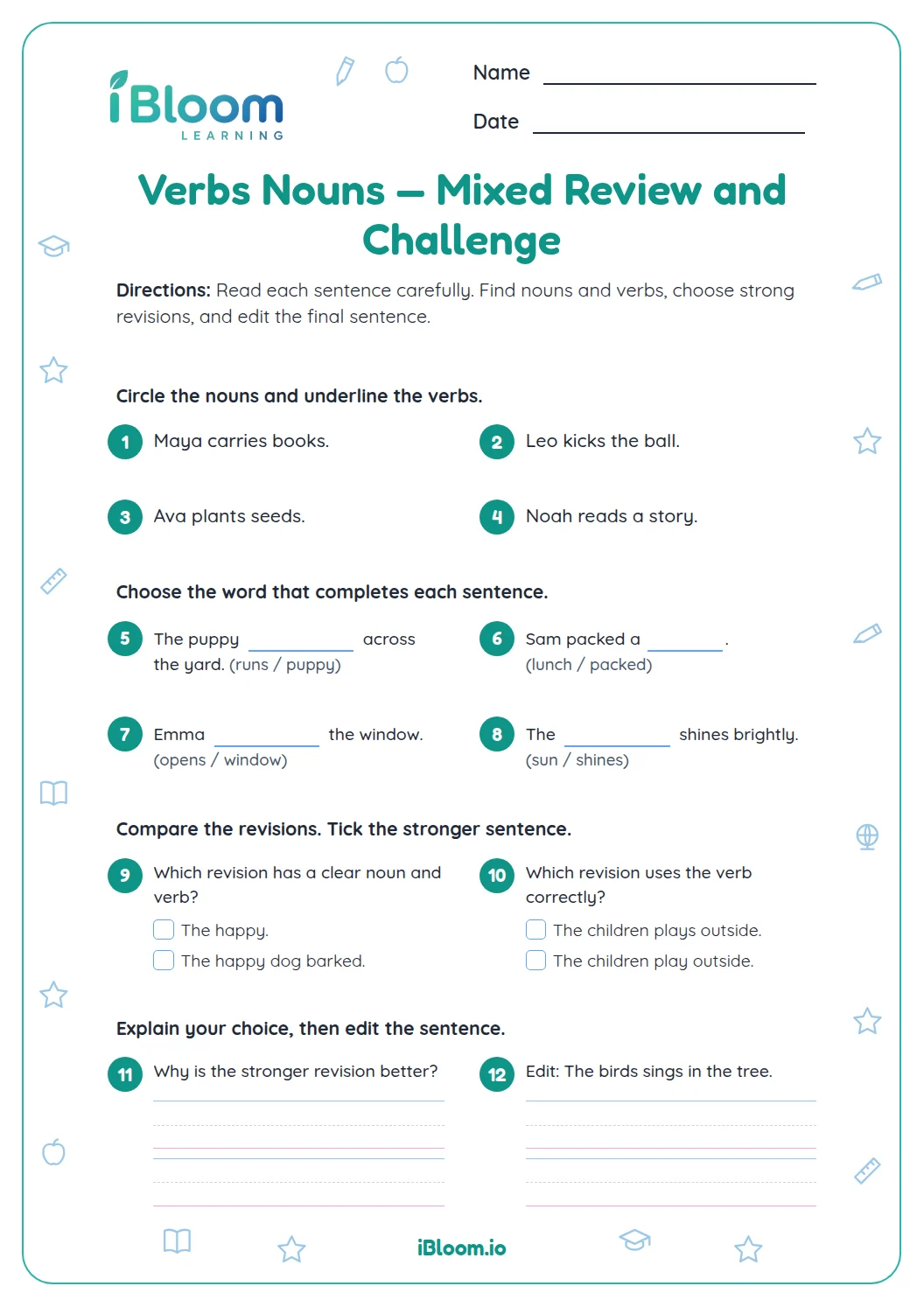
This Grade 3 grammar printable asks children to recognize nouns and verbs in complete sentences. They identify action words and words naming people, animals, places, or things, then write selected words from sentences. The activities practice Common Core L.3.1 grammar and usage. A separate key lists the target words and the noun-then-verb response for the final item.
Aligned to L.3.1
What should children notice first?
In “The rabbit hops over a log,” rabbit and log name things, while hops tells the action.
How can one example be worked out?
Question 1 asks for the verb, so the answer is hops.
- 1Question 1 asks for the verb, so the answer is hops.
How does the page build practice?
The page practices choosing words in context first, then finding and writing nouns and verbs independently.
How to use this worksheet
- 1Read the full sentence.
- 2Ask who or what the sentence names.
- 3Ask what the person, animal, or thing does.
- 4Check the choices in the sentence.
- 5Copy the exact word requested.
Common mistakes and quick fixes
The mistake
Choosing the first word in a sentence as the noun can miss the action.
The fix
Ask what word names something and what word tells what happens.
The mistake
A place can be a noun too.
The fix
Museum names a place, even though it is not a person or object.
The mistake
Adjectives such as bright describe nouns but do not name the action.
The fix
In “bright stars twinkle,” twinkle is the verb.
This worksheet practices the following Common Core skill.
A noun names; a verb tells an action or state.
On this sheet:
Show the official wordingHide the official wording
Demonstrate command of the conventions of standard English grammar and usage when writing or speaking.
What to practice next
Make more practice
Further reading
Questions parents and teachers ask
What is a noun?
A noun names a person, place, animal, or thing. In “The baker kneads dough,” baker names a person and dough names a thing. The worksheet asks learners to locate nouns within complete sentences. For example, rabbit names an animal, so it is a noun.
What is a verb?
A verb tells what someone or something does, or describes a state. In “Birds build nests,” build tells the action. Children can ask, “What is happening?” to help find the verb. The verb helps tell what happens in the sentence.
Can a place be a noun?
Yes. A noun can name a place as well as a person, animal, or thing. Museum is a noun in “We visited the museum” because it names a place. Museum names a place, so it is a noun. Its job in the sentence, not its ending, makes it a noun.
Why read the whole sentence?
The sentence shows how each word is being used. In “The rabbit hops over a log,” rabbit and log are nouns, while hops is the verb. Looking at the whole sentence helps distinguish a naming word from an action word.
What does the answer key include?
The key identifies the noun or verb requested in each sentence and gives the final item in noun-then-verb order. A child may find other nouns in some sentences, but each question asks for one particular word job. It also includes one sample noun-and-verb pair for the last item.