



About this worksheet
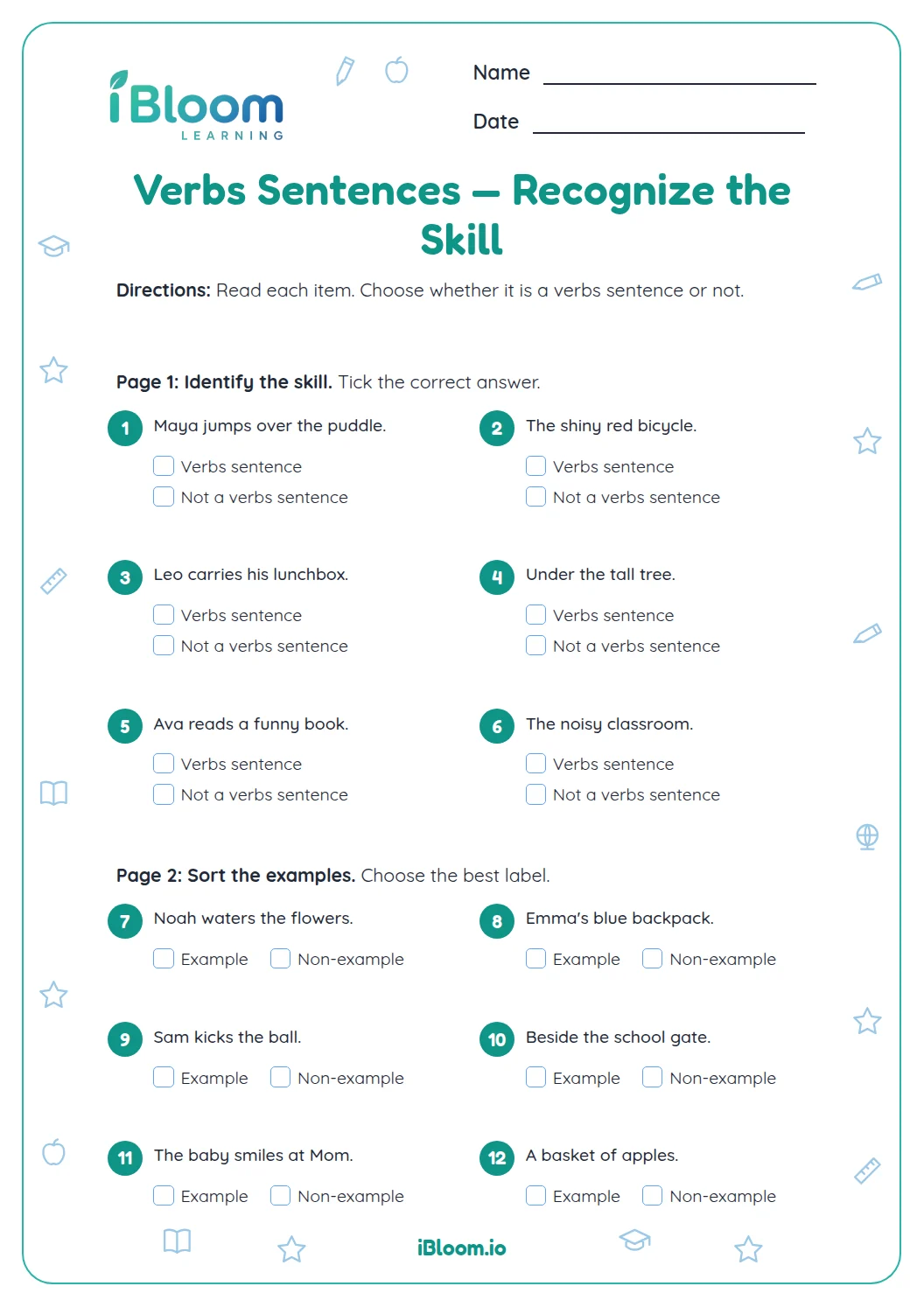
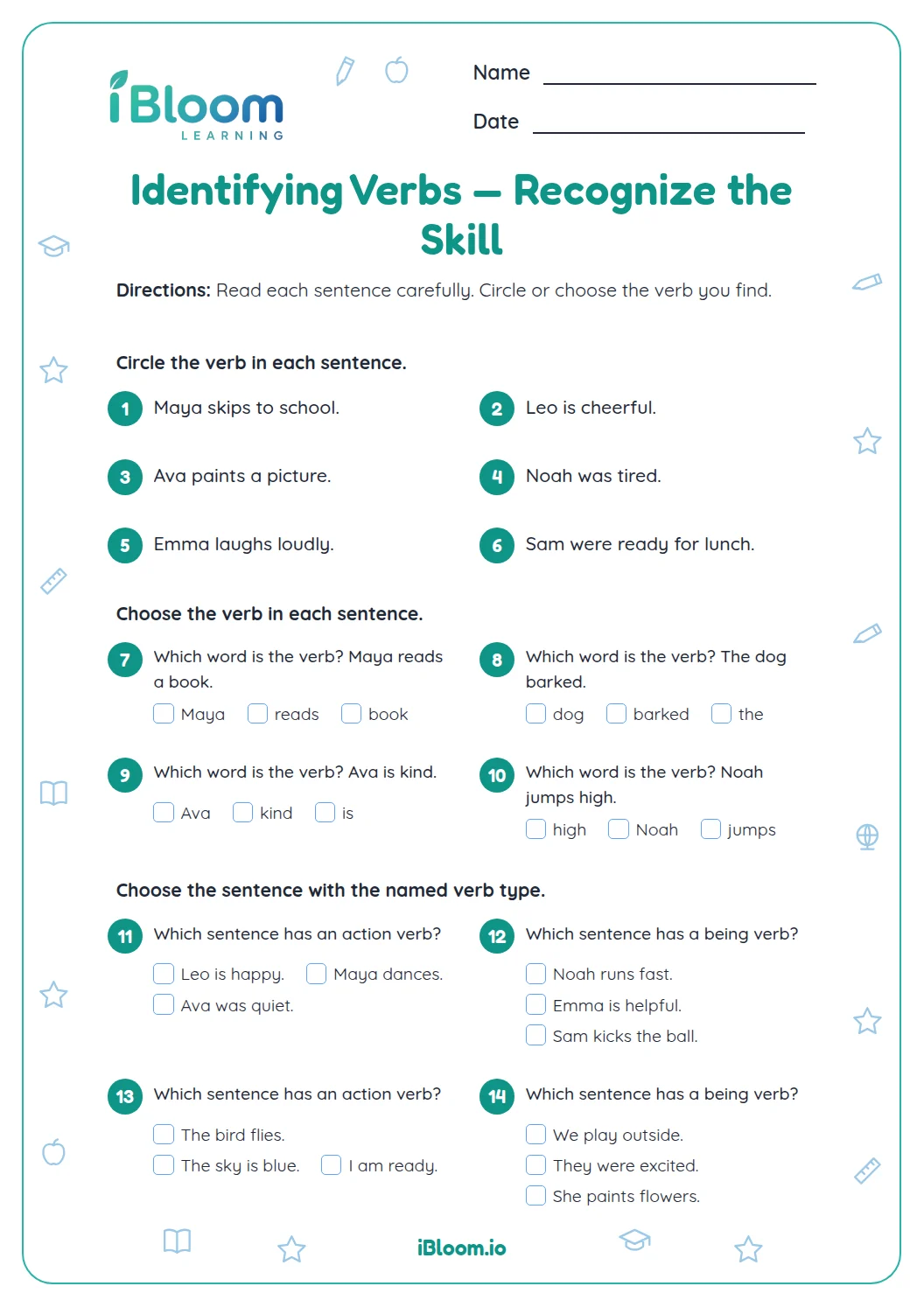
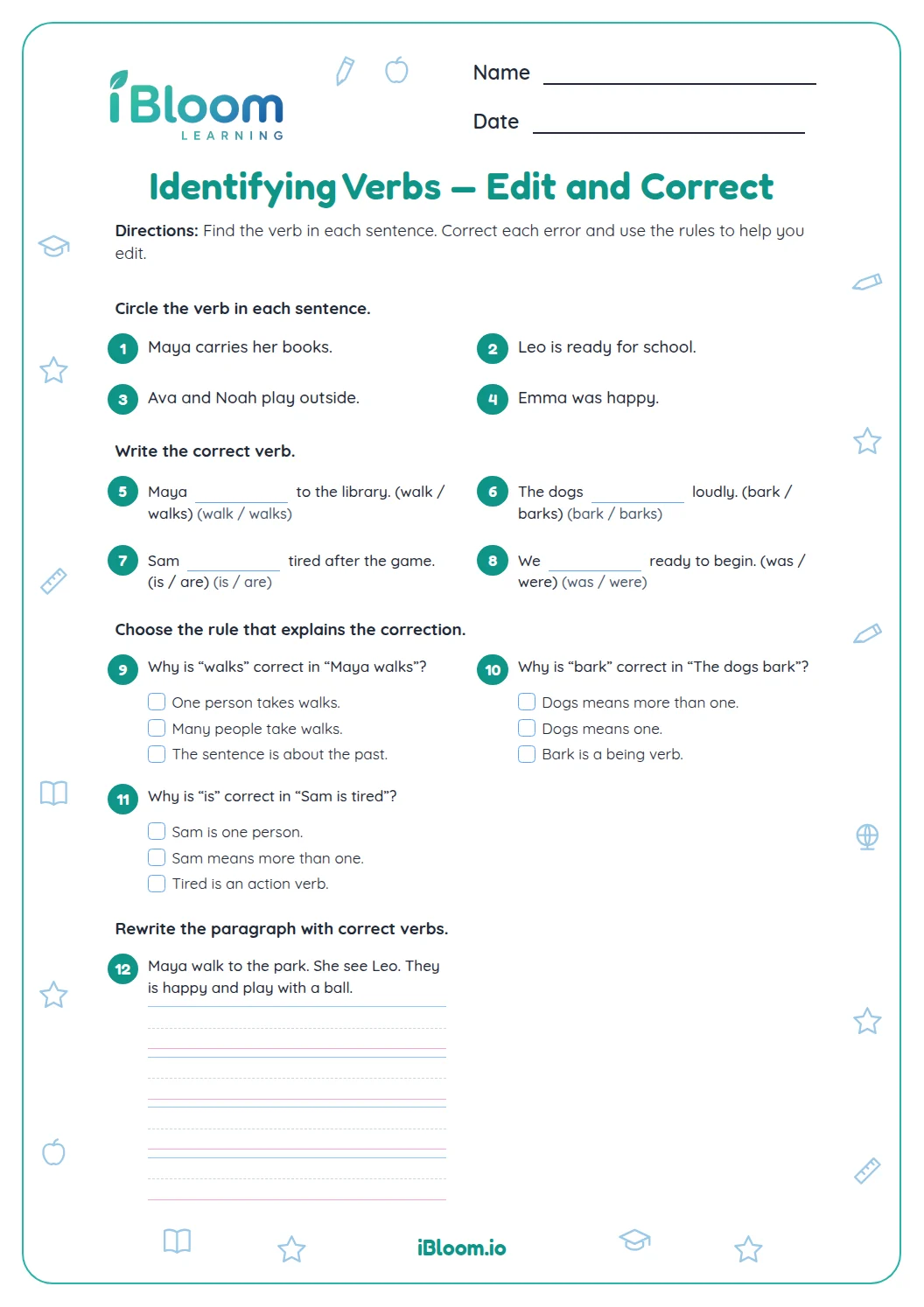
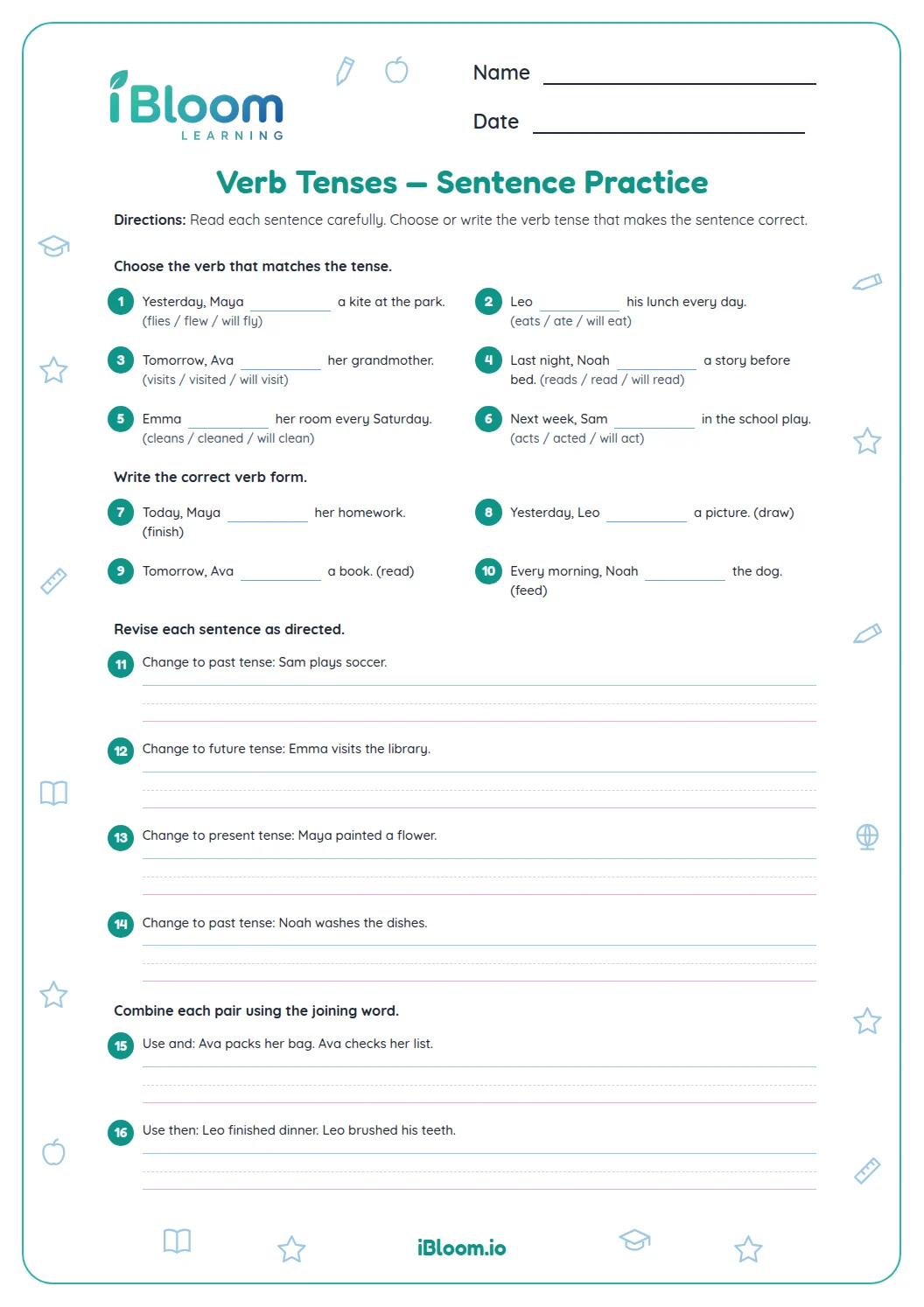
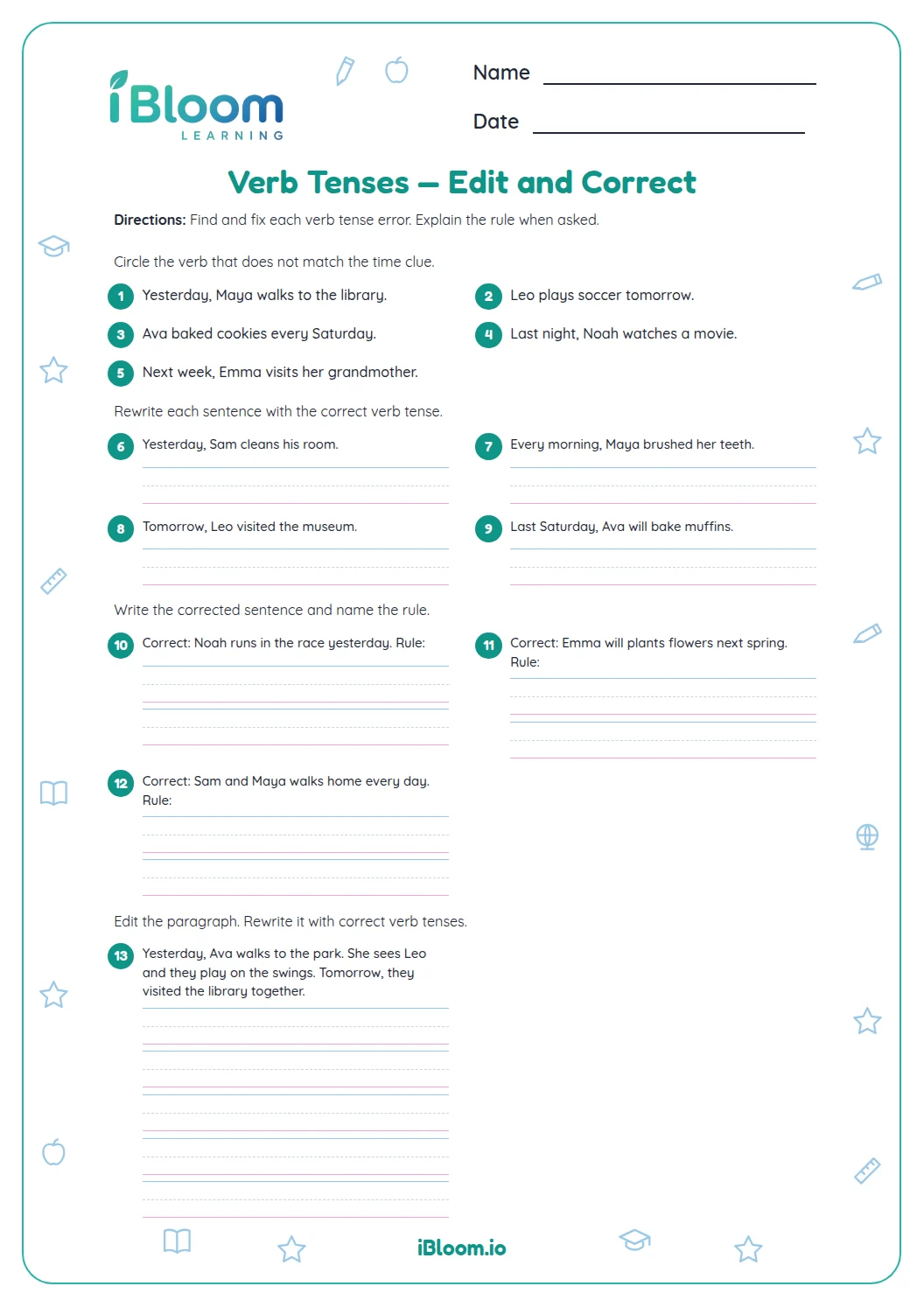
This Grade 3 worksheet gives students 16 questions about verbs in sentences. They identify action, linking, and helping verbs; choose verb forms that match a subject or time clue; and write two original sentences. The questions use everyday contexts and a mix of short answers and choices. A separate answer key gives the expected response or a sample. The practice aligns with CCSS L.3.1.
Aligned to L.3.1
What kinds of verbs appear on the sheet?
Action verbs tell what someone or something does, as hopped does in question 1. Linking verbs connect a subject to a description, as became does in “The sky became dark.” Helping verbs work with a main verb; have helps finished in question 11.
- 1They have finished the puzzle.
- 2Have helps the main verb finished.
How do tense and subject change a verb?
A time clue such as yesterday points to past tense; every morning points to a repeated present action. A subject also affects the verb form. In question 8, basket is the subject, so the singular verb sits fits even though apples appears nearby.
What should a complete verb sentence include?
A complete sentence tells a complete thought and includes a subject and a verb. The final items ask students to use seems in a sentence and to write an action in past tense. The key gives examples; other sentences are acceptable when they meet the directions.
How to review verbs
- 1Read the whole sentence before choosing a verb.
- 2Ask whether the verb shows an action, links a description, or helps another verb.
- 3Use time words to decide which tense fits.
- 4Find the sentence subject before matching its verb.
- 5For a verb phrase, include every helping and main verb.
- 6Reread original sentences to check they are complete.
What verb errors should I watch for?
The mistake
Matching a verb to a nearby noun instead of the subject.
The fix
Find the main subject first; in “basket of apples,” basket is the subject.
The mistake
Leaving out a helping verb in a verb phrase.
The fix
Include all words that work together, such as is reading.
The mistake
Using a present form after a past-time clue.
The fix
Look for words such as yesterday and choose a past-tense form.
Common Core alignment
Students use verbs and sentence patterns in standard English.
Use standard English grammar and usage when writing or speaking.
On this sheet: Students identify and use verbs that fit sentence meaning, tense, and subject.
Show the official wordingHide the official wording
Demonstrate command of the conventions of standard English grammar and usage when writing or speaking.
What to practice next
Make more practice
Further reading
Questions parents and teachers ask
What types of verbs are included?
Students identify action, linking, and helping verbs. The worksheet also asks about verb phrases, past and present tense, and subject-verb agreement. Complete sentences help show the verb’s job in context, and the final items ask students to write their own examples.
How many questions are on the worksheet?
There are 16 questions across four printed pages, including a separate answer key. The set includes verb identification, choices, short answers, and two sentence-writing prompts. Students can use the key to check the expected form or compare a sample.
What is a helping verb?
A helping verb works with a main verb to complete a verb phrase. In “They have finished the puzzle,” have helps finished. Question 11 asks students to identify that helping word. The worksheet also includes a short-answer item that asks for a full verb phrase.
How can students check subject-verb agreement?
First identify the main subject, then choose the verb form that matches it. In “The basket of apples sits on the table,” basket is the subject; apples is part of a phrase describing the basket. Ignore nearby nouns until you have found the sentence’s subject.
What should count as a correct written answer?
For question 15, the sentence must use seems as a linking verb in a complete thought. For question 16, accept a complete sentence with an action verb in past tense. The key shows one sample for each, and other correct sentences may use different subjects or details.