


About this worksheet
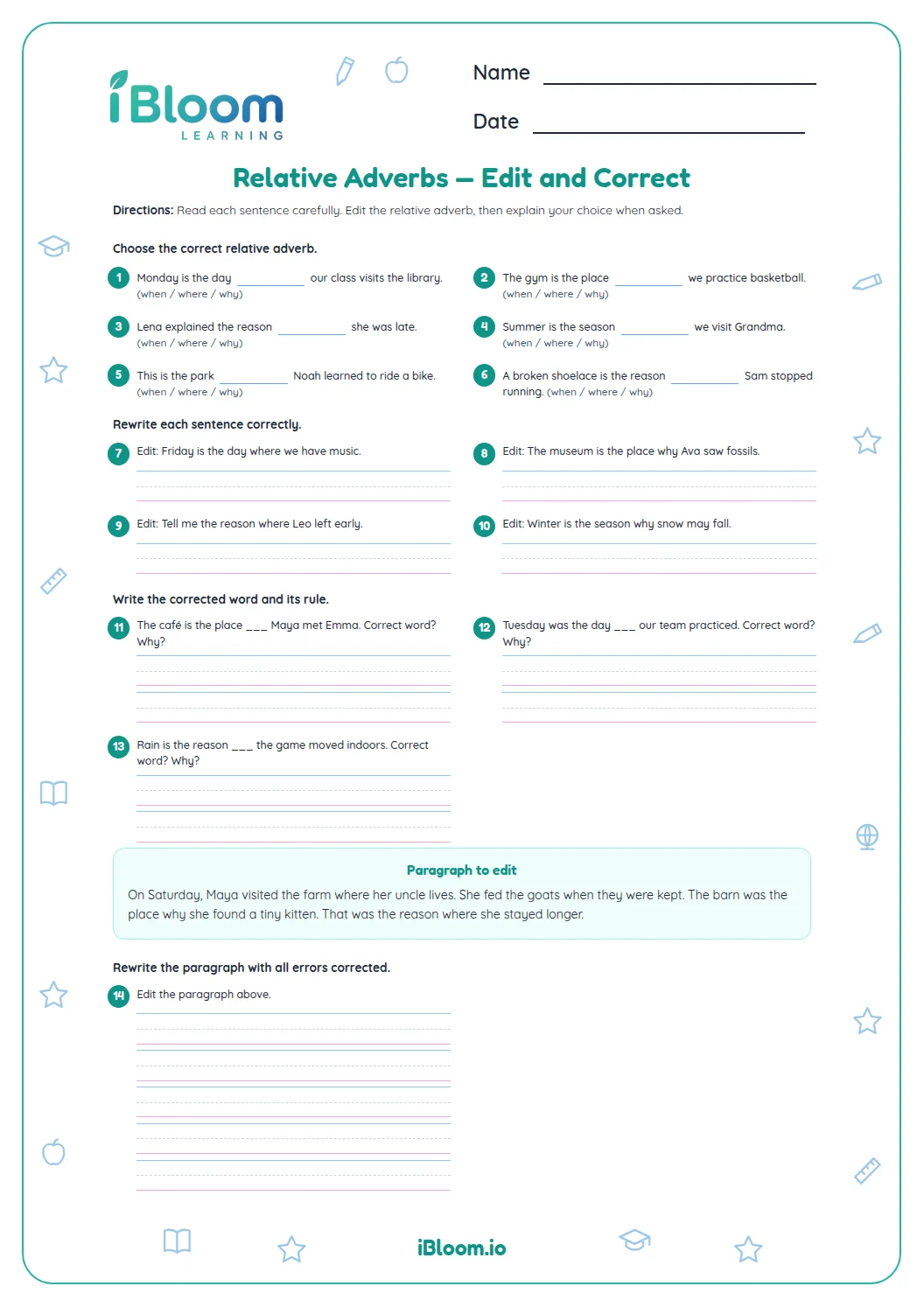
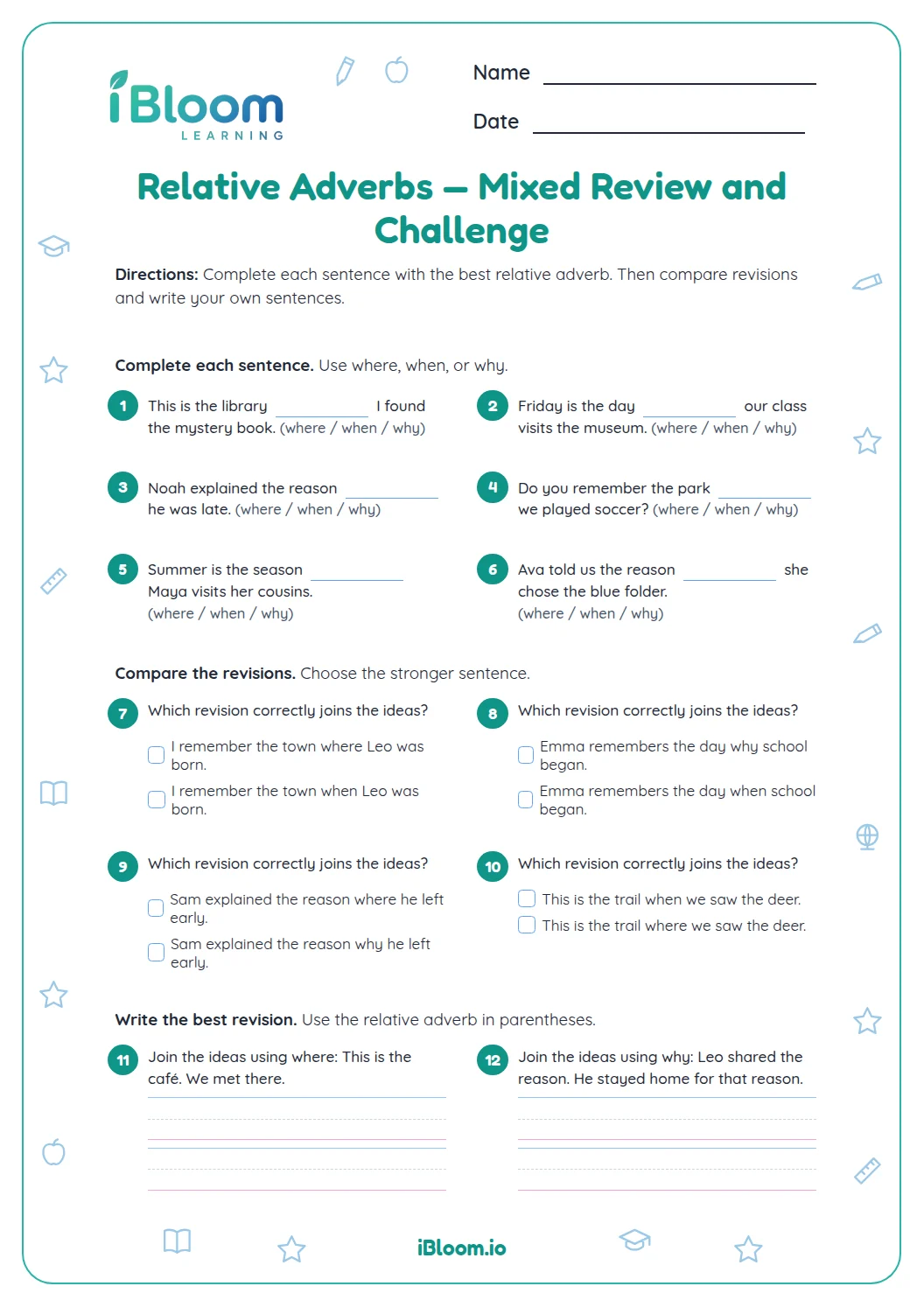
This Grade 4 grammar worksheet focuses on the relative adverbs where, when, and why. Students choose the word that completes a sentence, then name the adverb that signals a place, time, or reason. The 14 questions move from sentence completion to identifying the relationship, and a separate answer key is included. The page practices CCSS L.4.1a, which names the use of relative adverbs.
Aligned to L.4.1a
What does each relative adverb tell?
Where connects to a place, when connects to a time, and why connects to a reason. These words link a dependent clause to a noun or idea in the sentence.
How can students choose the right word?
Read the whole sentence and look for the noun or idea that comes before the blank. A place such as room or park points to where; a year or day points to when; a stated reason points to why.
- 1Do you remember the year ___ the bridge opened?
- 2Year names a time, so when completes the sentence.
How does the worksheet check recognition?
The later prompts ask which relative adverb names a place, time, or reason, then apply those relationships in new sentences. Read the clause after the blank and check that the word signals the right relationship.
How to use this worksheet
- 1Read the sentence before and after the blank.
- 2Find the place, time, or reason connected to the clause.
- 3Choose where for a place, when for a time, or why for a reason.
- 4For the identification items, match the word to its job.
- 5Reread the completed sentence to check its meaning.
- 6Use the key after completing all 14 questions.
Common mistakes and quick fixes
The mistake
Choosing by the first word after the blank
The fix
Read the whole sentence and identify whether it refers to place, time, or reason.
The mistake
Using when for a place
The fix
Ask whether the clue names when something happened or where it happened.
The mistake
Confusing why with where
The fix
Why signals a reason; where signals a location.
Curriculum alignment
Students use relative adverbs to connect clauses to places, times, and reasons.
Use where, when, and why to connect clauses to places, times, and reasons.
On this sheet: Students choose and identify relative adverbs in sentences.
Show the official wordingHide the official wording
Use relative pronouns (who, whose, whom, which, that) and relative adverbs (where, when, why).
What to practice next
Further reading
Questions parents and teachers ask
Which words are relative adverbs?
This worksheet practices where, when, and why. They connect a clause to an idea about place, time, or reason, as in “the day when Maya joined our class.” Each item gives a sentence context for deciding which relationship is meant.
How many questions are included?
There are 14 questions on two rendered pages, followed by a separate answer key page. Eight items ask students to choose a word in a sentence, and six ask them to name or use the correct relative adverb. The page includes both sentence choices and short written blanks.
How can students decide between where and when?
Look for the kind of information in the sentence. A room or park names a place and calls for where; a day, year, or season names a time and calls for when. A location answers where; a time clue answers when.
When should a student use why?
Use why when the clause tells a reason. For example, “the reason why the team practiced late” connects the idea of practicing late to the reason for it. A reason clue is the signal for why in the sentence.
What standard does this worksheet practice?
It aligns with CCSS L.4.1a, which asks students to use relative pronouns and relative adverbs. Here, the focus is specifically on recognizing and using where, when, and why in sentences. The sentence practice focuses on the three relative adverbs named in the skill.