




About this worksheet
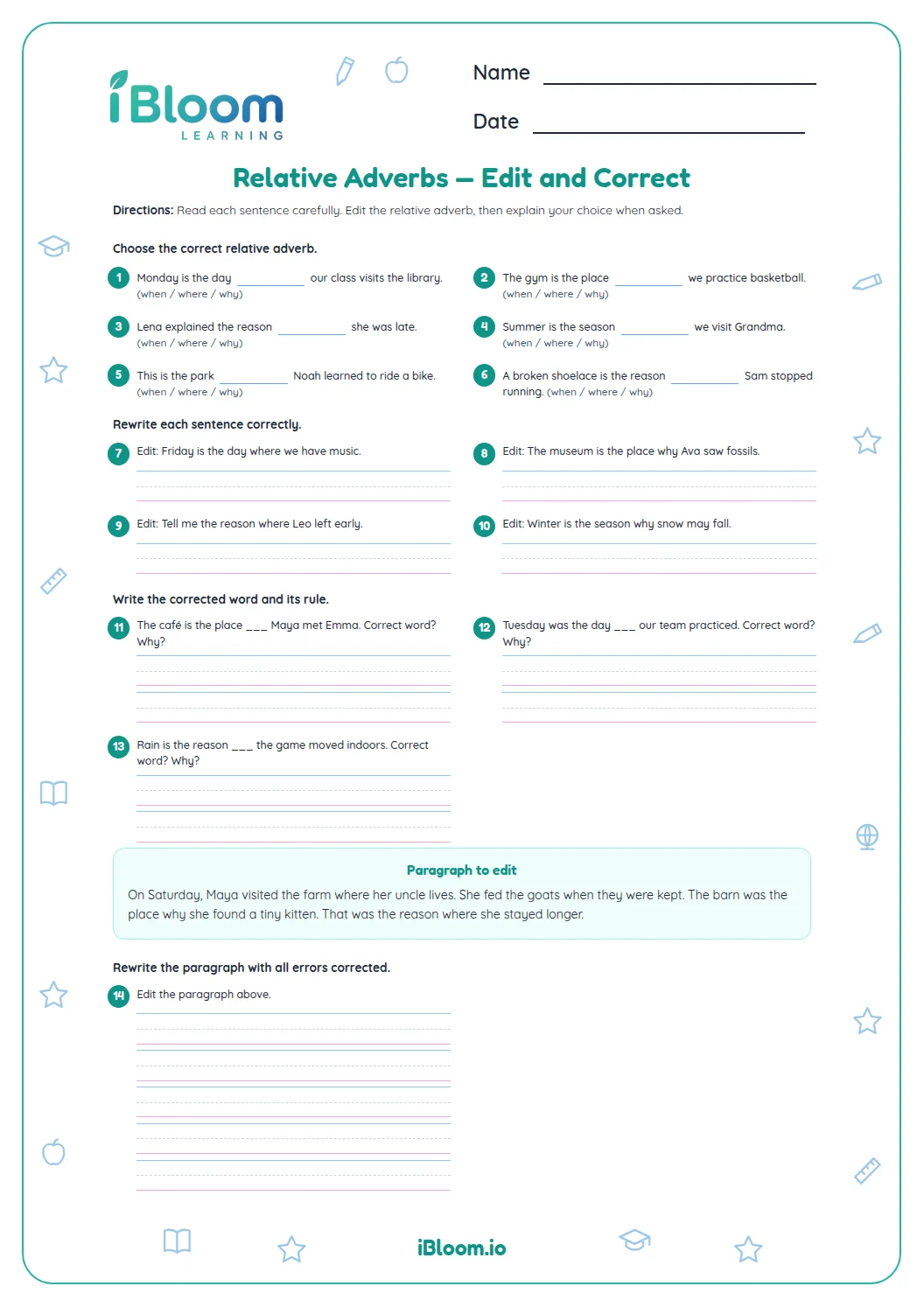
This Grade 4 worksheet builds practice with relative adverbs. Students choose where, when, or why to complete clauses that describe a place, time, or reason. Fourteen items use fresh sentence contexts: eight recognition questions followed by six sentence completions. The answer key lists one word for each blank. The practice aligns with CCSS L.4.1.a.
Aligned to L.4.1.a
How can students spot the relative adverb?
In Part A, students select the relative adverb that introduces a clause describing a place, time or reason noun. In “the trail where we saw a deer,” where introduces information about the trail.
Ask what question the added clause answers. “Where we saw a deer” gives a place detail; “when our class visits” gives a time detail; “why the gate is locked” gives a reason detail.
- 1Our class meets at the park ___ we can watch the birds.
- 2The place clue makes where the fitting relative adverb.
How do students complete a sentence with where, when or why?
Part B removes the relative adverb, so students use both the noun before the blank and the clause after it. A place noun such as gym points to where; a day or season points to when; a reason noun points to why.
Read the completed sentence again to check that the added clause describes the place, time or reason named before the blank.
How to use this worksheet
- 1Read the full sentence before choosing a word.
- 2Ask whether the extra detail tells a place, time or reason.
- 3In Part A, select the word that answers that question.
- 4In Part B, use the noun and clause clue to fill the blank.
- 5Read the sentence again with the selected word.
Mistakes to watch for
The mistake
Using when for a place because the sentence mentions an event.
The fix
Find the noun the clause describes; a location calls for where.
The mistake
Choosing why just because a sentence contains “because” elsewhere.
The fix
Check that the clause explains a reason for the noun or idea before the blank.
The mistake
Treating where, when and why as interchangeable.
The fix
Ask which question the clause answers: where, when or why.
Common Core alignment
These standards describe the reading, writing or math skills practiced on this page.
Use where, when and why to join a detail to a noun.
On this sheet: Every item selects or supplies where, when or why to complete a sentence.
Show the official wordingHide the official wording
Use relative pronouns (who, whose, whom, which, that) and relative adverbs (where, when, why).
What to practice next
Make more practice
Further reading
Questions parents and teachers ask
What are relative adverbs?
Relative adverbs are where, when and why when they introduce a clause that describes a place, time or reason noun. This worksheet asks students to identify each word in Part A and supply one in Part B. For example, where introduces a detail about “the trail.”
How many questions are on the page?
There are 14 questions across two parts. Part A has eight recognition choices, and Part B has six sentence completions. The answer key lists one relative adverb for each item. Students can check each choice by rereading the noun and the clause together.
What does Part A ask students to do?
Part A asks students to choose where, when or why in a clause connected to a place, time or reason noun. For instance, “the day when our class visits” names a time. The key includes examples for all three words.
What does Part B ask students to do?
Part B gives a sentence with a blank where the relative adverb belongs. Students use the noun before the blank and the meaning of the clause after it. A place noun points toward where, a time noun toward when, and a reason noun toward why.
How can students tell the three words apart?
Ask what kind of detail the clause adds to the noun. Where introduces a place detail, when introduces a time detail, and why introduces a reason detail. Then reread the whole sentence to make sure the clause describes the noun before the blank.
Which standard does this worksheet practice?
It practices CCSS L.4.1.a, which names relative pronouns and relative adverbs as language conventions. The questions focus on where, when and why in clauses attached to place, time and reason nouns. The answer key helps an adult review each response with the student.