



About this worksheet
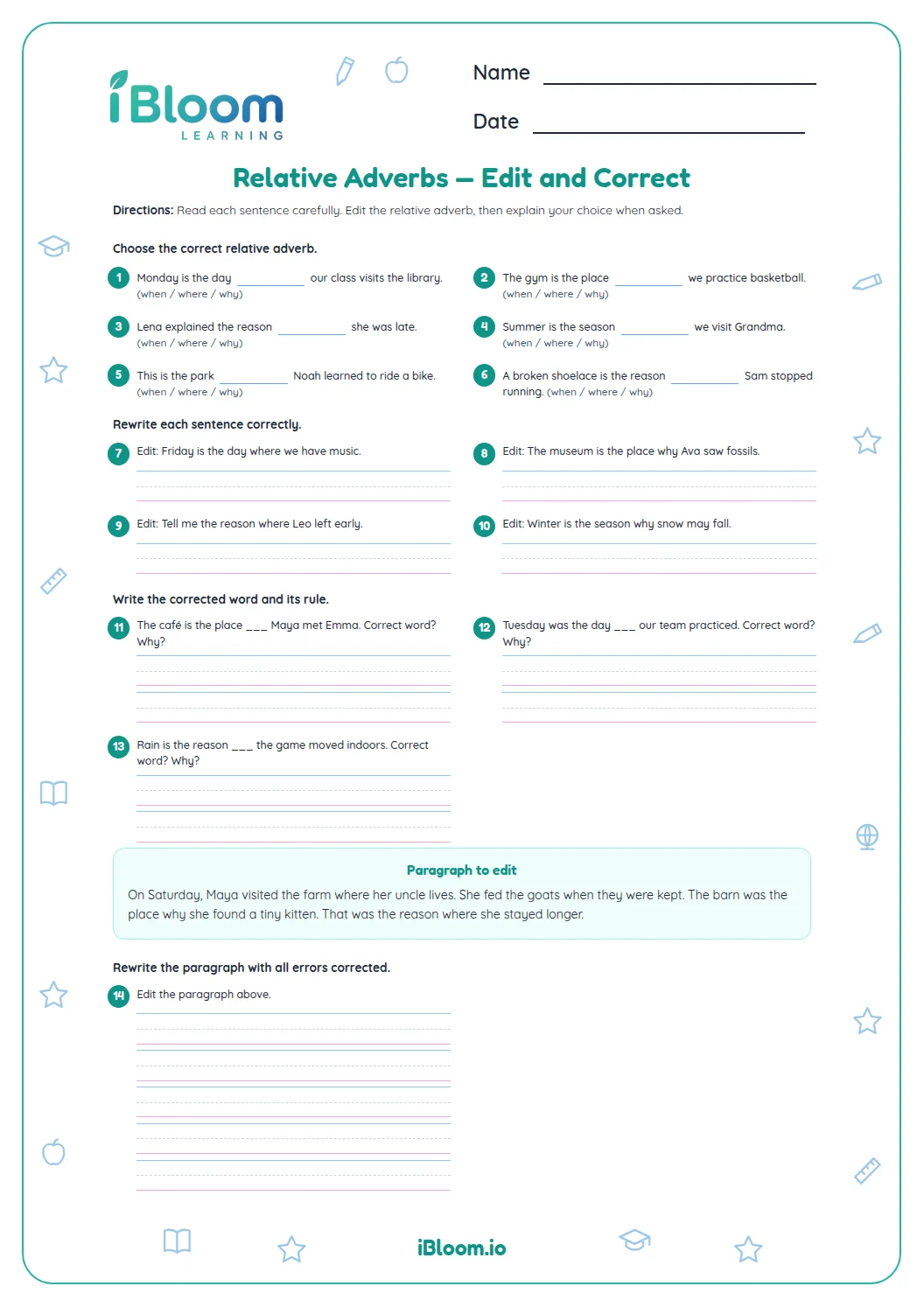
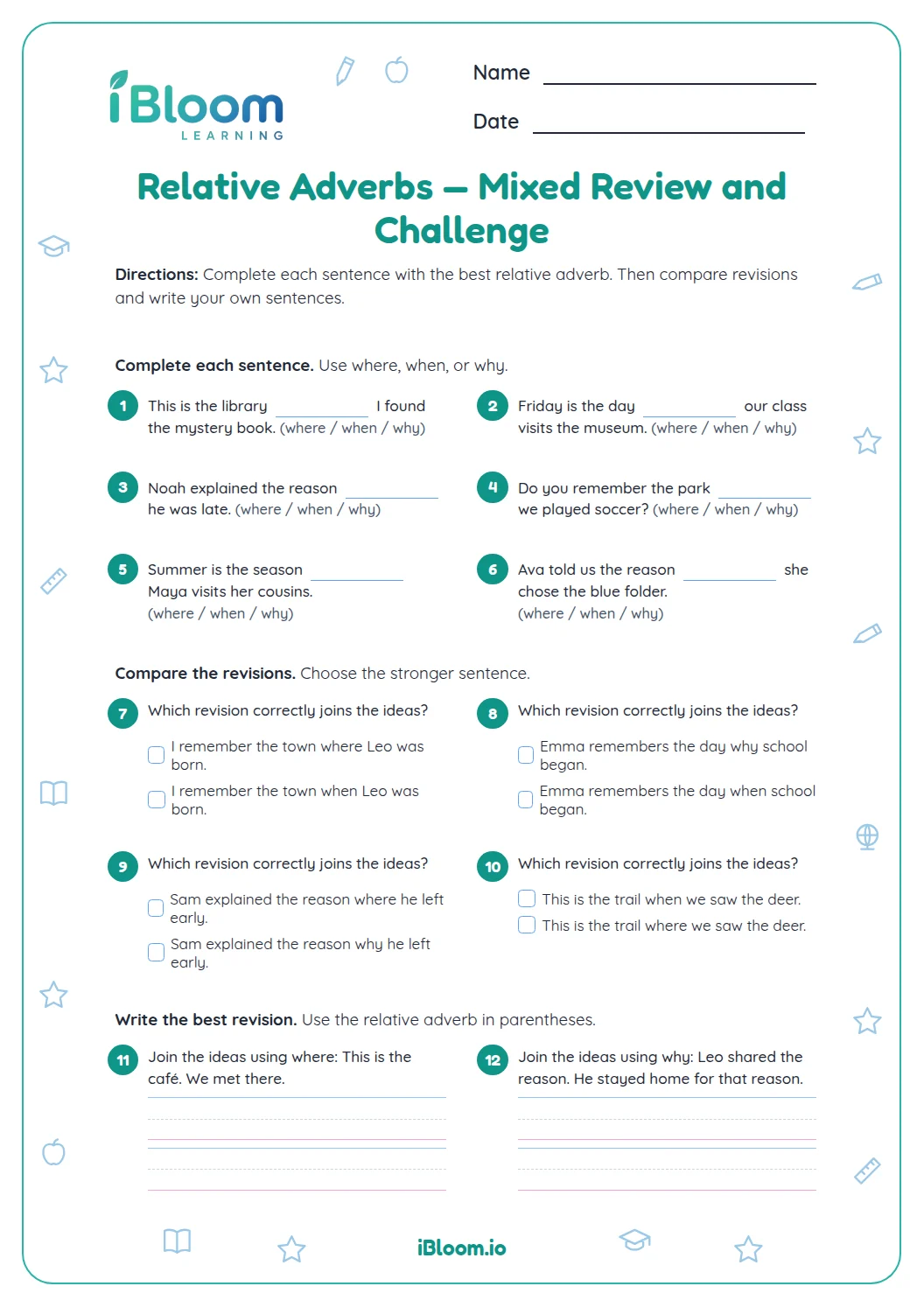
This Grade 4 grammar worksheet helps students use the relative adverbs where, when, and why to connect ideas in complete sentences. Students choose an adverb to complete a sentence, fill in relative adverbs in context, and identify which word fits a sentence. The practice aligns with CCSS L.4.1.a, which names relative adverbs as part of grade-level grammar. The answer key lists the correct choices.
Aligned to L.4.1.a
What does the worksheet ask students to do?
Students choose among where, when, and why in connected contexts. The page starts with completion, then asks them to select correctly combined sentences and identify the relative adverb in a sentence.
- Part A: choose where, when, or why.
- Part B: complete sentences with relative adverbs.
- Part C: choose the adverb that fits a sentence.
- The answer key lists all 14 answers.
How do where, when, and why differ?
Where points to a place, when points to a time, and why introduces a reason. Match the clue in the sentence to the kind of information that follows. In question 1, park is a place, so where completes the thought.
- 1This is the park ___ we learned to ride bikes.
- 2Park names a place.
- 3Complete it with where.
How does a relative adverb connect a clause?
A relative adverb introduces a clause that tells about a place, time, or reason. In question 7, “bench” names a place, and the blank connects it to the clause about leaving lunch there. The word where makes the relationship clear.
- 1Maya found a bench ___ she left her lunch there.
- 2Bench names a place, so complete the sentence with where.
How can students check their own sentences?
Read the sentence aloud and ask whether the clause after the relative adverb tells about a place, time, or reason. Then check that the combined sentence is complete and keeps the meaning of both original ideas.
How to use this worksheet
- 1Review the clues place, time, and reason before beginning.
- 2Complete Part A by matching each clue to where, when, or why.
- 3In Part B, use where for places, when for times, and why for reasons.
- 4Read each completed sentence aloud to check the connection.
- 5Use the answer key to check that each adverb matches the sentence meaning.
Relative adverb mix-ups
The mistake
Choosing when because an event happened in a sentence about a place.
The fix
Ask whether the blank refers to a location, a time, or an explanation.
The mistake
Using where for a reason because both clauses explain an idea.
The fix
A reason answers why; a place answers where.
The mistake
Combining sentences but leaving both there and where.
The fix
Use the relative adverb to connect the clause in place of the repeated clue word.
Common Core alignment
The questions practice the Grade 4 grammar skill of using relative adverbs to connect ideas.
Use where, when, and why to connect clauses about place, time, and reason.
On this sheet: Students select and use where, when, and why in complete sentences.
Show the official wordingHide the official wording
Use relative pronouns (who, whose, whom, which, that) and relative adverbs (where, when, why).
What to practice next
Make more practice
Further reading
Questions parents and teachers ask
What are the three relative adverbs on this page?
The worksheet practices where, when, and why. Where connects to a place, when connects to a time, and why connects to a reason. Students use these clues to complete sentences, join related ideas, and create a sentence of their own.
How many questions are included?
There are 14 questions in three parts. Students first choose an adverb, then complete sentences with where, when, or why, and finish by choosing a word that fits the sentence meaning. The separate answer key lists the correct answer for every item.
What is the answer to the first sentence?
The first sentence is completed with where: This is the park where we learned to ride bikes. A park is a place, so where introduces the clause that tells what happened there. The other choices name a time or a reason, which do not fit this sentence.
Can students word a combined sentence differently?
The sentence-completion items leave a blank where the relative adverb belongs. Accept where for a place, when for a time, and why for a reason. The key gives the intended word for each sentence, and rereading the whole sentence helps check that the connection makes sense.
How can students remember which word to choose?
Ask what kind of information the clause gives. If it tells a location, choose where. If it tells a time, choose when. If it explains a cause or reason, choose why. Then reread the whole sentence to make sure the connection makes sense.