




About this worksheet
This Grade 4 printable focuses on relative adverbs in context. Students identify where, when, and why in short clauses, complete three items, and write one sentence using where. The answer key gives the target word or relationship and a model sentence.
Aligned to L.4.1.a
How do you recognize a relative adverb?
A relative adverb begins a clause that describes a place, time, or reason named in the sentence. In “the day when we planted the tree,” when begins the clause that describes the day.
Question 2 asks children to find when in a clause that describes a named day.
- 1I remember the day when we planted the tree.
- 2The clause “when we planted the tree” describes the day.
- 3The relative adverb is when.
How do you choose between where, why, and when?
Ask what information the clause adds. If it tells a place, use where. If it tells a time, use when. If it gives a reason, use why. The clause should make sense with the noun or idea it follows.
Part B contrasts close choices so children use the meaning of the whole sentence rather than guess from the word alone.
How can you check the adverb in a sentence?
Read the complete sentence and replace the relative adverb with its question: where? why? or when? If the clause answers that question, the choice fits. Check punctuation and keep the whole sentence clear.
What does the worksheet include?
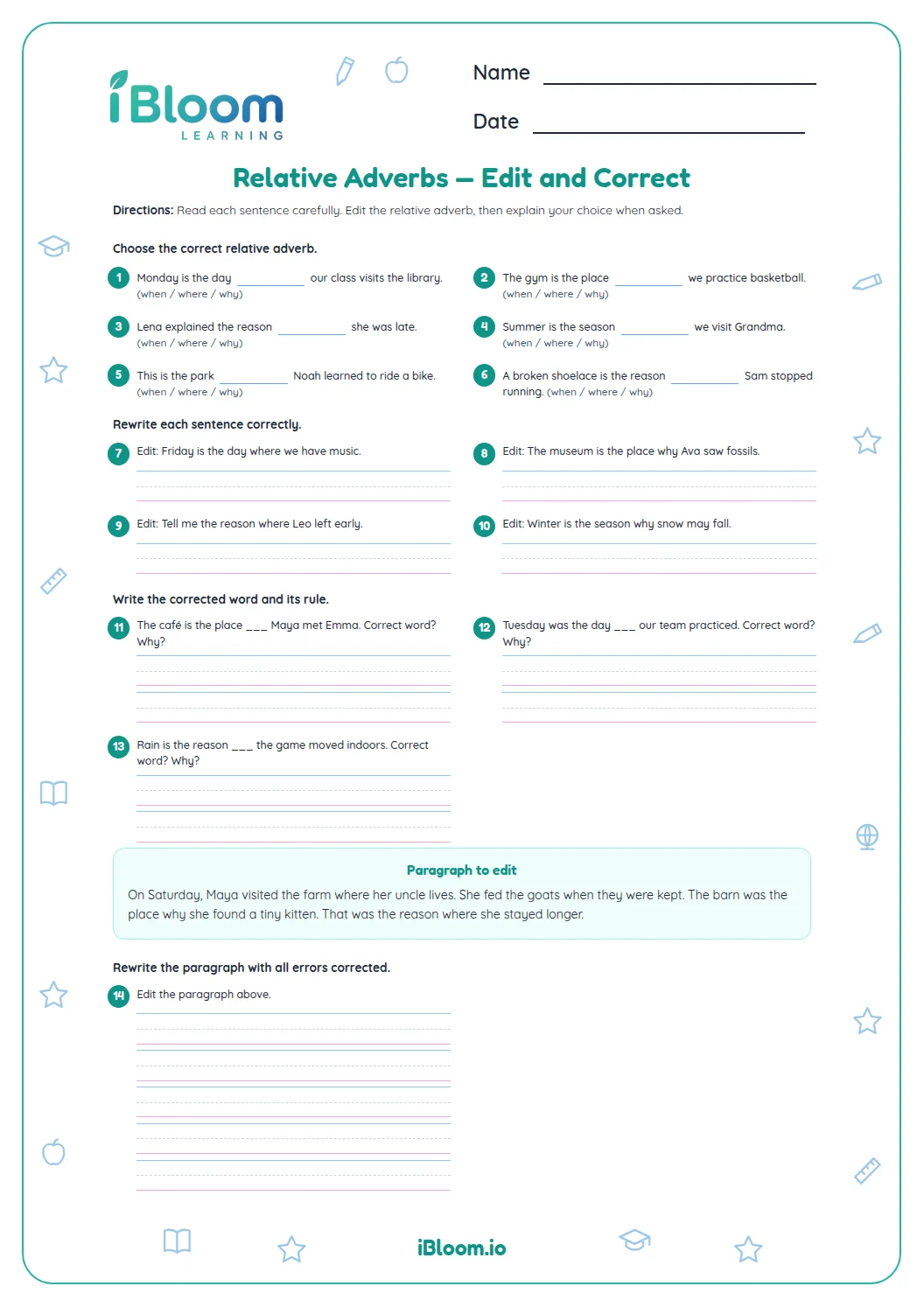
Part A identifies relative adverbs in sentences. Part B fills sentence gaps. Part C revises mismatched choices and explains whether a clause tells place, reason, or time. The answer key shows the target word and its role.
How to use this grammar worksheet
- 1Read the whole sentence before looking for the relative adverb.
- 2Find the clause that gives extra information about a place, reason, or time.
- 3Ask whether that clause answers where, why, or when.
- 4Choose the adverb that makes both the meaning and sentence structure work.
- 5For the editing items, replace the incorrect word and read the revised sentence aloud.
- 6Check the key and explain the clue that helped identify the relationship.
Common relative-adverb mix-ups
The mistake
Choosing when because an event happened in the past.
The fix
Ask what the clause tells. Use when only if it names the time of the event.
The mistake
Using where for a clause that gives a reason.
The fix
Try asking “why?” If the clause answers that question, choose why.
The mistake
Calling any use of where, why, or when a relative adverb.
The fix
Check the word’s job in the sentence: it must introduce a clause that gives information about a noun or idea.
Common Core alignment
The questions practice the relative adverbs named in the Grade 4 language standard.
Recognize where, why, and when introducing clauses with place, reason, and time details.
On this sheet: The worksheet identifies and selects where, when, and why as relative adverbs.
Show the official wordingHide the official wording
Use relative pronouns (who, whose, whom, which, that) and relative adverbs (where, when, why).
What to practice next
Make more practice
Further reading
Questions parents and teachers ask
What is a relative adverb?
A relative adverb is where, when, or why when it begins a clause that adds place, time, or reason information about a noun. In “the room where our class meets,” the clause describes the room. Children identify this job in the worksheet’s sentences.
How can a child tell where from when?
Look for the noun the clause describes. In “the day when we planted,” day names a time, so when fits. In “the room where we meet,” room names a place, so where fits. The worksheet pairs each relative adverb with a clear place, time, or reason clue.
Does the worksheet include editing?
No editing passage appears on this sheet. Children read sentences and identify which relative adverb introduces a clause, complete a sentence with where, and classify a clause as place, reason, or time. A final prompt asks them to write a sentence using where.
Is there an answer key?
Yes. The separate key gives an answer for all 16 questions and a model for the last sentence. Other sentences are correct when where introduces a clause that tells about a place in context. The examples use clear place clues.
What makes where, when, and why relative adverbs?
These words introduce clauses that add a place, time, or reason detail to a noun. In “the room where our class meets,” where begins a clause describing the room. The worksheet asks children to identify that relationship and complete one sentence with the fitting relative adverb.