




About this worksheet
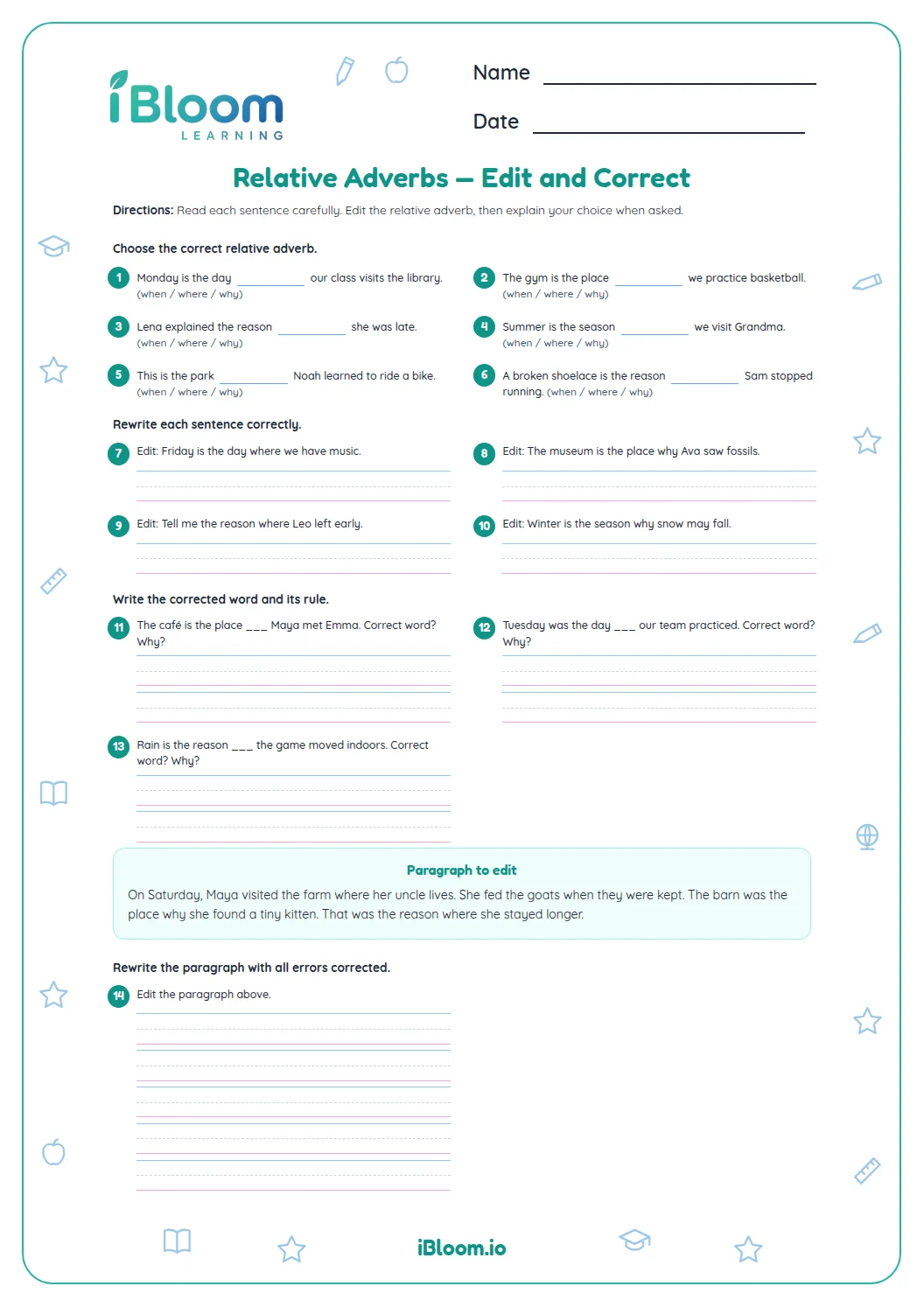
This Grade 4 editing worksheet focuses on where, why, and when. Students choose the adverb that tells place, reason, or time, correct sentences where the word is misplaced, and revise a short paragraph. The examples use familiar situations, including a robot show and a muddy path. The practice connects to the Common Core expectation to use relative adverbs where, when, and why.
Aligned to L.4.1a
How do where, why, and when differ?
Where points to a place, why gives a reason, and when points to a time. Ask a question about the sentence: where did it happen, why did it happen, or when did it happen?
- 1“I know the reason ___ Leo left early.”
- 2Ask what explains the reason.
- 3Why introduces the reason clause.
How can students edit an adverb mistake?
Read the clause after the blank and ask whether it gives a place, time, or reason. Then choose the matching word. In a revision, make sure the sentence still says what the writer means.
What should students check in the paragraph?
Read each clause carefully and check the job of its adverb. A paragraph may contain several errors, so reread after each change to make sure the ideas connect.
How to use this worksheet
- 1Read the clause after the blank.
- 2Ask whether it answers where, why, or when.
- 3Choose the adverb that matches that meaning.
- 4Rewrite the whole sentence when editing.
- 5Reread the paragraph to check that each clause makes sense.
Common mistakes and fixes
The mistake
Using when for a reason.
The fix
Ask “why did it happen?” A reason needs because or why.
The mistake
Using where for a time.
The fix
Ask “when did it happen?” Use when with a time.
The mistake
Fixing the target word but leaving the sentence unclear.
The fix
Read the complete revised sentence aloud and check its meaning.
Common Core alignment
Students practice relative adverbs in complete sentences and a short paragraph.
Use where, when, and why to introduce adverb clauses.
On this sheet: Students choose and edit where, why, and when in sentences and a paragraph.
Show the official wordingHide the official wording
Use relative pronouns (who, whose, whom, which, that) and relative adverbs (where, when, why).
What to practice next
Make more practice
Further reading
Questions parents and teachers ask
What do where, why, and when tell a reader?
Where introduces a place, why introduces a reason, and when introduces a time. The worksheet asks students to choose and correct these relative adverbs in sentences and a short paragraph. For example, a place clause can say “the field where his team played.”
How many questions are included?
There are 14 questions: eight multiple-choice items and six written responses. Students start with individual clauses, revise sentences, edit a paragraph, and write an example of their own. The written questions ask students to edit sentences and repair a paragraph.
What is the paragraph about?
Maya and Leo visit a science museum and plan to see a robot show. Students correct three misplaced relative adverbs so the dinosaur exhibit, show time, and reason are connected clearly. Students correct the clauses about the dinosaur exhibit, show time, and reason.
How is why used in a relative clause?
Why introduces a reason after a noun such as reason: “I know the reason why Leo left early.” Students use that relationship to distinguish why from where for a place and when for a time. Relative why introduces a reason clause after a word such as reason.
How can I help a child choose the right adverb?
Ask whether the clause names a place, a time, or a reason. Then reread the full sentence with the chosen word and check whether the clause connects naturally to the noun or idea before it. This check helps distinguish the clause meaning from the clause’s punctuation.