




About this worksheet
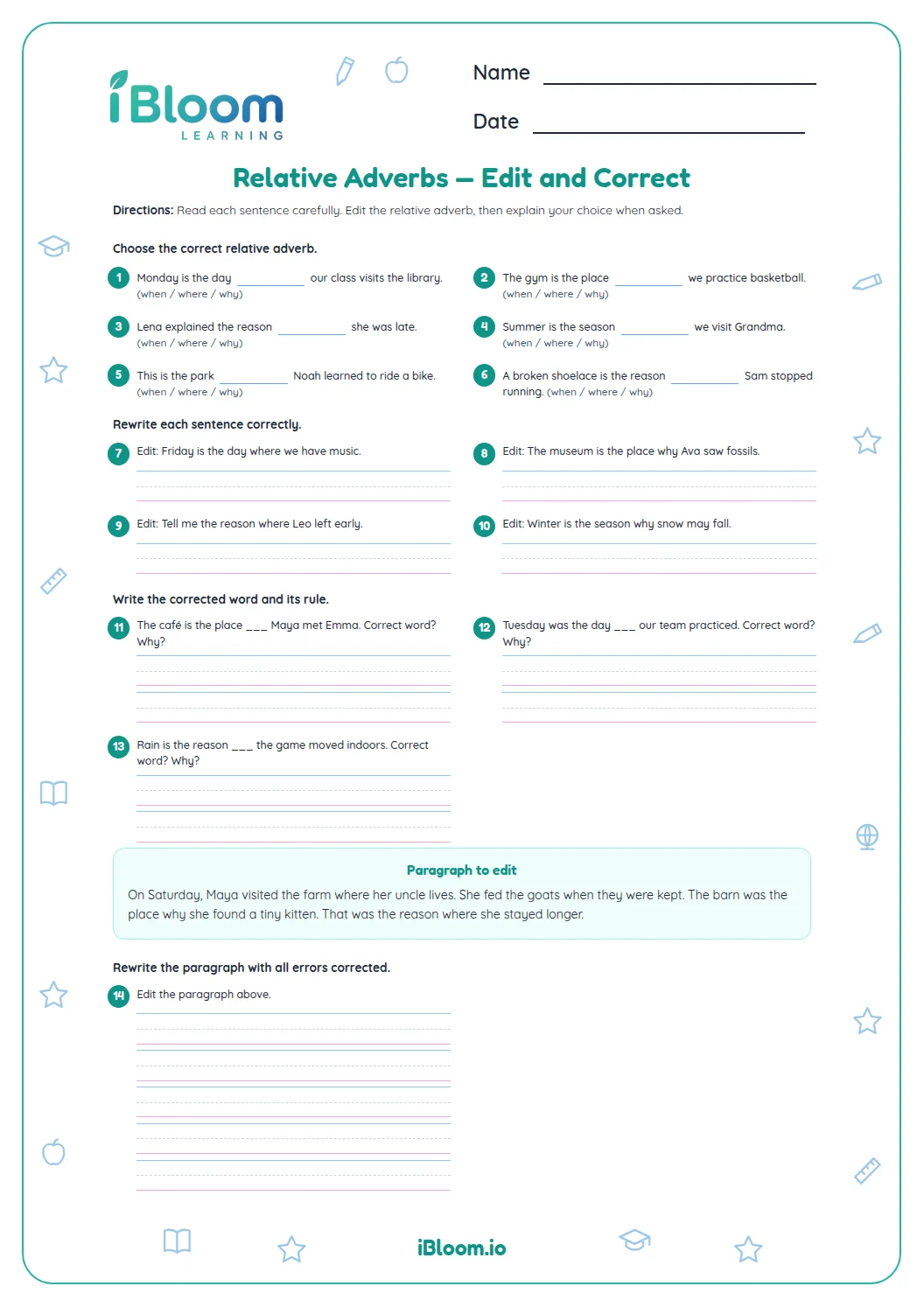
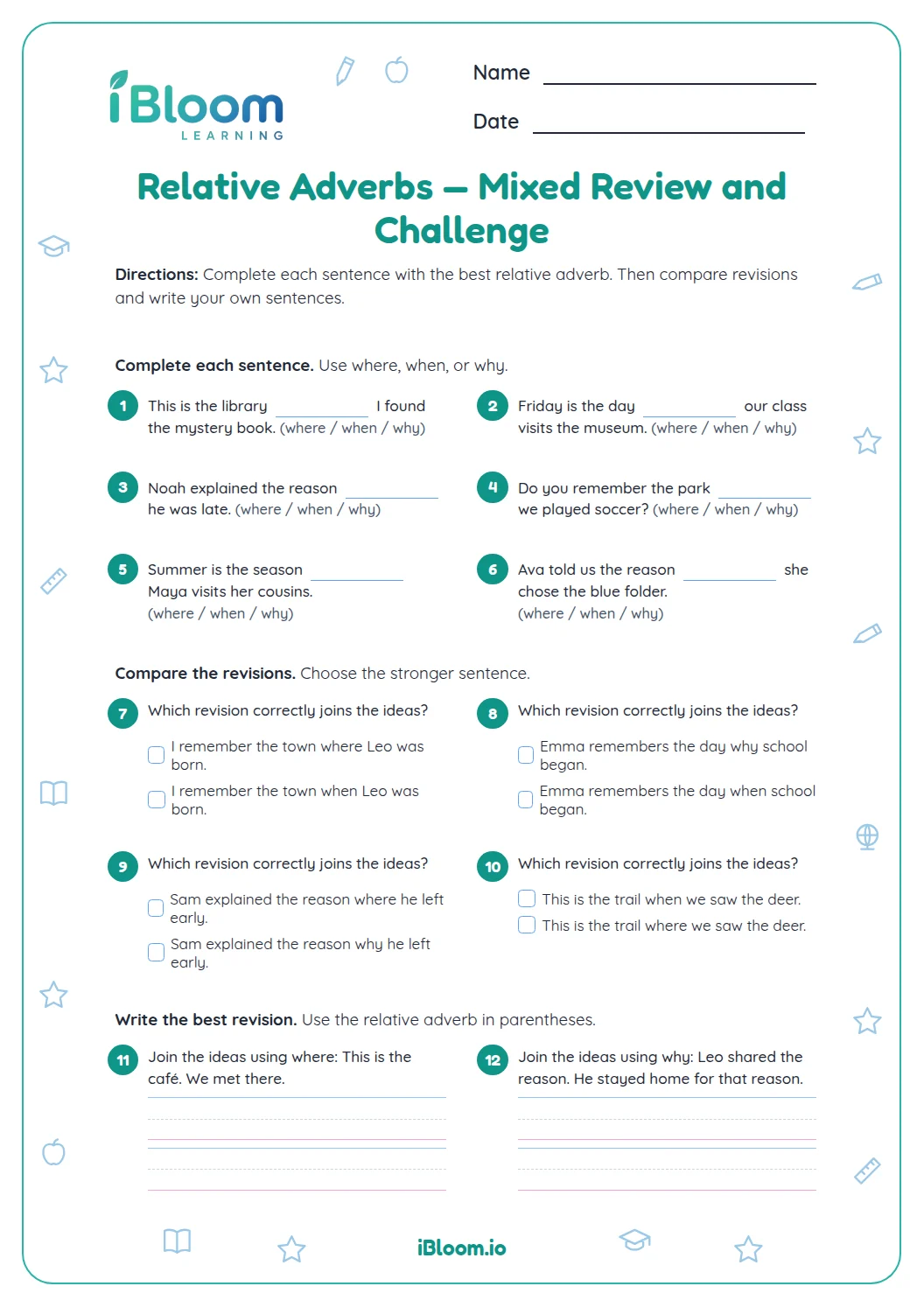
This free Grade 4 worksheet gives students 16 sentences to complete with the relative adverbs where, when, or why. The three parts move from direct examples to mixed sentence clues, including a town, a summer, a reason, and other familiar contexts. Students decide whether the clause points to a place, time, or reason, then check their choices with a separate answer key. The page practices Common Core language standard L.4.1.a.
Aligned to L.4.1.a
What does Part A ask students to notice?
Part A uses clear clues such as town, summer, and reason. Students complete each sentence with the relative adverb that connects the clause to a place, time, or reason.
How does Part B use sentence clues?
Part B keeps the same three choices but varies the clue words. In q7, “We found the field ___ the kites were flying,” field names a place, so where completes the sentence.
What changes in the final part?
Part C mixes place, time, and reason clues without sorting them first. Reread the full sentence after filling the blank to check that the clause connects naturally.
How to use this worksheet
- 1Read the complete sentence before choosing a word.
- 2Ask whether the clause points to a place, time, or reason.
- 3Write where, when, or why in the blank.
- 4Read the finished sentence aloud to check the connection.
- 5Use the separate key after completing a part, then revisit any missed clue.
Common mistakes and quick fixes
The mistake
Choosing where because a sentence names a place, even when the blank refers to a time.
The fix
Check the word immediately connected to the clause: year, day, and moment signal time, so use when.
The mistake
Using why after any mention of a reason, without reading the clause.
The fix
Complete the sentence and confirm the clause gives the reason being asked about.
The mistake
Picking an adverb from the noun alone.
The fix
Read the whole sentence and identify what the clause adds: place, time, or reason.
Curriculum alignment
This worksheet practices the following Common Core language skill.
Use where, when, and why to connect clauses to places, times, and reasons.
On this sheet: Use where, when, and why to connect clauses to places, times, and reasons.
Show the official wordingHide the official wording
Use relative pronouns (who, whose, whom, which, that) and relative adverbs (where, when, why).
What to practice next
Make more practice
Further reading
Questions parents and teachers ask
What does this worksheet practice?
This sheet asks students to complete 16 sentences with where, when, or why. Each word names a relationship: place, time, or reason. Students work through three parts, then use the separate key to check whether the clause connects clearly to the rest of the sentence.
How many questions and pages are included?
There are 16 fill-in-the-blank questions in three parts, printed across two worksheet pages. The separate answer key also has two pages. Students can complete one part at a time and check the key after finishing, rather than looking up each answer as they go.
What is one example from the worksheet?
In q1, “The town ___ I grew up has a river,” the clause describes a place. “Where” connects grew up to town: “The town where I grew up has a river.” Use when for a time and why for a reason.
How can a student tell which relative adverb fits?
Use where when the clause points to a place, when when it points to a time, and why when it gives a reason. Ask the student to read the completed sentence aloud; the connection should make sense, as in “the day when our club starts.”
Is an answer key included?
Yes. The answer key is printed separately in two pages and lists all 16 expected words. Have the student finish a section before checking, then reread any missed sentence with the answer inserted. The goal is to hear how the clause adds place, time, or reason information.