





About this worksheet
This free Grade 4 printable has two editing parts: eight sentences to strengthen with a fitting sensory detail and eight sentences to correct for capitalization and end punctuation. Students practice making a scene more precise, then apply conventions to complete sentences. A separate three-page answer key gives sample descriptive revisions and corrected sentences.
Aligned to W.4.3.d and L.4.2
How does the first part build description?
Questions 1–8 begin with a complete sentence and ask for one fitting sensory detail. Students can add a sight, sound, smell, taste or feeling without changing the scene. The answer key offers examples; other clear, relevant revisions can also work.
- 1At dawn, the garden glowed with dew.
- 2Sample revision: At dawn, the quiet garden glowed with silver dew.
- 3“Quiet” and “silver” add details that fit the garden scene.
What should students correct in the second part?
Questions 9–16 present complete sentences without a capital at the beginning or an end mark. Rewrite each sentence with an uppercase first letter and suitable ending punctuation, keeping its words and meaning.
How can a student check a revision?
Read the sentence aloud and ask whether the new detail fits the scene. For an editing item, check the first letter and final punctuation, then compare with the key.
How to use this worksheet
- 1Read the whole sentence before changing it.
- 2For Questions 1–8, add one specific detail that fits what is happening.
- 3For Questions 9–16, capitalize the first word and add an end mark.
- 4Reread each revision to check that it is a complete, clear sentence.
- 5Compare with the key, remembering that descriptive answers may vary.
Common mistakes and quick fixes
The mistake
Adding a detail that changes the scene.
The fix
Choose a detail that could belong in the sentence as written.
The mistake
Using a vague word such as “nice.”
The fix
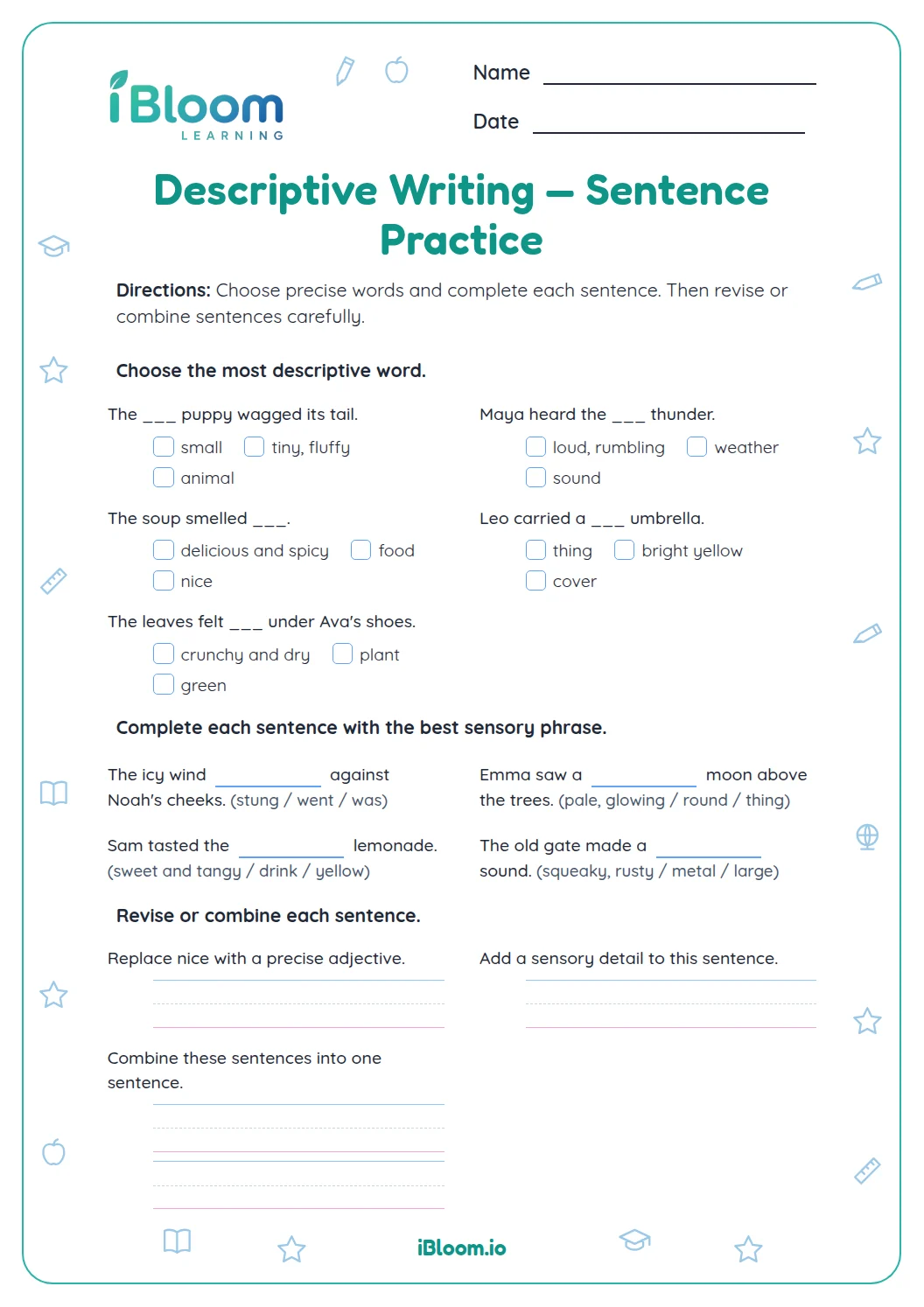
Choose a concrete sensory word, such as “rough,” “spicy” or “steady.”
The mistake
Leaving a sentence lowercase or without an end mark.
The fix
Check the first character and the final punctuation after rewriting.
Common Core alignment
The prompts practice narrative details and standard sentence conventions.
Use sensory details to convey narrative experiences precisely.
On this sheet: The first part asks students to revise sentences with sensory description.
Show the official wordingHide the official wording
Use concrete words and phrases and sensory details to convey experiences and events precisely.
Apply capitalization and punctuation when editing.
On this sheet: The editing part asks students to add capitals and end punctuation.
Show the official wordingHide the official wording
Demonstrate command of the conventions of standard English capitalization, punctuation, and spelling when writing.
What to practice next
Make more practice
Further reading
Questions parents and teachers ask
Can students give answers other than the sample revisions?
Yes. Questions 1–8 allow more than one good revision. A different detail works when it fits the scene and makes it more vivid; the key supplies examples rather than the only acceptable wording. Check that the added words preserve the original event.
What does the first part ask students to do?
The first eight prompts ask students to add one fitting descriptive detail to a sentence. A detail may help a reader picture, hear, smell, taste or feel the scene. The printed examples include a garden, wind, bees, soup and a stream.
What should students edit in Questions 9–16?
These eight sentences need a capital at the beginning and end punctuation. Students should preserve the sentence’s words and meaning while correcting those mechanics. A period is suitable for each statement on this sheet, followed by a quick reread.
How many questions and pages are included?
There are 16 questions: eight descriptive revisions and eight mechanics edits. The printable worksheet uses three pages, and its answer key also spans three pages with sample responses for checking. Students may print the key separately for review.
How can an adult help without choosing the detail?
Ask a question tied to the scene, such as “What might the wind feel like?” or “What sound might the bees make?” The student can then choose and write a detail independently. Invite them to reread the full sentence aloud.