





About this worksheet
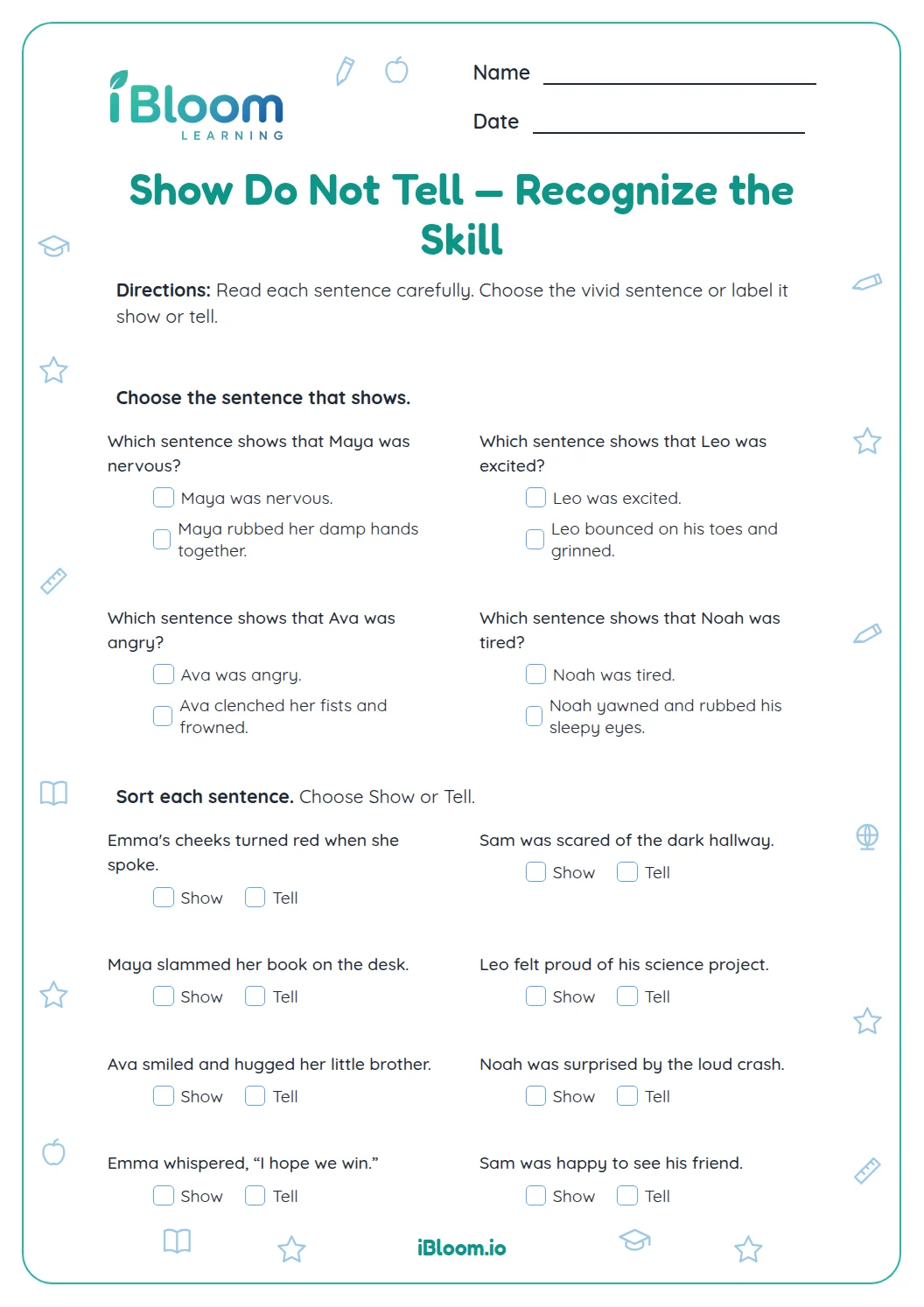
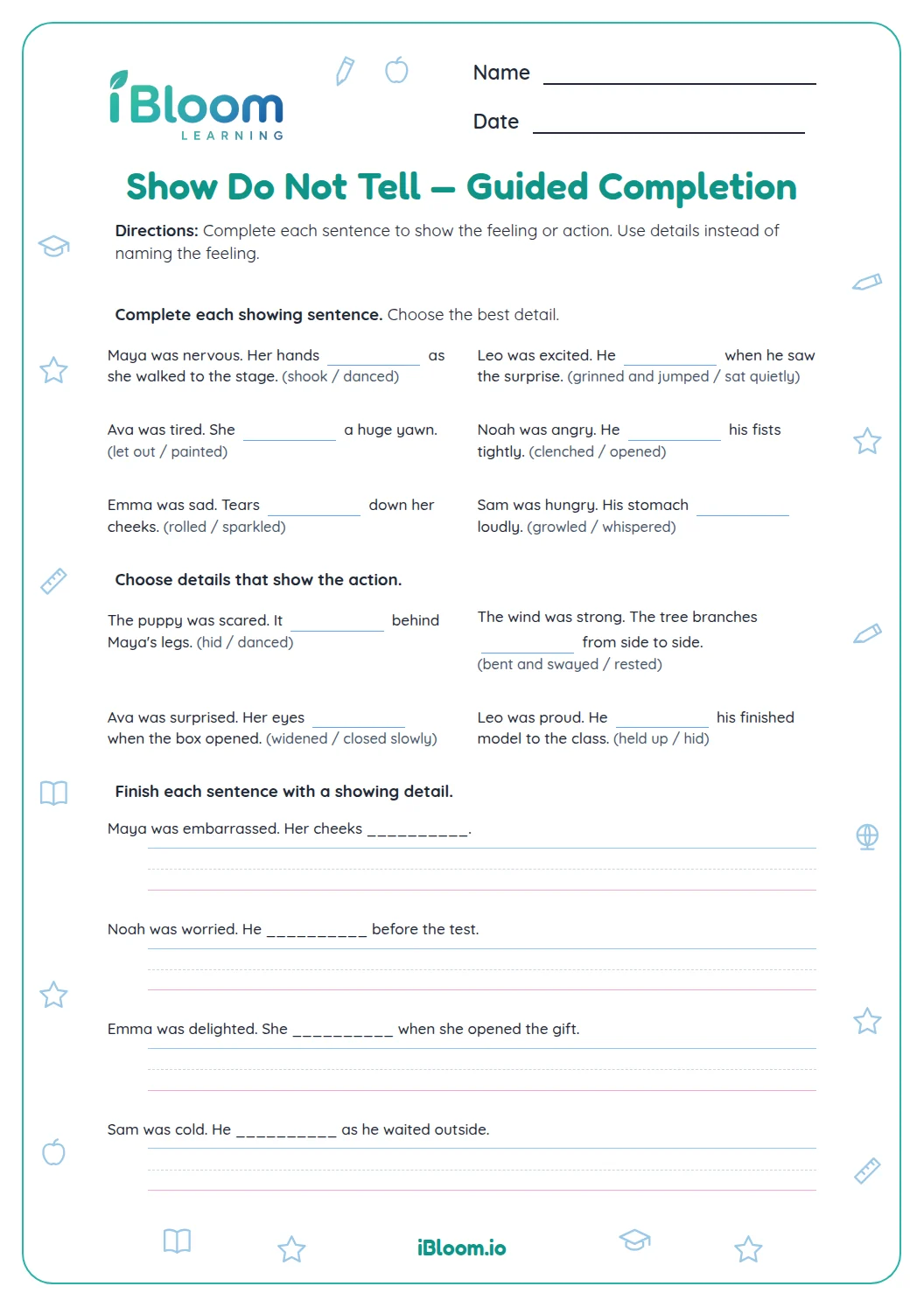
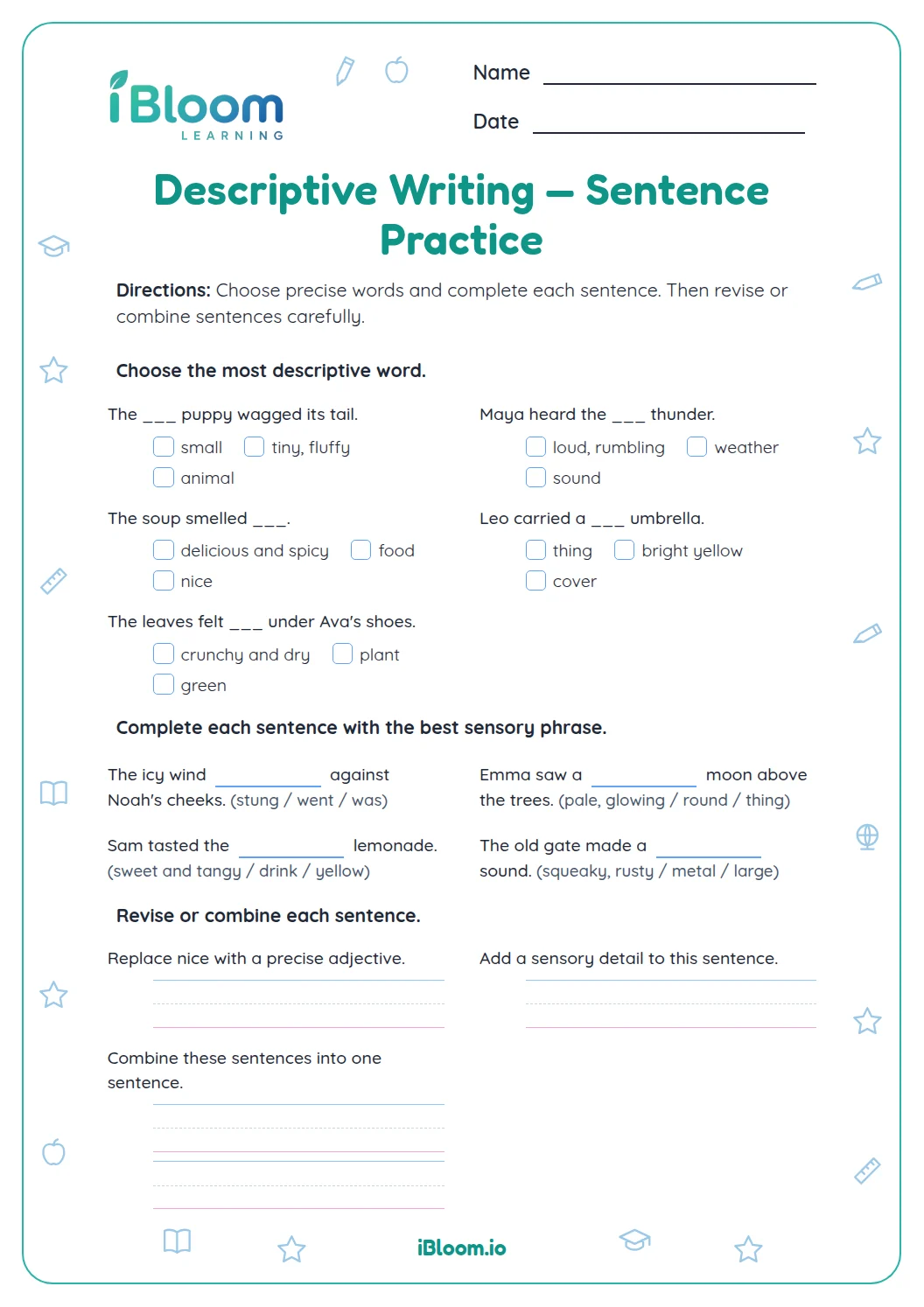
This free Grade 4 worksheet practices show, don’t tell through four clue choices and ten sentence completions. Students use actions, expressions, sounds and sensory details to help a reader infer a feeling or picture a moment. The answer key gives sample responses for the sentence items; students may use other details that fit the situation. The practice aligns with CCSS W.4.3 and W.4.3.d.
Aligned to W.4.3 and W.4.3.d
How does a detail show a feeling?
A telling sentence names an emotion: “Ravi was nervous.” A showing sentence gives a clue, such as a shaky voice or tapping foot, so the reader can infer the feeling.
Part A asks students to choose a clue that fits the feeling. Part B asks them to complete sentences with concrete details. Part C asks them to revise a moment so the reader can infer what happens; the key offers sample responses.
How can a writer revise a moment?
Keep the event and add a concrete clue that fits it. For example, “A branch cracked nearby. Maya grabbed her flashlight” can become “Maya’s heart raced as she grabbed her flashlight.” The racing heart suggests fear without naming it.
How can students check a response?
Read the sentence and ask whether its action, expression or sensory detail helps a reader picture the moment. If it only repeats the emotion word, choose a more specific clue.
Use the worksheet
- 1Read each situation and clue choice in Part A.
- 2Choose a detail that lets a reader infer the feeling.
- 3Complete Parts B and C with a concrete action, sound, or expression.
- 4Read the completed sentence aloud to check that it fits the moment.
- 5Compare with the sample key; another fitting detail can work.
Common Core alignment
This page practices narrative description and concrete sensory details in the Common Core Grade 4 Writing standards.
Use effective technique and details to develop real or imagined experiences.
On this sheet: Parts B and C develop narrative moments with actions and sensory details.
Show the official wordingHide the official wording
Write narratives to develop real or imagined experiences or events using effective technique, descriptive details, and clear event sequences.
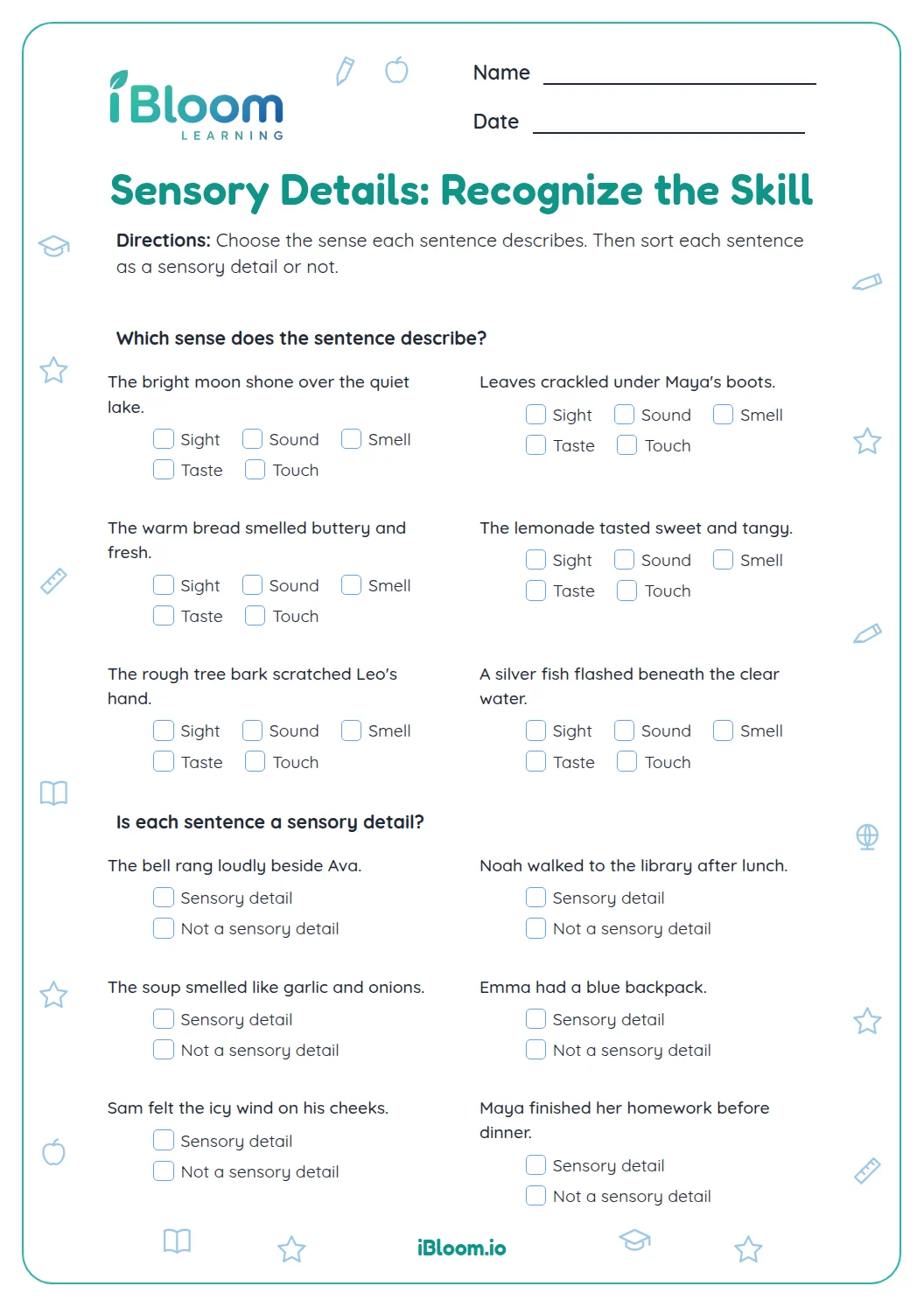
Use concrete words and sensory details.
On this sheet: Students add precise clues that let readers infer a character’s feelings.
Show the official wordingHide the official wording
Use concrete words and phrases and sensory details to convey experiences and events precisely.
What to practice next
Make more practice
Further reading
Questions parents and teachers ask
What does “show, don’t tell” mean?
“Show, don’t tell” means giving readers clues instead of naming an emotion. On this page, a racing heart can suggest fear when a branch cracks nearby. The clue lets a reader infer how the character feels. For example, ask which concrete action or sensation helps readers picture that moment.
Can a written answer differ from the key?
Yes. The key gives sample responses for Parts B and C. A different action, expression or sensory clue works when it fits the situation and helps a reader picture the moment. Students can explain why their detail fits. A student can point to the event that supports the chosen detail.
What makes a detail concrete?
A concrete detail names something a reader can imagine seeing, hearing or feeling. “Her hands trembled” gives a clearer clue than “she felt bad.” The first example gives readers an action they can picture. For example, ask which concrete action or sensation helps readers picture that moment.
How can an adult help without supplying a sentence?
Ask what the character might do, say or notice in that moment. Then invite the student to choose one clue that fits and read the sentence aloud. This supports the writer without supplying a finished sentence. For example, ask which concrete action or sensation helps readers picture that moment.
How long does the worksheet take?
Plan for about 20 minutes for both worksheet pages. Students choose four details, then write ten sentence responses and check them against the sample key. Give extra time if the student wants to revise a response. For example, ask which concrete action or sensation helps readers picture that moment.