



About this worksheet
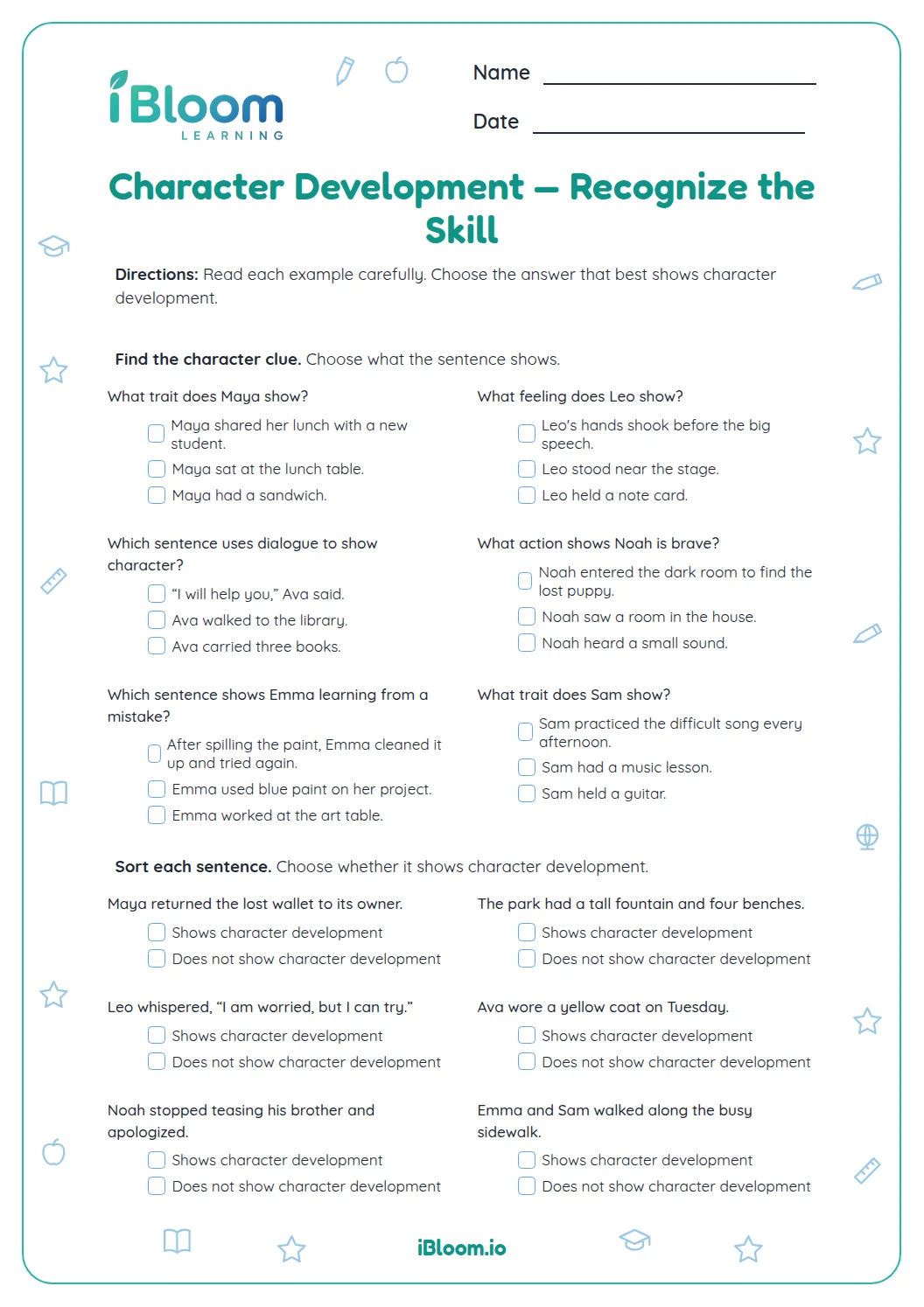
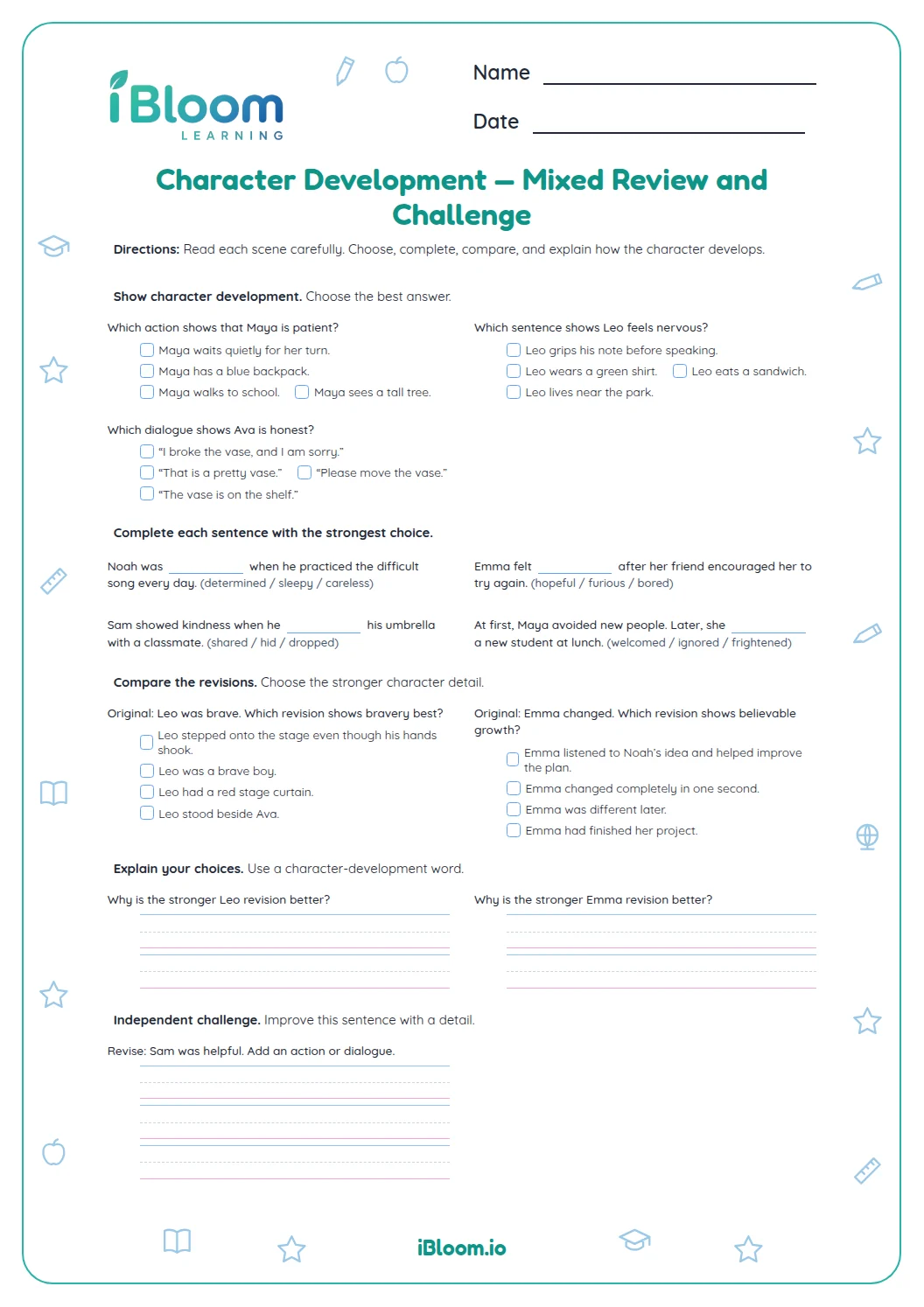
This Grade 4 character-development worksheet asks students to infer traits and feelings from actions, identify actions that reveal a trait, and complete ideas about how a character changes. It moves from six trait clues to four action clues, then to character change and two independent completions. The answer key includes the selected answers and sample endings for the open responses.
What do students do on the worksheet?
Part A uses six short situations to identify a trait or feeling. Part B connects a trait to an action or spoken clue. Part C tracks a change, and Part D finishes two character ideas.
- 1Maya shares her lunch with a new student. Which trait fits Maya?
- 2Kind; sharing lunch shows thoughtfulness toward someone else.
How can students use a clue?
Ask what the character does, says, or feels. Match the answer to that detail instead of guessing from the character’s name.
How should families check the written answers?
Compare each completion with its clue. The key gives one sample for each open response; another ending works if it follows the situation and makes sense.
How to use this worksheet
- 1Read the whole situation before choosing a trait.
- 2Underline the action or feeling that serves as a clue.
- 3For action questions, check that the action demonstrates the named trait.
- 4Notice the before-and-after clue in Part C.
- 5Finish each idea with an action or result that follows from the prompt.
- 6Use the key to discuss other reasonable endings.
Common mistakes and quick fixes
The mistake
Naming a feeling when asked for a trait.
The fix
Ask whether the word describes a temporary feeling or a character quality.
The mistake
Picking an action that does not show the named trait.
The fix
Connect the action directly to what the character is like.
The mistake
Completing an idea with an unrelated event.
The fix
Reread the situation and make the ending follow its clue.
What to practice next
Questions parents and teachers ask
What kinds of questions are on this worksheet?
It has 15 questions in four parts. Students identify traits and feelings, choose actions or words that reveal traits, consider a character change, and complete two character ideas. The separate key includes the correct choices and sample endings. Ask what detail in the situation points to that trait, action, or change.
What does “character development” mean here?
Students look at what a character does, says, or feels and use those details to describe the character. Later items ask them to notice a change or finish an idea that shows how the character responds. Ask what detail in the situation points to that trait, action, or change.
Are there multiple acceptable written answers?
Yes. The last two questions are open completions, so the key gives a sample rather than a single required phrase. Accept another answer when it follows the clue, completes the thought, and fits the character situation. Ask what detail in the situation points to that trait, action, or change.
How can an adult support a student without giving the answer?
Ask the student to point to the action, words, or feeling in the prompt. Then ask how that clue supports the chosen trait or ending. This keeps the response grounded in the situation. Ask what detail in the situation points to that trait, action, or change.
How long should the practice take?
Plan for about 15 minutes. Students may need a little longer to explain why a clue fits a trait or to revise a written completion. The worksheet can also be split into the four parts across a lesson. Ask what detail in the situation points to that trait, action, or change.