






About this worksheet
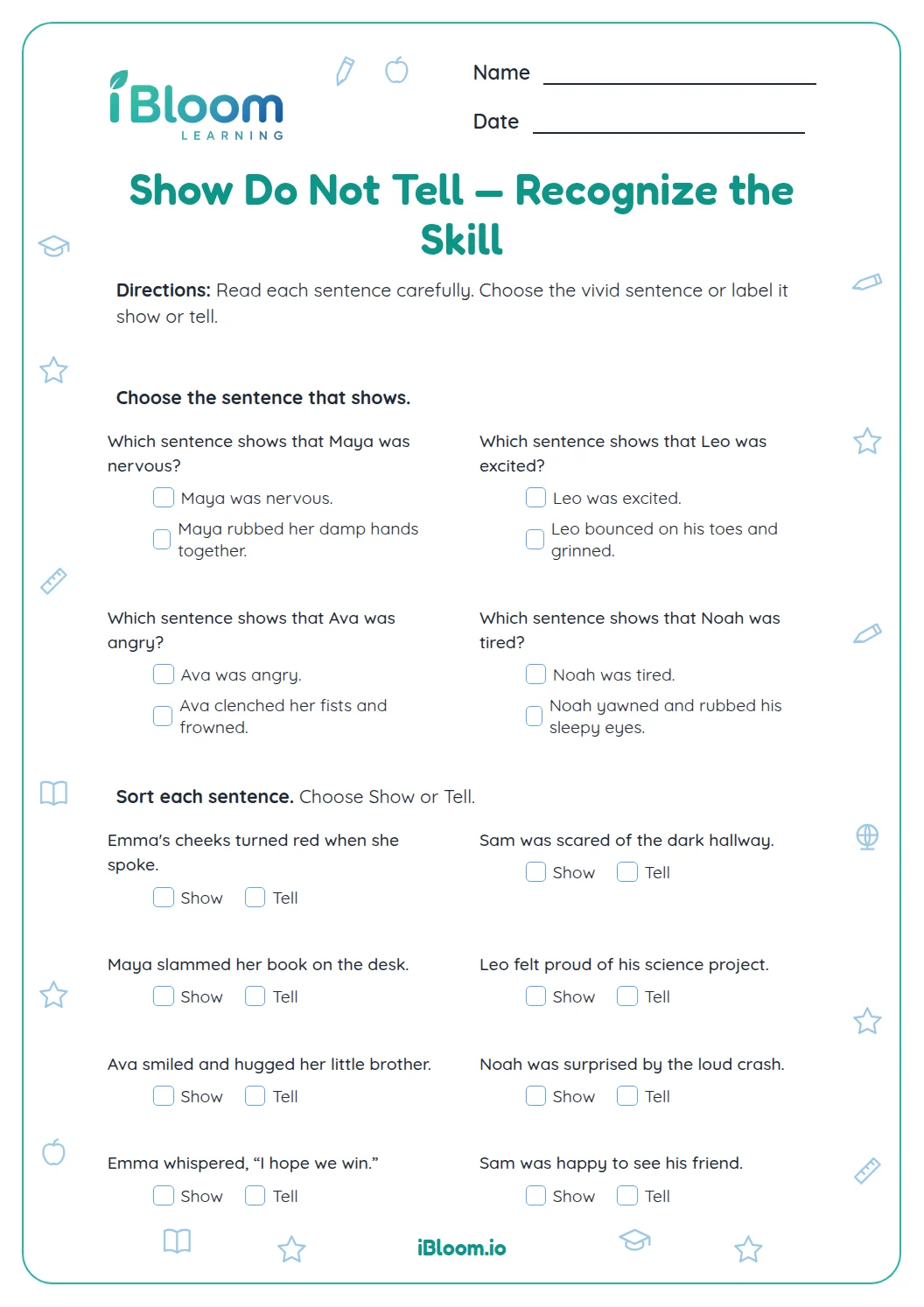
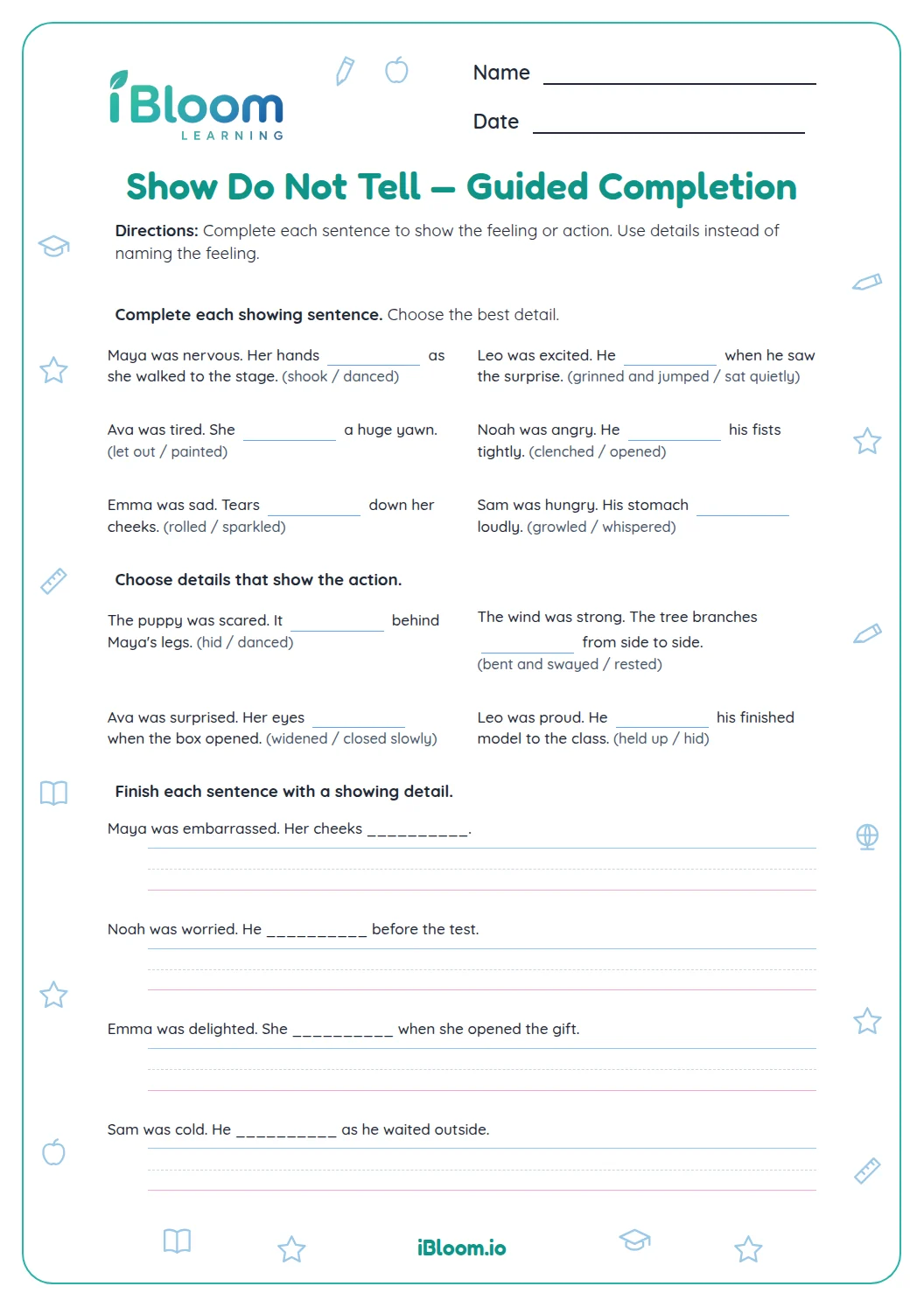
This free Grade 4 printable helps writers replace broad statements such as “Maya was nervous” with actions and sensory details that let a reader infer the feeling. Part A asks students to recognize showing sentences. Part B gives short revision prompts; Part C compares precise details; Part D asks students to edit and improve. The work practices CCSS W.4.3.d and W.4.5. A separate answer key includes sample revisions because students may write many correct versions.
Aligned to W.4.3.d and W.4.5
How can a detail show a feeling?
A telling sentence names an emotion; a showing detail gives a reader something to notice. “Maya twisted her sleeve and swallowed” gives physical actions from which a reader can infer nervousness. Part A practices that distinction without requiring one particular feeling word.
- 1Question 1: “Maya twisted her sleeve and swallowed.”
- 2Those actions support the inference that Maya is nervous.
What makes a revision vivid?
Use an action, sound, texture, taste, or other concrete clue that fits the scene. In Part B, there are many possible answers, so the key provides examples rather than a single required sentence. Keep the detail focused on the original idea.
How can a writer improve a sentence?
First preserve the meaning, then add a specific clue. Part D also asks students to separate two complete thoughts with punctuation. Read the revised sentence aloud to check that the event and detail are clear.
- Part A: infer a feeling or scene from details
- Part B: replace a telling sentence
- Part C: select precise actions and sensory clues
- Part D: revise punctuation and add a detail
How to use this worksheet
- 1Read Part A and ask what each action lets the reader infer.
- 2For Part B, brainstorm a visible action or sensory clue before writing.
- 3Keep each revision connected to the original emotion or scene.
- 4In Part C, reject repeated adjectives when an action would be clearer.
- 5Read Part D aloud and check both punctuation and meaning.
Common mistakes and quick fixes
The mistake
Using an emotion word again, such as “Nora was very excited.”
The fix
Replace the label with an observable action, sound, or body movement.
The mistake
Adding a detail that changes the event instead of clarifying it.
The fix
Keep the original meaning; add a clue that a reader could notice.
The mistake
Joining two complete thoughts with only a comma.
The fix
Use a period or another correct joining mark, then reread both sentences.
Common Core alignment
These standards describe the writing or math work practiced on this page.
Use concrete words and sensory details to make narrative moments precise.
On this sheet: Students select or write concrete actions and sensory details in place of vague telling.
Show the official wordingHide the official wording
Use concrete words and phrases and sensory details to convey experiences and events precisely.
Revise narrative sentences by adding details and editing them.
On this sheet: Parts B and D ask students to revise and edit their own sentences.
Show the official wordingHide the official wording
With guidance and support from peers and adults, develop and strengthen writing as needed by planning, revising, and editing. (Editing for conventions should demonstrate command of Language standards 1-3 up to and including grade 4 here.)
What to practice next
Make more practice
Questions parents and teachers ask
What does “show, don’t tell” mean?
It means giving a reader concrete actions or sensory clues instead of only naming an emotion or condition. “Jules erased twice, then checked each answer again” suggests that the test is challenging. The first part of this worksheet asks students to recognize that kind of clue.
How many questions are on the worksheet?
There are 14 questions in three parts. Students recognize showing details, revise a short paragraph, choose precise alternatives, and select edits for punctuation and sensory detail. The worksheet prints across two pages, with a separate answer key that includes sample responses for adults to review with students.
Can my child use a different revision from the answer key?
Yes. The key’s written responses are models, not the only possible answers. A revision works when its action or sensory detail clearly supports the original idea and reads as a complete, understandable sentence. Compare the child’s wording with the model for meaning, specificity, and punctuation.
Why does the worksheet ask students to edit punctuation?
Showing details are most useful when a sentence is also easy to read. The final part combines the target skill with a brief editing check: students separate two complete thoughts and add a relevant action or sound. The answer key offers one correct version for each prompt.
How long should this worksheet take?
Plan for about 20 minutes, with extra discussion time if a student wants to try several revisions. Recognition questions are quick; writing original details takes longer because there can be more than one strong answer. The four parts can also be completed in two short sessions.
What can we practice next?
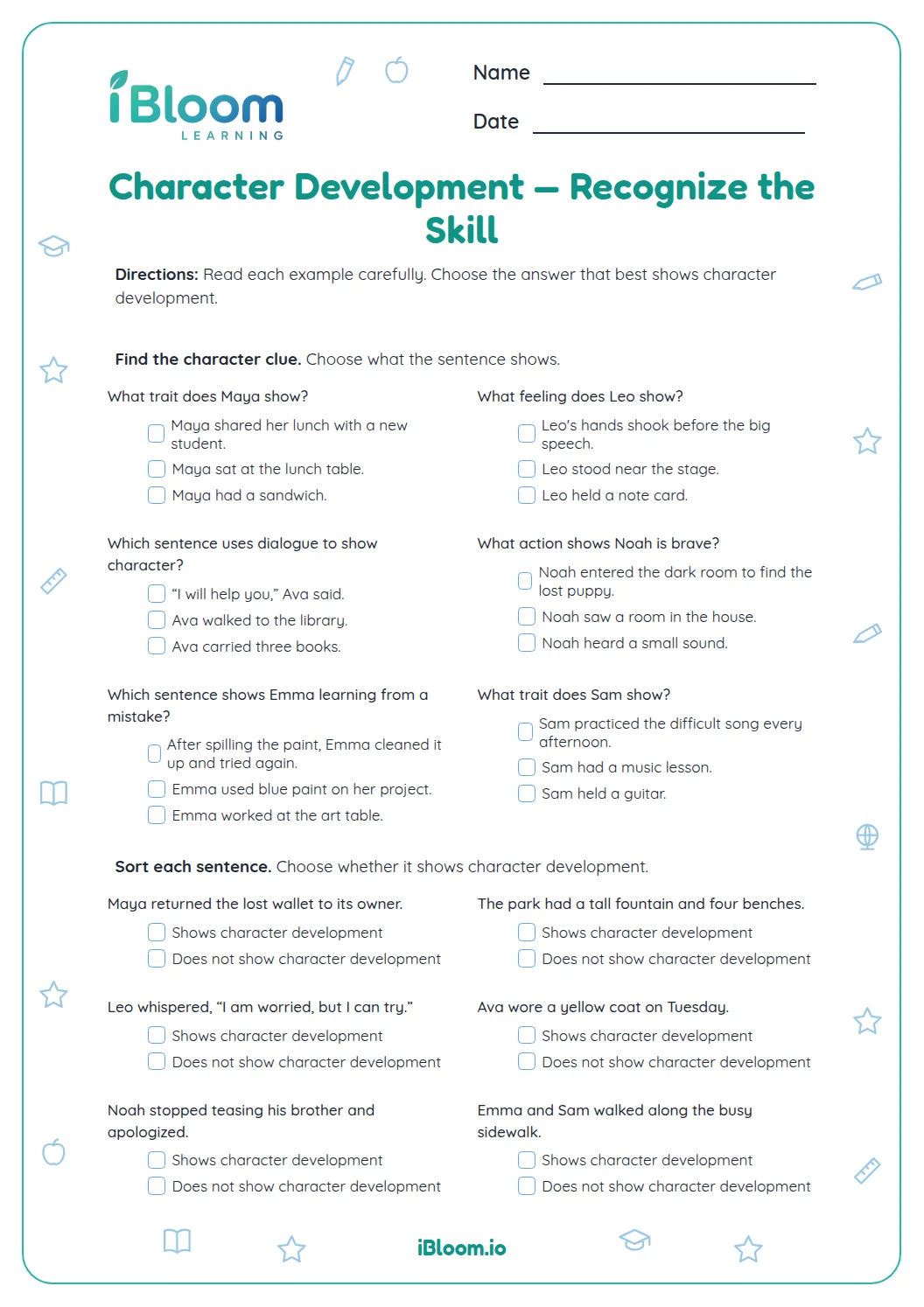
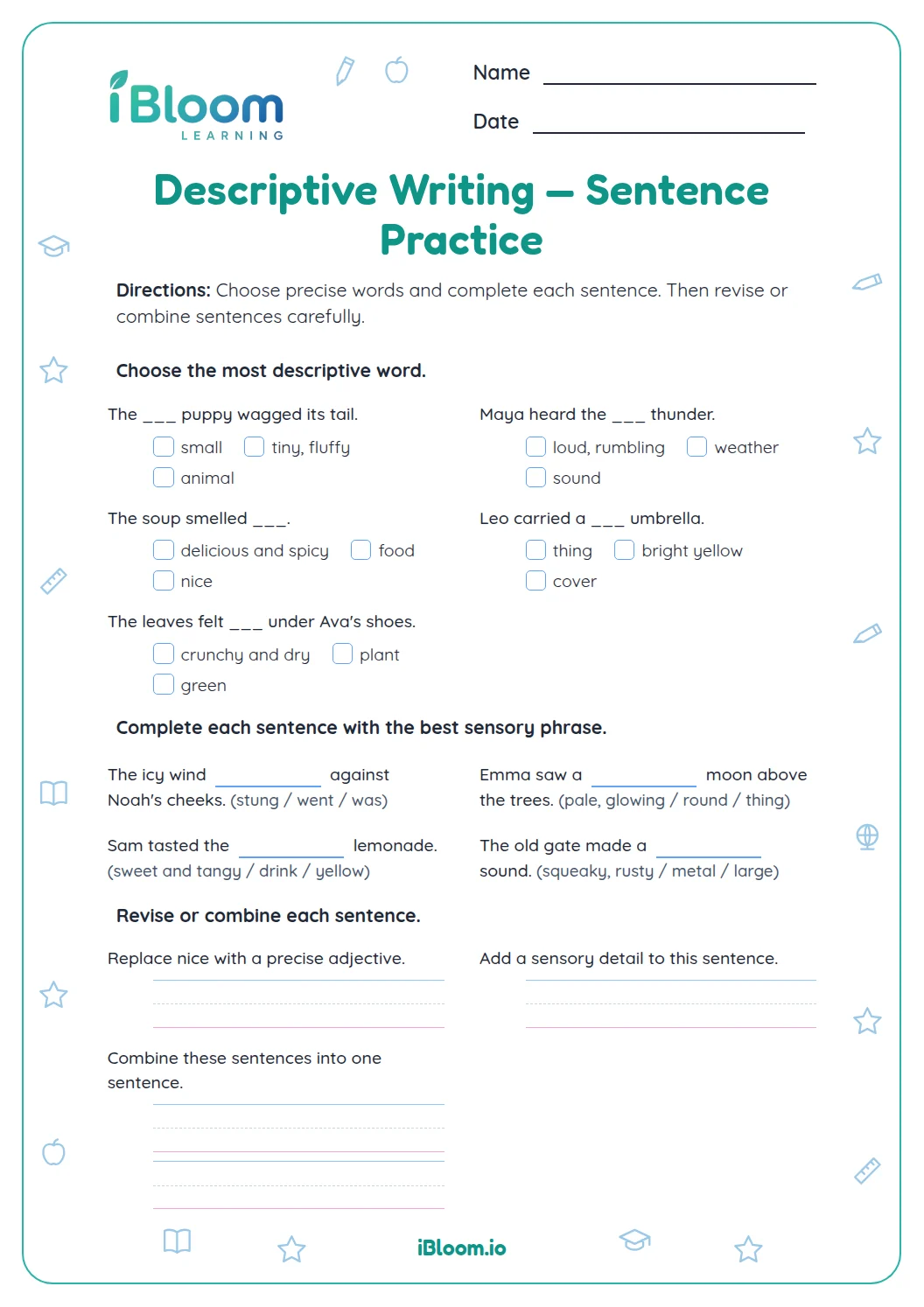
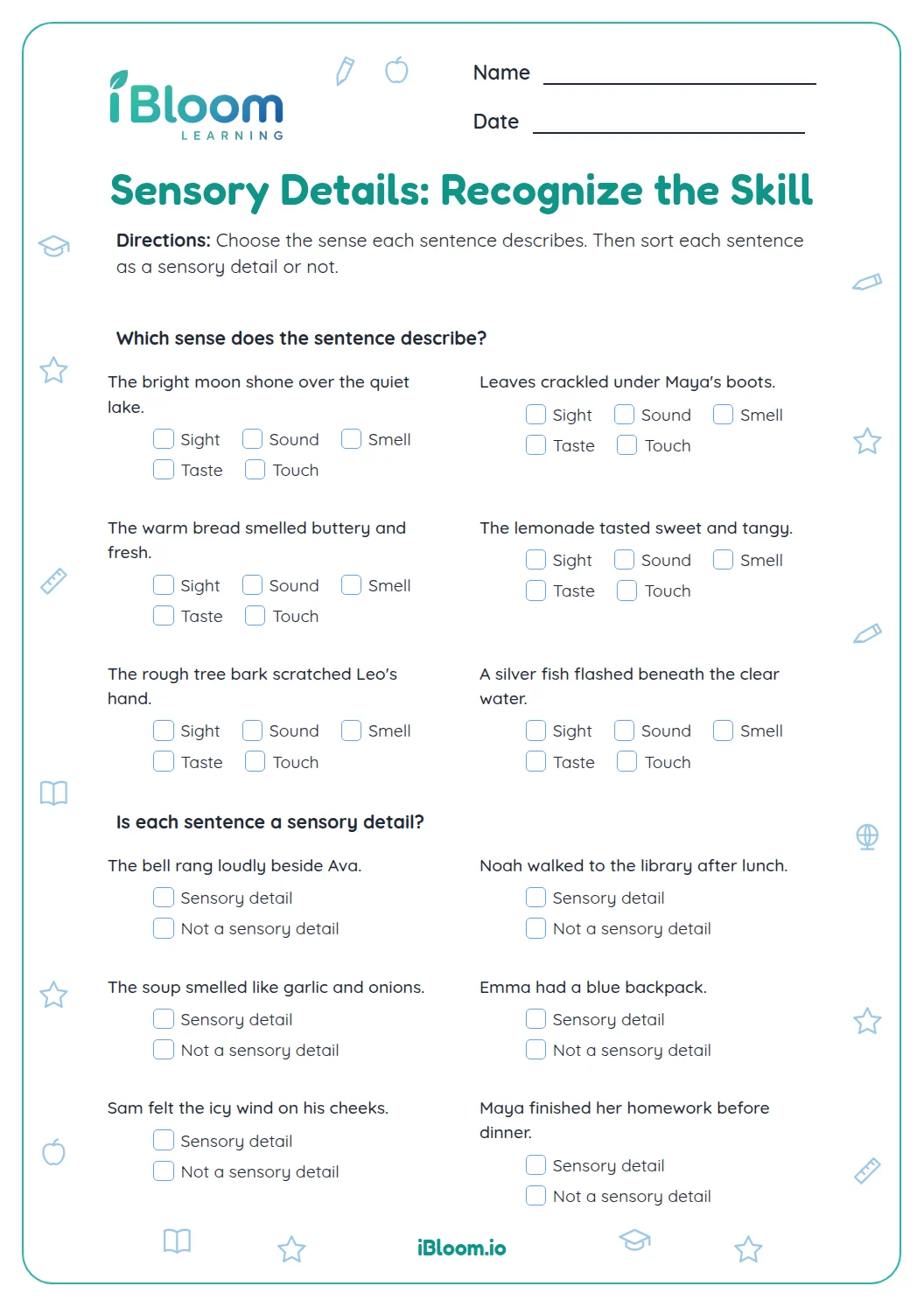
Character Development and Descriptive Writing extend the same work: one focuses on how actions reveal a character, and the other develops precise descriptions. Sensory Details offers another way to choose clues readers can see, hear, feel, taste, or smell.