







About this worksheet
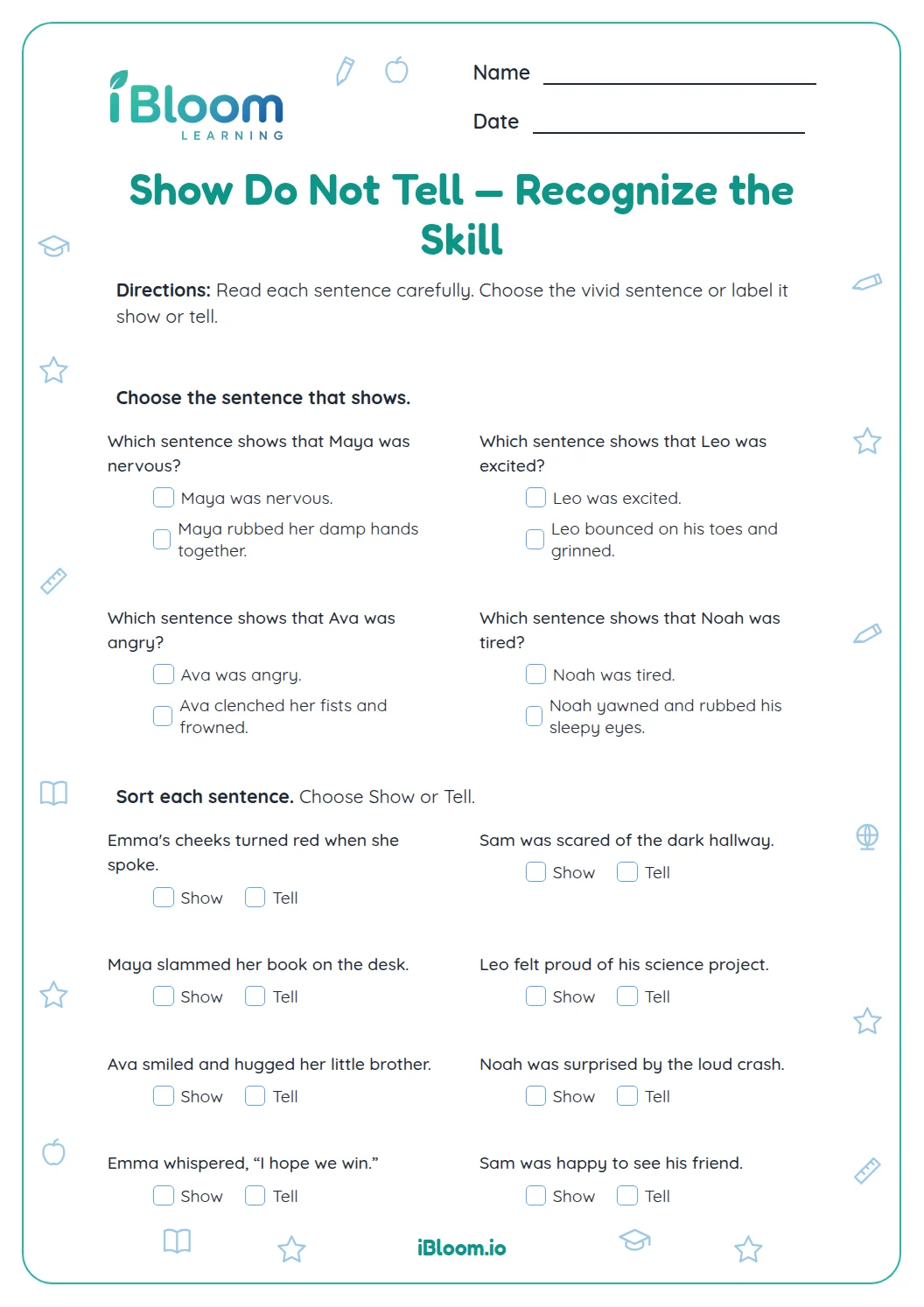
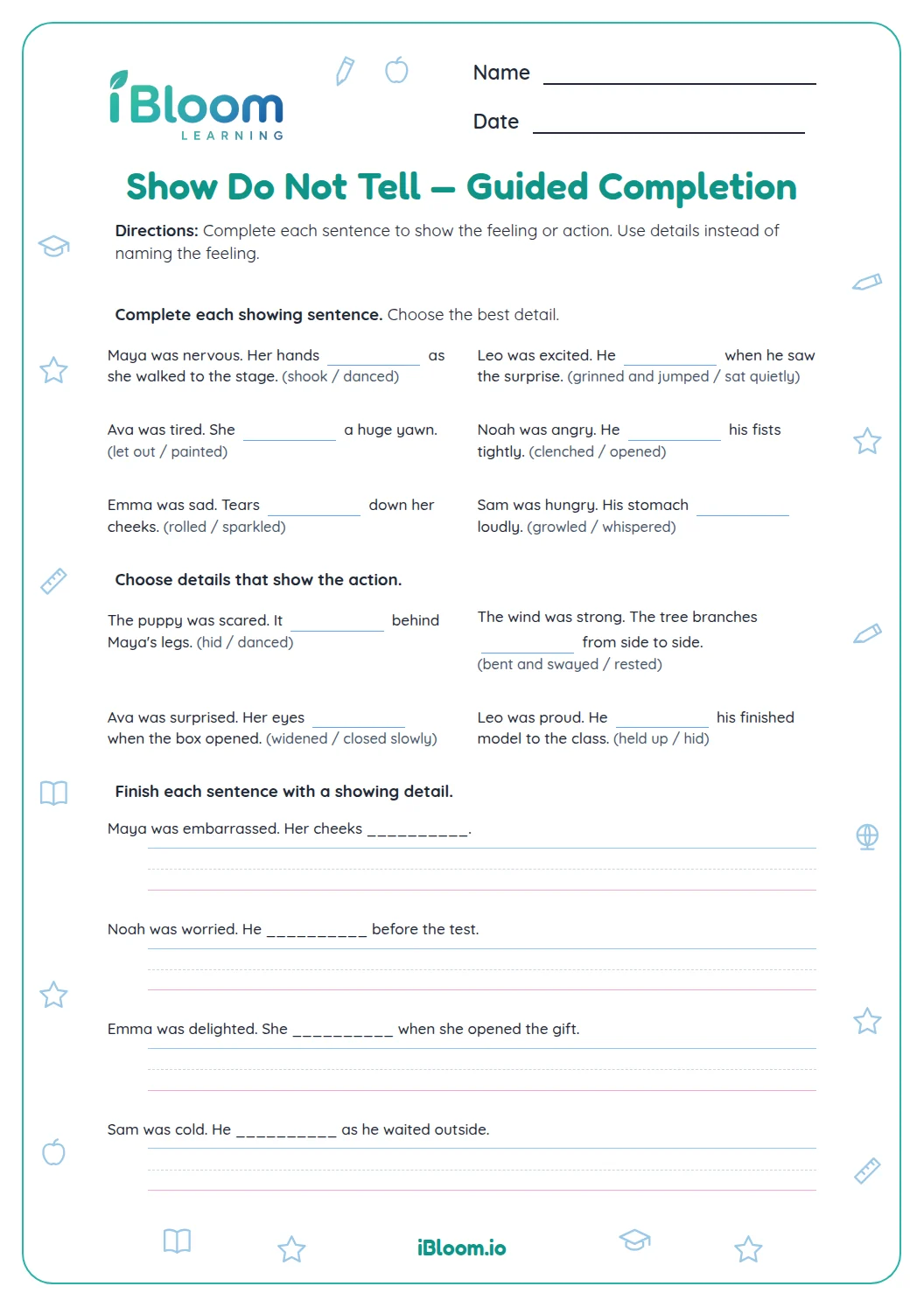
This free two-page worksheet helps Grade 4 writers show feelings through actions and details instead of naming them. In Part A, children pick the detail that shows a feeling, such as "Her hands shook" for a nervous Maya. In Part B, they circle the one action word that shows how a character felt, like trembled or stomped. In Part C, they choose the revision that shows instead of tells. In Part D, they rewrite "Emma was proud of her science project" in two sentences of their own. It practices Common Core W.4.3.b and W.4.3.d, and a separate answer key covers all 12 questions.
Aligned to W.4.3.b and W.4.3.d
What does "show, don't tell" mean?
A telling sentence names the feeling: "Ava was tired." A showing sentence gives the reader something to see, hear or feel so they work it out themselves: "Ava rubbed her eyes and yawned." Readers get more from a story when they notice the clues themselves.
Showing does not need long sentences. One strong action, such as clenched fists or a bitten lip, can carry the whole feeling.
How do you tell which detail shows the feeling?
Ask what a person with that feeling would do or look like. A nervous person might shake or fidget, an excited person bounces, a tired person yawns, and an angry person clenches a fist. The wrong choices on this sheet show other feelings, so children have to match the detail to the feeling, not just pick the most active one.
A good detail does not use the feeling word at all. If the sentence still says nervous, tired or happy, it is still telling.
- 1Maya was nervous.
- 2What would a nervous person do?
- 3She hummed a tune: that fits a calm or happy person, not a nervous one.
- 4Her hands shook: this fits nervousness.
- 5Answer: Her hands shook.
What is on this worksheet?
The sheet moves from recognizing to writing. Part A gives four telling sentences about nervous, excited, exhausted and furious characters. Part B gives four sentences in which one action word carries the feeling: trembled, beamed, gasped and stomped. Part C asks for the revision that shows, for a playful puppy, an embarrassed girl and a cold child. Part D asks for a two-sentence rewrite on lines.
- Part A: 4 questions, pick the detail that shows the feeling
- Part B: 4 sentences, circle the action that shows how someone felt
- Part C: 3 questions, pick the sentence that shows instead of tells
- Part D: 1 telling sentence to rewrite in two sentences
How do you rewrite a telling sentence?
Start by naming the feeling in your head, then ask what the character does, says or notices because of it. Write that instead and take the feeling word out. Try "Emma was proud of her science project." Emma might stand a little taller, point out every label, or grin at her teacher. Any one of these shows pride without naming it.
How to use this worksheet at home or in class
- 1Read the two examples aloud: "Maya was nervous" and "Her hands shook." Ask which one lets you picture something.
- 2Let your child finish Part A and say why each wrong choice shows a different feeling.
- 3In Part B, ask your child which word in each sentence a reader could act out, then circle it. Ask what feeling it shows.
- 4In Part C, have your child test each choice: does it name the feeling, show a different feeling, or show this one?
- 5For Part D, ask your child to say the feeling out loud, then write what the character does instead.
- 6Check with the answer key. The sample rewrite is only an example, so accept any clear action or detail that fits the feeling.
Common mistakes and quick fixes
The mistake
Choosing a detail that shows the wrong feeling, like "He grinned and waved" for a furious Noah, just because it is an action.
The fix
Ask what the character feels, then whether the detail matches. A grin and a wave go with a happy or friendly mood, not anger.
The mistake
Rewriting with a stronger feeling word, such as "Emma was thrilled" for proud.
The fix
A bigger word still tells. Cross out the feeling word and write what Emma does, says or looks like.
The mistake
Piling on actions that do not fit together, so a nervous character shakes, laughs and dances.
The fix
Choose one or two details that point to the same feeling. A few precise details work better than a long list.
Common Core alignment
Most US states use the Common Core Writing standards or a close state version, so this sheet fits Grade 4 narrative writing in most classrooms.
Show how characters respond to events through what they do, say and look like.
On this sheet: Parts A to D ask children to choose and write actions that show how a character responds to a situation.
Show the official wordingHide the official wording
Use dialogue and description to develop experiences and events or show the responses of characters to situations.
Choose precise, concrete words and details instead of general ones.
On this sheet: Parts C and D replace a general feeling word with a precise, concrete detail such as chattering teeth.
Show the official wordingHide the official wording
Use concrete words and phrases and sensory details to convey experiences and events precisely.
What to practice next
Make more practice
Further reading
Questions parents and teachers ask
What is show, don't tell for fourth graders?
It is a writing technique where you describe what a character does, says or looks like so the reader can tell the feeling without being told. "Noah clenched his fists" shows anger without using the word. Fourth graders use it to make narrative writing clearer and more interesting to read.
What are the answers to Part A?
The four answers are "Her hands shook," "He bounced on his toes," "She rubbed her eyes" and "He clenched his fists," matching nervous, excited, exhausted and furious. Each wrong choice shows a different feeling, such as a yawn for tiredness or a grin for happiness, so children must match the detail to the feeling.
Why does Part B ask children to circle only one word?
One word in each sentence does the showing. In "Noah stomped up the stairs," stomped tells the reader Noah is angry without the word angry. Finding that single action trains children to notice strong verbs in what they read, which is the first step to choosing them in their own stories.
How is Part D marked, since answers will differ?
The answer key shows one sample, but many answers are correct. Look for an action, a spoken line or a physical detail that matches the feeling, and no feeling word. "Emma stood on tiptoe and pointed out every label" shows pride; "Emma was very proud" does not.
Should children never use feeling words?
No. Feeling words are useful, and good writers mix telling and showing. Showing works best at important moments, when you want the reader to feel what the character feels. A quick feeling word is fine when a detail is not needed, such as when moving from one scene to the next.
Is there an answer key, and how long does the sheet take?
Yes. The answer key is two separate pages with all 12 answers, including a sample rewrite for Part D. Most fourth graders finish in about 20 minutes. Part D takes the longest, because children have to picture what Emma does before writing it down.