




About this worksheet
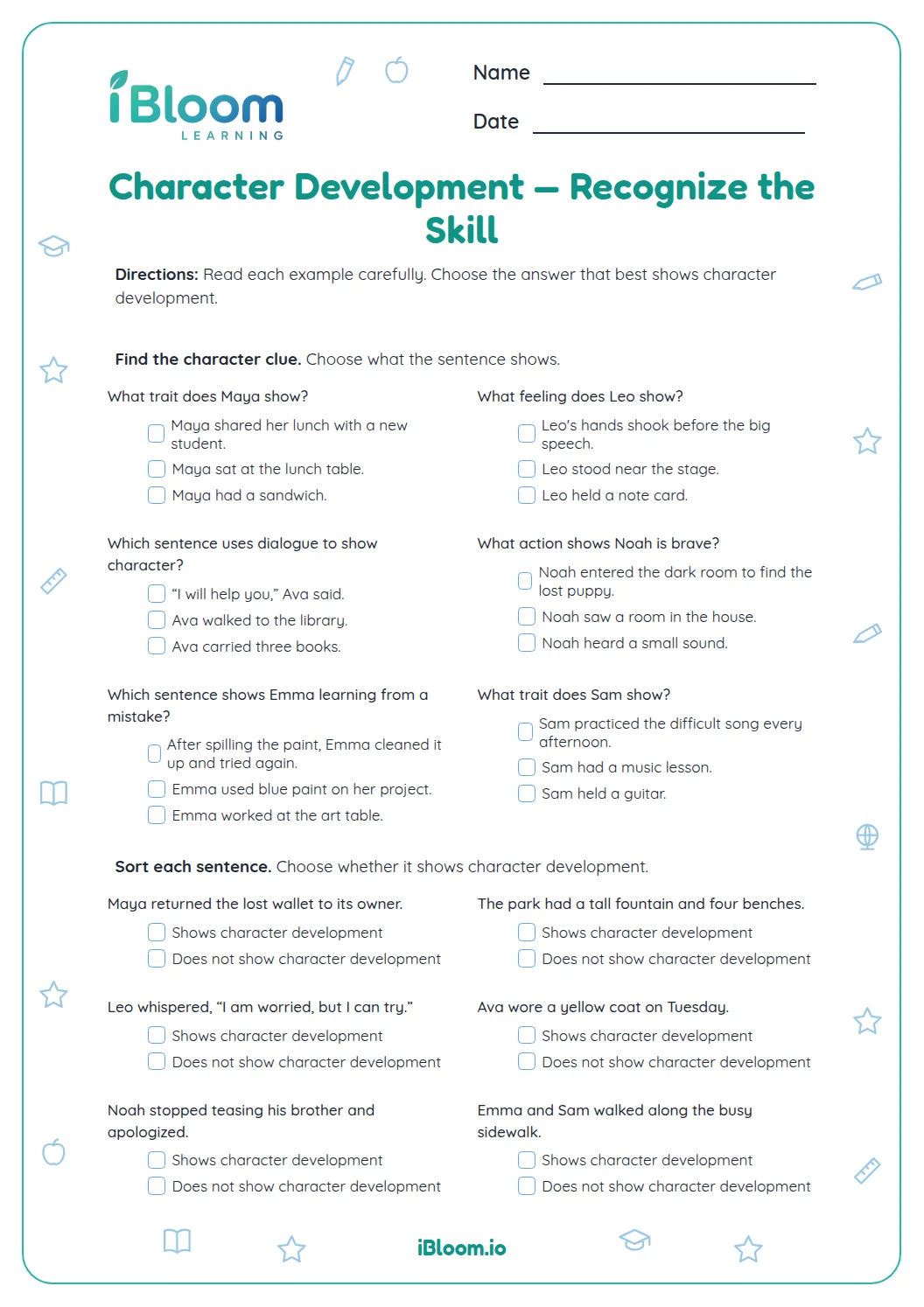
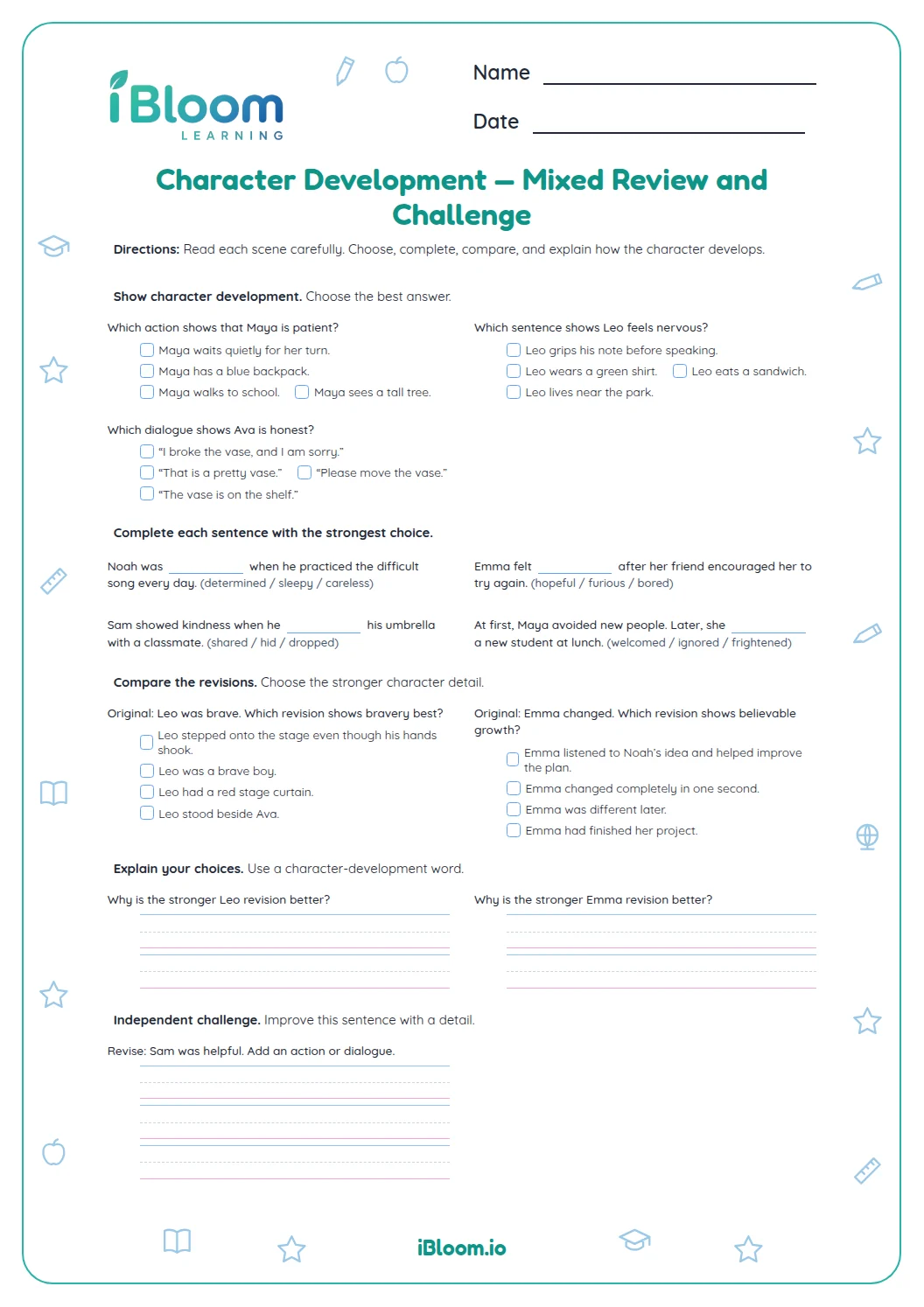
This free printable helps Grade 4 writers notice how a character’s actions, descriptions and words reveal traits or responses. Twelve short blanks ask students to interpret clues, then two writing prompts invite them to show feelings with an observable action or line of dialogue. The answer key includes the best choice for each inference and sample responses for open writing. Students can use the patterns to make character behavior clear in their own narratives.
Aligned to W.4.3.b
How do actions reveal a character trait?
A trait is a quality readers infer from what a character does repeatedly or deliberately. A single clear action can suggest a trait when the choice is meaningful. Returning a lost wallet points toward honesty; checking each display label twice suggests care.
- 1“Jay returns the lost wallet to its owner.”
- 2The action suggests honesty because Jay chooses to return something that is not his.
What can dialogue show about a character?
A character’s words can reveal a feeling, intention or response. The line “You can use my last blue pencil” suggests generosity because the speaker gives something up to help another person. Dialogue is strongest when the words fit the moment.
- Ask what the character says or does.
- Name the feeling or trait those clues support.
- Point to the exact words or action as evidence.
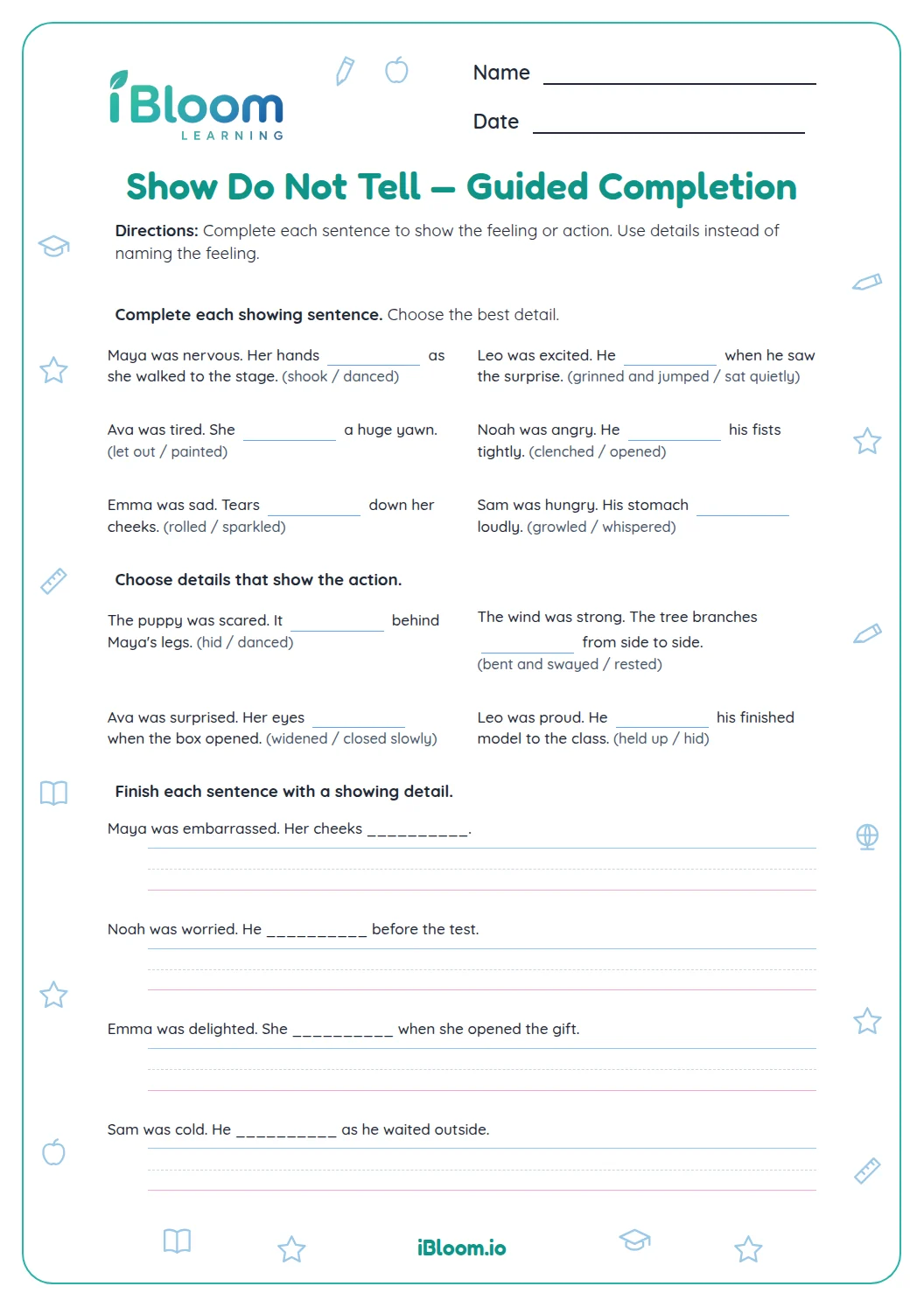
How can writers show a feeling without naming it?
Replace a label such as “Niko felt left out” with an action a reader can picture. Niko might watch the teams form, fold his hands, and step aside. For a more complex response, pair dialogue with an action that reinforces it.
How to use the worksheet
- 1Read the short clue before looking at the answer choices.
- 2Underline the action or spoken words that reveal something.
- 3Choose the trait or response that best fits that evidence.
- 4For writing prompts, show the feeling through an action, description or dialogue.
- 5Compare open responses with the sample and discuss other details that could also work.
Common mistakes and quick fixes
The mistake
Choosing a trait from a character’s name or role rather than the clue.
The fix
Point to the exact action or line of dialogue that supports the answer.
The mistake
Writing “she is nervous” when the prompt asks to show nervousness.
The fix
Add an observable detail, such as tapping a shoe or speaking softly.
The mistake
Using dialogue that names a trait without sounding like something a person would say.
The fix
Write a natural line that fits the situation and pair it with a relevant action.
Common Core alignment
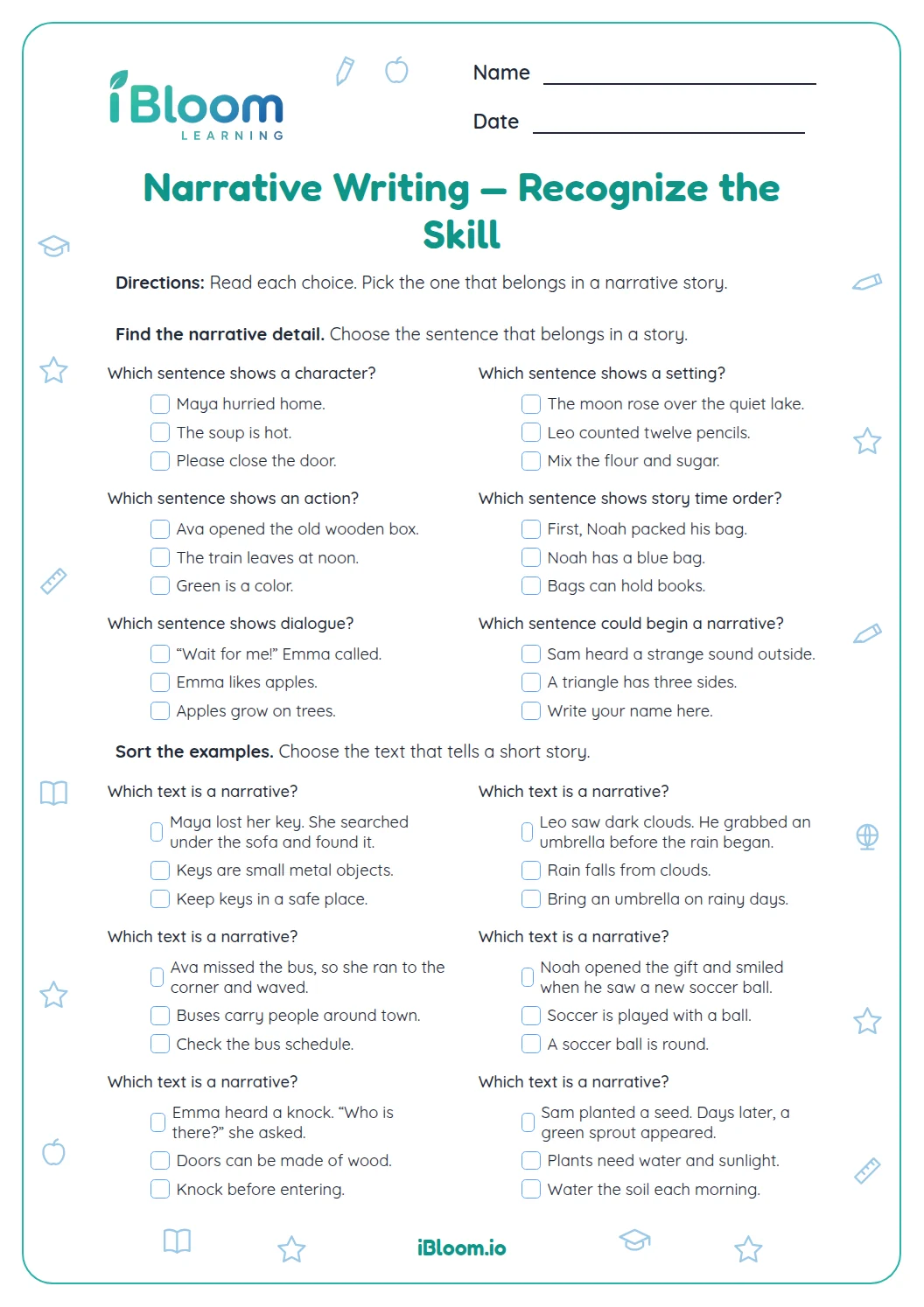
This Grade 4 narrative writing standard includes the use of dialogue and description to develop characters and events.
Use dialogue and description to develop events or reveal character responses.
On this sheet: Part A fills in a trait or response from a clue; Part B asks students to write details that reveal a character.
Show the official wordingHide the official wording
Use dialogue and description to develop experiences and events or show the responses of characters to situations.
What to practice next
Make more practice
Further reading
Questions parents and teachers ask
What does character development mean?
Character development is the way a story helps readers understand a character’s qualities, feelings and responses. Actions, descriptions and dialogue all provide clues. This worksheet practices reading those clues in short examples and then writing a sentence that lets a reader infer a feeling or trait.
How can a reader tell a trait from one action?
Look at what the character chooses to do and ask what quality that choice suggests. Returning a lost wallet is evidence of honesty because the character gives it back instead of keeping it. A good answer connects the trait to the action rather than guessing from the character’s name.
What is the difference between telling and showing a feeling?
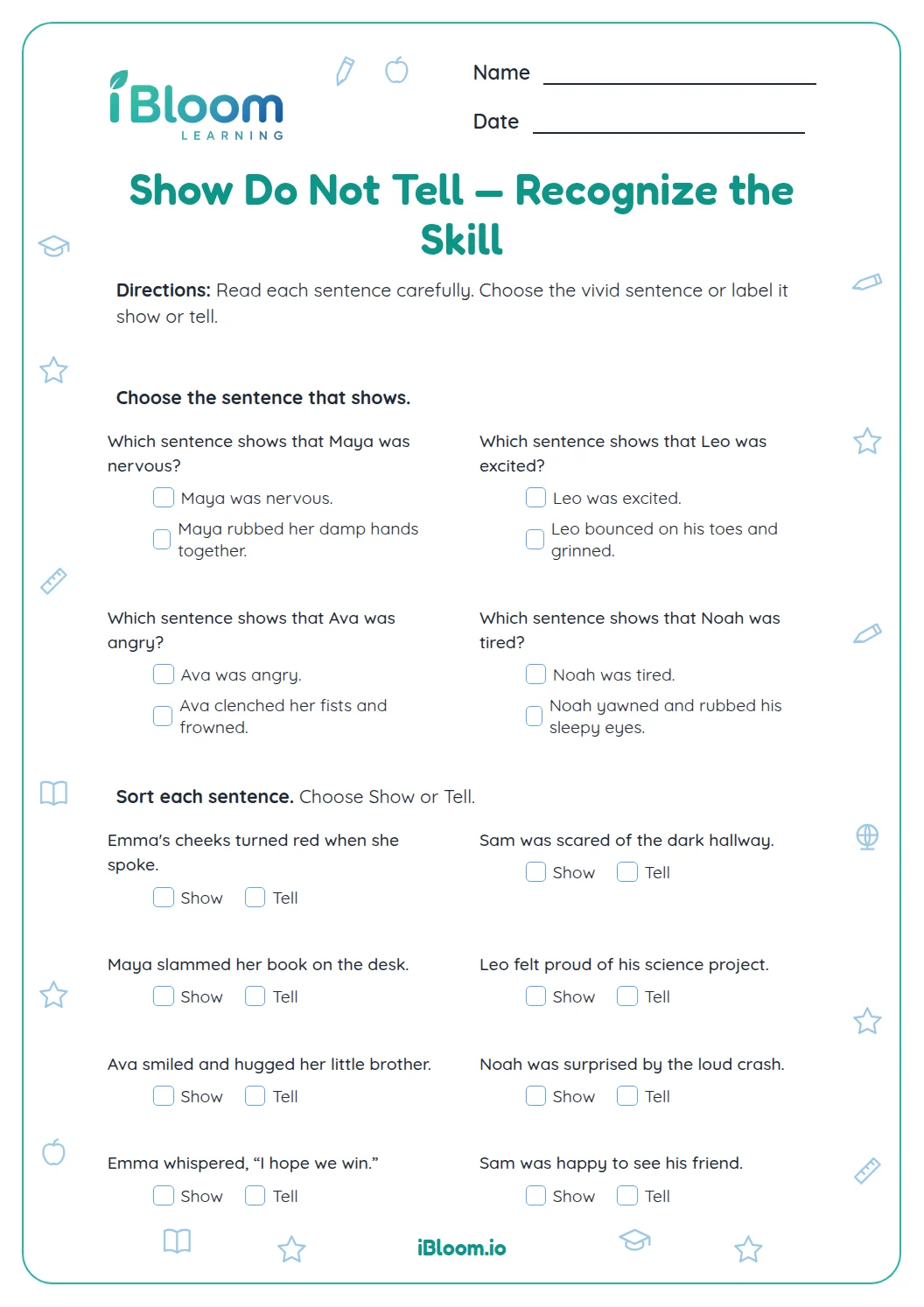
Telling names the feeling directly, as in “Niko felt left out.” Showing gives the reader observable evidence, such as Niko watching teams form and stepping away. The writing prompts ask students to practice showing a feeling with an action, a description or natural dialogue.
Are the open-ended answers checked word for word?
No. The answer key offers a sample, but many sentences can reveal the same feeling or trait. A response works when its action or dialogue clearly supports the requested idea. Ask the student to explain which words or action make the character’s response understandable.
Can dialogue develop a character?
Yes. A character’s words can reveal what the person values, fears, hopes or notices. In one item, offering a last blue pencil suggests generosity. In a writing response, a natural line of dialogue paired with an action can make the character’s emotion especially clear.