




About this worksheet
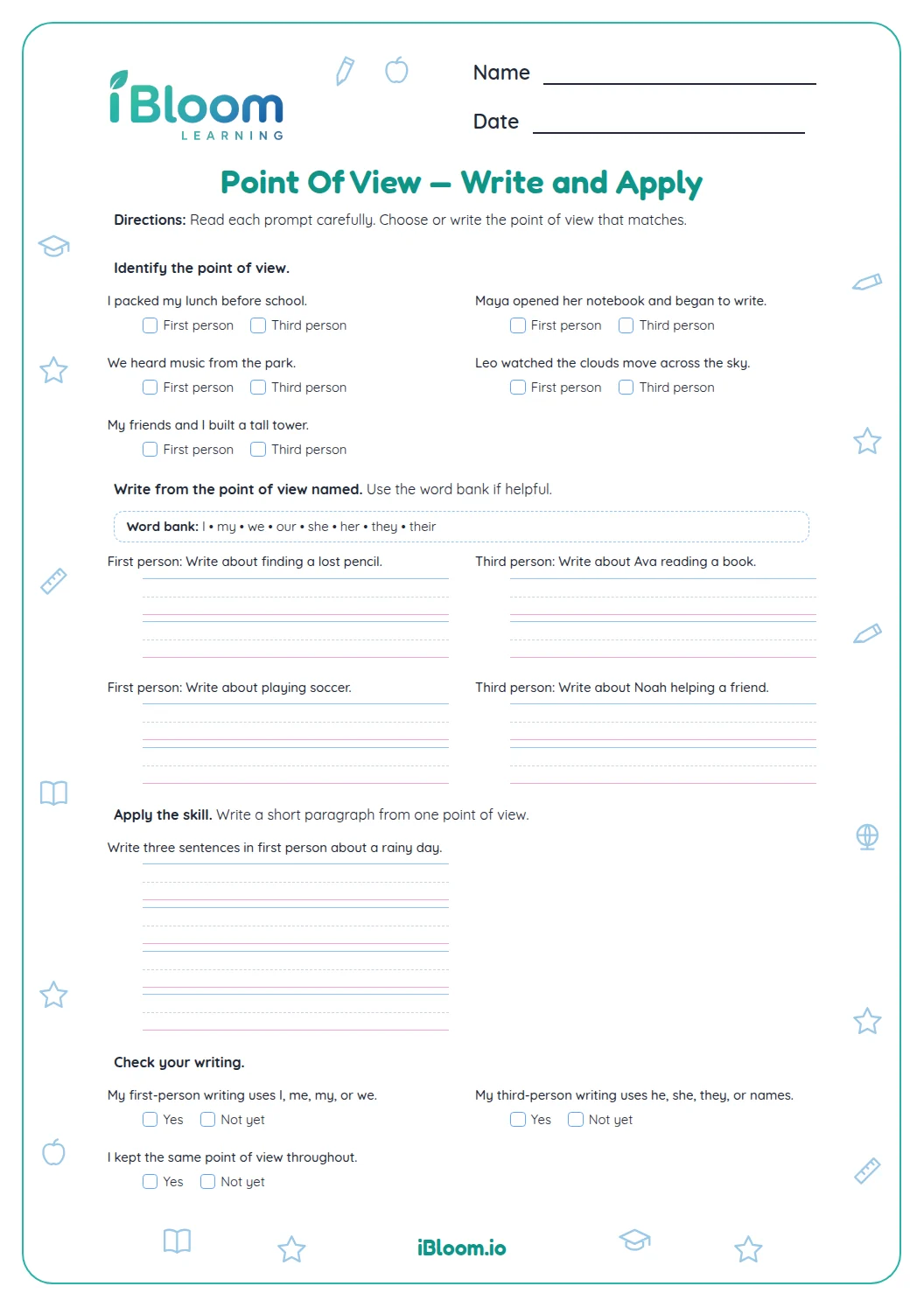
This free Grade 4 printable helps students recognize first-, second- and third-person point of view in sentences. The first two parts use pronouns such as I, we, you, he, she and they as clues. In Part C, students explain a first-person clue, rewrite a sentence from a new point of view and identify a second-person pronoun. A separate answer key gives sample writing responses. Reading pronouns in context helps students track who tells each sentence.
What clues identify the narrator?
Students classify sentences as first, second or third person. The pronouns help: I and we place the narrator in the action, you addresses the reader, and names or pronouns such as he and she tell about someone else.
How does “I packed my lunch” show first person?
The narrator uses I and my to tell about an experience. In second person, the sentence speaks to you; in third person, it names another person or uses he, she or they.
- 1I packed my lunch before school. → first person
- 2The narrator uses I to tell about themself.
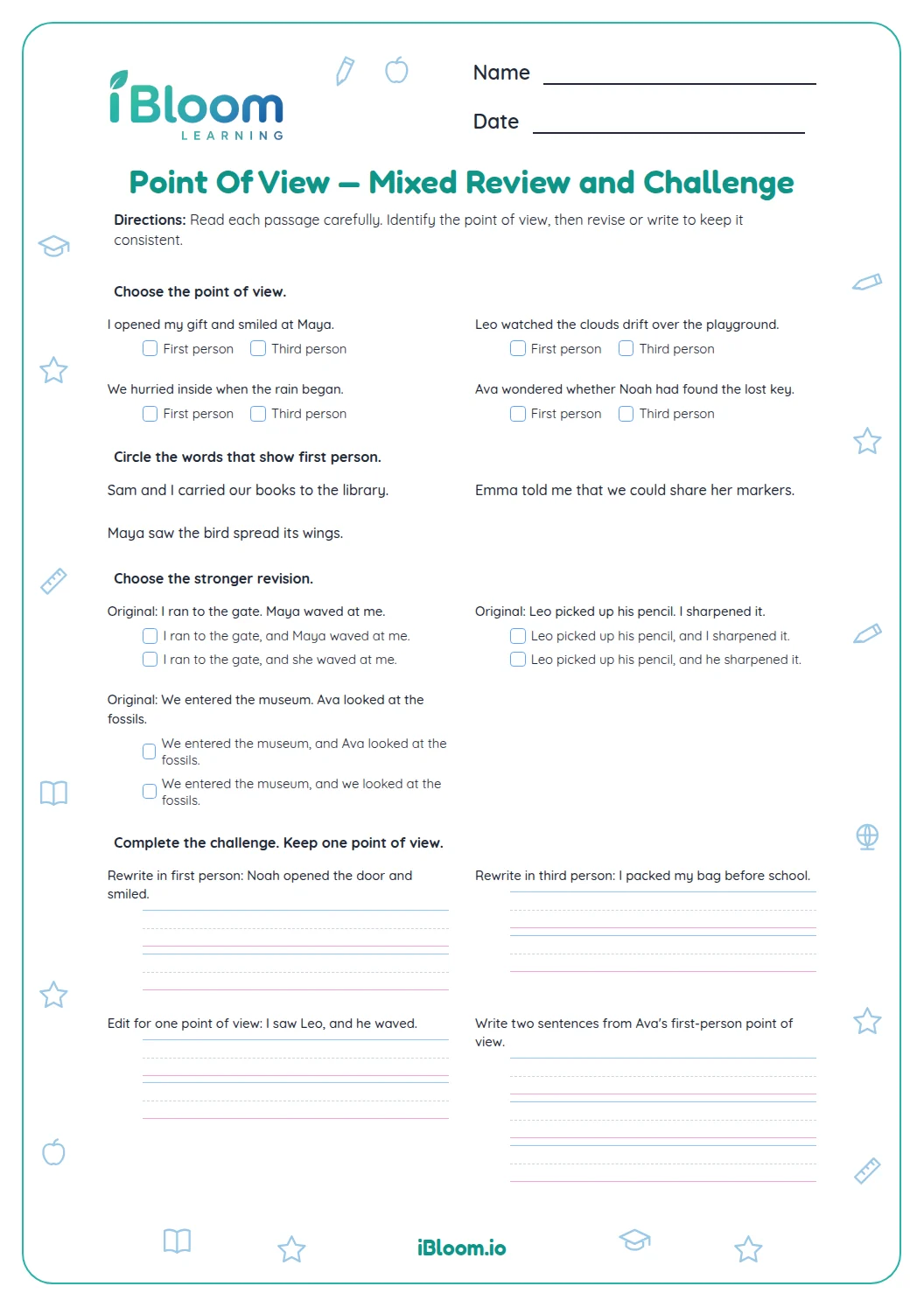
What changes when a sentence is rewritten?
In Part C, students keep the event but change the narrator’s point of view. For example, “Lena opened the window” becomes “I opened the window” in first person. The key gives a sample; other wording can work if the point of view is clear.
How to use this worksheet
- 1Read the full sentence once for meaning.
- 2Circle or notice the pronoun that tells who is speaking.
- 3Choose first, second or third person based on that clue.
- 4For a rewrite, keep the event and change the narrator’s pronouns.
- 5Check the short answer and compare written work with the sample key.
Common mistakes and quick fixes
The mistake
Calling every sentence with a name third person even when the narrator says I.
The fix
Use the narrator’s words and pronouns, not only the character’s name.
The mistake
Mixing up you and we.
The fix
You addresses someone; we includes the narrator and at least one other person.
The mistake
Changing the event while rewriting the point of view.
The fix
Keep the same action and adjust only the narrator and needed pronouns.
What to practice next
Make more practice
Questions parents and teachers ask
What points of view do students practice?
The sheet covers first, second and third person. Students identify each in complete sentences, use pronouns as clues, and apply the idea by rewriting a sentence from a different point of view. Each item gives a complete sentence, so the pronouns can be read in context.
How many items are included?
There are 15 questions across three parts: 12 identification questions and three written responses. A separate answer key lists the identification answers and sample wording for the writing prompts. The questions build from identifying clues to using point of view in writing.
What is a simple clue for first person?
Look for I, me, my, we or our when the narrator is part of the sentence. In “I packed my lunch,” both I and my show that the narrator is telling about themself. This gives students a direct sentence example of the narrator speaking.
Does the worksheet include second person?
Yes. Students identify sentences that address the reader with you, such as “You should bring your notebook.” This helps them distinguish second person from first-person we and third-person names or pronouns. The answer choices include all three points of view throughout the first two parts.
Can a rewritten sentence differ from the answer key?
Yes. The key offers a sample response. A student’s answer can use different words if it preserves the original event and clearly changes to the requested point of view. The same event should remain clear after the narrator changes. Read each sentence carefully and use its meaning as the clue.
What is point of view in a sentence?
Point of view shows who is speaking or telling about an event. First person uses I or we, second person addresses you, and third person tells about someone by name or with he, she or they. The worksheet practices noticing these clues in complete sentences.