





About this worksheet
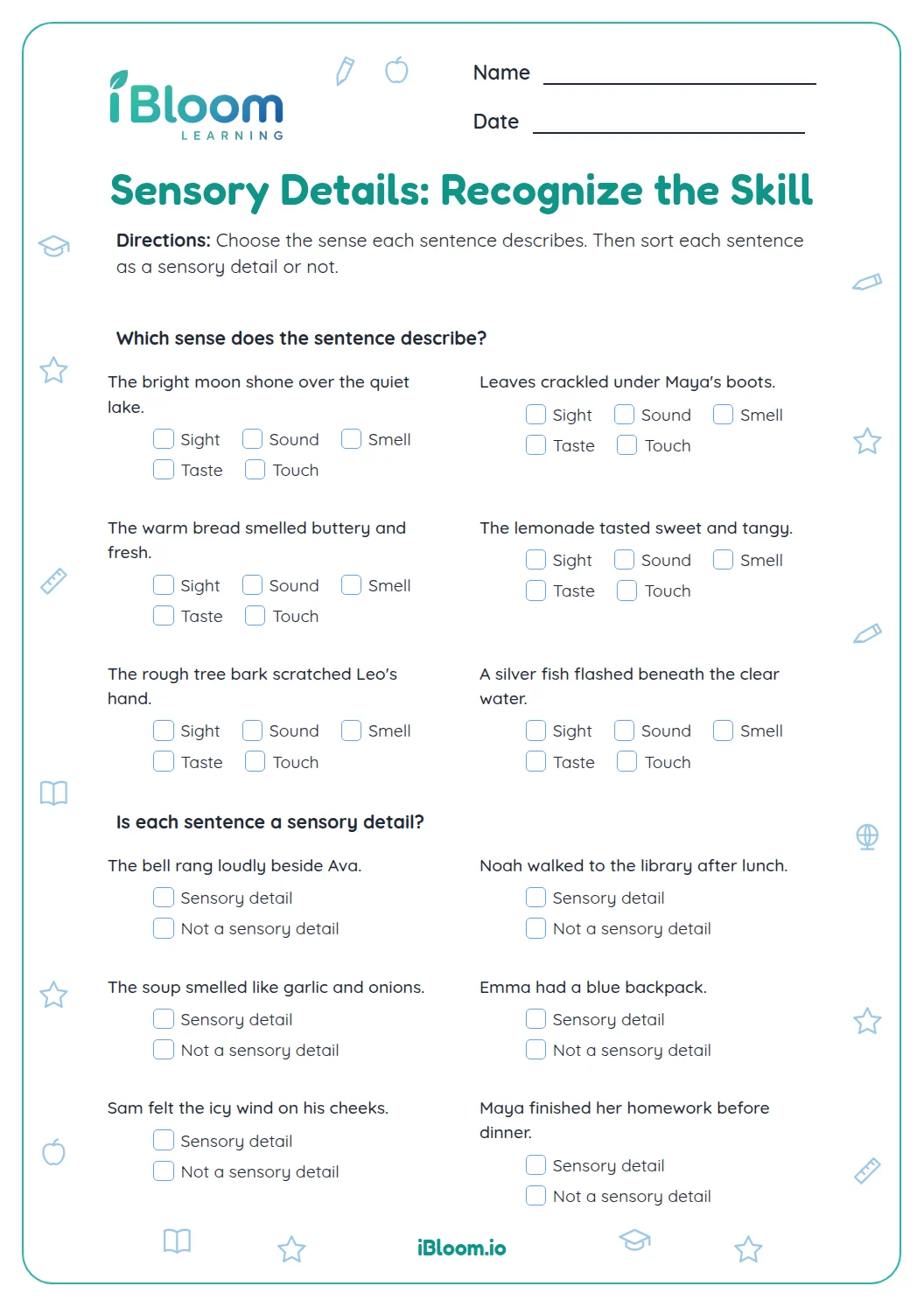
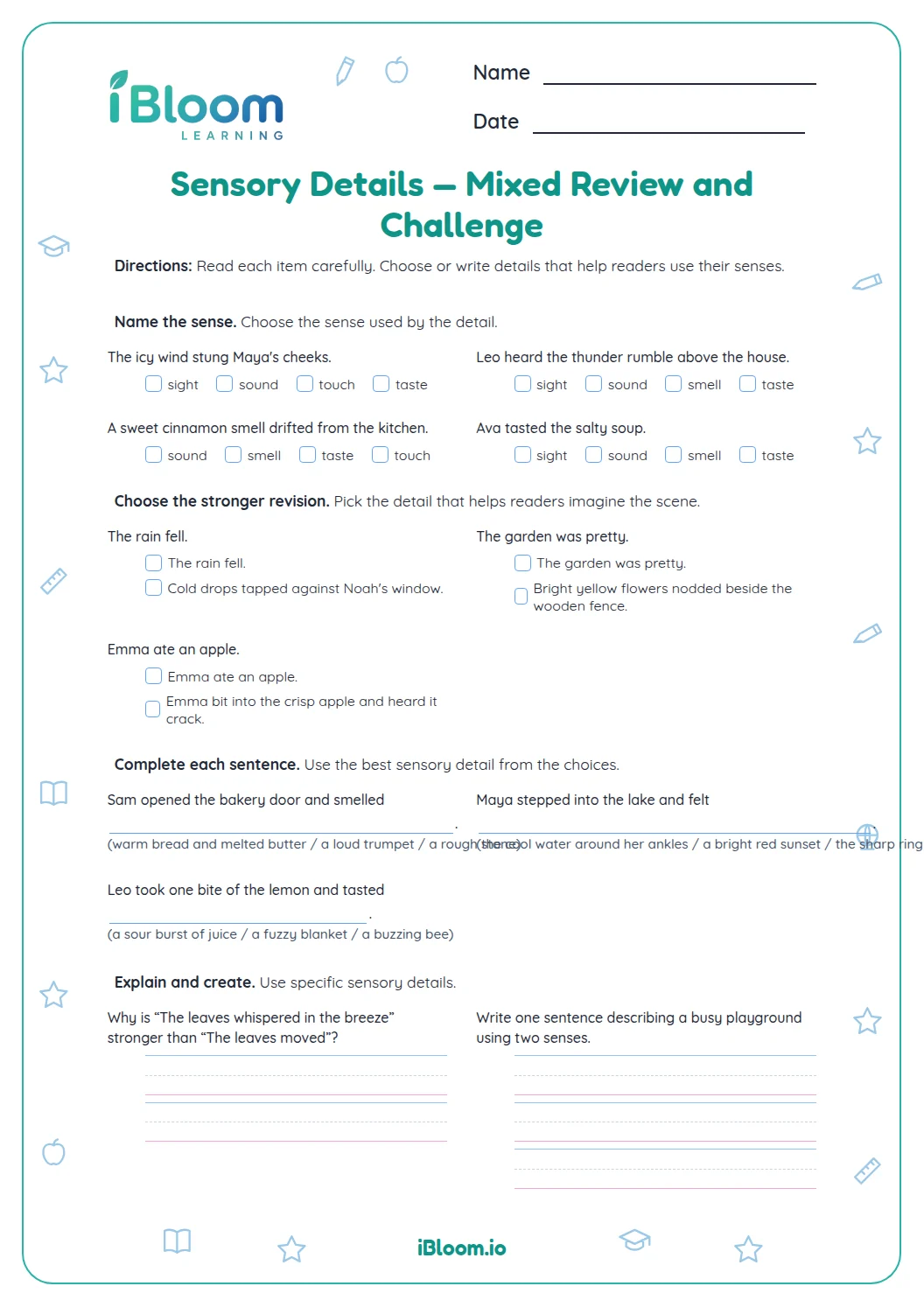
This Grade 4 writing worksheet moves from identifying sensory language to using details in a narrative. Students name senses in short clues, add precise sound, smell, and touch details, then write a rainy-walk sentence using at least three senses. The 14 questions and separate answer key support CCSS W.4.3.d: using concrete words and sensory details to make a narrated moment precise.
Aligned to W.4.3.d
How do you identify the sense in a detail?
Look for the word that gives a sensory clue. “Smelled of garlic” points to smell; “brushed her cheeks” points to touch. A sentence may mention more than one sense, but each identification item highlights one clear clue.
- 1“A cool breeze brushed Nia’s cheeks” describes touch.
What makes a sensory detail precise?
A precise detail names what a character senses rather than saying only that something was nice or strange. “Its hinges gave a soft squeak” lets a reader imagine a particular sound. Details should also fit the scene: a bakery may smell of warm bread or cinnamon.
How can several senses build a narrative moment?
For question 14, place the reader in one moment of a rainy walk. Add details that belong together, such as rain tapping a hood, a cool sleeve, wet pavement, or silver reflections. The details should help the reader imagine the same scene.
How to use this worksheet
- 1Read the sensory word or phrase before naming a sense.
- 2Complete the identification items and check each clue.
- 3Add one concrete detail to each short narrative moment.
- 4For question 14, keep the sentence focused on one rainy-walk moment.
- 5Reread for at least three senses and details that fit together.
- 6Use the sample answers as models; original details can differ.
Common mistakes and quick fixes
The mistake
Naming the object instead of the sense it appeals to.
The fix
Ask whether the clue tells what a character sees, hears, smells, tastes, or feels.
The mistake
Using a vague word such as “good” or “weird.”
The fix
Replace it with a concrete detail, such as “warm cinnamon smell” or “sharp, sour taste.”
The mistake
Adding details that do not belong in the same scene.
The fix
Keep the sentence in one rainy walk and choose details the character could notice there.
Common Core alignment
This page practices the specific reading, writing, or mathematics skills named below.
Use concrete words and sensory details to make a narrated moment precise.
On this sheet: Learners identify and write sensory details for narrative moments.
Show the official wordingHide the official wording
Use concrete words and phrases and sensory details to convey experiences and events precisely.
What to practice next
Make more practice
Further reading
Questions parents and teachers ask
Which five senses does the worksheet practice?
The worksheet practices sight, hearing, smell, taste, and touch. The first ten questions ask students to identify the sense described by a clue, such as garlic in soup or a cool breeze on someone’s cheeks. The writing items apply those senses in narrative moments.
What is a sensory detail in narrative writing?
A sensory detail names what a character sees, hears, smells, tastes, or feels. “The hinges gave a soft squeak” is more precise than “the door made a sound.” Students identify sensory clues first, then use concrete details in their own writing.
What should the sentence in question 14 include?
Question 14 asks for one sentence about a rainy walk using at least three senses. A student might describe rain tapping a hood, cool drops on a sleeve, and the smell of wet pavement. The details should fit the same moment and scene.
Does every written answer need to match the key exactly?
No. Questions 11 through 14 invite original details, so the key gives sample responses. Accept another answer when it clearly uses the requested sense, fits the scene, and makes the moment more precise. Question 14 also asks for details from three senses.
How many questions and pages are included?
There are 14 questions on two worksheet pages, followed by a two-page answer key. The first ten identify sensory clues, three ask for a precise detail, and the final prompt applies the skill in a short narrative sentence.