



About this worksheet
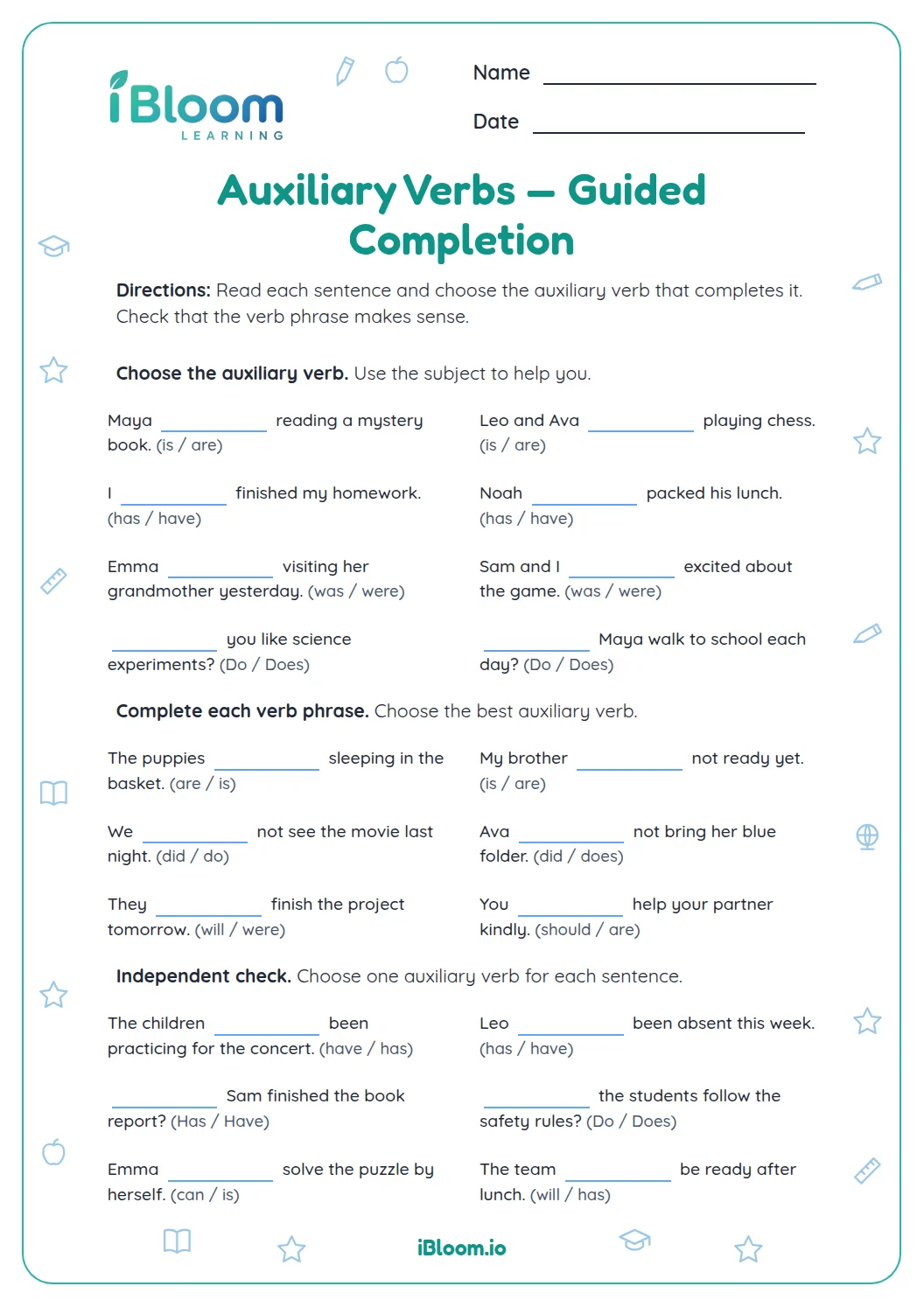
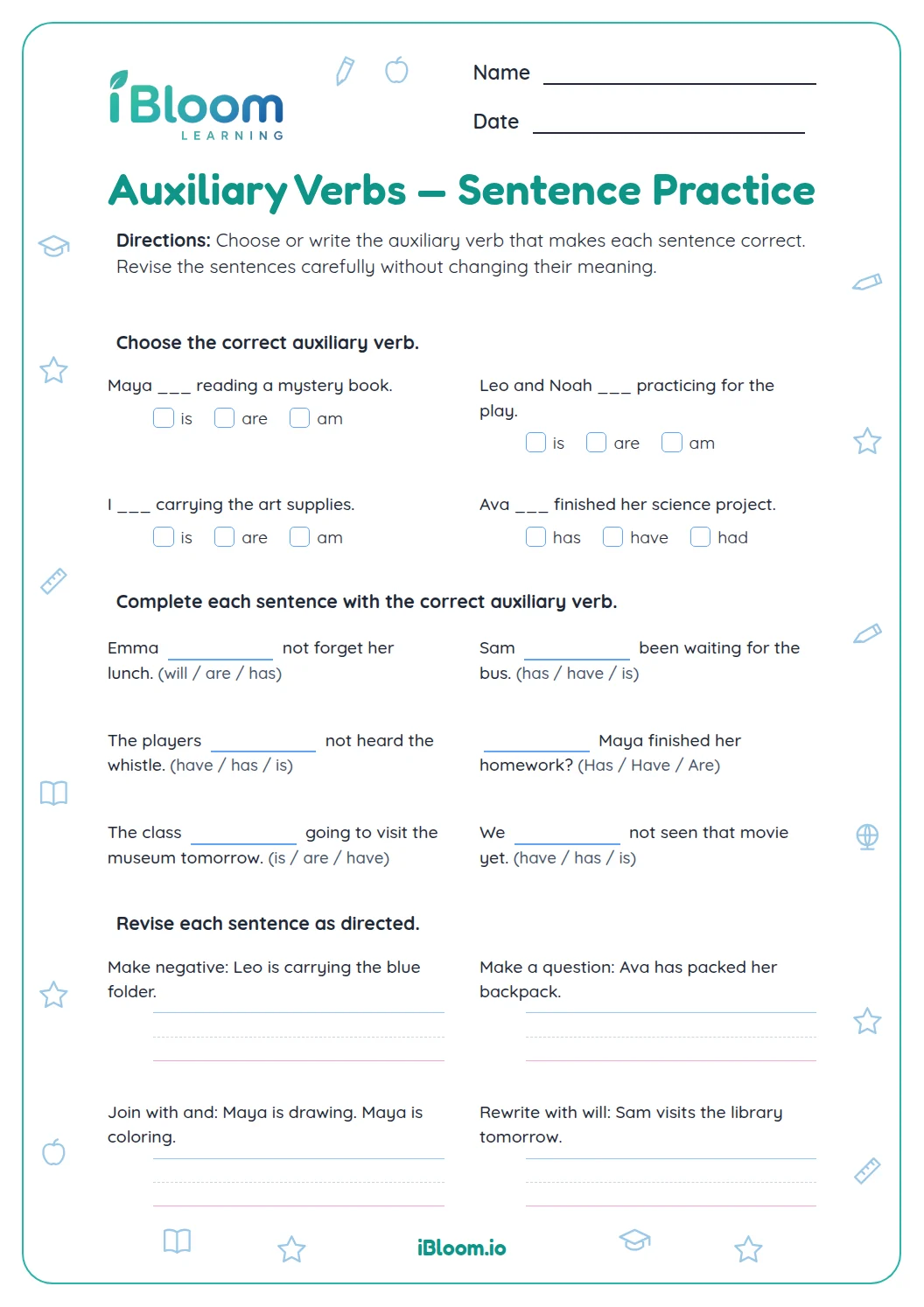
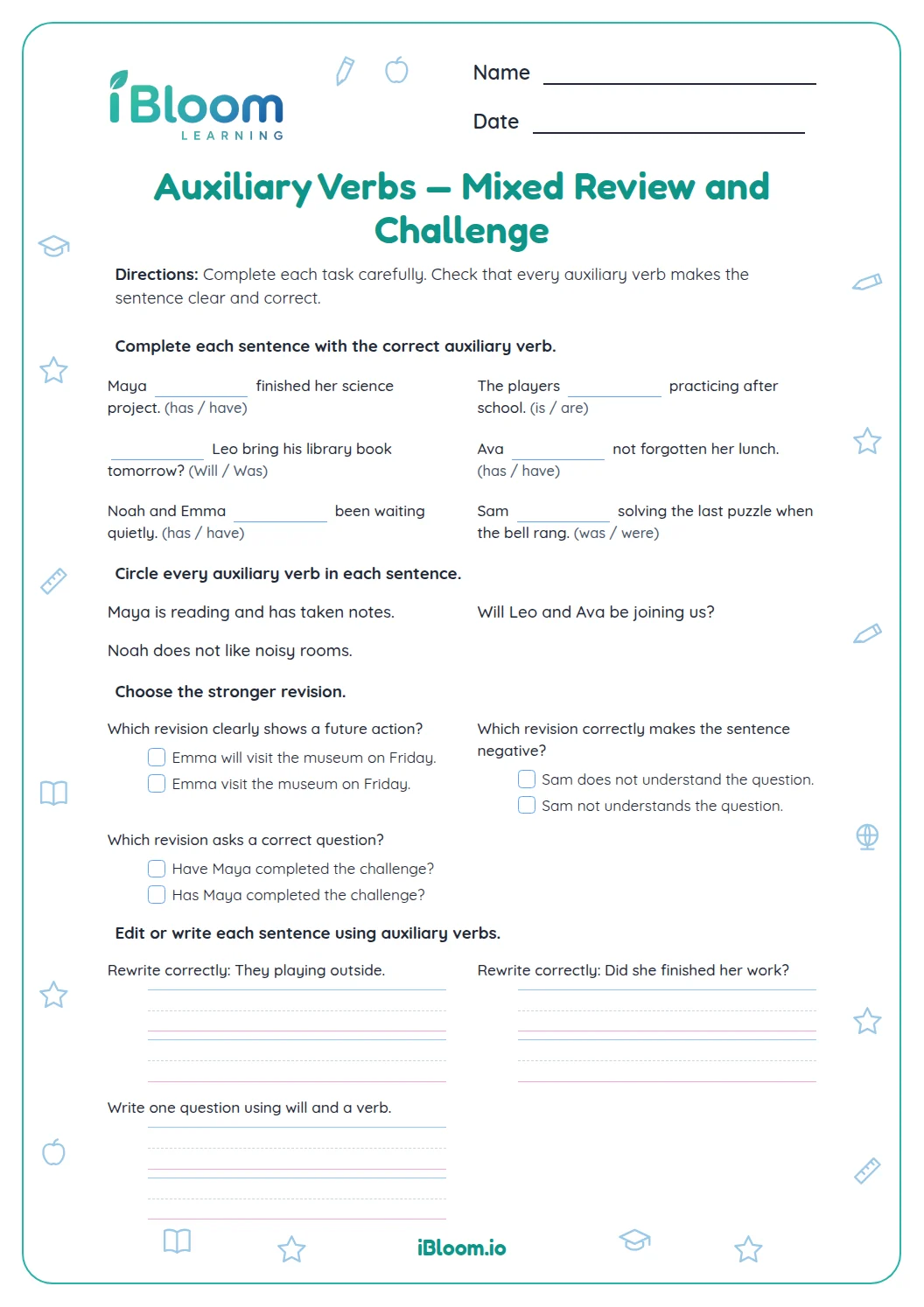
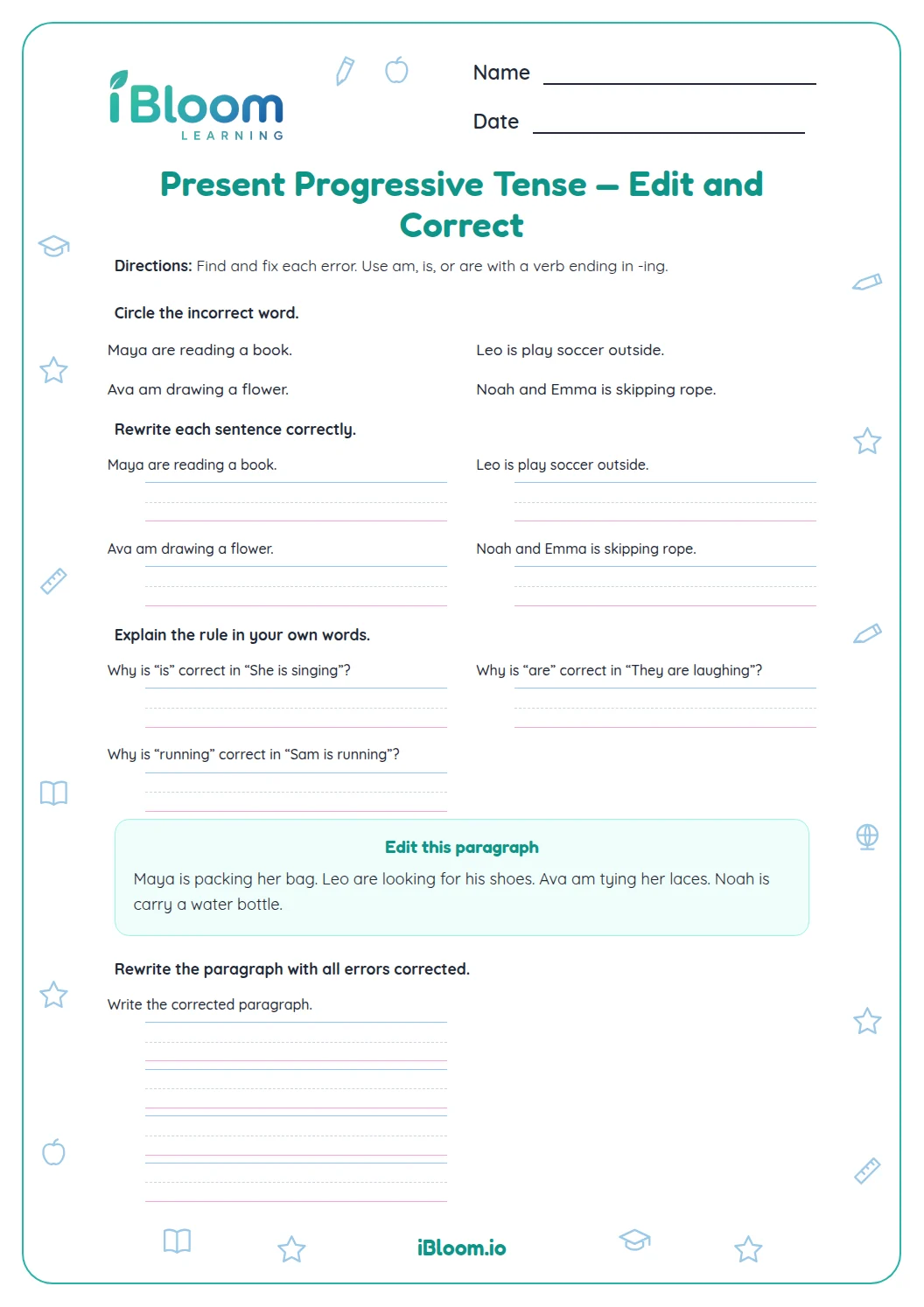
This free Grade 4 auxiliary verb worksheet helps children notice how a helping verb works with a main verb. Part A asks them to circle four helpers. Part B uses four multiple-choice questions to distinguish a helper from a main verb and read a modal verb’s meaning. Part C asks for four missing helpers from printed choices. The work practices progressive forms and modal auxiliaries under Common Core L.4.1b and L.4.1c. A separate answer key identifies the helper in each sentence.
Aligned to L.4.1b and L.4.1c
How can a child recognize a helping verb?
Look for a verb working with another verb. In “We are painting a mural,” painting names the action and are helps tell that the action is ongoing. Together they form the verb phrase are painting.
A modal helper adds a condition. Can in “Omar can swim across the pool” tells about ability. Must in the helmet sentence tells what is required.
Is “is” always a helping verb?
Its job depends on the sentence. In “She is jumping,” is helps the action verb jumping. In “She is tired,” is connects the subject with a description. Question 6 asks children to notice that difference.
- 1She is tired. → is connects She and tired.
- 2She is jumping. → is helps jumping.
- 3She is my friend. → is connects She and my friend.
- 4Choose: She is jumping.
What does each part ask children to do?
Part A has four short sentences with one helper to circle in each. Part B checks the helper, the whole verb phrase, the role of is, and the meaning of might.
Part C supplies two choices for each blank. The first two sentences build present progressive forms with am and are; the last two explicitly ask for ability and a rule so that the modal choice has a clear purpose.
How to use this worksheet
- 1Read the first sentence aloud and find the action word painting.
- 2Ask which word works with painting, then circle are.
- 3Finish the four circle rows and check that only helpers are circled.
- 4Use Part B to compare the helper alone with the complete verb phrase.
- 5Read each Part C meaning clue before choosing a helper.
Mistakes to notice and fix
The mistake
Circling painting instead of are in the first sentence.
The fix
Name painting as the main action, then find the word helping it.
The mistake
Calling is a helping verb in every sentence.
The fix
Look for a main verb it helps: jumping has a helper; tired is a description.
The mistake
Treating might and must as if they mean the same thing.
The fix
Might signals a possibility; must signals a requirement. Reread the rain and rule contexts.
Common Core alignment
Recognize helping verbs and complete progressive verb phrases.
On this sheet: Children identify forms of be helping an -ing verb and complete present progressive phrases.
Show the official wordingHide the official wording
Form and use the progressive (e.g., I was walking; I am walking; I will be walking) verb tenses.
Recognize and use modal auxiliaries to express ability, possibility, and necessity.
On this sheet: Children identify can and must, interpret might, and complete modal sentences with stated meanings.
Show the official wordingHide the official wording
Use modal auxiliaries (e.g., can, may, must) to convey various conditions.
What to practice next
Make more practice
Further reading
Questions parents and teachers ask
Are auxiliary verbs and helping verbs the same thing?
Yes, helping verb is the child-friendly name used here for an auxiliary verb. The sheet includes forms of be with ongoing actions and modals such as can, must, and might. Children identify the helper separately from the main verb before completing a few verb phrases themselves.
Why is “is” a helper in only one Part B choice?
Only “She is jumping” uses is to help another verb. Jumping names an action, so is jumping forms a verb phrase. In “She is tired” and “She is my friend,” is connects the subject with a description or identity instead of helping an action verb.
Should children circle the whole verb phrase in Part A?
No, Part A asks children to circle only the helping verb in each row. The four answers are are, was, can, and must. Question 7 separately asks for a complete verb phrase, were waiting, so children practice distinguishing the helper alone from the helper and main verb together.
How does the sheet teach what modal verbs mean?
The sentences connect modal verbs with a clear purpose. Can describes Omar’s ability to swim, must describes a helmet requirement, and might marks rain as possible. In Part C, the prompts explicitly name ability and a rule, helping children choose a modal that expresses the requested meaning.
Can I use this before children write their own sentences?
Yes, the sheet moves from recognition to completing short sentences with a helper. After checking it, ask children to say a new sentence with are and an action ending in -ing. Then ask for a sentence using can to tell something they know how to do.