


About this worksheet
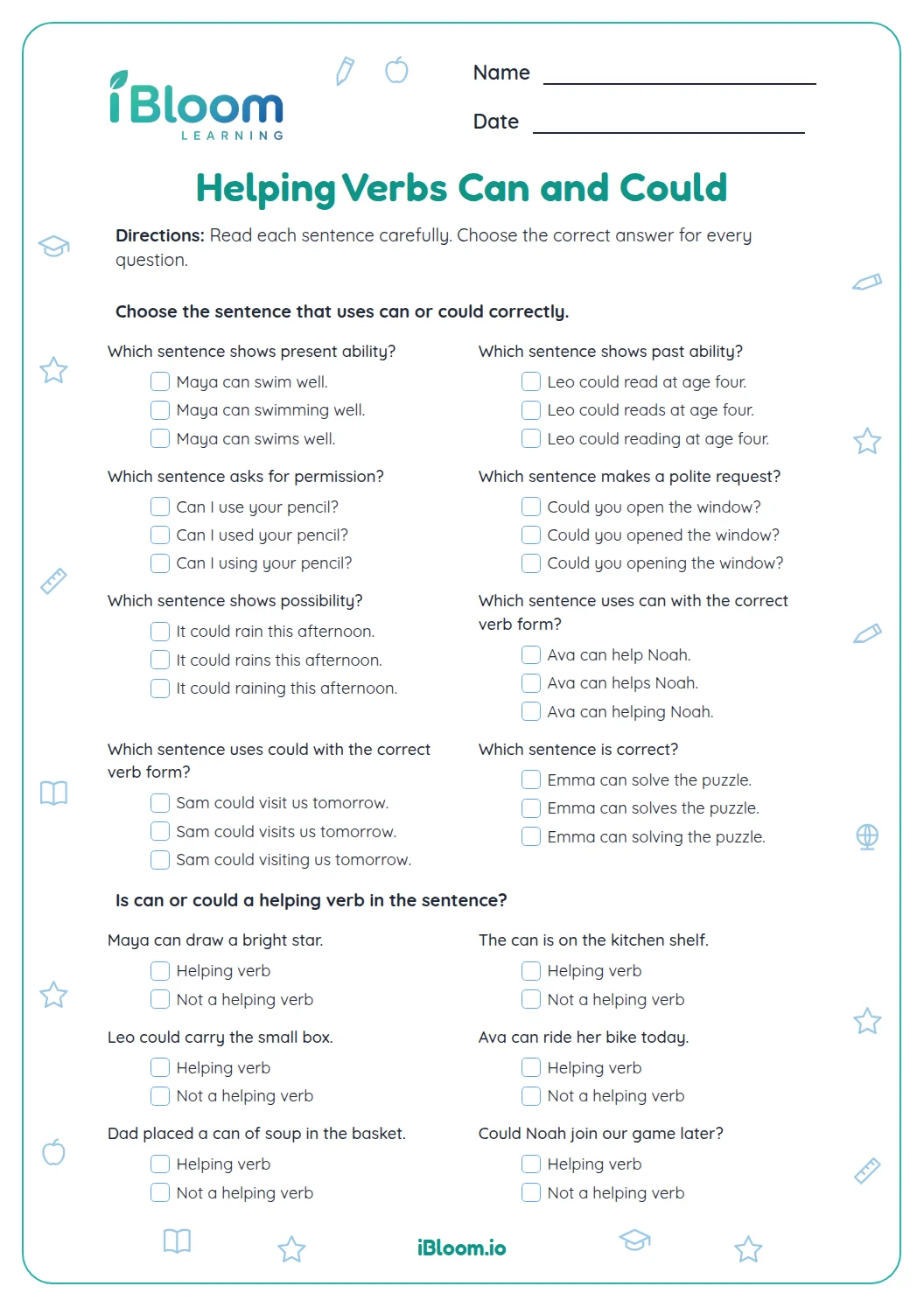
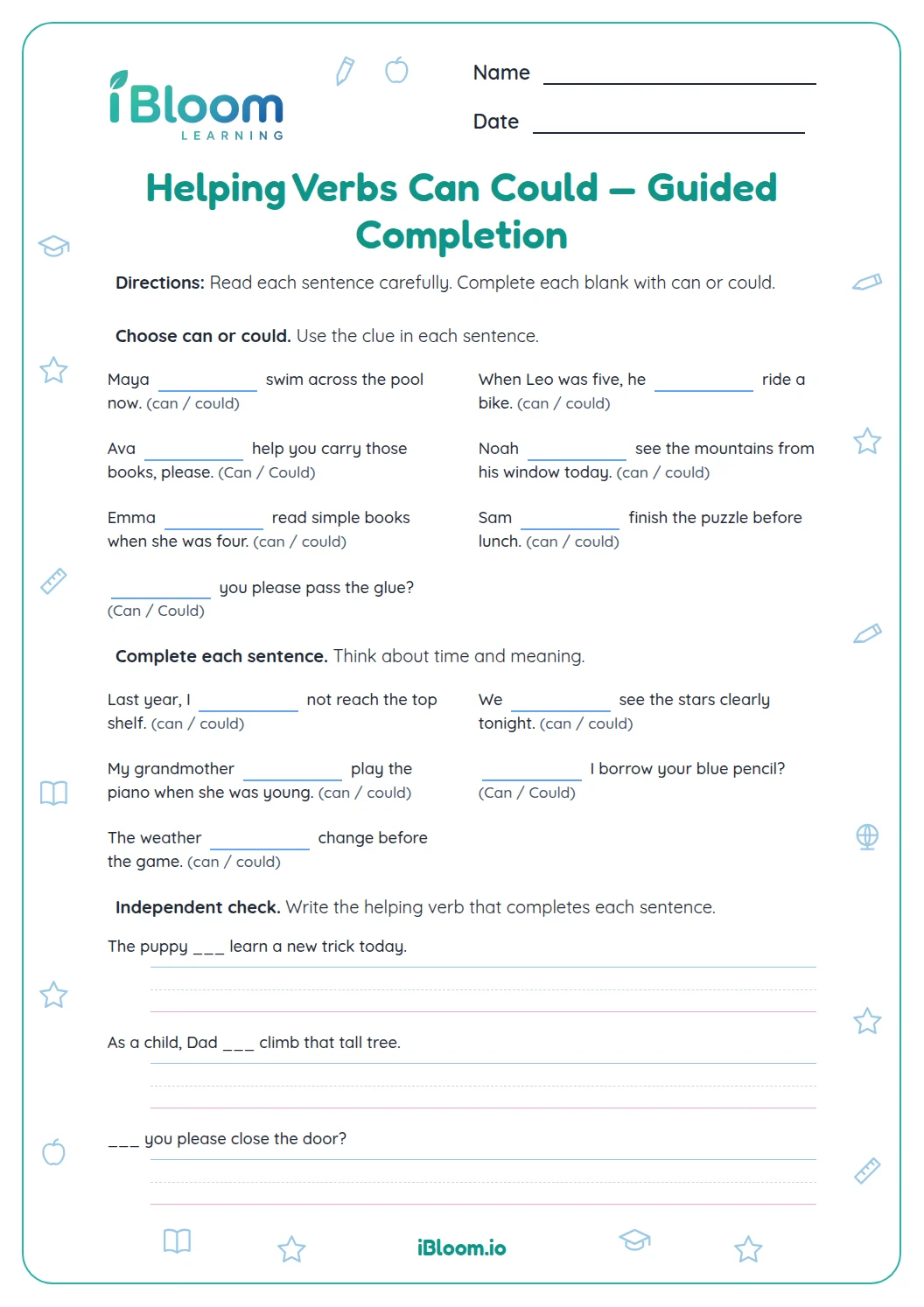
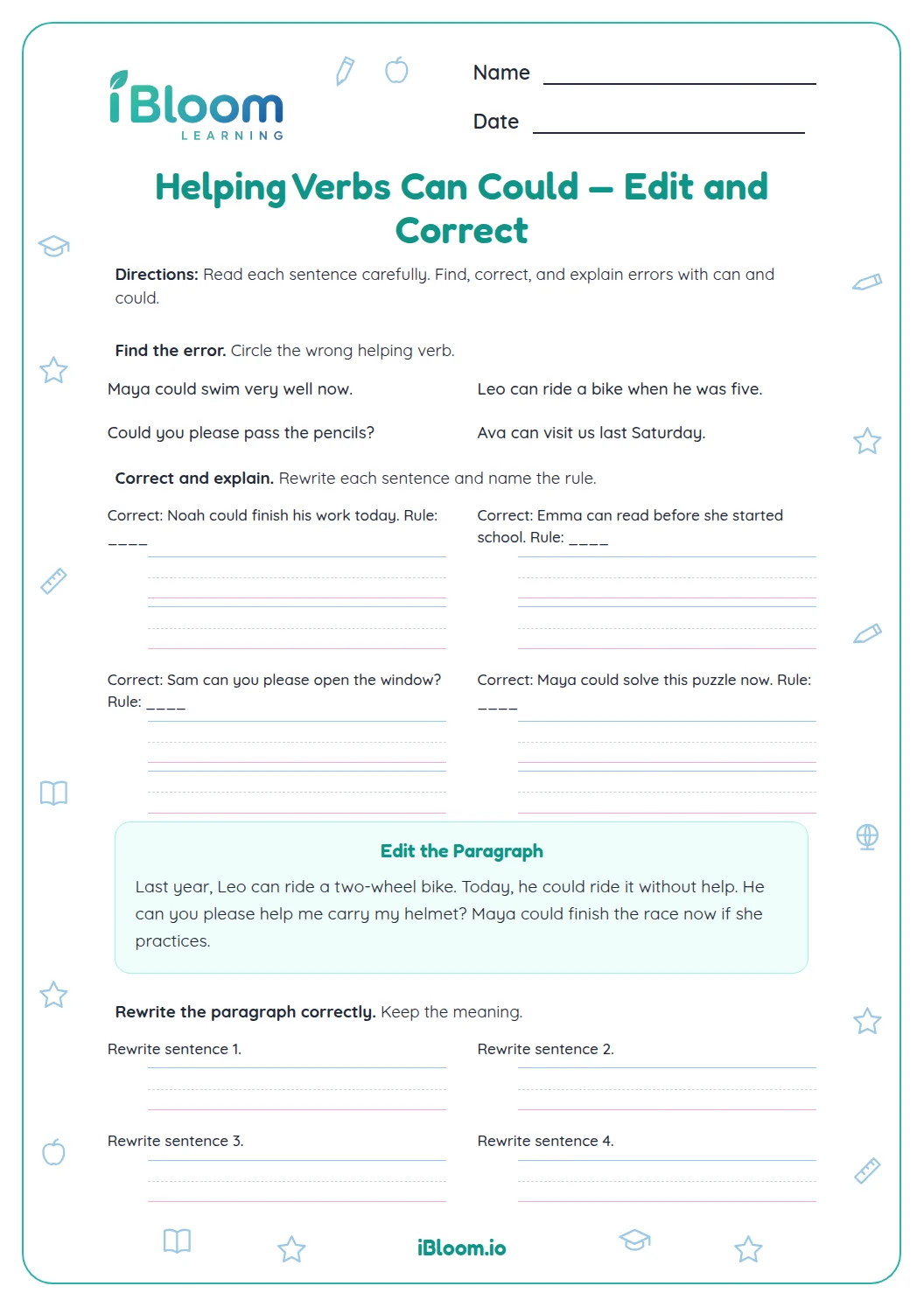
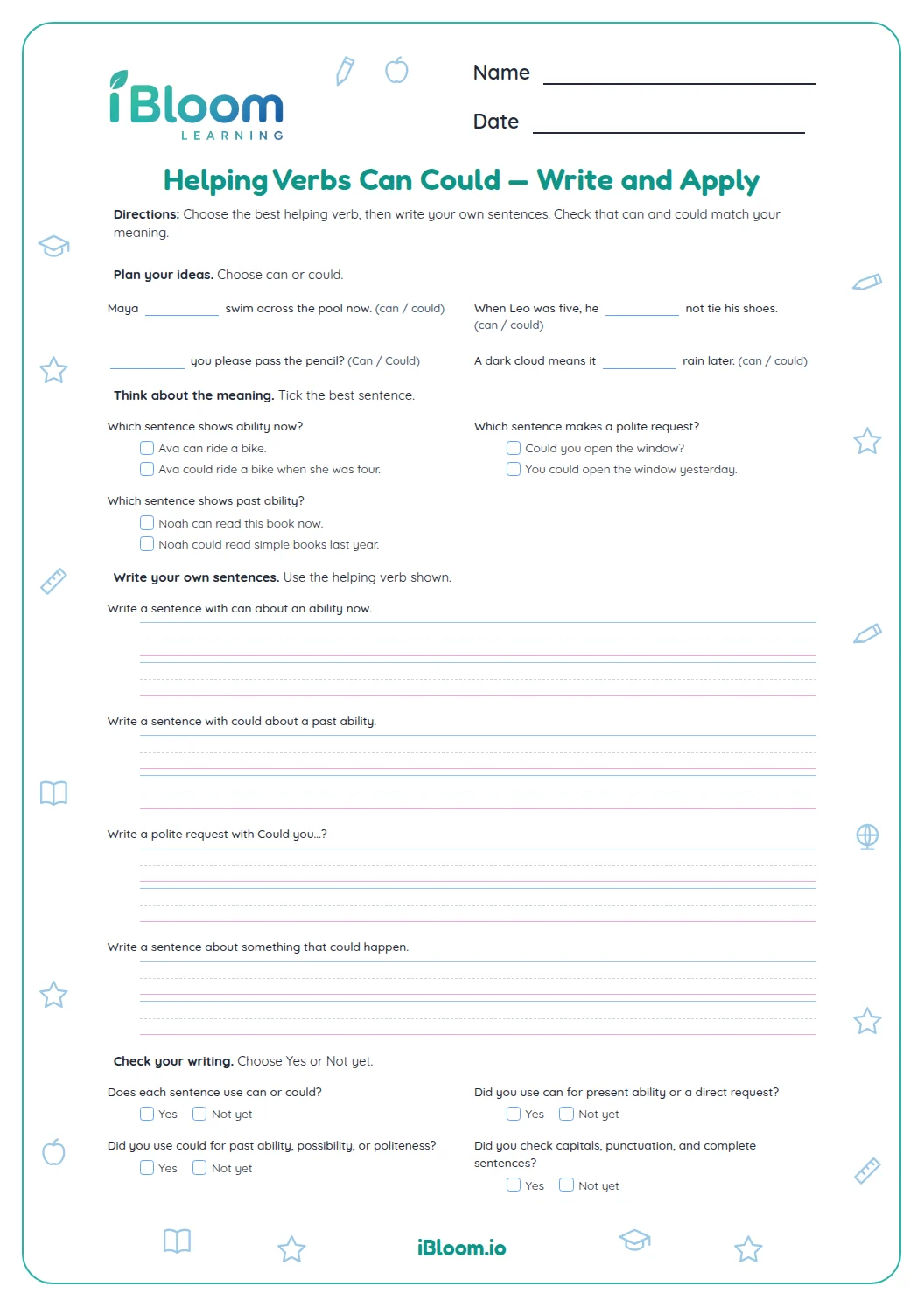
This worksheet focuses on can and could as modal helping verbs. Students identify present and past ability, use time clues to complete sentences, and write two original sentences with the target verbs. The answer key includes sample responses for the open-ended items.
Aligned to L.4.1c
How can and could work as helping verbs
Can and could are modal helping verbs. They come before a main verb and add meaning. “I can skate” describes ability now; “I could skate when I was six” describes ability in the past.
A time clue such as today, now, last year, or when I was six helps readers understand which meaning fits.
Read the time clue before choosing
Part A asks students to recognize what a modal verb tells. Part B uses clear time phrases. Part C asks students to create complete sentences.
- Identify present or past ability
- Complete sentences using a time phrase
- Write original sentences with can and could
Build a complete sentence
A modal helping verb is followed by the base form of the main verb: can read, could jump, can help. Do not add an ending to the main verb after can or could.
How to use this worksheet
- 1Find the time clue in each sentence.
- 2Choose can for a current ability or possibility and could for a past one.
- 3For Part C, include a subject, helping verb, and base-form action verb.
- 4Other complete and sensible sentences may also be correct.
Common mistakes and quick fixes
The mistake
Using could with a sentence that clearly says today.
The fix
Match the verb to the time clue; today and now point to can.
The mistake
Adding -s after a modal, as in “can reads.”
The fix
Use the base verb after can or could: can read.
The mistake
Writing a fragment without a subject.
The fix
Add a subject: “I could swim when I was five.”
Common Core alignment
Students identify and use modal auxiliaries to express ability and possibility.
Students use can and could to convey ability or possibility in complete sentences.
On this sheet:
Show the official wordingHide the official wording
Use modal auxiliaries (e.g., can, may, must) to convey various conditions.
What to practice next
Make more practice
Further reading
Questions parents and teachers ask
What is a helping verb?
A helping verb works with a main verb to add meaning. In “I can read,” can is the helping verb and read is the main verb. Can and could are modal auxiliaries; they can express ability or possibility. The worksheet uses time clues to make the intended meaning clear.
What is the difference between can and could?
Can commonly describes an ability or possibility in the present: “I can skate now.” Could commonly describes an ability in the past: “I could skate when I was six.” Context matters, so time phrases such as now, today, and last year help readers interpret each sentence.
What verb form follows can or could?
Use the base form of the main verb after can or could. Write “can help” and “could swim,” not “can helps” or “could swam.” The helping verb carries the tense or modal meaning, while the main verb stays in its base form.
Why are there time clues?
Time clues make the target choice clearer. In this practice, words such as today, now, last year, and when I was four distinguish current ability from past ability. Students should read the whole sentence before filling the blank, rather than choosing from the verb alone.
Can writing answers vary?
Yes. The answer key gives a sample sentence for each writing prompt, but children may use different subjects and actions. A response is appropriate if it is a complete sentence, follows the prompt, and uses can or could with the base form of a main verb.
What does the language standard ask students to practice?
The Grade 4 language standard asks students to use modal auxiliaries to express conditions. On this sheet, students interpret and use can and could to express ability or possibility, then apply the verbs in complete sentences of their own.