





About this worksheet
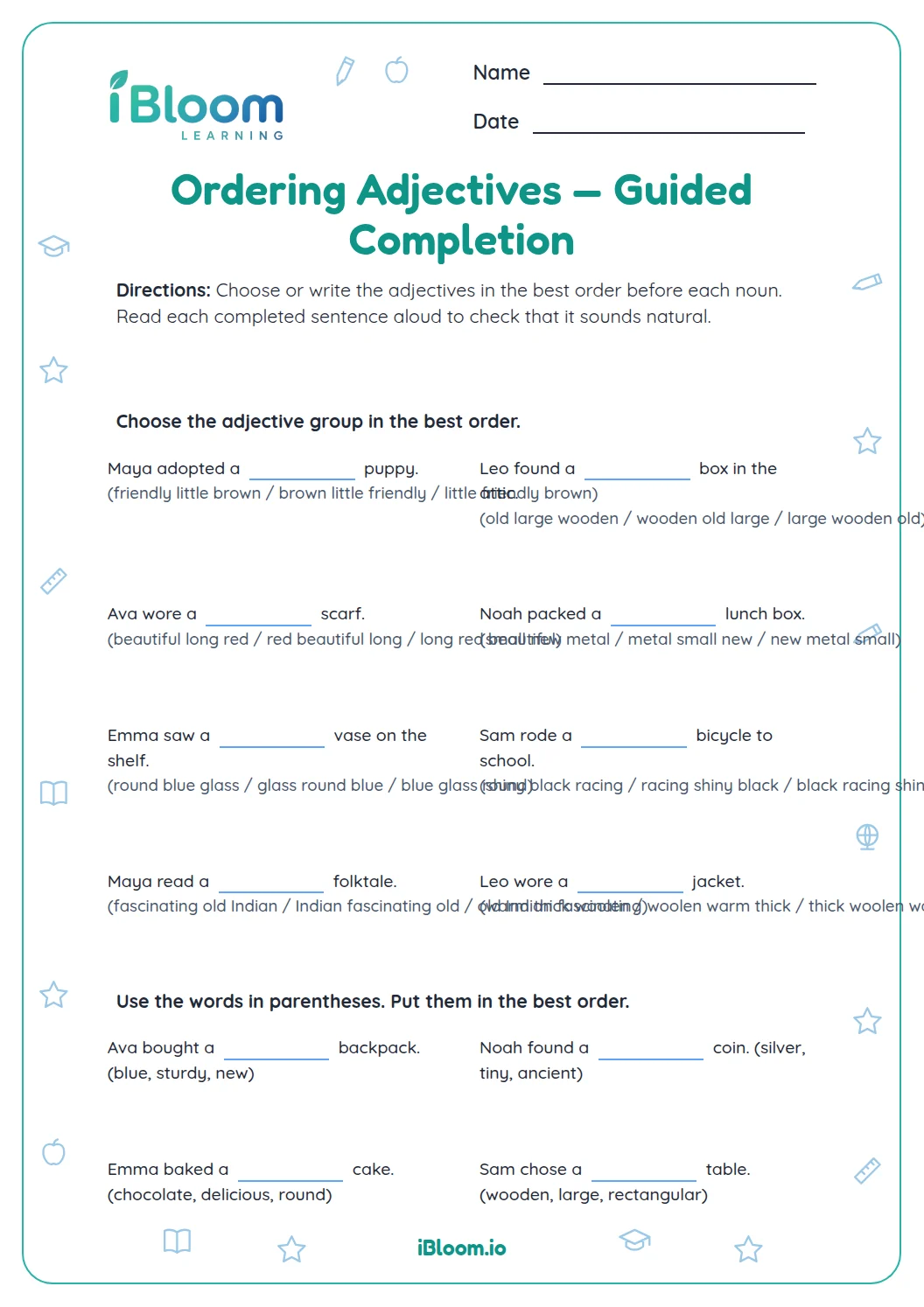
This Grade 5 printable gives practice arranging adjectives naturally before a noun. Learners choose among adjective sequences, then write their own noun phrases using clues for number, size, age, shape, color, and material. It includes 16 questions and a separate answer key.
How can adjective order make a phrase clear?
A phrase often places number, opinion, size or age, shape, color, and material in that general order. Not every phrase uses all these kinds, and some combinations can sound natural in more than one order.
- 1a small red ball
- 2Size comes before color.
How does the practice build?
The 16 questions are grouped into 2 parts, moving from direct practice to applying the skill.
- Part A: Choose the natural order
- Part B: Write and apply
How can an adult support practice?
Invite the learner to say the rule aloud, then point to the word, model, or clue that supports each answer. Review any missed item by comparing it with a correct example.
How to use the worksheet
- 1Read the directions and scan the examples before starting.
- 2Work through one part at a time.
- 3Say the rule or strategy aloud before answering.
- 4Use the answer key to check every response.
- 5For missed items, explain the clue and try a similar example.
Common mistakes and quick fixes
The mistake
Putting material before size or color.
The fix
Try the material word closest to the noun.
The mistake
Placing color before opinion.
The fix
Say the phrase aloud with the opinion word first.
The mistake
Leaving out an article in a singular count noun phrase.
The fix
Use a or an before one singular countable noun.
What to practice next
Make more practice
Questions parents and teachers ask
How many questions are on this Grade 5 worksheet?
There are 11 questions in 2 parts. Learners move from direct practice to applying the skill. A separate answer key is included, so an adult or learner can check each response and revisit an item that needs more thought.
Can I use it for independent practice?
Yes. The directions are written for learners to work through each part in order. An adult can review the answer key afterward and ask the learner to explain a tricky item. For younger learners, read directions aloud and let them explain their reasoning in their own words.
What should I do when an answer is incorrect?
Ask the learner to find the clue or rule that applies to that item. Compare it with a correct example, then try the item again before checking the key. Talking through the choice can make the rule easier to remember next time.
Is an answer key included?
Yes. A separate answer key is included with the printable pages. Use it to check responses and discuss how each answer follows the skill being practiced. If an answer differs, ask what clue would help select or write the correct response.
How long will the worksheet take?
Plan for about 20 minutes, depending on how much discussion or checking you include. Learners can complete one part at a time and pause between parts. The time can vary with reading speed and how much explanation the learner writes.