






About this worksheet
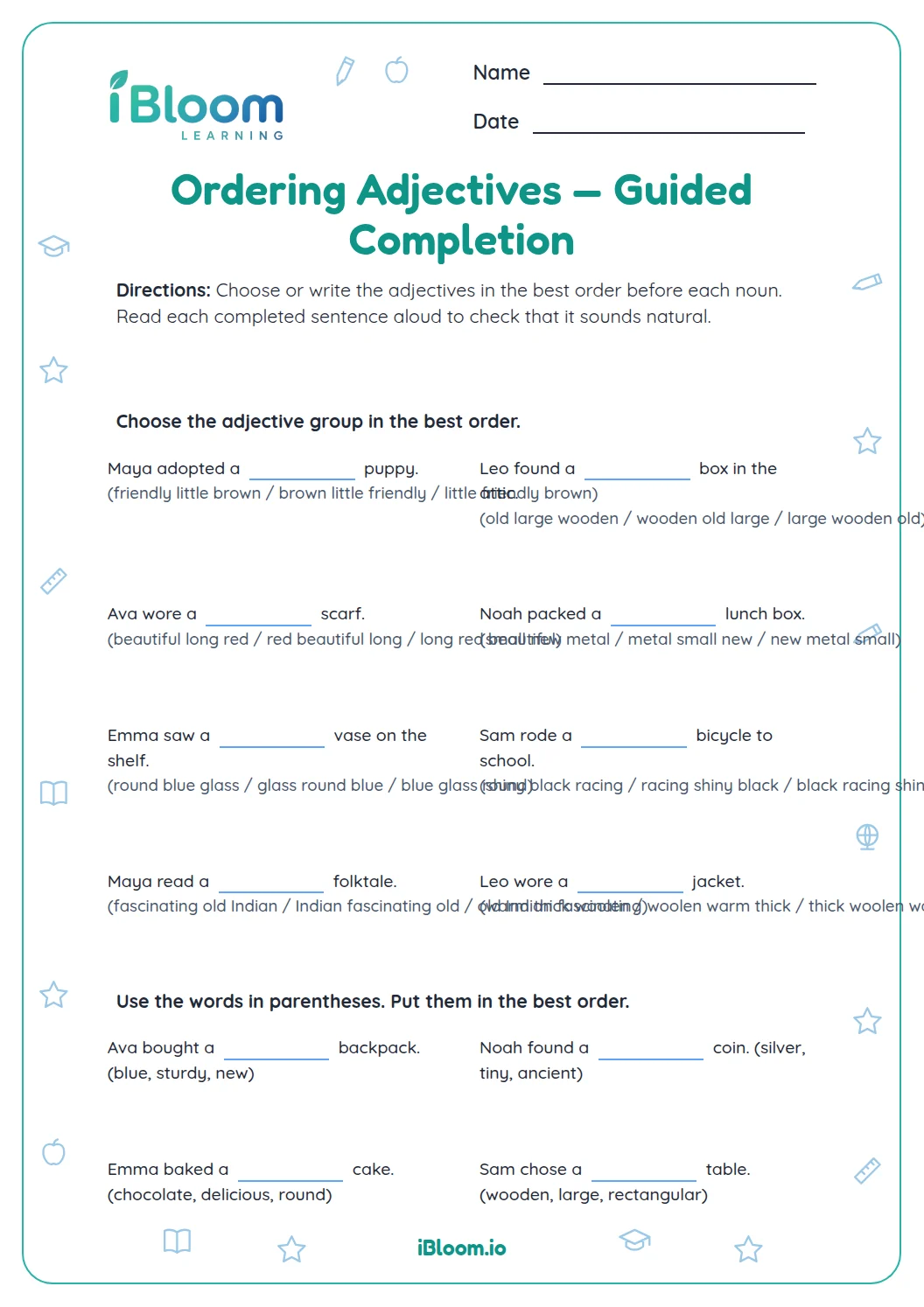
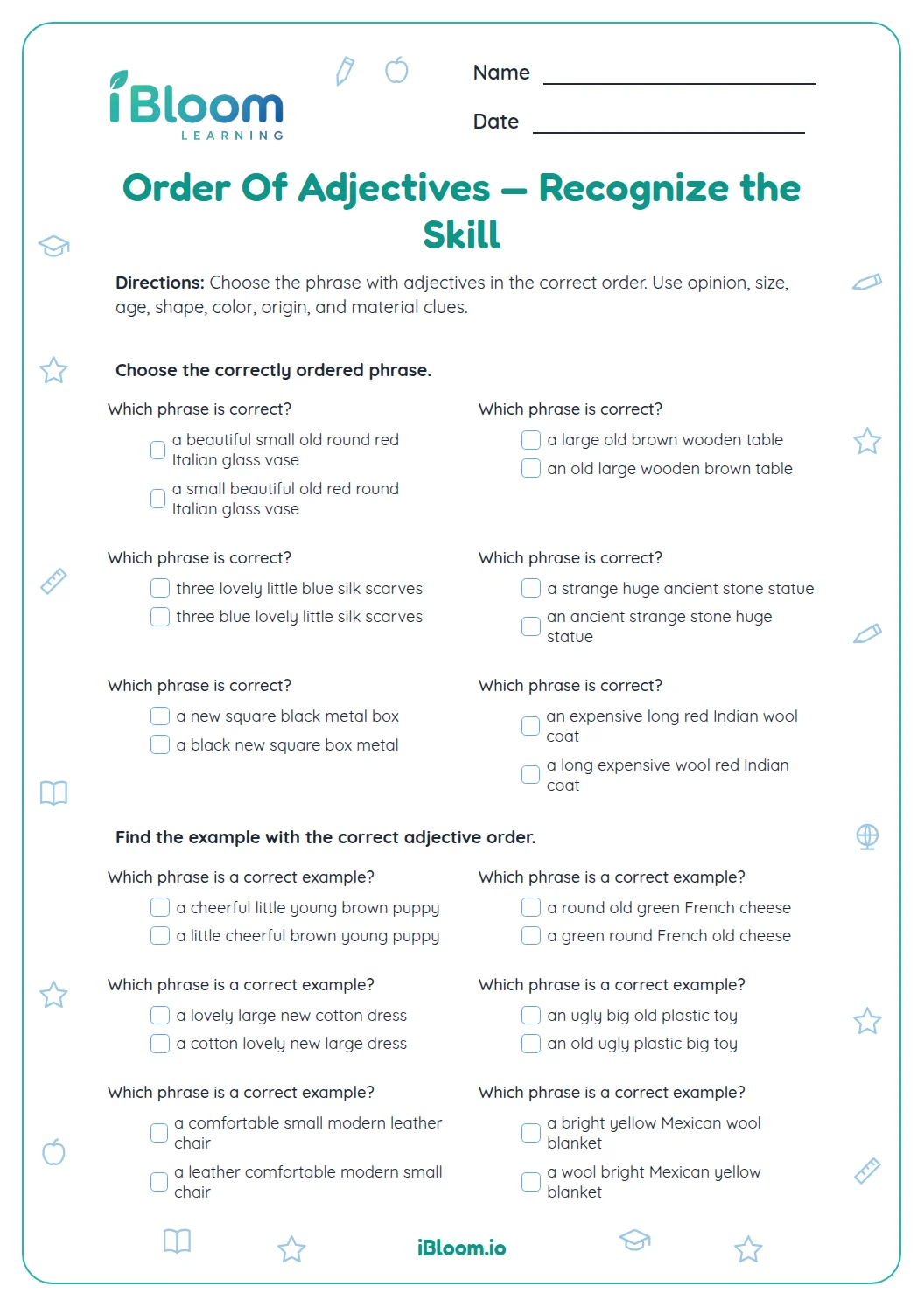
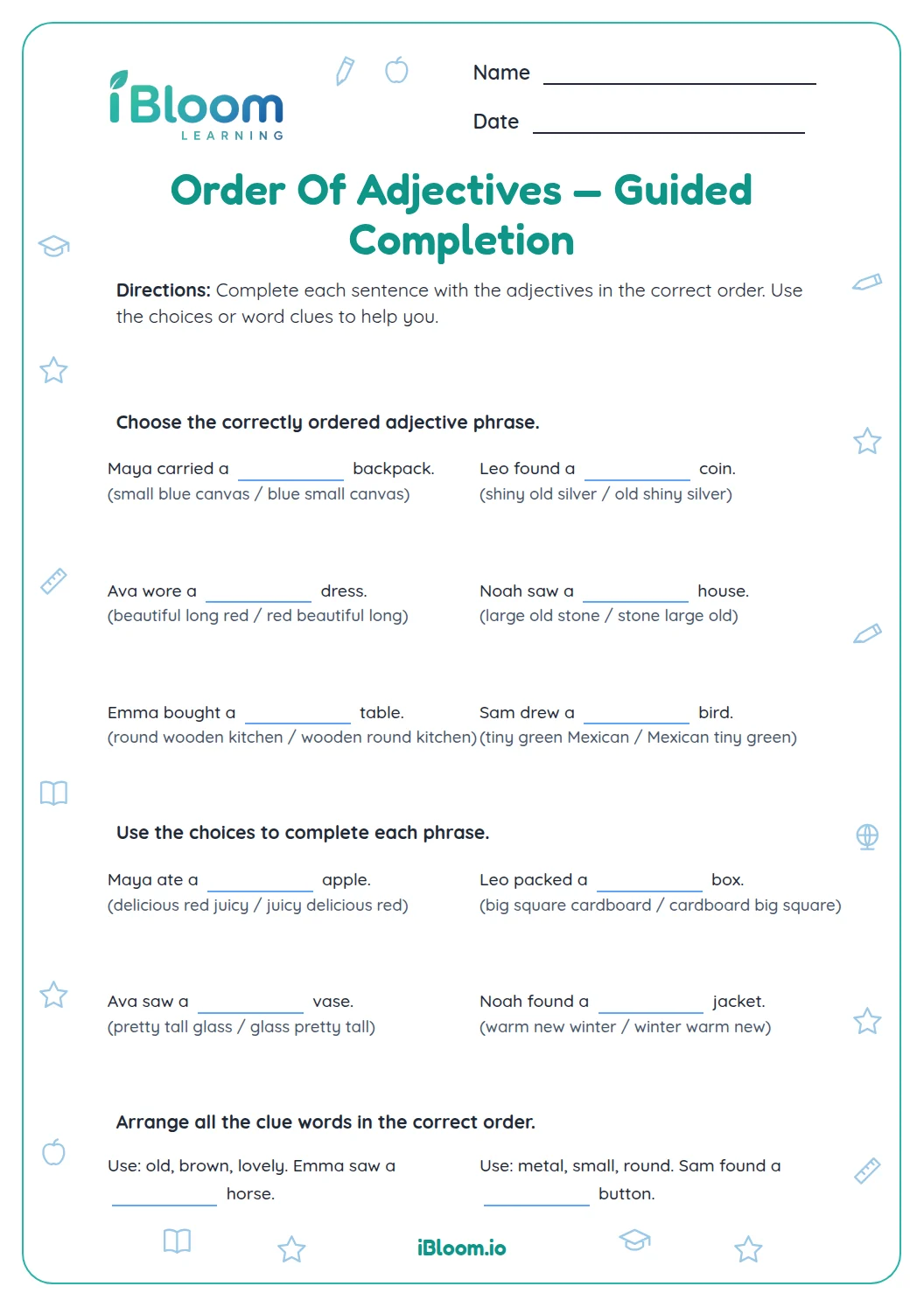
This Grade 5 grammar worksheet gives mixed practice ordering more than one adjective before a noun. Part A selects natural phrases, Part B reorders adjective lists, Part C edits phrases, and Part D revises complete sentences. The work practices conventional adjective order (CCSS L.4.1d). A separate answer key shows the expected phrase or sentence.
Aligned to L.4.1d
What order do adjectives usually follow?
Writers commonly put number or quantity first, then opinion, size, age, shape, color, origin, and material. The sequence helps readers take in details in a predictable way.
How do you reorder a phrase?
In q7, lovely expresses opinion, yellow gives color, and silk names the material. Put them in that sequence before scarf.
- 1(silk, lovely, yellow) scarf
- 2Opinion → color → material
- 3lovely yellow silk scarf
How does the challenge section work?
The final four questions show complete sentences with adjectives out of sequence. Choose the corrected sentence that puts the adjectives in a conventional order and keeps the original meaning.
How to use this worksheet
- 1Read the noun first and identify what it is.
- 2Name each adjective’s job: number, opinion, size, age, shape, color, origin, or material.
- 3Arrange the details in a familiar sequence.
- 4Read the full phrase aloud to check that it flows.
- 5For a sentence, move only the modifiers and keep the meaning.
- 6Compare with the answer key and explain the ordering choice.
Common mistakes and quick fixes
The mistake
Putting color before size.
The fix
Place size before color, as in tiny blue shell.
The mistake
Placing material before number.
The fix
Put quantity first: two wooden boats.
The mistake
Changing the noun while revising.
The fix
Keep the noun and sentence meaning; rearrange only the adjectives.
Common Core alignment
Order adjectives within sentences according to conventional patterns.
On this sheet: The questions ask learners to choose, reorder, and revise adjective sequences.
Show the official wordingHide the official wording
Order adjectives within sentences according to conventional patterns (e.g., a small red bag rather than a red small bag).
What to practice next
Make more practice
Further reading
Questions parents and teachers ask
What is a conventional adjective order?
A common pattern places quantity before opinion, size, age, shape, color, origin, and material. The worksheet uses combinations such as lovely yellow silk and three beautiful white shells. The examples ask students to arrange only the adjectives present before the noun.
Does each phrase include every adjective type?
No. Each item includes a few modifiers rather than every possible type. Students use the details that appear, such as opinion before color or quantity before color, and arrange them in a conventional sequence before the noun. These examples keep the adjective sequence tied to the noun.
What is the answer to question 7?
The expected phrase is lovely yellow silk scarf: lovely gives an opinion, yellow names the color, and silk names the material. Question 7 gives the adjectives in a mixed order, and the answer key lists the reordered phrase.
Can a different adjective order ever sound natural?
Some adjective sequences allow variation in ordinary speech. These items are designed around a conventional order with one clearly intended answer. Students can use the category of each adjective and the supplied answer key to check the target sequence.
How many questions and pages are included?
There are 14 questions on two worksheet pages, followed by two key pages. They include natural-order choices, adjective reordering, phrase editing, and sentence revision. The final four questions ask students to choose a corrected sentence rather than rewrite it.