





About this worksheet
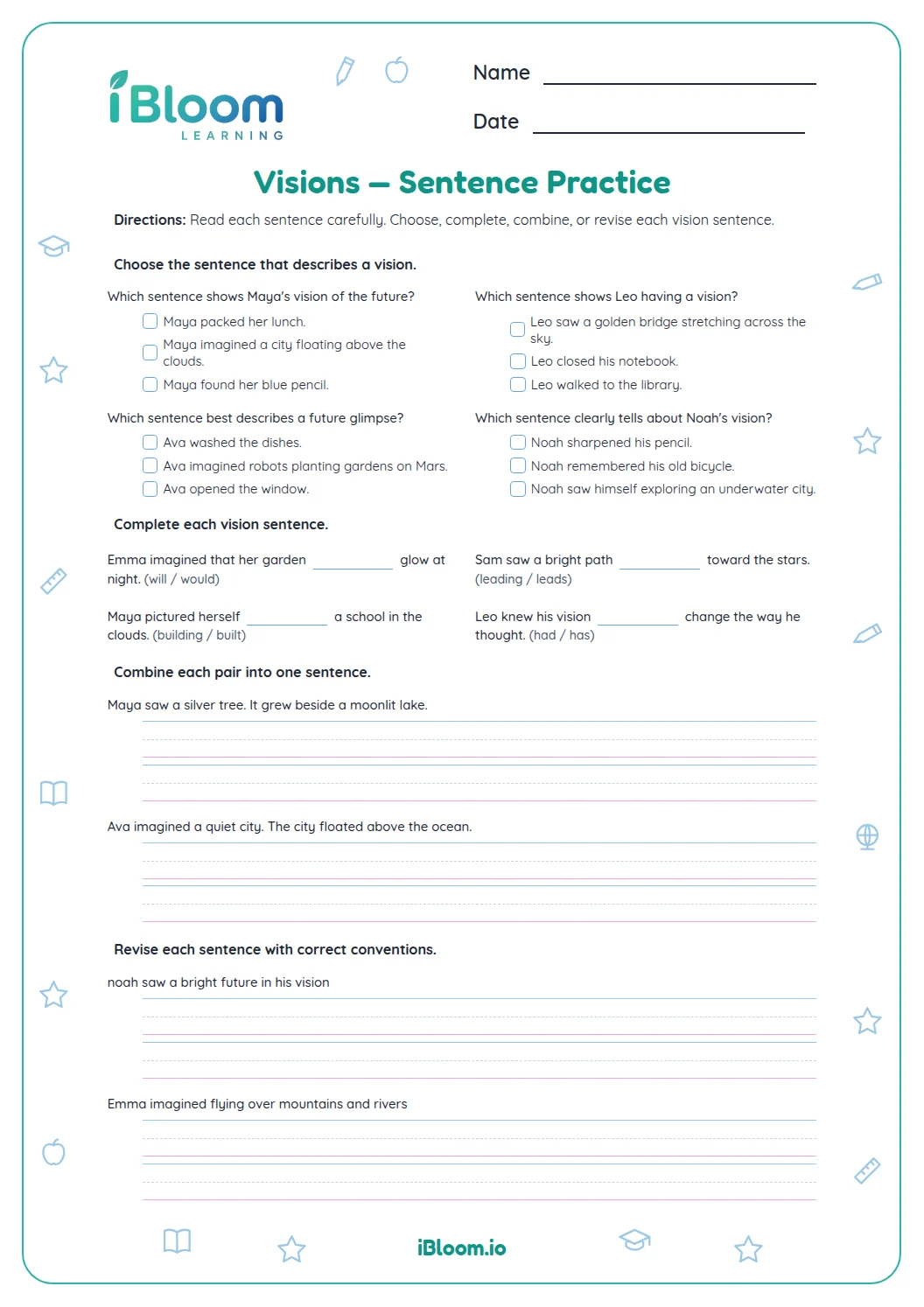
This Grade 5 worksheet uses imagined futures as a setting for narrative craft practice. Students identify vivid description, event sequence, dialogue, conflict, resolution, and character reaction, then write seven brief examples. The answer key gives selected answers and sample responses. These tasks practice descriptive details and clear event sequences in Common Core W.5.3.
Aligned to W.5.3
Which craft choices help a vision story come alive?
A specific sensory detail gives a reader something to imagine. Event order helps the reader follow what happens, while a character’s reaction shows how an event matters. Dialogue and a resolved problem can move a scene forward.
Part A asks students to recognize these choices. Part B invites them to try a craft move in a short sentence. “Silver birds circled the floating garden” gives the reader a concrete image of an imagined place.
- 1Silver birds circled the floating garden.
- 2The detail helps readers picture the imagined setting.
How to use this worksheet
- 1Read the direction at the start of each part.
- 2Work through each item and use the provided response space.
- 3For a written response, include the detail named in the prompt.
- 4Check answers with the key and revise any response that misses the task.
Common mistakes and quick fixes
The mistake
Answering before identifying exactly what the prompt asks.
The fix
Underline the key task word, such as quotient, reason, or detail.
The mistake
Giving a choice without checking its supporting evidence.
The fix
Point to the fact or text detail that makes your choice fit.
The mistake
Leaving a written response too general.
The fix
Add the specific number, reason, example, or story detail requested.
Curriculum alignment
Use description, dialogue, event sequence, and endings to develop a narrative.
On this sheet:
Show the official wordingHide the official wording
Write narratives to develop real or imagined experiences or events using effective technique, descriptive details, and clear event sequences.
What to practice next
Further reading
Questions parents and teachers ask
What does “visions” mean on this worksheet?
Here, a vision is an imagined future or place that can become a story setting. Students use that idea to recognize and practice narrative details, sequence, character reactions, dialogue, problems, and endings. The examples keep the focus on story craft.
Which narrative skills appear?
The choice questions address sensory description, event order, vivid setting details, dialogue punctuation, conflict, resolution, and character reaction. The writing prompts ask students to apply related moves in a sentence or short detail. The answer key supplies sample responses for those open items.
Do students write a complete story?
No. The 14 questions focus on recognizing and trying individual narrative moves. Students write brief examples rather than a full story. A teacher may later invite students to connect selected responses into a longer scene, using the details and events they practiced on the page.
How can a sensory detail improve a scene?
A sensory detail helps readers imagine what a character sees, hears, smells, tastes, or feels. “Cool mist brushed my cheeks” gives a clearer image than saying only that a place felt strange. Choose a detail that fits the moment.
How many items are included?
The worksheet has 14 items in two parts: seven multiple-choice craft questions and seven short writing prompts. The key lists correct selections and offers sample answers for the written items. Students may use different wording when it meets the prompt.