




About this worksheet
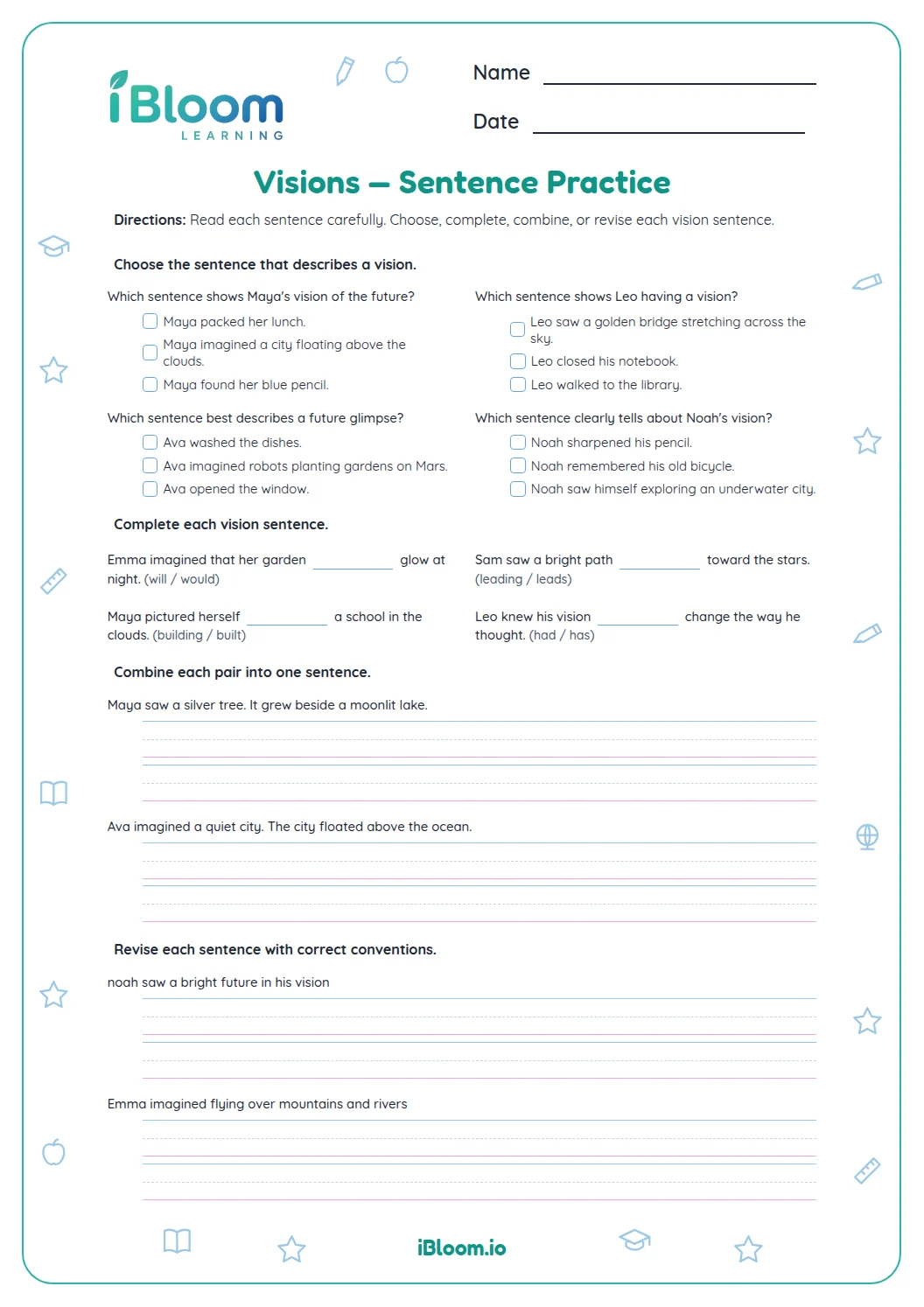
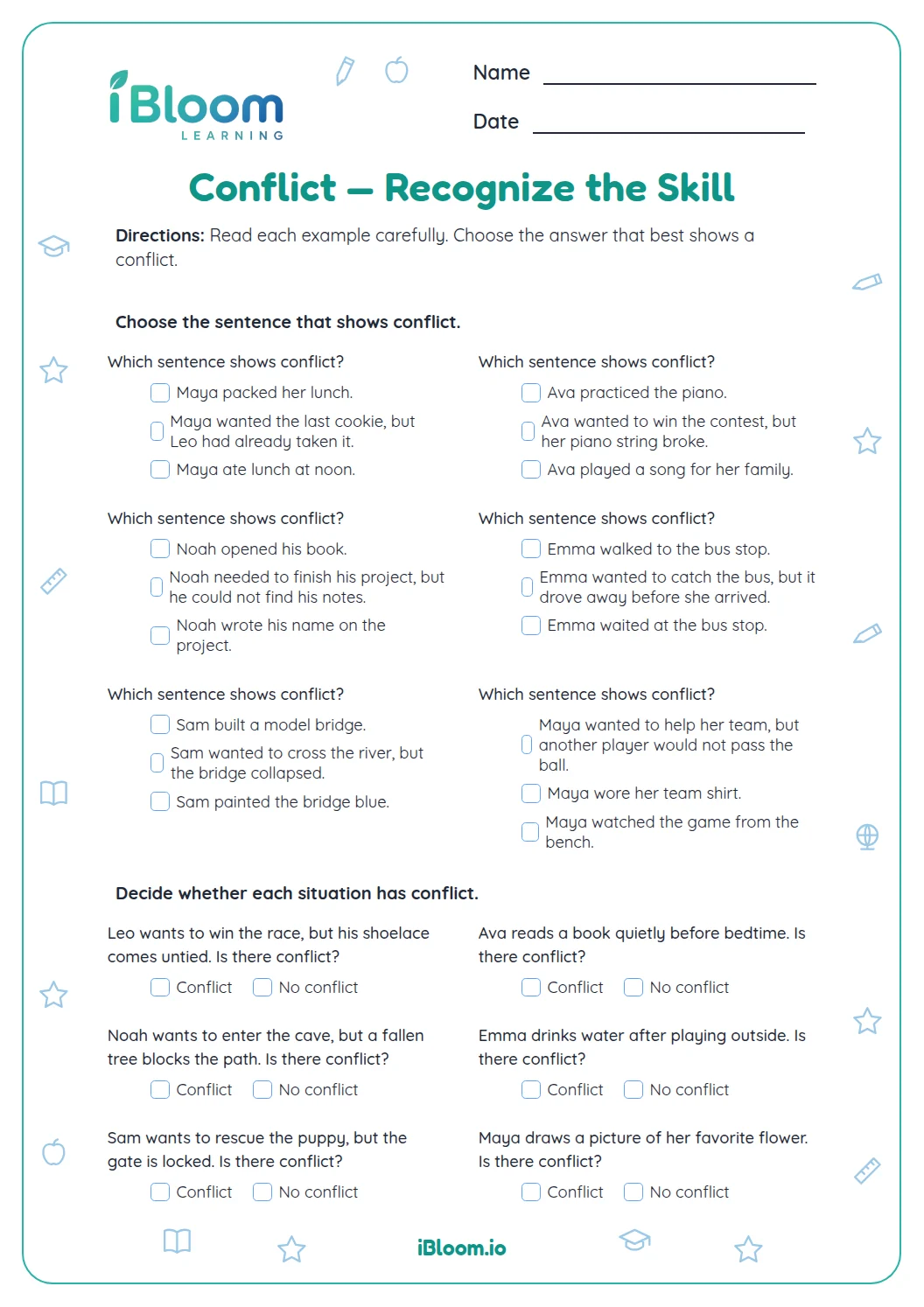
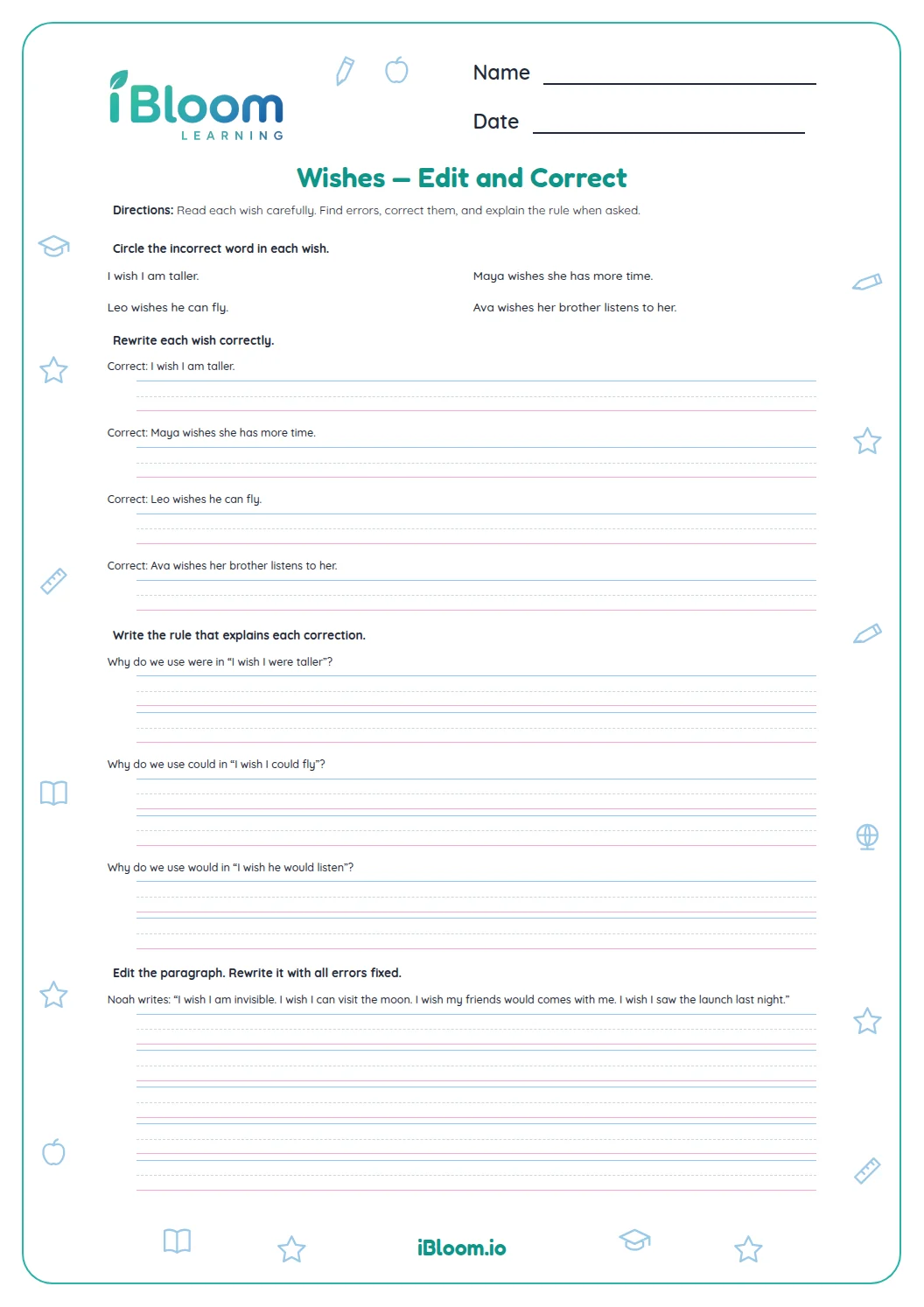
This free Grade 5 narrative writing worksheet turns glimpses of the future into scenes readers can picture. Students review four story choices, make four word choices, compare two revised sentences, and write four brief responses about cities, floods, a locked gate, and a future garden. Parts A–C prepare students to use dialogue, action, and sensory language in Part D. The practice supports CCSS W.5.3.b and W.5.3.d. A separate answer key gives fixed answers for the review and sample responses for the writing challenges.
Aligned to W.5.3.b and W.5.3.d
What does a vision mean in these prompts?
A vision is an imagined glimpse of something that may happen later. Each question supplies its own situation. The future city, Leo’s flood, and Noah’s garden give students a concrete starting point without requiring a shared passage.
The useful writing question is what changes because the character saw the future. A warning, a hurried movement, or a decision to plant can turn a surprising image into a sequence of events.
How can students replace a vague description?
Ask for a detail that a reader could see, hear, smell, or feel. In question 11, strange gives a judgment but leaves the reader to invent the scene. Naming two unusual features makes the vision specific.
- 1Question 11: Revise “The future city was strange” with one sight and one sound.
- 2Sample: Blue towers swayed while bells rang overhead.
- 3Sight: swaying blue towers. Sound: ringing bells.
What makes the final writing tasks a challenge?
Part D asks students to make four different craft choices: combine senses, pair dialogue with action, slow a moment, and connect an ending to a decision. The first three responses need one or two sentences; the garden ending needs three.
For the locked gate, two small movements hold attention on the obstacle. For the garden, the ending should show what Noah does and how that action affects the future. Accept different wording when it fulfills the task.
How to use this worksheet
- 1Read the subtitle and explain that the scenes involve possible futures.
- 2In Part A, ask which words reveal a sense, emotion, or response.
- 3Choose the Part B words and reread the completed sentences aloud.
- 4Compare the revisions in Part C, then draft the four Part D responses.
- 5Use the sample key to discuss the writing choices, then revise one vague phrase.
Mistakes to notice and fix
The mistake
Writing “It was amazing” as a sensory detail.
The fix
Name an actual sight or sound, such as swaying towers or ringing bells.
The mistake
Adding dialogue that ignores the danger.
The fix
Make the speaker’s words respond to the flood or broken bridge.
The mistake
Ending Noah’s scene with an unrelated surprise.
The fix
Connect his planting decision to the garden he later sees.
Common Core alignment
Use dialogue, description, and pacing to develop a character’s response to a future vision.
On this sheet: Students write a warning, slow an action sequence, and connect a vision to a character’s choice.
Show the official wordingHide the official wording
Use narrative techniques, such as dialogue, description, and pacing, to develop experiences and events or show the responses of characters to situations.
Replace vague descriptions with concrete sights, sounds, and actions.
On this sheet: Students identify sensory details and revise a future-city description with sight and sound.
Show the official wordingHide the official wording
Use concrete words and phrases and sensory details to convey experiences and events precisely.
What to practice next
Make more practice
Further reading
Questions parents and teachers ask
Does my child need to write a complete story?
The worksheet asks for four brief writing responses after ten review questions. Each response develops a particular narrative technique, with one or two sentences for the first three and three sentences for the garden ending. A child can later combine favorite ideas into a longer story, using the city or garden as a starting point.
What counts as a good answer to the city revision?
A good answer includes one visible feature and one sound. Blue towers and ringing bells meet those requirements in the sample key. Other combinations can work just as well if they are concrete and help a reader imagine the future city rather than simply calling it strange.
How should students slow down the locked-gate moment?
Students should describe two small actions before moving past the obstacle. Leo might test the latch and then listen through the gate. Those actions let the reader linger with him. Check that the response stays on this moment instead of jumping straight to the next day.
Must the vision come true at the end?
The garden challenge lets Noah change the future through his choice. He sees an empty garden, then takes action that leads to a different outcome. An effective ending connects those events clearly. Students can choose the plants, the time that passes, and the details of the changed garden.
How do I use the answer key for creative writing?
Use the key as a model of the requested technique. The first ten questions have fixed answers, while the final four begin with “Sample.” For those responses, check the required senses, dialogue, actions, or cause and effect. Discuss a successful detail before asking the child to improve anything.