





About this worksheet
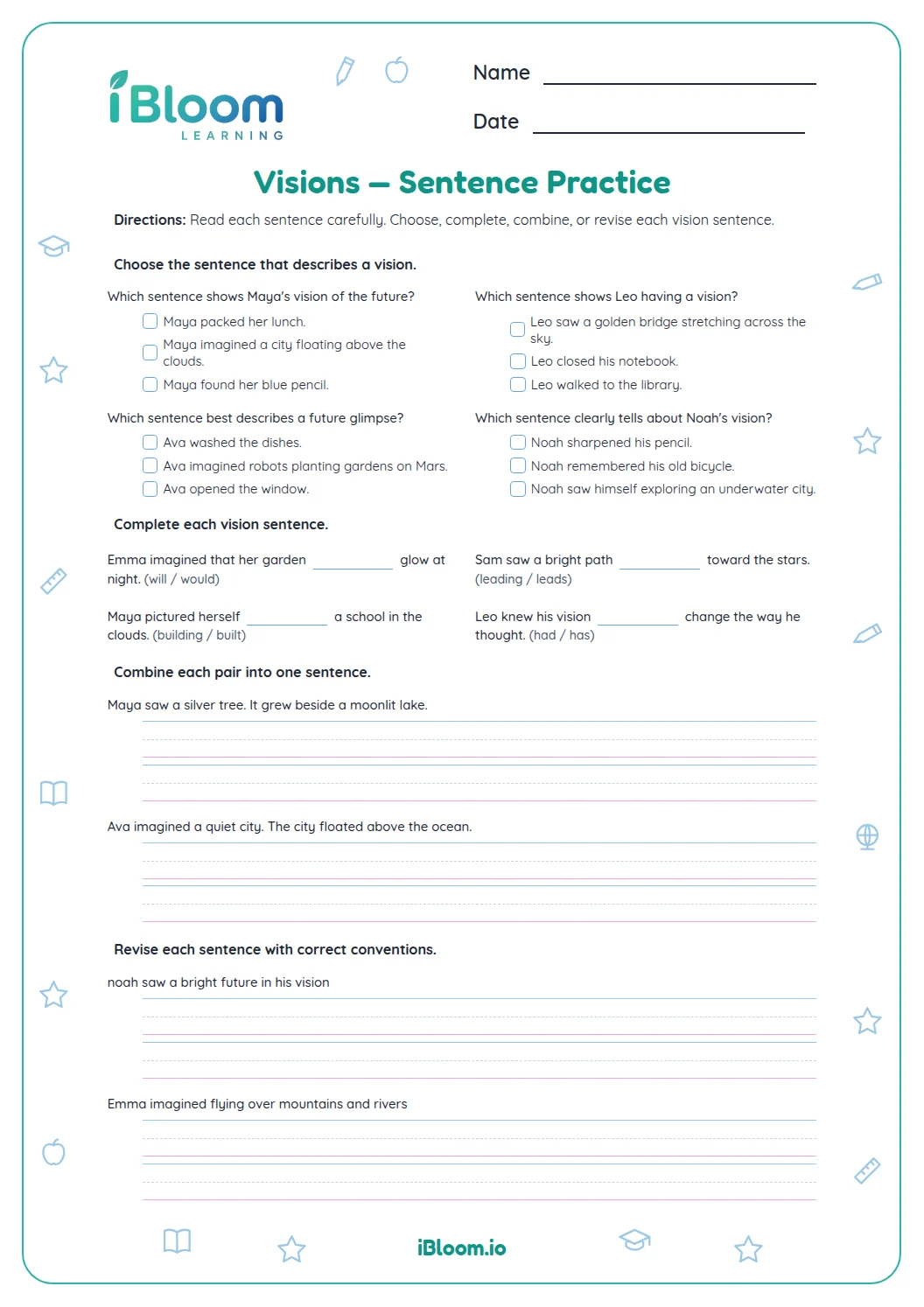
This free Grade 5 writing worksheet helps students complete imagined future visions. Six short sentence prompts ask them to choose a fitting word, four more ask them to select a clear ending, and six open prompts invite original details and next events. The sequence practices building an imagined experience with descriptive details and a clear progression, supporting CCSS W.5.3. The answer key gives sample completions for open responses.
Aligned to W.5.3
How do the parts build a future vision?
Part A asks students to choose words that make sense in a future scene. Part B asks them to choose an ending that fits the sentence. Part C gives sentence starters for original details and events.
How can a detail lead into the next event?
For “First, I noticed ___,” a writer might add “tiny lights moving along the river.” A following sentence can explain what the character decides to do after seeing them.
How can students check a completed vision?
Reread the full sentence with the chosen word or ending. For open responses, check that the detail belongs in the imagined future and that the next sentence follows from it.
How to use this worksheet
- 1Read the whole vision sentence before choosing a word.
- 2For each ending, check that it completes the thought rather than changing the topic.
- 3In Part C, add a specific place, object, sound, or action.
- 4Keep details connected when a prompt says “First” or “Then.”
- 5Reread every completed sentence aloud and check that it makes sense.
Common mistakes and quick fixes
The mistake
Choosing a word that does not fit the sentence meaning.
The fix
Read the complete sentence with each choice before deciding.
The mistake
Adding an unrelated detail to an open vision.
The fix
Connect the detail to the place, event, or character already named.
The mistake
Treating a sentence starter as a complete response.
The fix
Finish the thought with a clear event or description.
Common Core alignment
The listed standard describes the reading, writing, or math work students practice on this page.
Develop a narrative with effective technique, details, and a clear sequence.
On this sheet: The prompts guide students to plan and develop an imagined story with linked events and descriptive details.
Show the official wordingHide the official wording
Write narratives to develop real or imagined experiences or events using effective technique, descriptive details, and clear event sequences.
What to practice next
Make more practice
Further reading
Questions parents and teachers ask
What does “vision” mean on this worksheet?
A vision is an imagined picture of a possible future. Students complete sentences about future places, helpful inventions, gardens, and surprising events, then add details of their own in the final part. The word choices and endings should fit the scene described.
How many prompts are on the page?
There are sixteen prompts in three parts. Students choose words for six vision sentences, select endings for four more, and finish six open sentence starters with original ideas. Each part gives a different way to complete a future scene. This gives the student a clear next step before finishing the page.
What is one example of a word-choice item?
One sentence says that people in Leo’s vision travel in _____ cars. Students choose “flying” because it creates a clear future image; “sleeping” does not fit the sentence meaning. The other items ask students to select a word that completes a vision clearly.
Does the answer key require one exact ending for every response?
The first ten items have a listed choice or ending. The six open prompts have sample completions, so a different response can also work when it completes the sentence and stays connected to the vision. The key models one possible continuation. The open prompts give children room to add details in their own words.
How can a parent help without writing the response?
Ask the student to read the full sentence aloud and picture the scene. For an open prompt, ask what the character sees or does next, then let the student choose and write the detail independently. This keeps the ideas the student’s own. Students can check whether a second answer still completes the sentence.