
About this worksheet
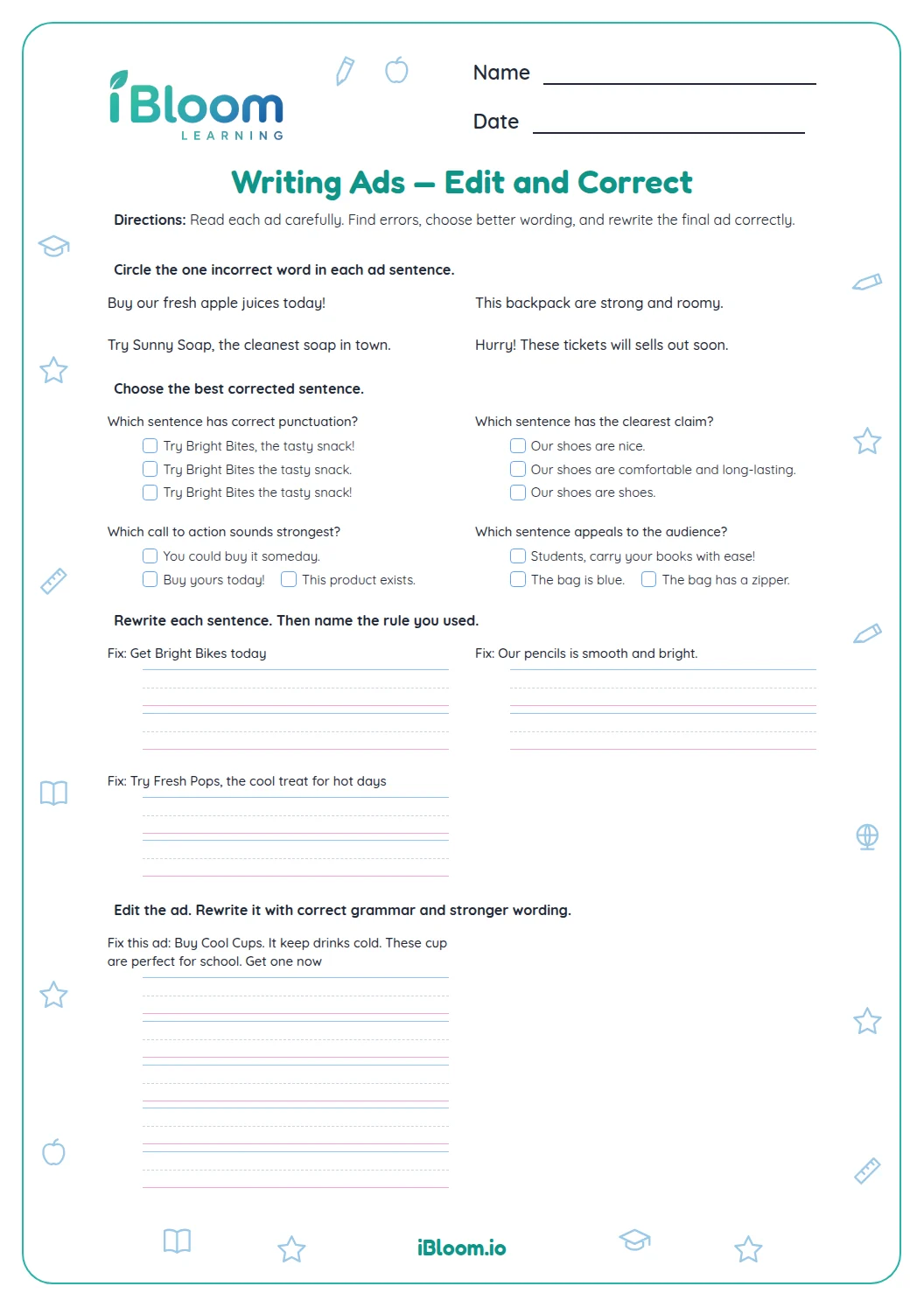
This Grade 5 printable moves from noticing how ads persuade to applying those choices in original copy. Students identify benefits, checkable facts, slogans, audiences and exaggeration, then choose details that make a claim useful and realistic. The final two prompts ask them to write short ads for everyday products, including reasons and a call to action. The answer key includes sample responses. The sequence mirrors a simple writing routine: plan for a reader, write, and check the claim.
Aligned to W.5.1.a
What makes an ad clear and convincing?
A useful ad names something the reader cares about, then gives a benefit and a specific detail. “Two roomy pockets” is a detail; “carry your books neatly” explains why it matters.
The first six questions ask students to distinguish checkable facts from unsupported boasts, and memorable slogans from plain descriptions. Four more choices review the words benefit, slogan, fact and audience.
- Benefit: why the product may help
- Fact: a detail a reader can verify
- Audience: the people the ad addresses
Which ad words should students recognize?
Questions 7–10 connect benefit, slogan, fact and audience to their meanings. Questions 13–16 then ask students to choose realistic claims, useful details and a direct call to action.
- 1A specific fact is easier to check than a broad boast.
- 2The word that completes the sentence is “fact.”
How can students write an ad for a real reader?
The final two prompts ask students to make a short ad for a named product and audience. One asks for two reasons and a call to action; the other asks for a reason and a call to action. A strong response gives concrete details without promising more than the product can deliver.
For the water bottle, “holds 20 ounces” is checkable; “best bottle ever” is an unsupported claim.
How to use this worksheet
- 1Read each question and identify the audience or goal it names.
- 2Finish the six ad-reading choices before moving to key terms.
- 3For each writing prompt, jot down one benefit and one true detail.
- 4Write the short ad in complete sentences or a memorable slogan as requested.
- 5Check that each claim sounds realistic and fits the intended reader.
Common mistakes and quick fixes
The mistake
Using a huge boast instead of a useful fact.
The fix
Replace “best ever” with a detail the reader could check.
The mistake
Naming a feature without explaining its benefit.
The fix
Tell how the feature helps the audience.
The mistake
Writing to everyone at once.
The fix
Use a detail or word that speaks directly to the named reader.
Common Core alignment
The writing prompts ask students to shape an opinion for a specific audience.
Introduce a product, audience and opinion with an organized ad.
On this sheet: Students organize an ad around a product benefit and intended reader.
Show the official wordingHide the official wording
Introduce a topic or text clearly, state an opinion, and create an organizational structure in which ideas are logically grouped to support the writer’s purpose.
What to practice next
Make more practice
Further reading
Questions parents and teachers ask
What is the difference between a feature and a benefit?
Students answer 14 multiple-choice questions about ad features and claims, then write two short ads. One prompt is for a reusable water bottle and asks for two reasons plus a call to action; the other is for an art kit for young artists and asks for a reason and a call to action.
Why does the worksheet ask about the audience?
The audience is the group an ad hopes to reach. A line for young artists can mention keeping markers together, while a reading-light ad can focus on aiming light at a page. Naming the audience helps students choose details that feel relevant.
What counts as a checkable fact in an ad?
A checkable fact is a specific detail a reader could verify, such as a bottle holding 20 ounces or a case having a zipper. A statement such as “the greatest product ever” is an opinion or boast, not a measurable product detail.
How long should each student ad be?
The prompts call for short ad copy rather than a full essay. Two focused sentences can state a claim, offer reasons and finish with a call to action. The art-kit prompt names young artists as the audience, so the reason and invitation should fit them.
How should I use the sample answers?
Treat the answers as models, not the only possible wording. Students may invent different product details if they remain plausible and answer the prompt, including the requested reasons and call to action. Ask them to point out the benefit, fact or audience in their response before checking it.