

About this worksheet
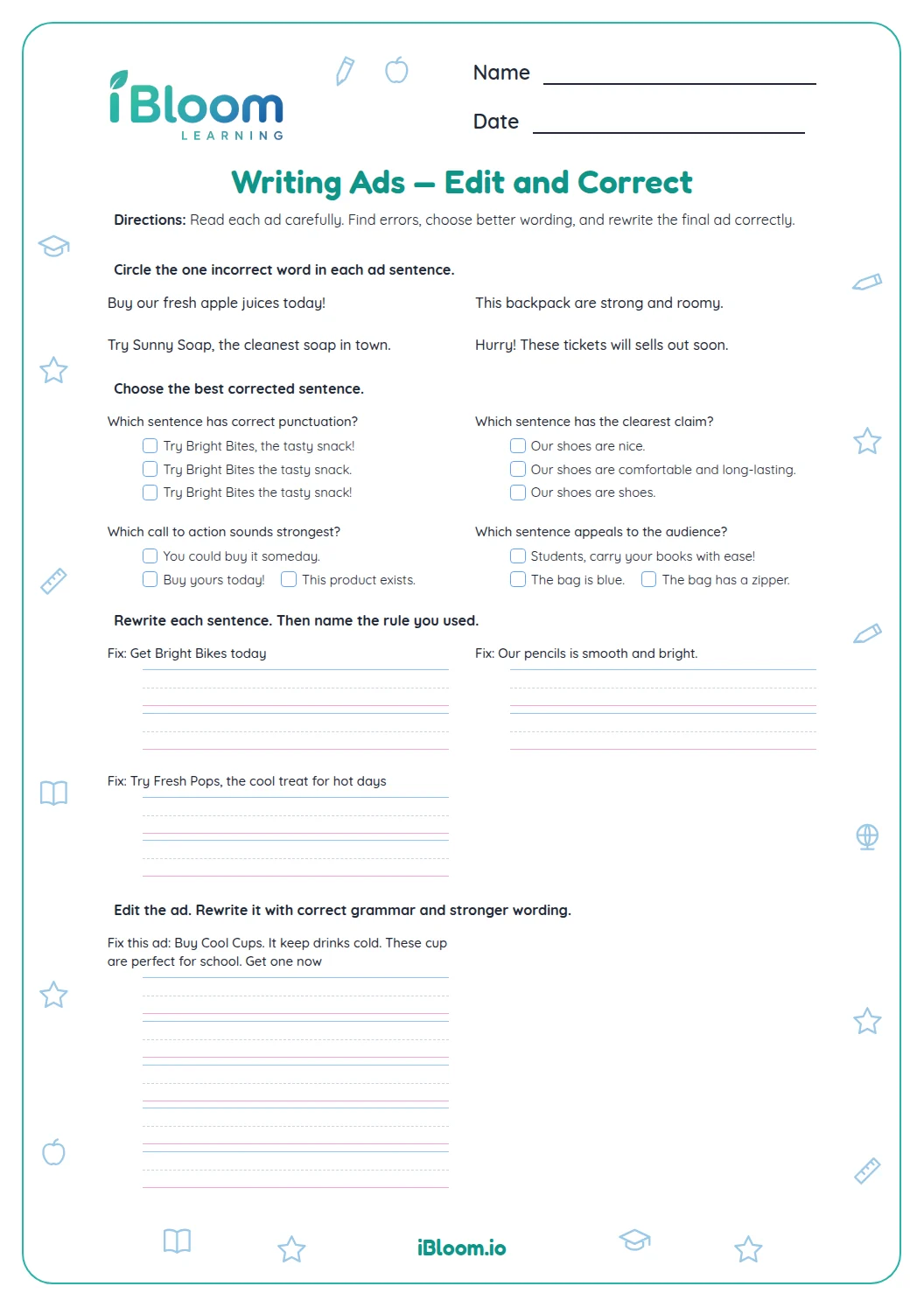
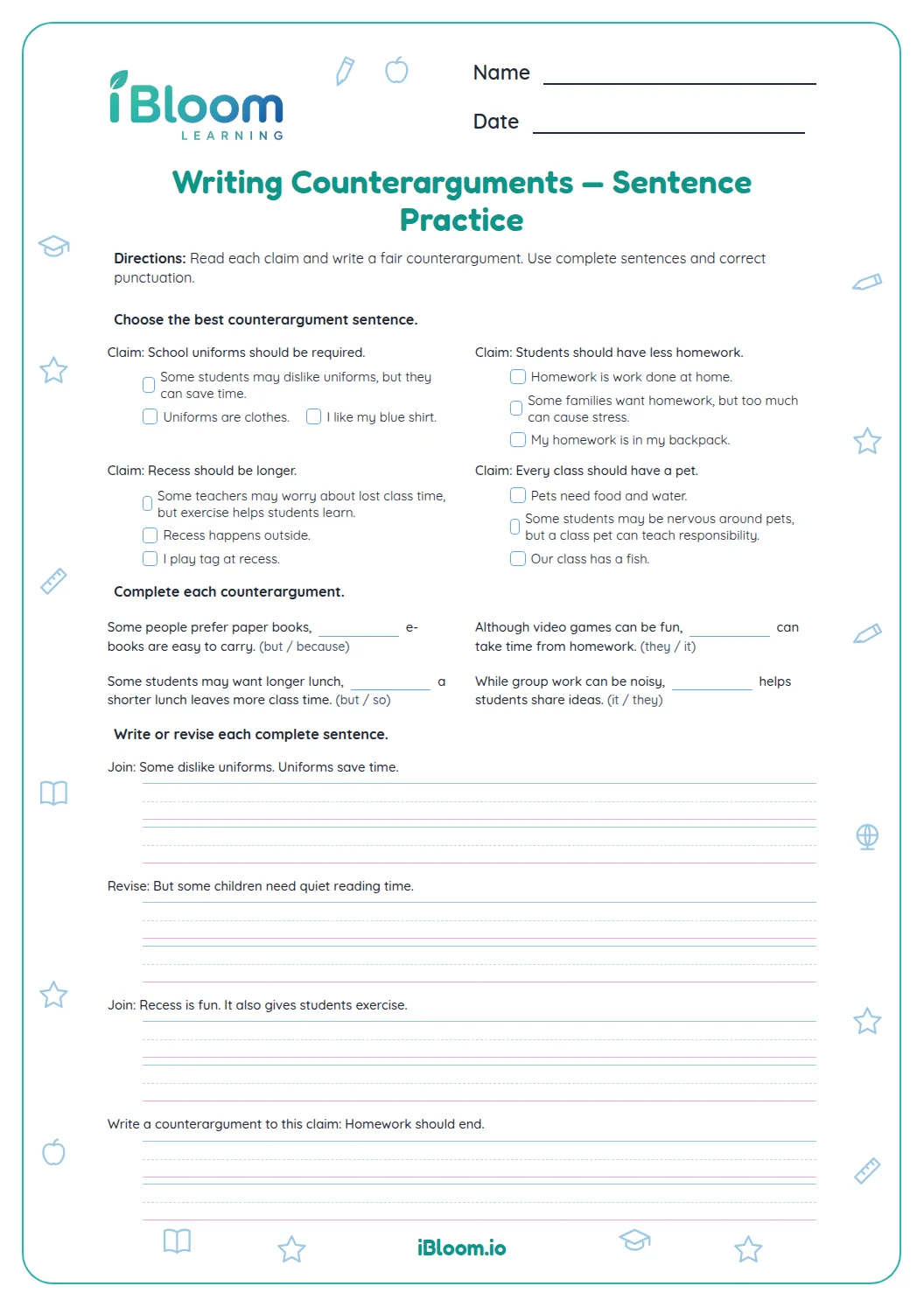
This printable guides Grade 5 students through writing short persuasive ad lines. They identify features and benefits, choose specific and believable reasons, complete claims, and write audience-focused lines with a call to action. The answer key models the fixed-choice answers and gives examples for open responses.
Aligned to 5.W.1
How is a feature different from a benefit?
A feature states what a product has; a benefit explains how that feature may help the audience. “The bottle holds 20 ounces” is a feature. “Carry books comfortably all day” names a benefit.
- 1The bottle holds 20 ounces.
- 2This names a product feature.
What makes an ad claim believable?
Use a detail that can be checked and avoid promises about what everyone will think. “80 ruled pages” is specific; “every student will love this kit” overpromises.
How does a call to action guide the reader?
A call to action gives the audience a next step. “Visit Friday” invites readers to a book sale, while a garden-kit claim can explain that it helps students grow herbs.
How to use the worksheet
- 1Read the whole prompt before writing an answer.
- 2Use the method named in the part direction.
- 3Keep work lined up or organize it on the response lines.
- 4Use the answer key after attempting the page and revisit any missed step.
Common slips to check
The mistake
Calling every product detail a benefit
The fix
Ask whether the phrase says what the item has or how it helps the reader.
The mistake
Making a promise about everyone
The fix
Use a specific claim that can be supported instead of a universal promise.
The mistake
Ending without a next step
The fix
Add a clear invitation that tells the audience what to do.
Curriculum alignment
This worksheet practices a focused skill that supports grade-level learning.
Support an opinion with relevant reasons and information for an audience.
On this sheet: Support an opinion with relevant reasons and information for an audience.
Show the official wordingHide the official wording
Write opinion pieces on topics or texts, supporting a point of view with reasons and information.
What to practice next
Further reading
Questions parents and teachers ask
What is the difference between a feature and a benefit?
A feature tells what a product has or does; a benefit explains why that feature may help the audience. “The bottle holds 20 ounces” is a feature. “Carry enough water for practice” is a possible benefit. Questions 1 and 2 practice this distinction.
What makes an advertising claim believable?
A believable claim is specific and can be supported. “The notebook has 80 ruled pages” gives a checkable detail. “Every student will love this kit” promises too much to know. The first part asks students to distinguish useful reasons from overstatements.
What is a call to action?
A call to action tells the reader what to do next, such as visiting a book sale on Friday. It should fit the product and audience. The worksheet asks students to recognize one and then complete a short invitation of their own.
How many questions are on this worksheet?
There are 14 questions in three parts. Students analyze ad elements, complete two claims, and write three short ad lines for different audiences. The answer key gives examples for open responses; other clear, truthful wording can also work. The worksheet then asks students to complete related ad lines.
Does the worksheet ask students to write a full advertisement?
The final part guides students through short ad lines: a benefit, a call to action, and a benefit for a school garden club. These are building blocks for persuasive writing rather than a multi-paragraph essay. The prompts keep the audience and purpose visible.