



About this worksheet
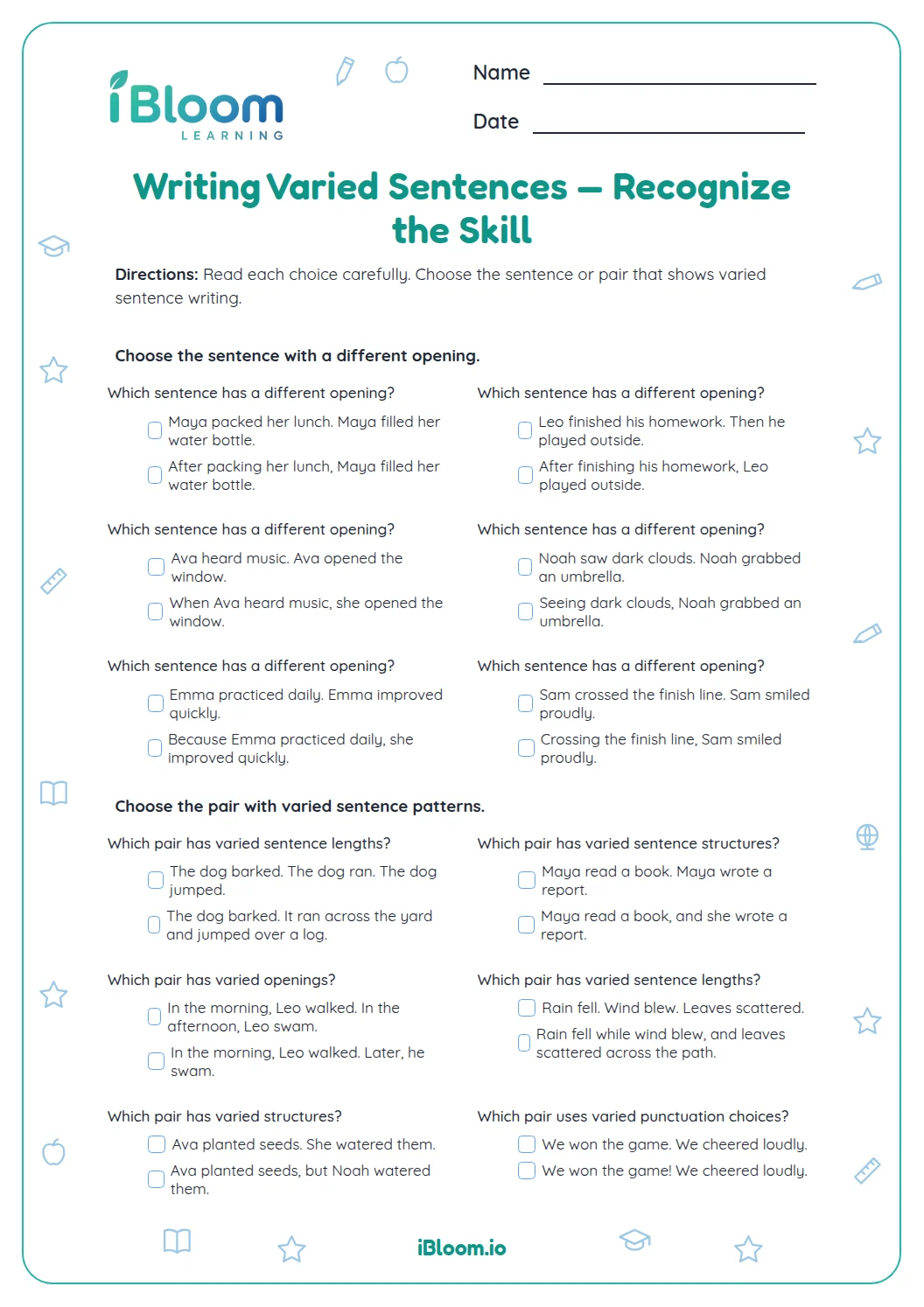
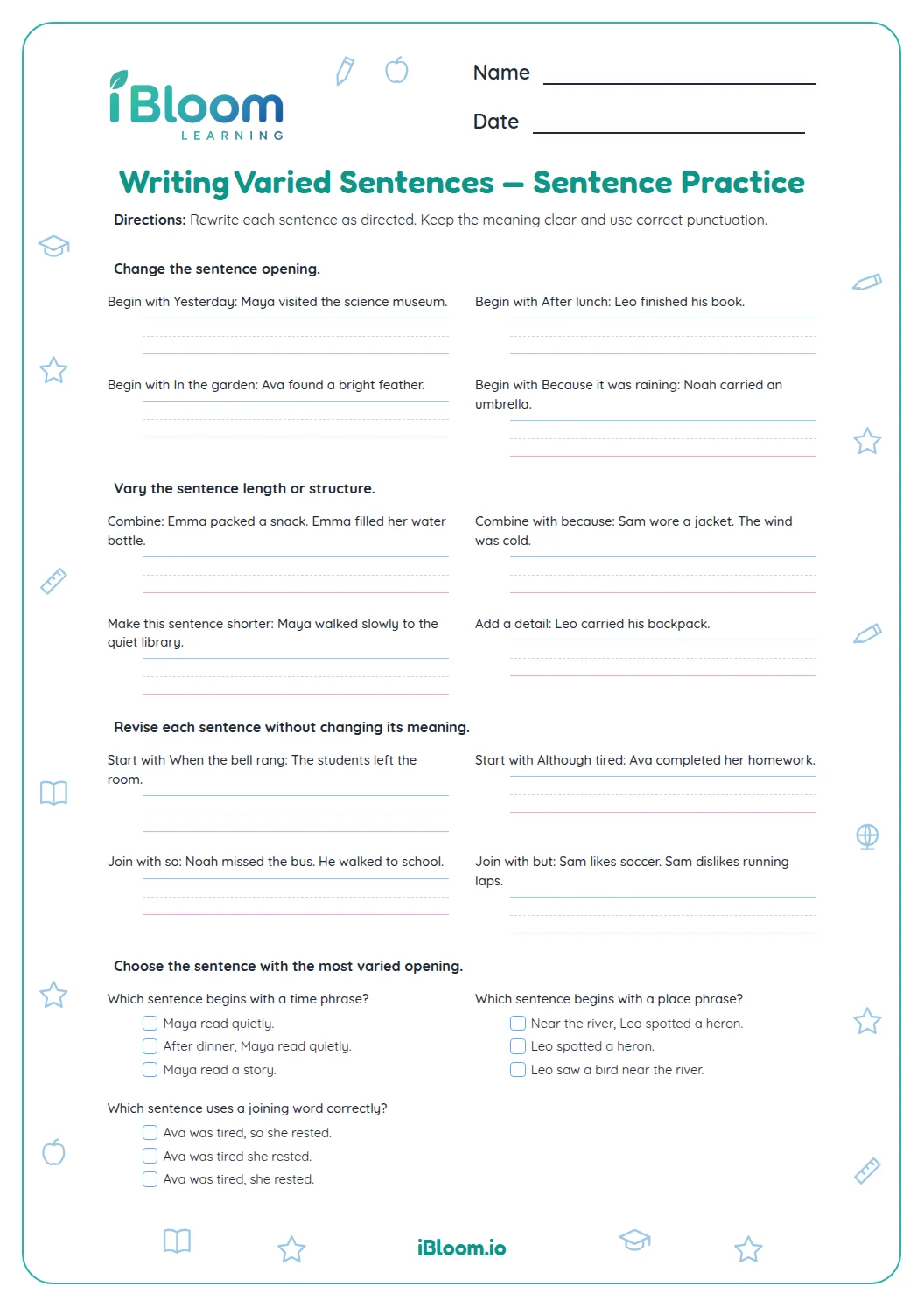
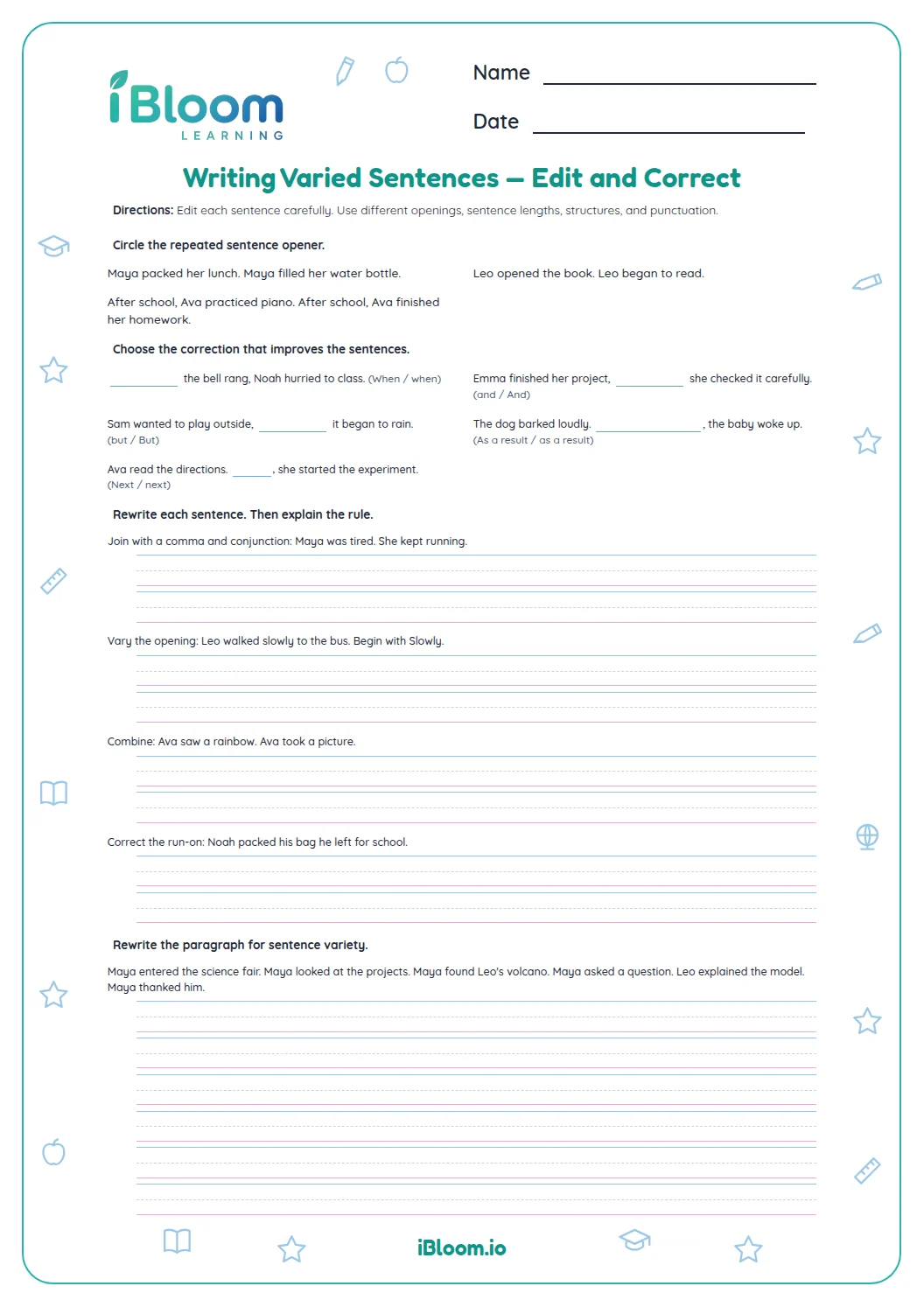
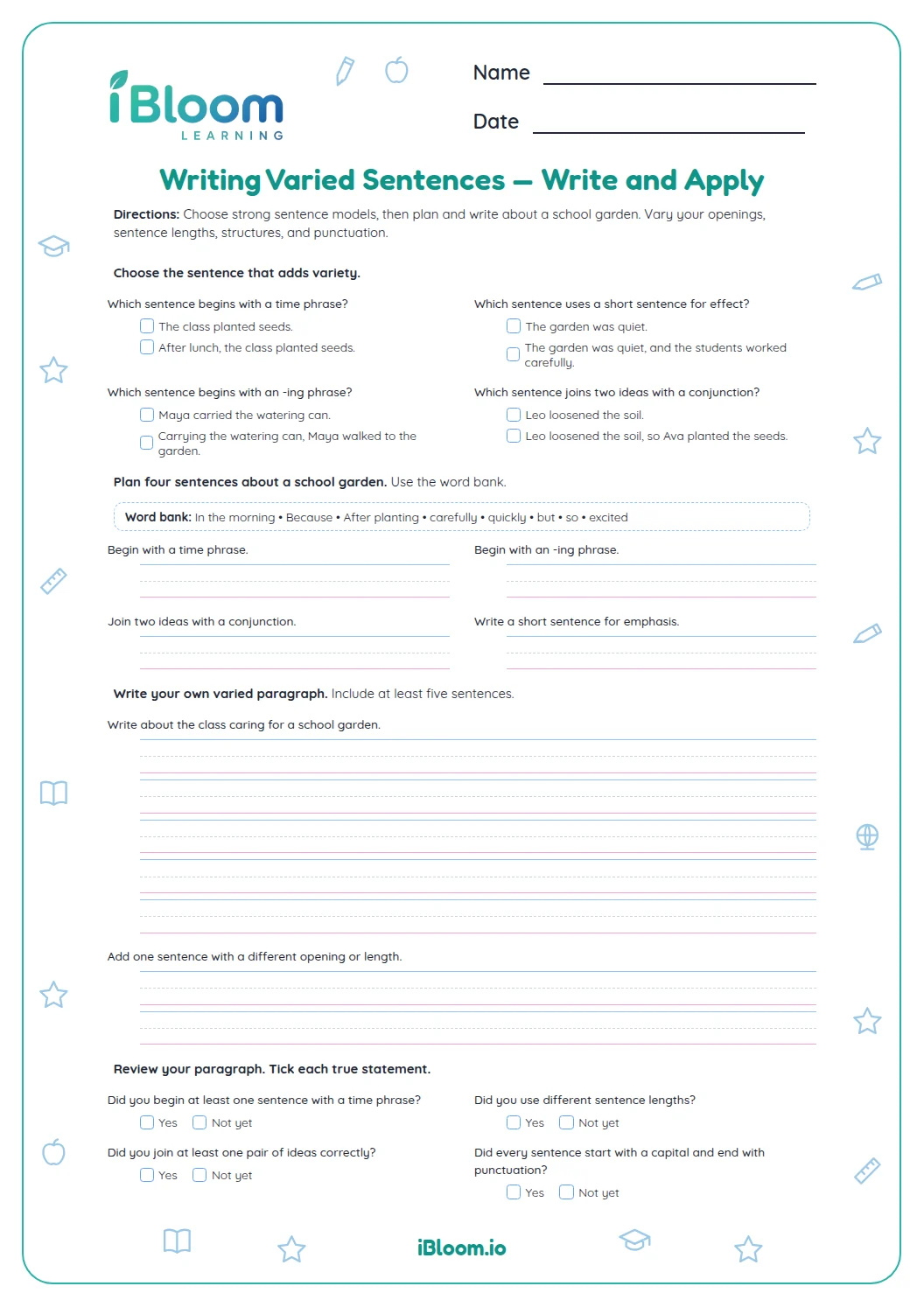
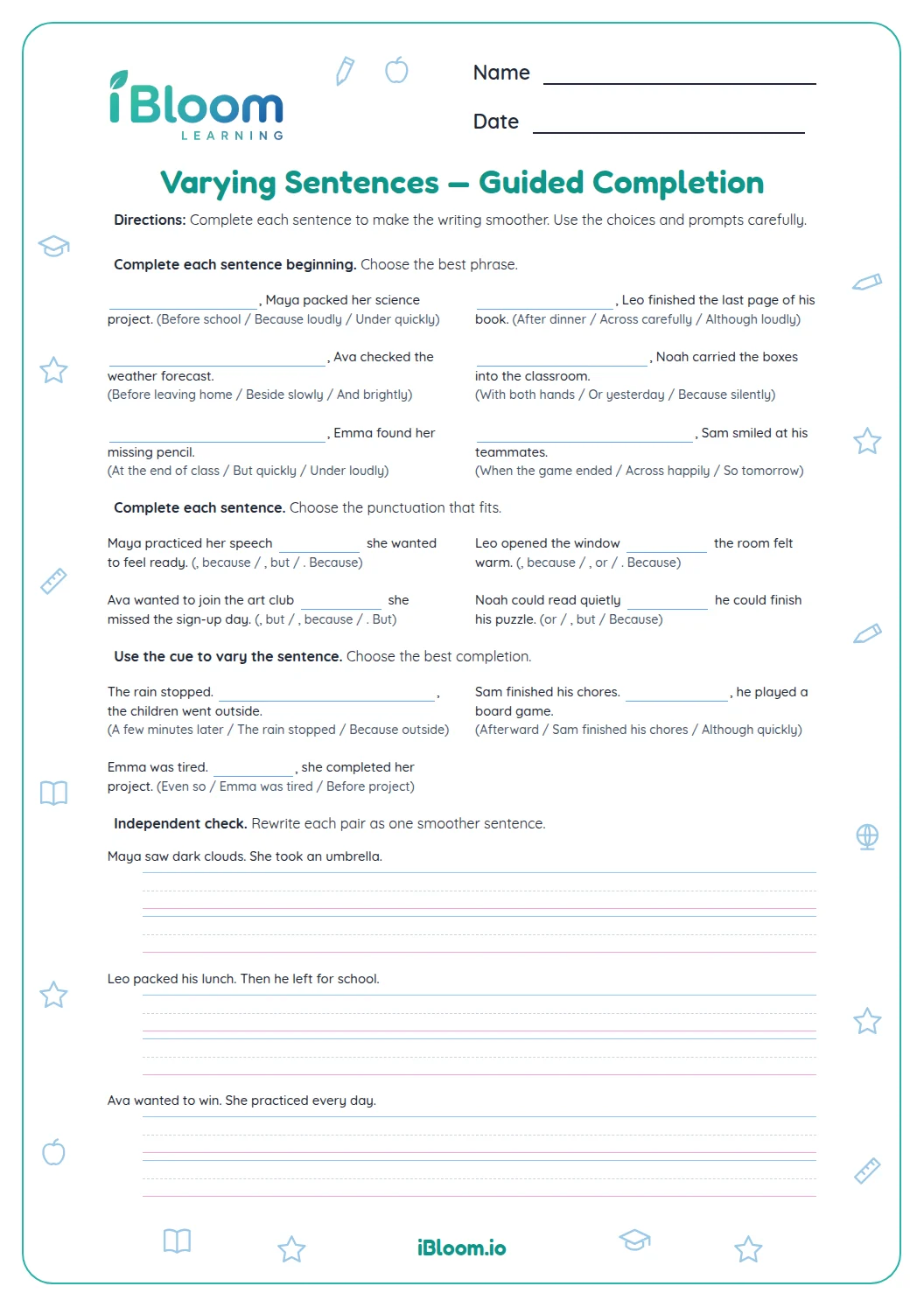
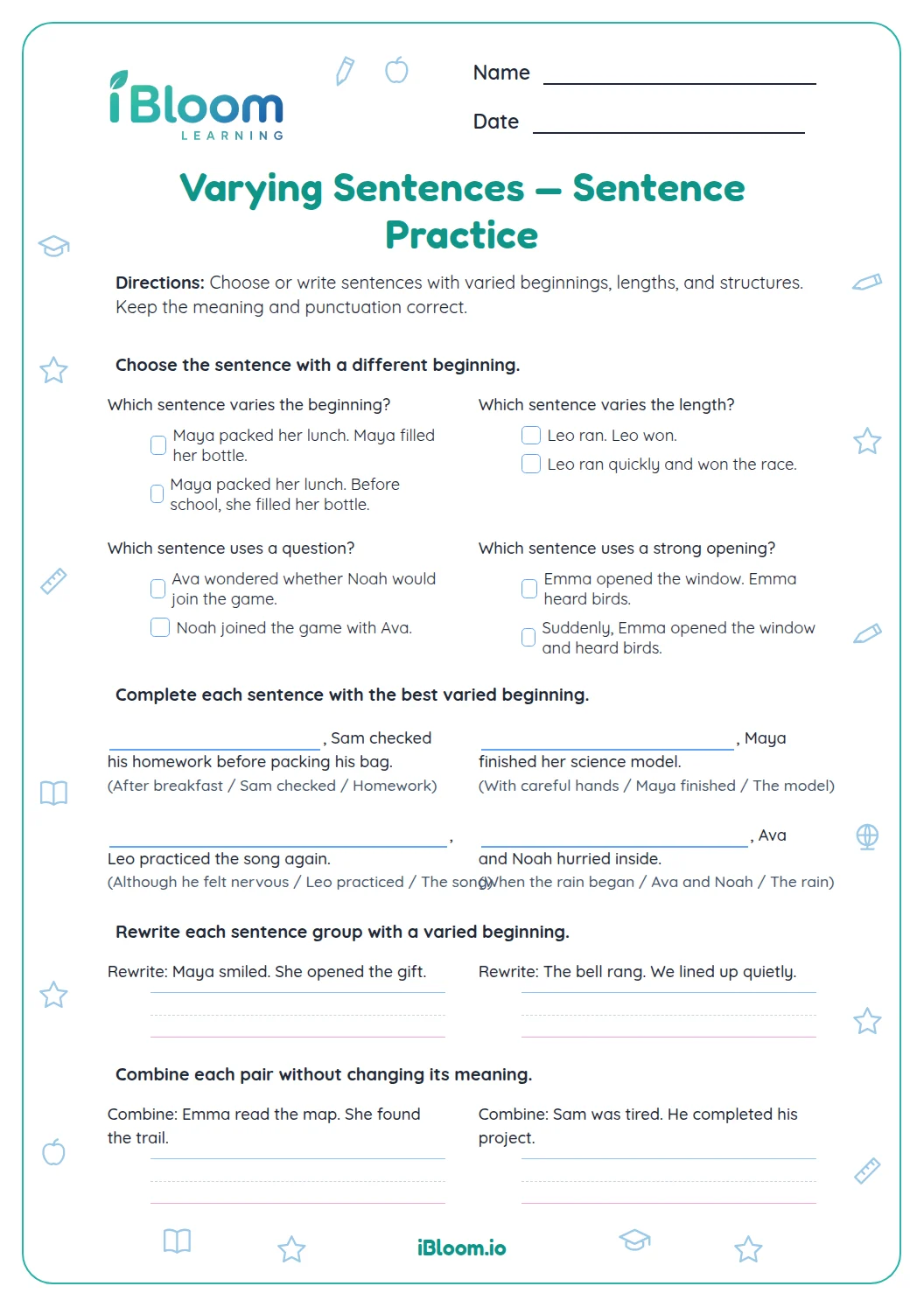
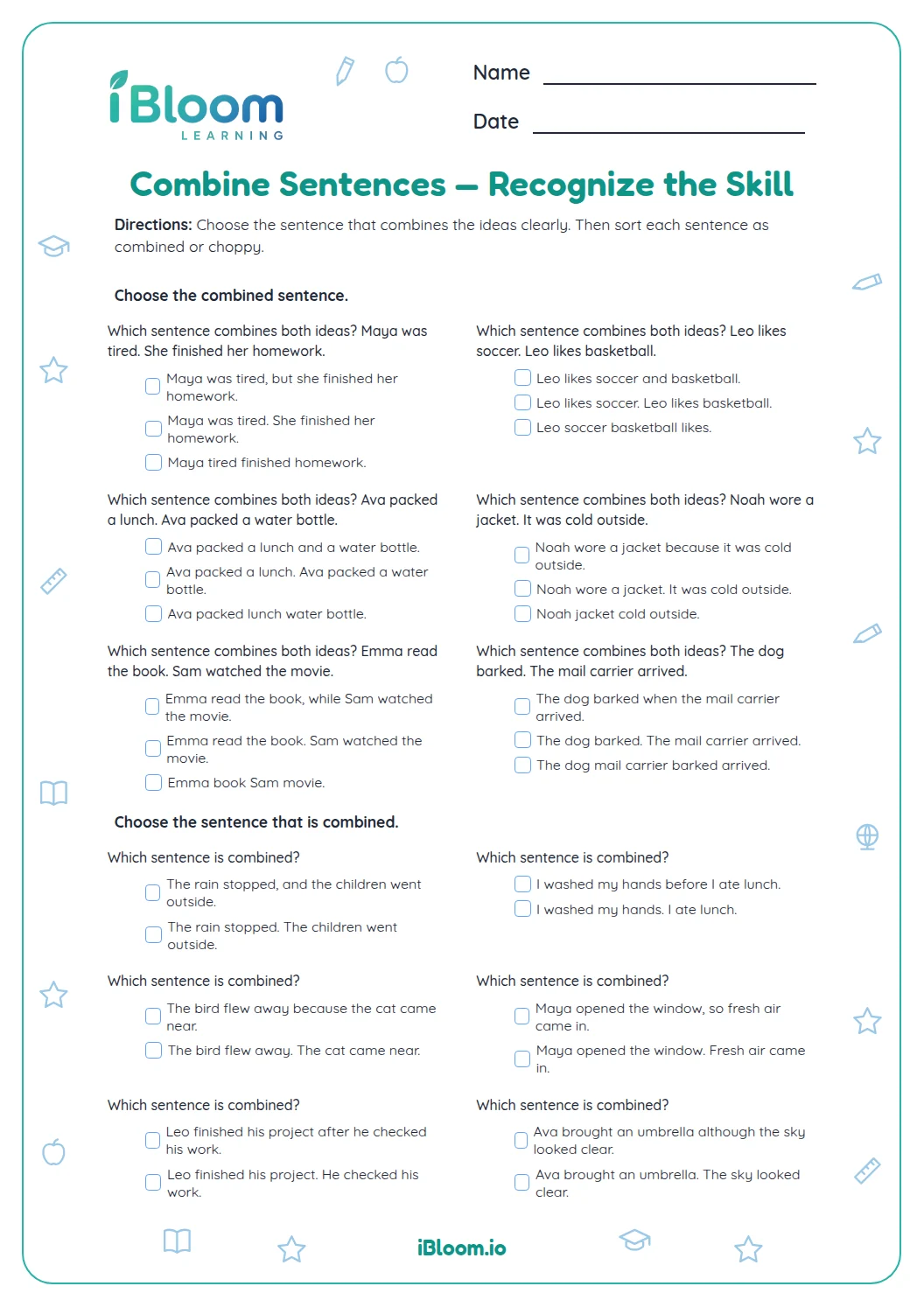
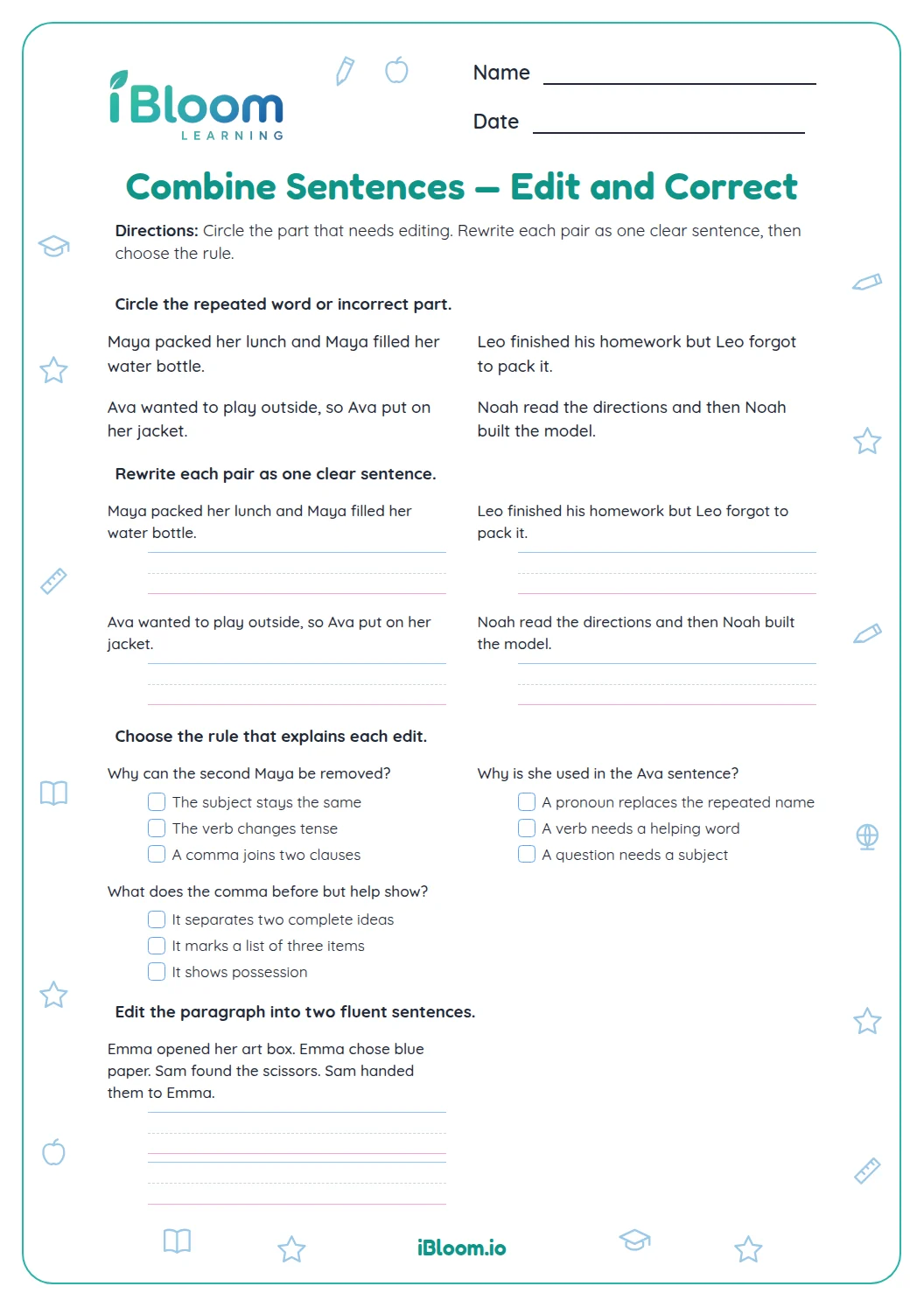
This Grade 5 sentence worksheet helps students notice and create variety in sentence openings and structure. Four multiple-choice questions focus attention on introductory phrases, compound sentences, and dependent clauses. Eight revision items and two short writing prompts ask students to combine related ideas and repair repetitive or choppy prose. A separate key includes model revisions while allowing other clear answers. The work aligns with CCSS L.5.3.a.
Aligned to L.5.3.a
What makes two sentence openings feel varied?
Writers can begin with the subject, a time phrase, or another introductory phrase. Variety helps a paragraph avoid a repeated rhythm, but every sentence still needs a clear subject and complete thought.
Question 2 contrasts two repeated “Mara” openings with the phrase “Before dawn.” The second beginning changes the rhythm while keeping the same topic.
- 1Mara packed the map. Before dawn, she filled the bottle.
- 2The second sentence opens with a time phrase.
How do conjunctions change the relationship between ideas?
A coordinating conjunction such as and, but, or so can join two complete ideas. A subordinating word such as when, although, or because makes one idea depend on another. Choose the connector that matches the meaning, not just the sentence length.
How can a revision smooth choppy writing?
A short pair may repeat a subject or describe one connected event twice. Combine the ideas if they belong together, then read the sentence aloud to check its rhythm. In question 8, “The lantern glowed and lit the path” removes the repeated subject while keeping both actions.
What should a varied sentence still do?
A varied sentence must remain clear. An introductory phrase should sit next to the person or thing doing that action. Question 13 begins “Carrying the sketchbook” and names Jalen right after it, so readers know who carried it.
How to use this worksheet
- 1Read the whole sentence, not just its first few words.
- 2Identify whether the ideas show time, contrast, cause, or a result.
- 3Choose a conjunction or opening phrase that signals that relationship.
- 4Keep a clear subject and verb in each complete thought.
- 5Read the revision aloud and check that the opening names the right actor.
Common mistakes and quick fixes
The mistake
Adding a comma but leaving the repeated opening unchanged.
The fix
Try a time phrase or combine the repeated ideas if they belong together.
The mistake
Using “although” without completing both ideas.
The fix
Make sure the dependent clause is joined to a complete main clause.
The mistake
Placing an introductory phrase beside the wrong subject.
The fix
Put the doer of the phrase immediately after the comma.
Curriculum alignment
The listed Common Core standard connects to the specific reading or writing work on this page.
Expand and combine sentences to support meaning, interest, and style.
On this sheet: The practice asks students to combine clauses and revise repetitive or choppy sentences for variety.
Show the official wordingHide the official wording
Expand, combine, and reduce sentences for meaning, reader/listener interest, and style.
What to practice next
Make more practice
Further reading
Questions parents and teachers ask
What is sentence variety?
Sentence variety means using different openings and structures while keeping ideas clear. A paragraph can mix a direct subject opening with a time phrase or a dependent clause. The four opening and structure questions ask students to recognize these patterns before they revise sentences themselves.
How can I tell a compound sentence from a complex sentence?
A compound sentence joins two complete thoughts, often with and, but, or so. A complex sentence joins a dependent clause to a complete clause, often with when, because, or although. Question 3 uses “When the bell rang” as the dependent part.
Should every sentence start differently?
No. Variation is a choice that helps writing flow, not a rule that every sentence must have a unique opening. Use a different structure when it makes the relationship between ideas clearer or improves the paragraph’s rhythm. The goal is a readable paragraph, not a different pattern every time.
What makes an introductory phrase clear?
The phrase should connect to the person or thing doing its action. In question 13, “Carrying the sketchbook” is followed by “Jalen,” the person carrying it. This avoids a dangling phrase that could make the reader wonder who did the action. Reading aloud can help catch a phrase attached to the wrong subject.
Can a student’s revision differ from the answer key?
Yes. The key gives model revisions, and several sentences can be correct. A different answer works if it keeps the original meaning, joins the ideas grammatically, and uses the structure requested in the prompt. The two writing responses also allow clear sentences that meet their directions.
What can we practice next?
The Combine Sentences page offers more practice joining related ideas, while Varying Sentences focuses on changing sentence patterns. Add Details Sentences is a useful next step when a sentence needs more precise information. These pages continue the same sentence-level work in a focused way.