
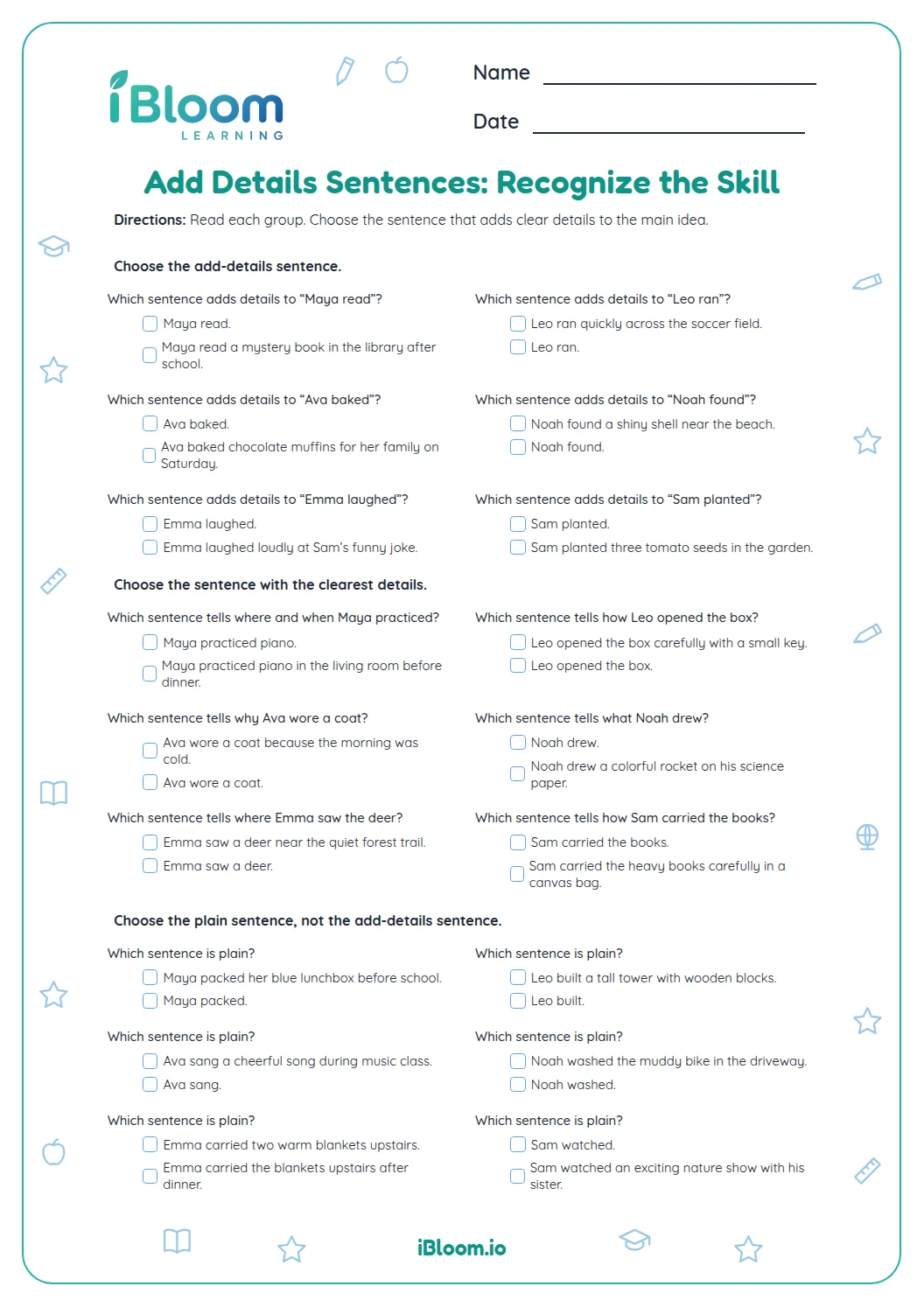
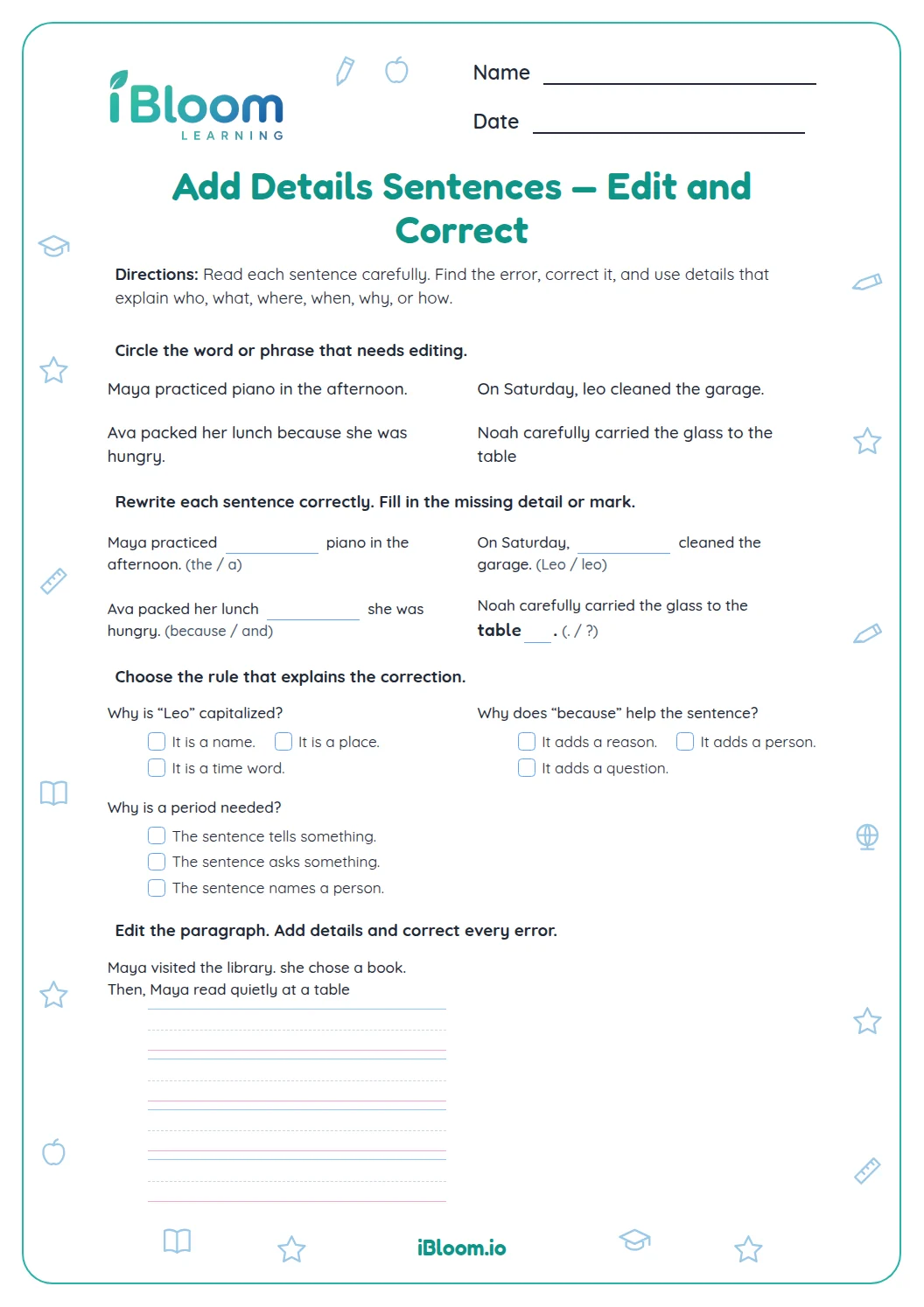
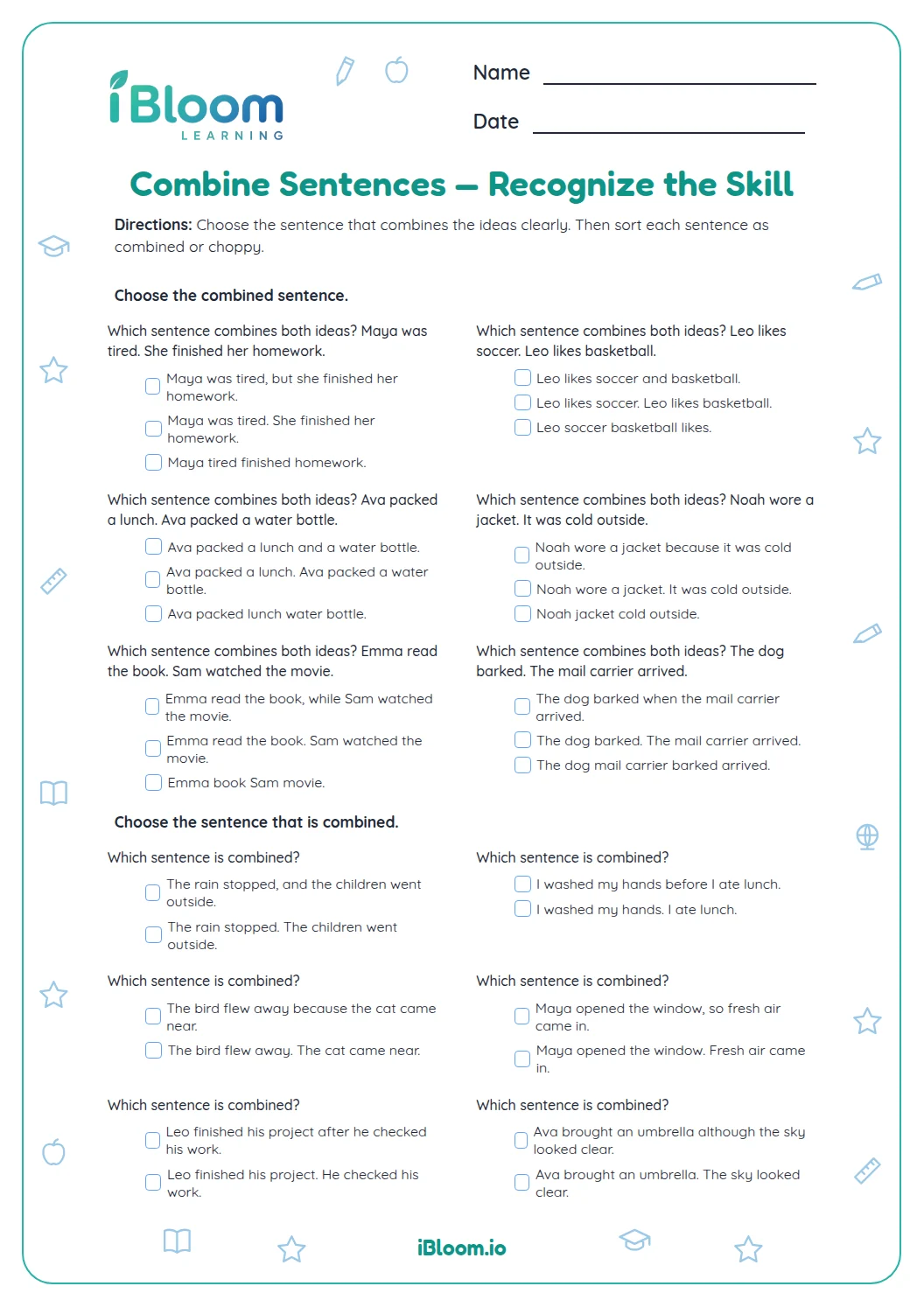
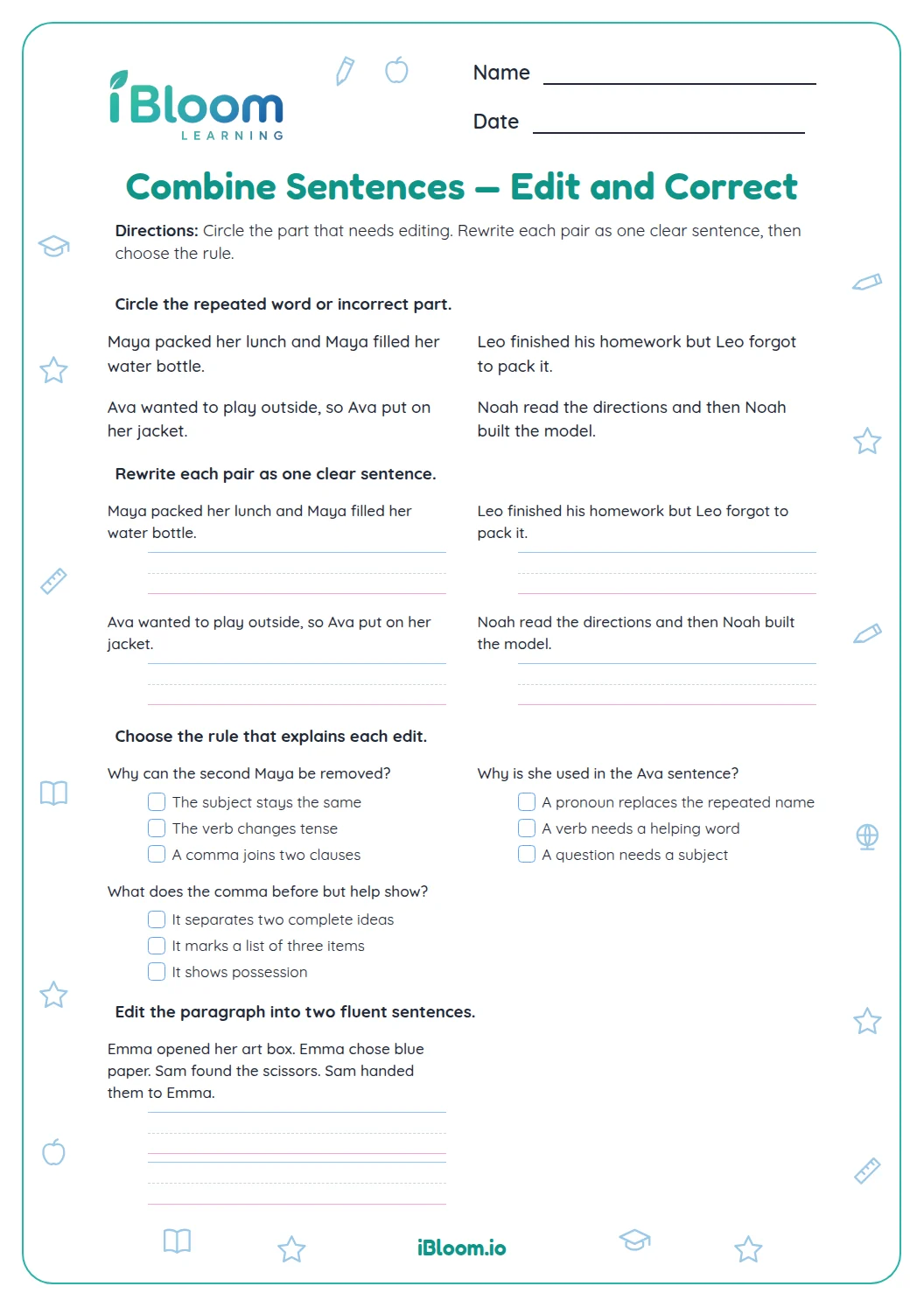

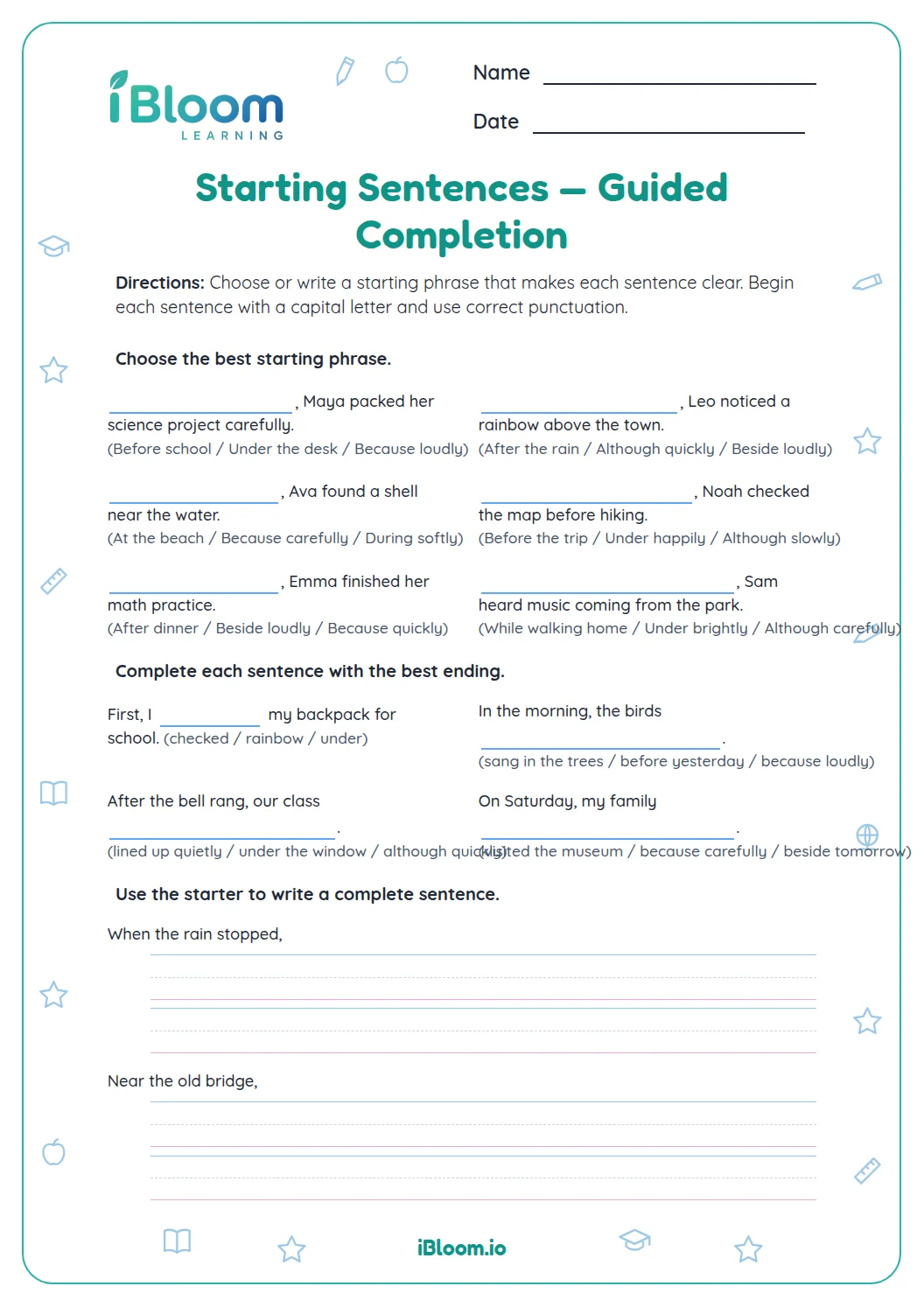
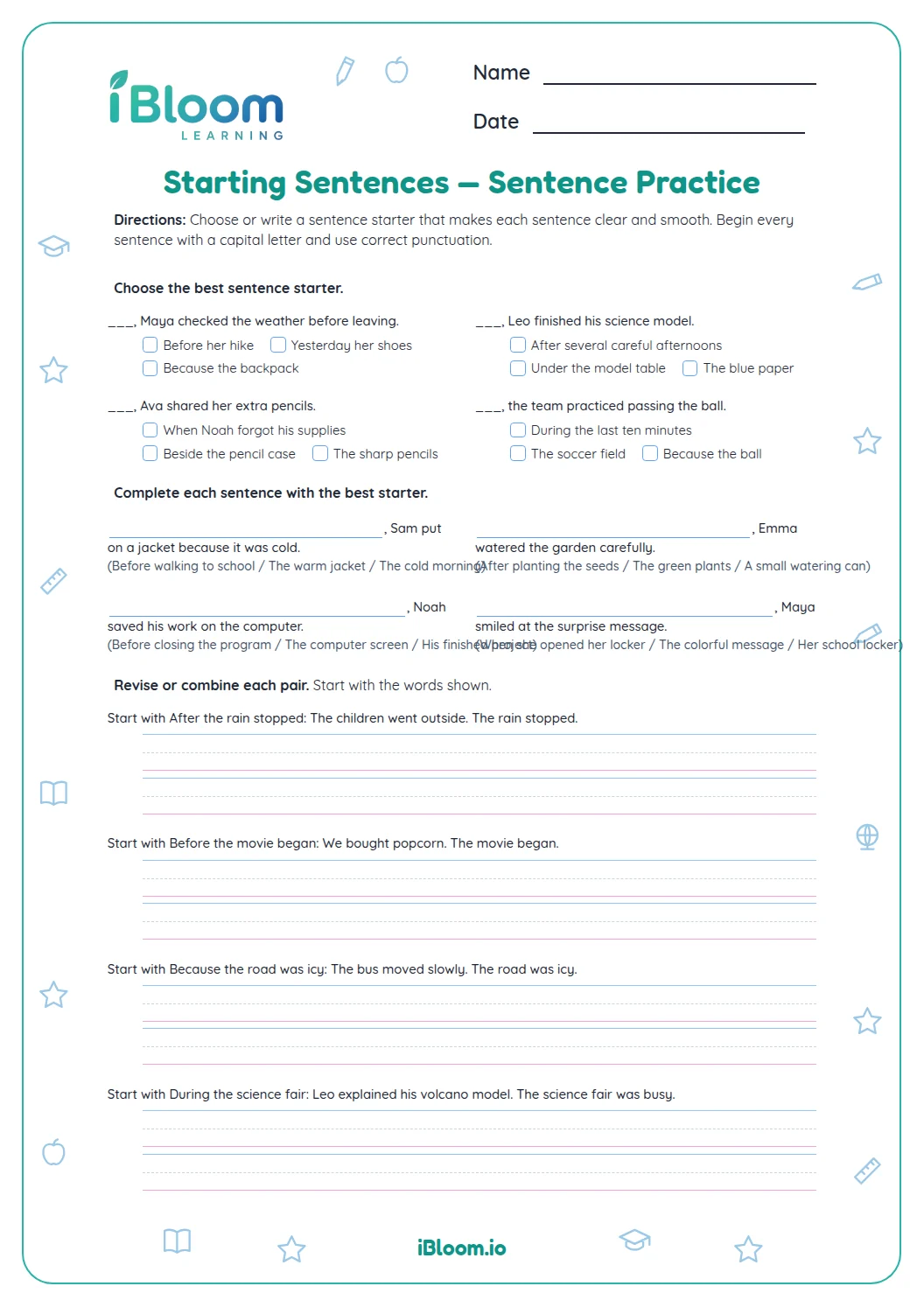
About this worksheet
This free Grade 5 worksheet helps students change sentence structure with a clear purpose. Part A supplies details to add to four sentence frames. Part B supplies conjunctions and pairs of ideas for four sentence-combining frames. Part C asks students to shorten two repetitive sentences and move the openings of two others. These twelve questions practice Common Core L.5.3.a: expanding, combining and reducing sentences for meaning and style. A separate answer key provides the eight frame completions and sample revisions for the four written responses.
Aligned to L.5.3.a
What makes sentence variety useful?
A detail can help a reader picture an action. A conjunction can explain how two ideas connect. A short sentence can state an idea directly. Sentence variety comes from choosing the structure that serves the meaning.
Part A makes those choices concrete: At dawn tells when, beside the pond tells where, with great care tells how, and bright yellow describes a kite. Students place each supplied phrase into its frame.
How do the combining frames guide students?
Part B gives two short sentences, a connecting word and a partially completed combined sentence. Students supply the missing clause. And adds an idea, but contrasts ideas, because gives a reason, and although introduces a contrast.
Read both original ideas before completing the frame. Keeping both meanings is more important than making the sentence longer.
- 1We stayed inside. Rain flooded the path.
- 2Frame: Because ___, we stayed inside.
- 3Complete it: Because rain flooded the path, we stayed inside.
- 4The opening clause gives the reason for staying inside.
How should we check the four written revisions?
Questions 9 and 10 remove repetition. Questions 11 and 12 move a location or time phrase to the front. Students write the full revised sentence, including a capital letter and ending punctuation.
The key marks these answers as samples. Accept another clear, grammatical sentence if it follows the requested opening, preserves the original idea and removes repetition where asked. Have the student read the original and revision aloud to compare them.
How to use this worksheet
- 1Read each supplied detail and name what it adds: when, where, how or description.
- 2Complete Part A without changing the given detail.
- 3Read both original sentences in each Part B question.
- 4Use the connecting word and sentence frame to join the ideas.
- 5Write full revisions for Part C, keeping the required openings.
- 6Compare with the key and read the revised sentences aloud for clarity.
Mistakes to notice and how to help
The mistake
Leaving a fragment such as Because rain flooded the path.
The fix
Attach the complete thought we stayed inside so the reason has an action to explain.
The mistake
Using but as if it means because.
The fix
Read the two ideas together. But signals a contrast; because introduces a reason.
The mistake
Shortening a sentence by deleting an important detail, such as red in the bike sentence.
The fix
Remove the repeated phrase is a bike that, but keep the bike’s color and its owner.
Common Core alignment
Expand, combine and shorten sentences, then vary their openings.
On this sheet: Students add meaningful details, join ideas with supplied conjunctions, remove repetition and change sentence openings.
Show the official wordingHide the official wording
Expand, combine, and reduce sentences for meaning, reader/listener interest, and style.
What to practice next
Make more practice
Further reading
Questions parents and teachers ask
Does this worksheet ask students to write a whole paragraph?
The sheet uses individual sentences so students can focus on one revision at a time. There are eight guided frame completions and four full sentence revisions. After checking, students can try the same techniques in a paragraph of their own by changing an opening or combining two related ideas.
Which connecting words do students use in Part B?
Students use and, but, because and although, with one word supplied for each question. Each frame shows where the word belongs. Have students explain whether the connection adds information, shows contrast or gives a reason before they fill the blank with the missing idea from the original sentences.
Can a written revision differ from the answer key?
Yes, the four Part C answers are samples. Accept a different sentence when it follows the requested opening, keeps the original meaning and is grammatically complete. For the shortening questions, also check that repeated wording has been removed. The supplied frames in Parts A and B have specific completions.
How do I explain the difference between expanding and padding?
Expanding adds a detail that helps the reader understand the action or picture the scene. In Part A, beside the pond tells where the frogs croaked. Repeating the same idea adds words without new information. Part C asks students to remove that kind of repetition from two sentences.
What should students check after moving a sentence opening?
Students should check that the new opening connects to a complete thought and that the meaning stays the same. In question 12, After the game moves to the front, followed by we walked home. Read the revised sentence aloud, then check its capital letter, comma and final period.