






About this worksheet
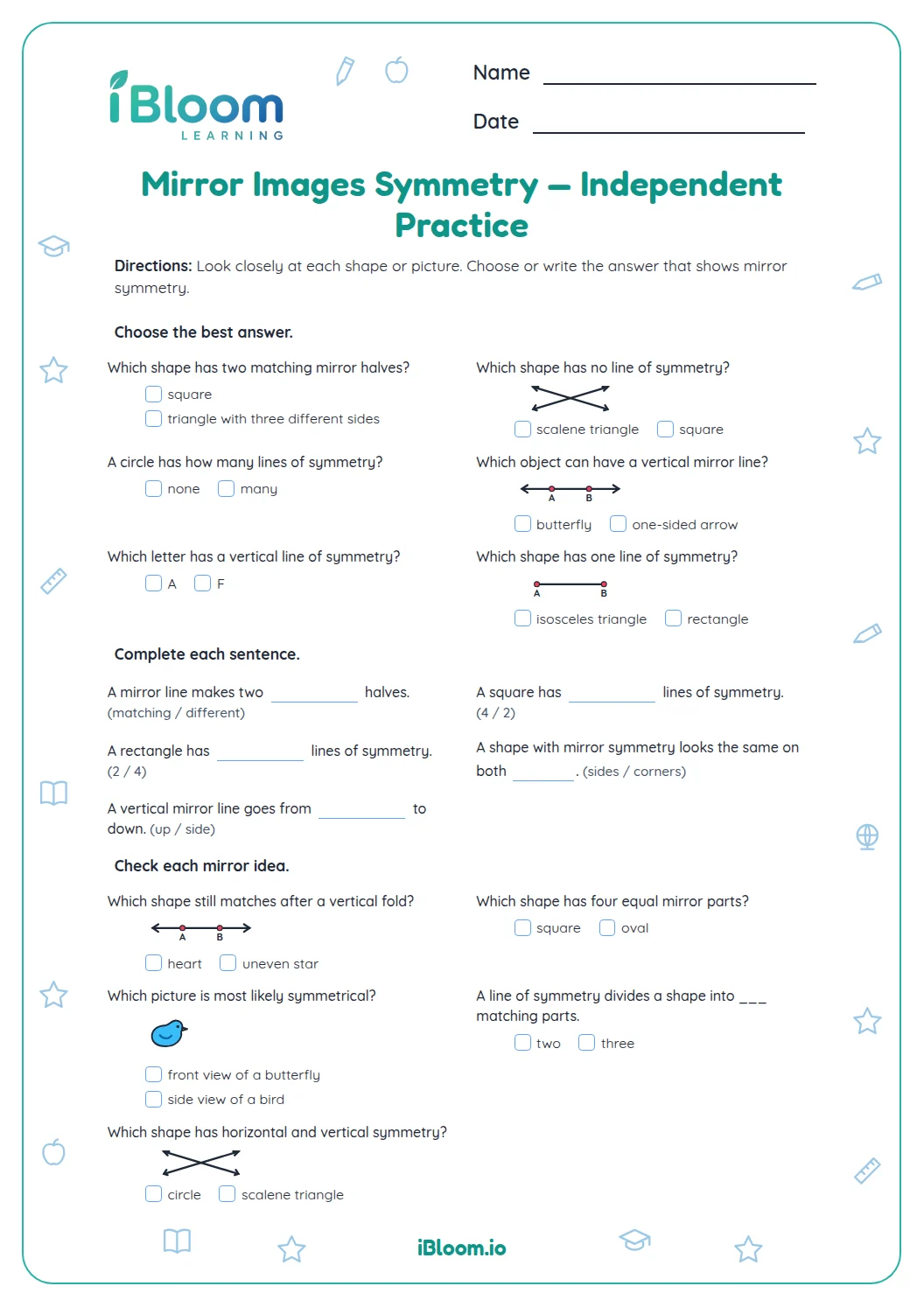
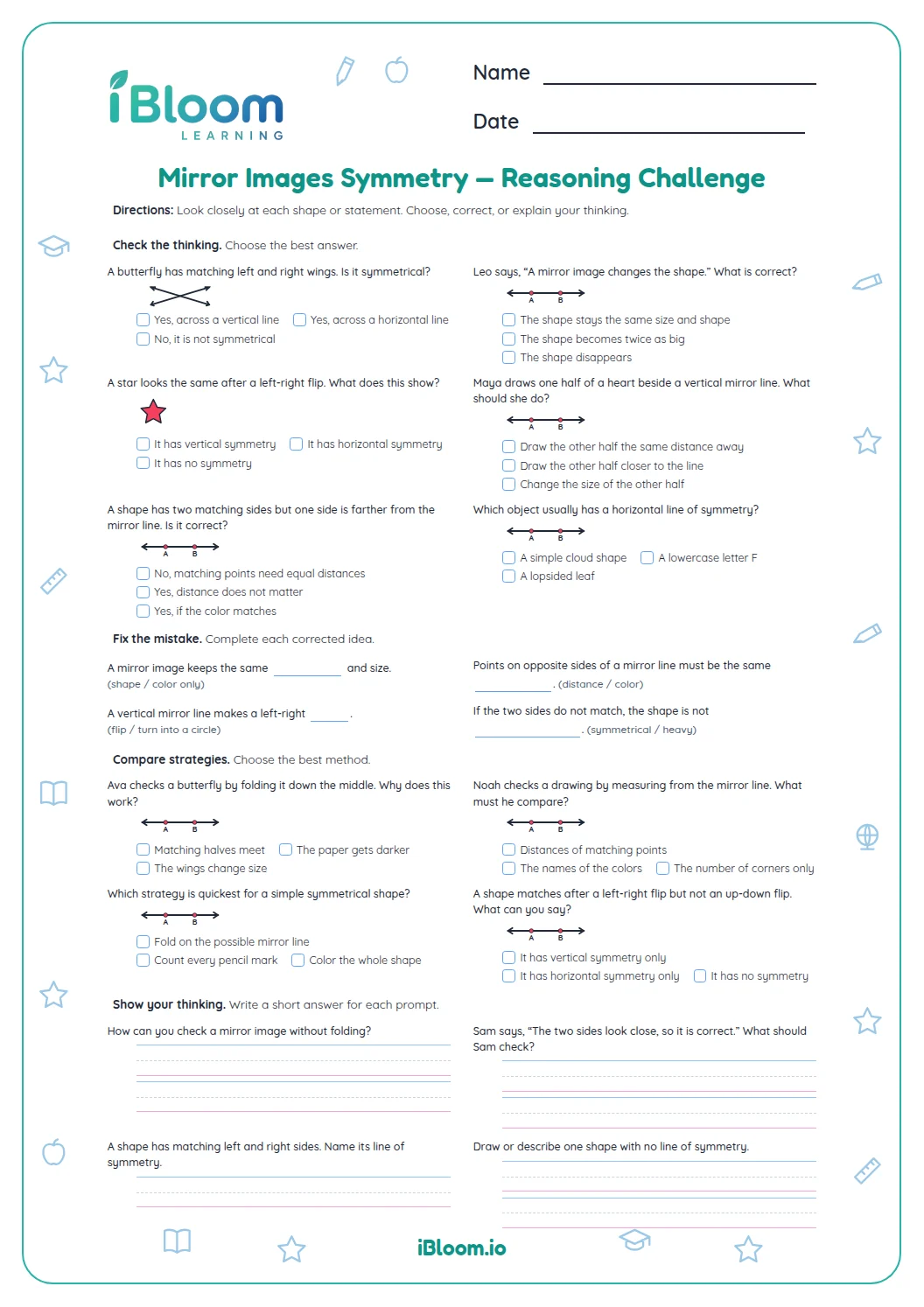
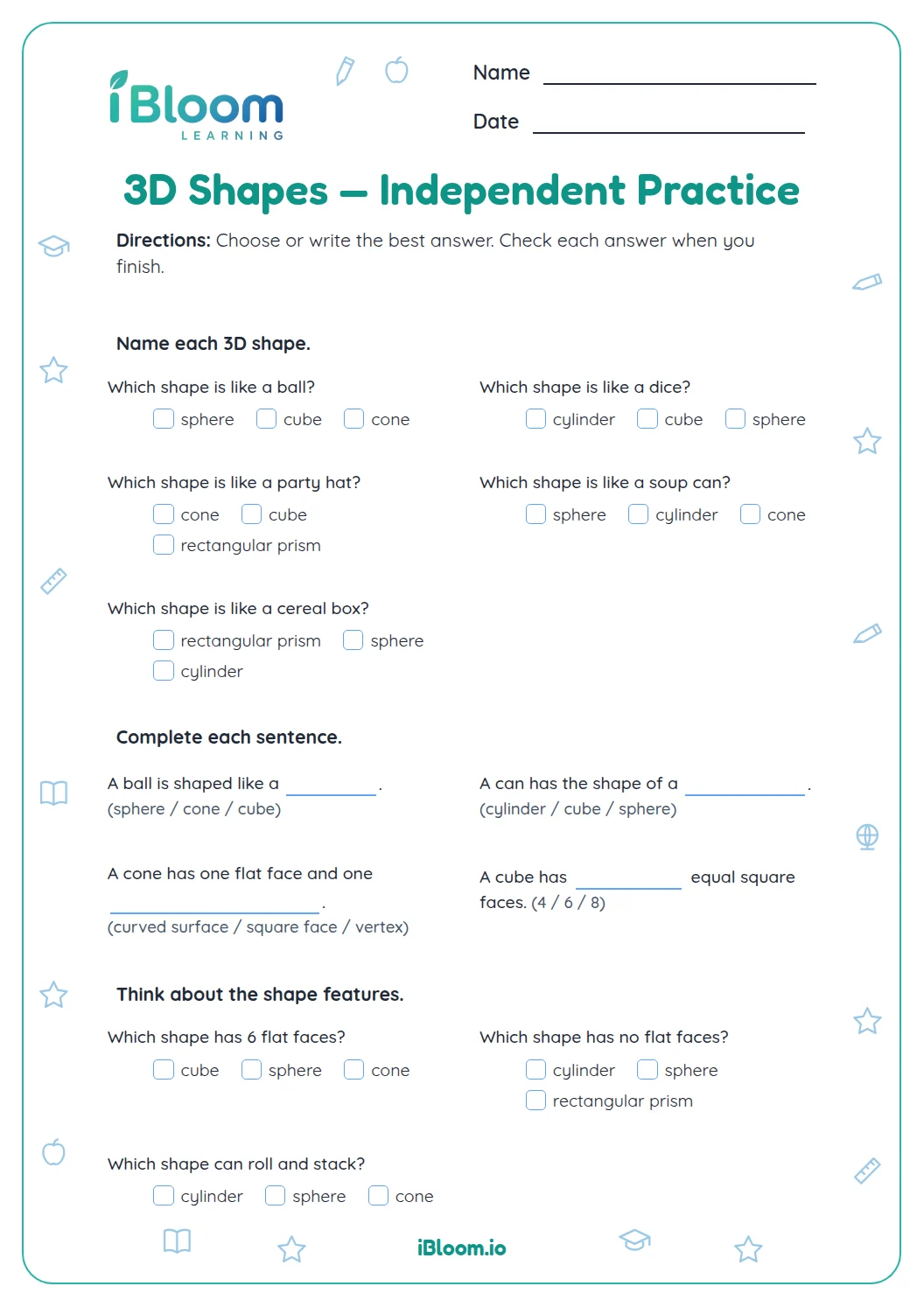
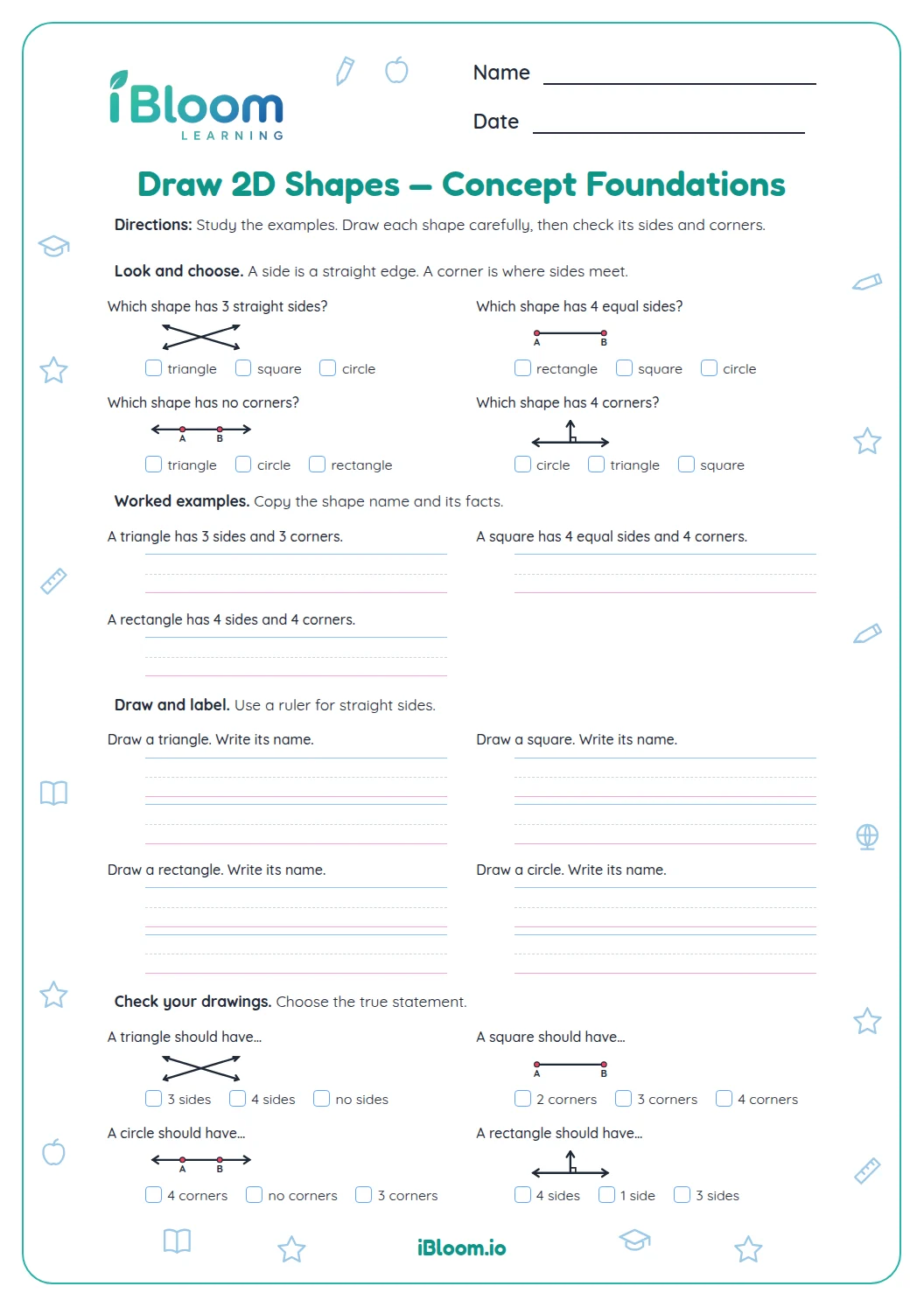
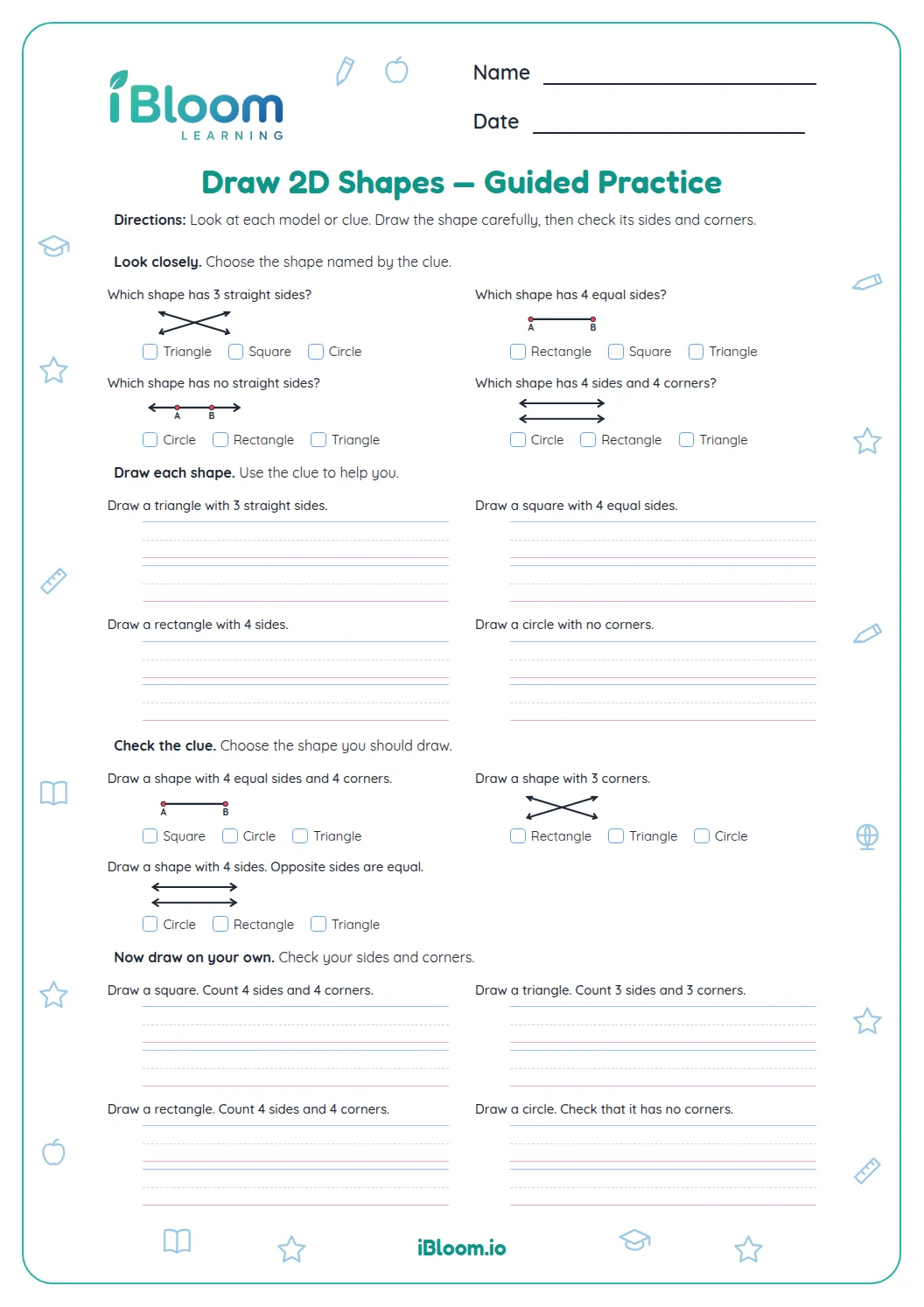
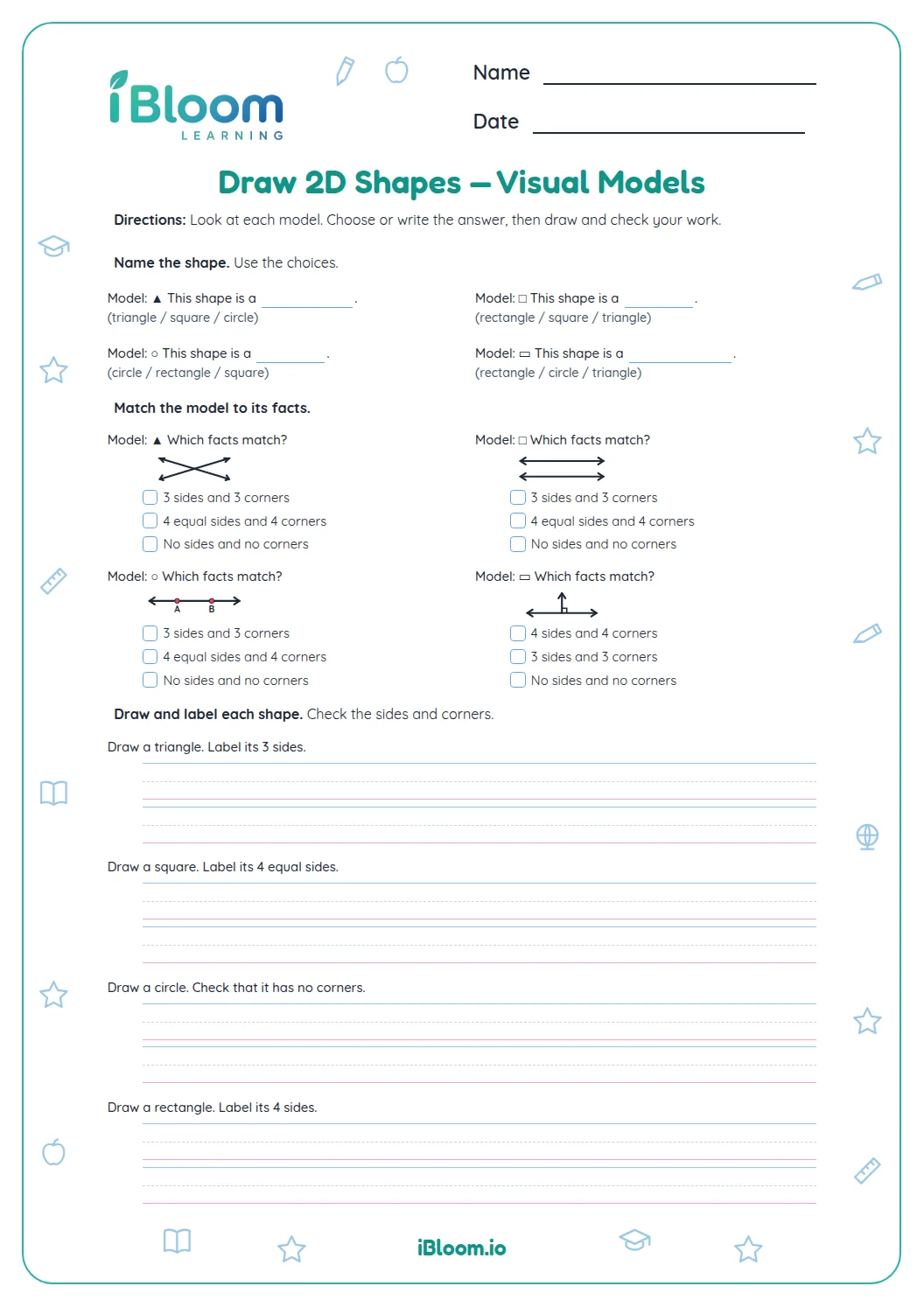
This free printable worksheet gives Grade 1 learners focused practice with shape attributes. Across 16 questions, children study symmetry in familiar shapes and explain matching halves., then use the answer key to check their work. The tasks move from direct practice to a short reasoning section so learners can explain how they know. The sheet aligns with 1.G.A.3: Partition circles and rectangles into two and four equal shares, describe the shares, and use the terms halves, fourths, and quarters. A worked example in the page text shows a way to approach a real question without giving away the full set.
What makes a line a line of symmetry?
It divides a shape into two halves that match when folded over the line. The questions begin with the meaning of a mirror image, then ask learners to count symmetry lines in named shapes.
- 1A square has ___ lines of symmetry.
- 2Imagine folding along each line that makes matching halves.
- 3Answer: 4
How can a child count a shape’s mirror lines?
Imagine folding the shape along a possible line. Keep the line only if both sides match exactly; count each different fold direction once. The diagram questions use mirror lines and equal spaces to make that check visible.
How can an adult help without giving away the answer?
Offer paper shapes to fold or let the learner trace a line through the middle of a shape. Ask, “Would the two sides land on each other?” Then have the learner compare the fold or diagram with the answer key.
How to use this worksheet
- 1Read the shape name or look at its diagram.
- 2Imagine folding along a possible mirror line.
- 3Check whether the two sides match exactly.
- 4Count each different line that makes matching halves.
- 5Use the answer key to check the count and reasoning.
Common mistakes and quick fixes
The mistake
Counting a line that does not split the shape into matching sides
The fix
Imagine folding on the line and compare both halves.
The mistake
Counting the same line twice
The fix
Count each different direction only once.
The mistake
Assuming every rectangle or triangle has the same symmetry
The fix
Use the specific shape and its marked features in the question.
What to practice next
Make more practice
Questions parents and teachers ask
How many questions are on this mirror symmetry worksheet?
There are 16 questions on two worksheet pages, followed by a separate answer key. The set practices mirror lines and matching halves in familiar shapes. Check the printed directions before beginning and use the key after completing the problems. The items move between practice formats.
What grade is this mirror symmetry practice for?
This worksheet is written for Grade 1. An adult may read a direction aloud, while the learner works through each item and explains a choice. The questions use the numbers, shapes, or situations printed on the page. The page is designed for independent practice.
Does the worksheet include an answer key?
Yes. A separate answer key follows the two worksheet pages. Let the learner try the questions first, then compare each result with the key. For a missed answer, return to the original item and check the steps or diagram. Use the printed steps for checking.
How can I help a child who gets stuck?
Offer paper shapes to fold. Ask, “Would the two sides land on each other?” Then compare the fold with the answer key. Let the learner explain the count in their own words. This gives the learner a simple way to check each shape.
How long does this worksheet take?
Plan for about 20 minutes, with extra time if the learner writes out steps or checks answers carefully. Work through one part at a time and pause between sections if helpful. The worksheet can also be completed over more than one sitting.