
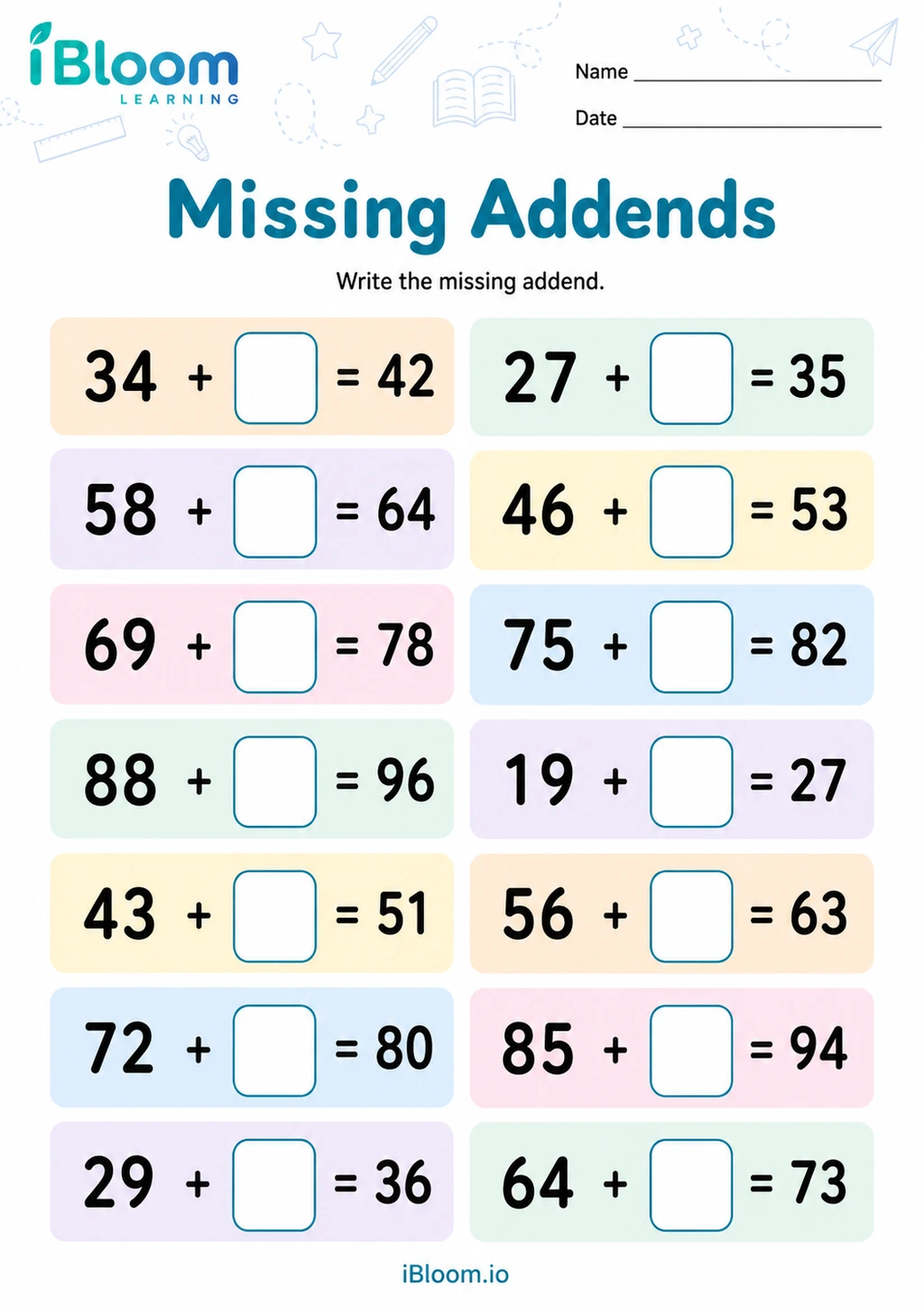
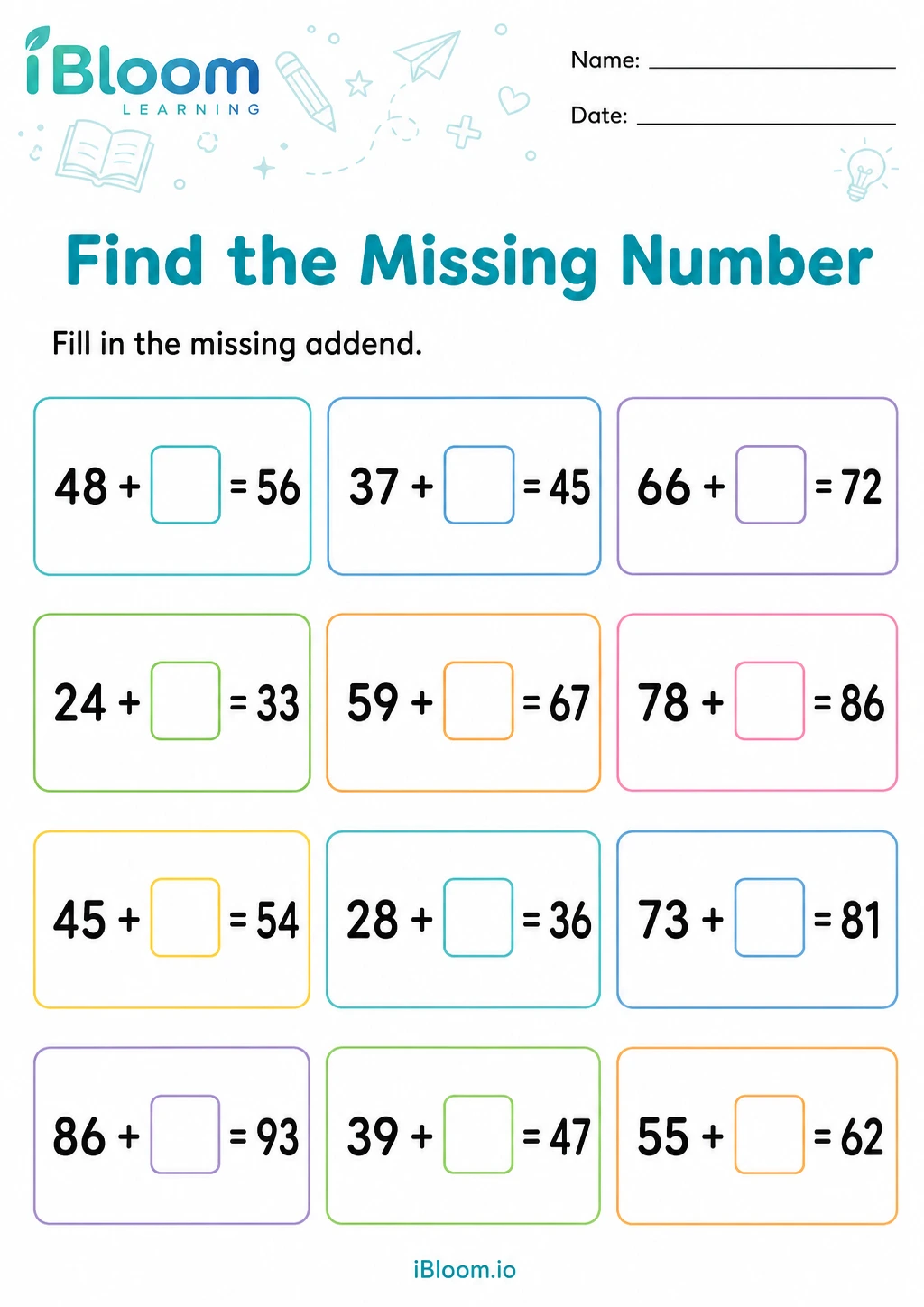
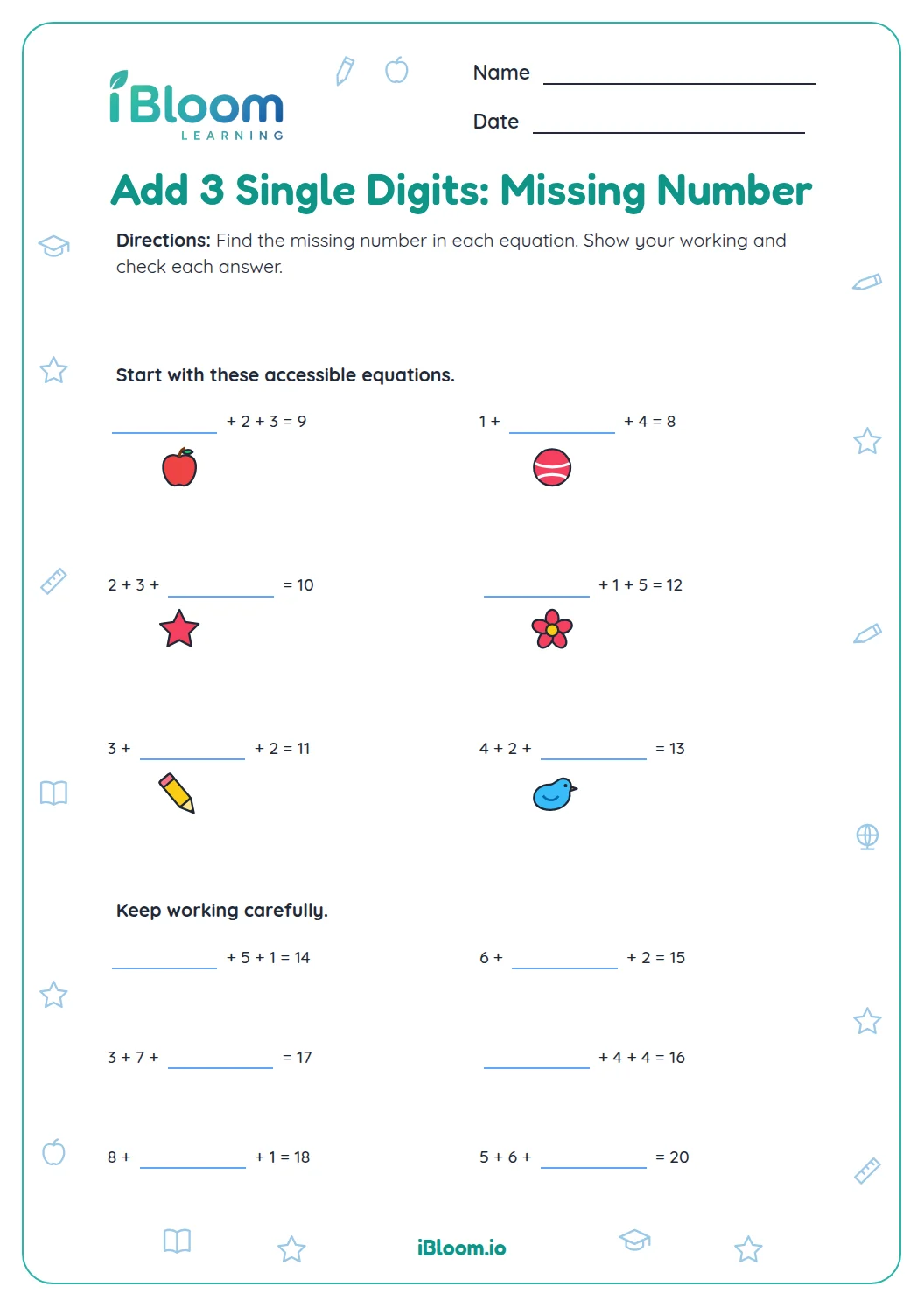
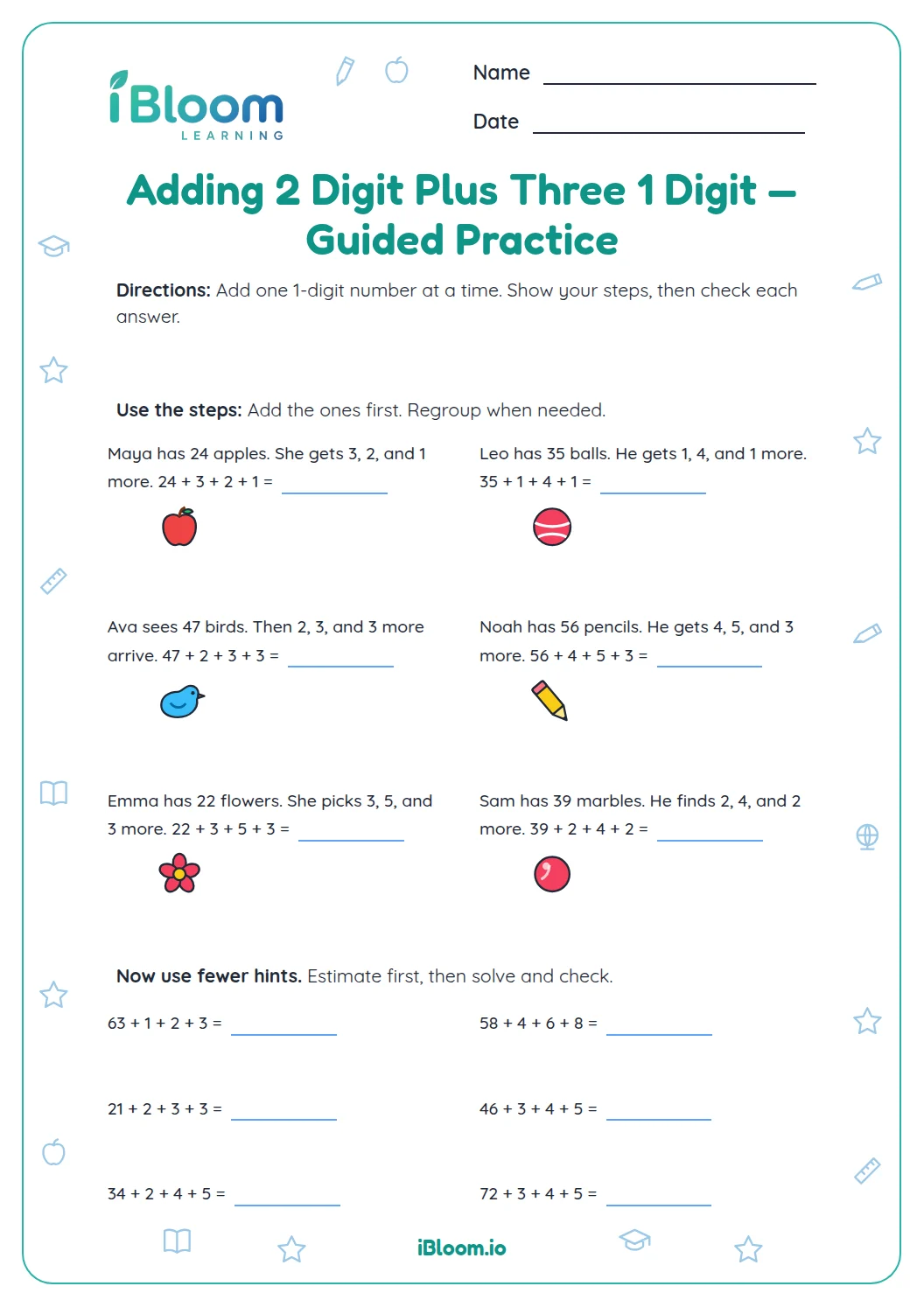


About this worksheet
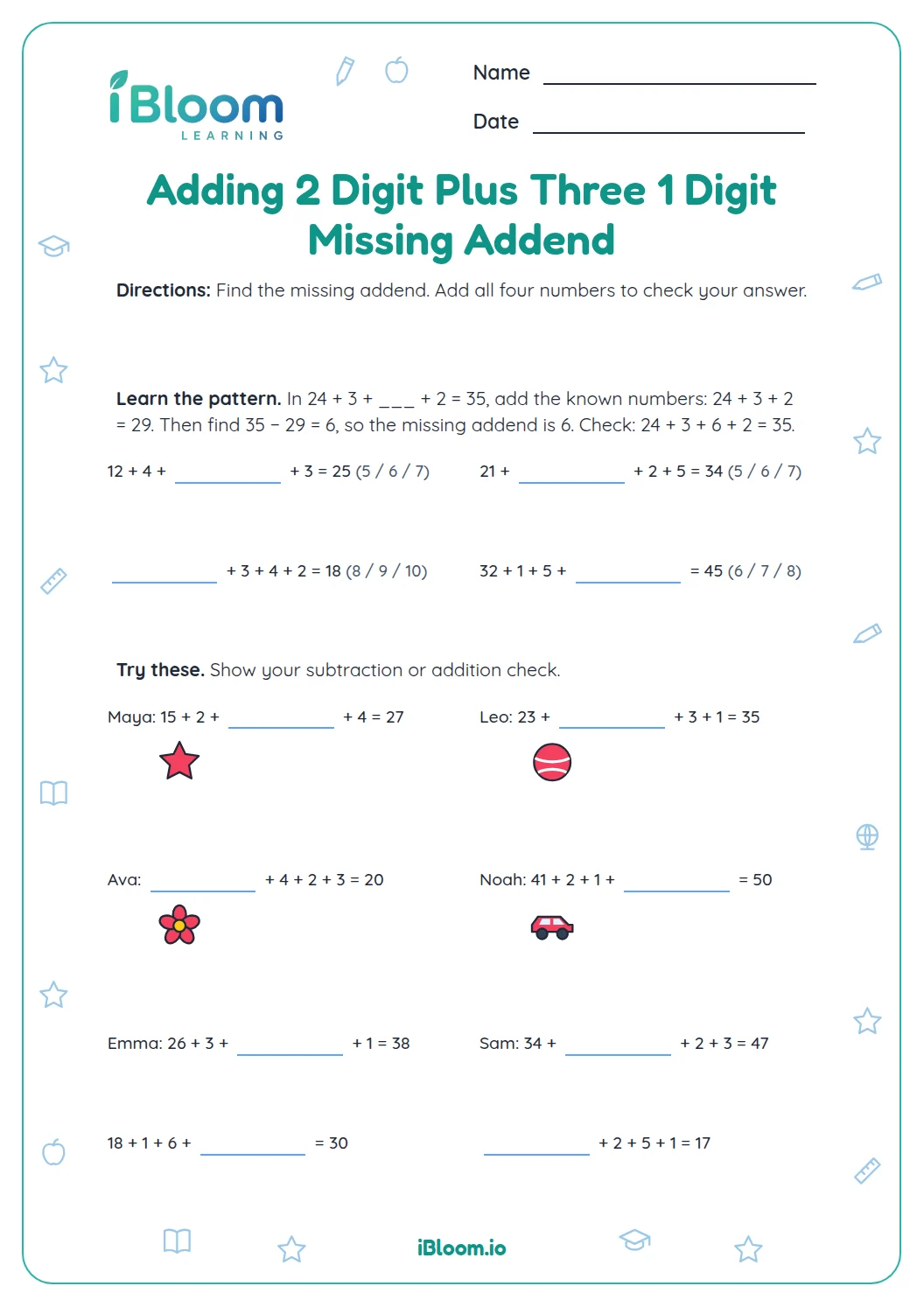
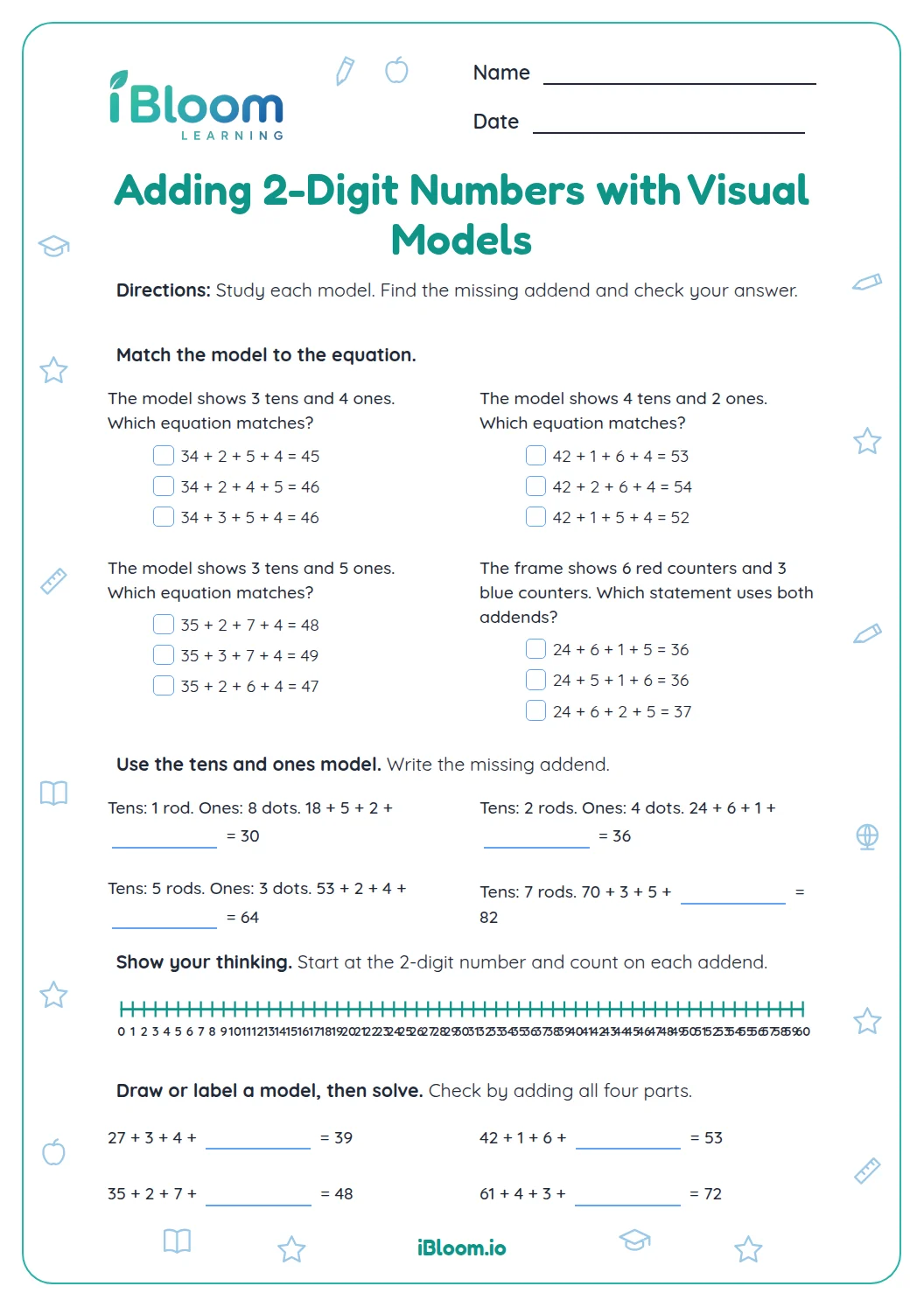
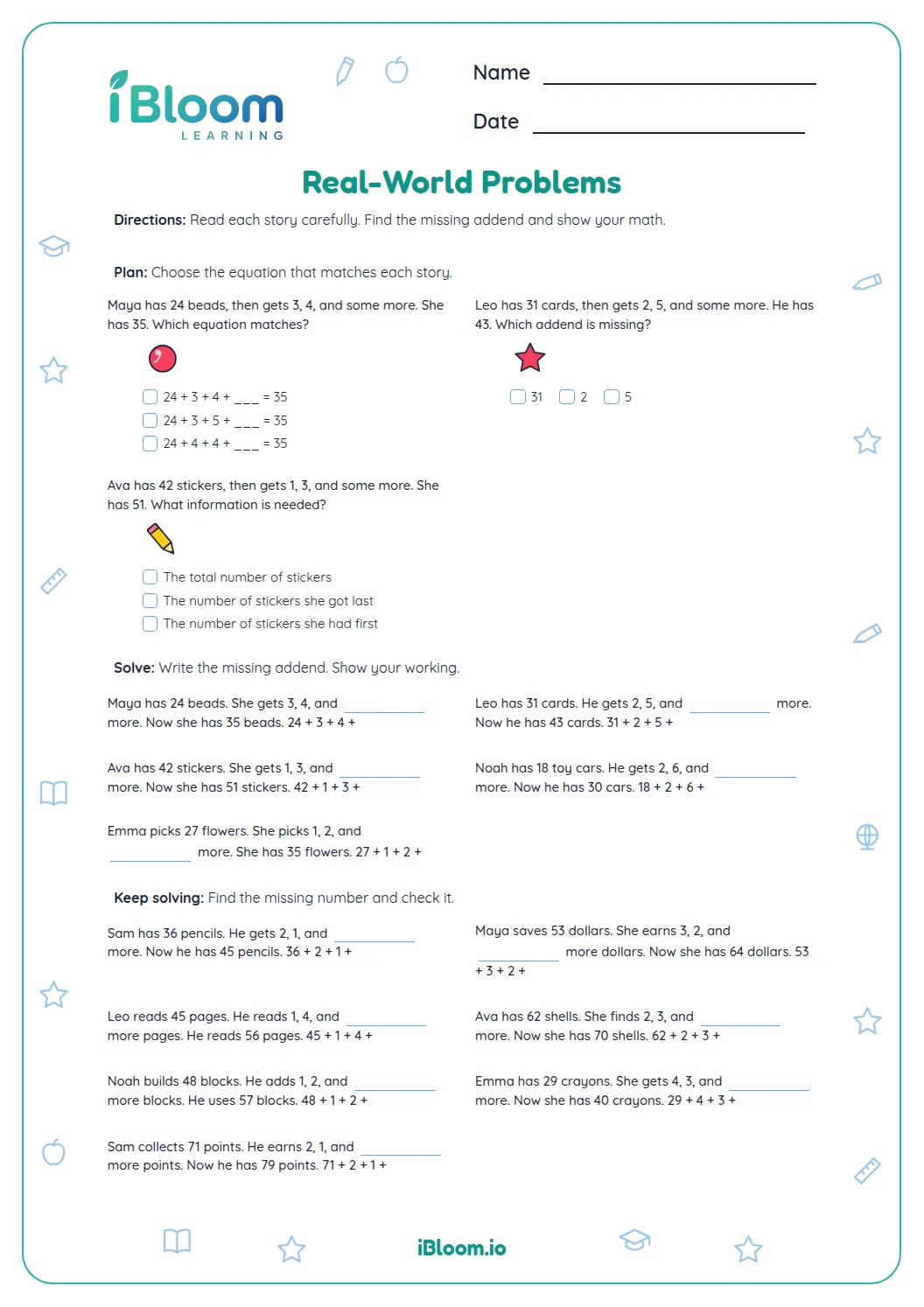
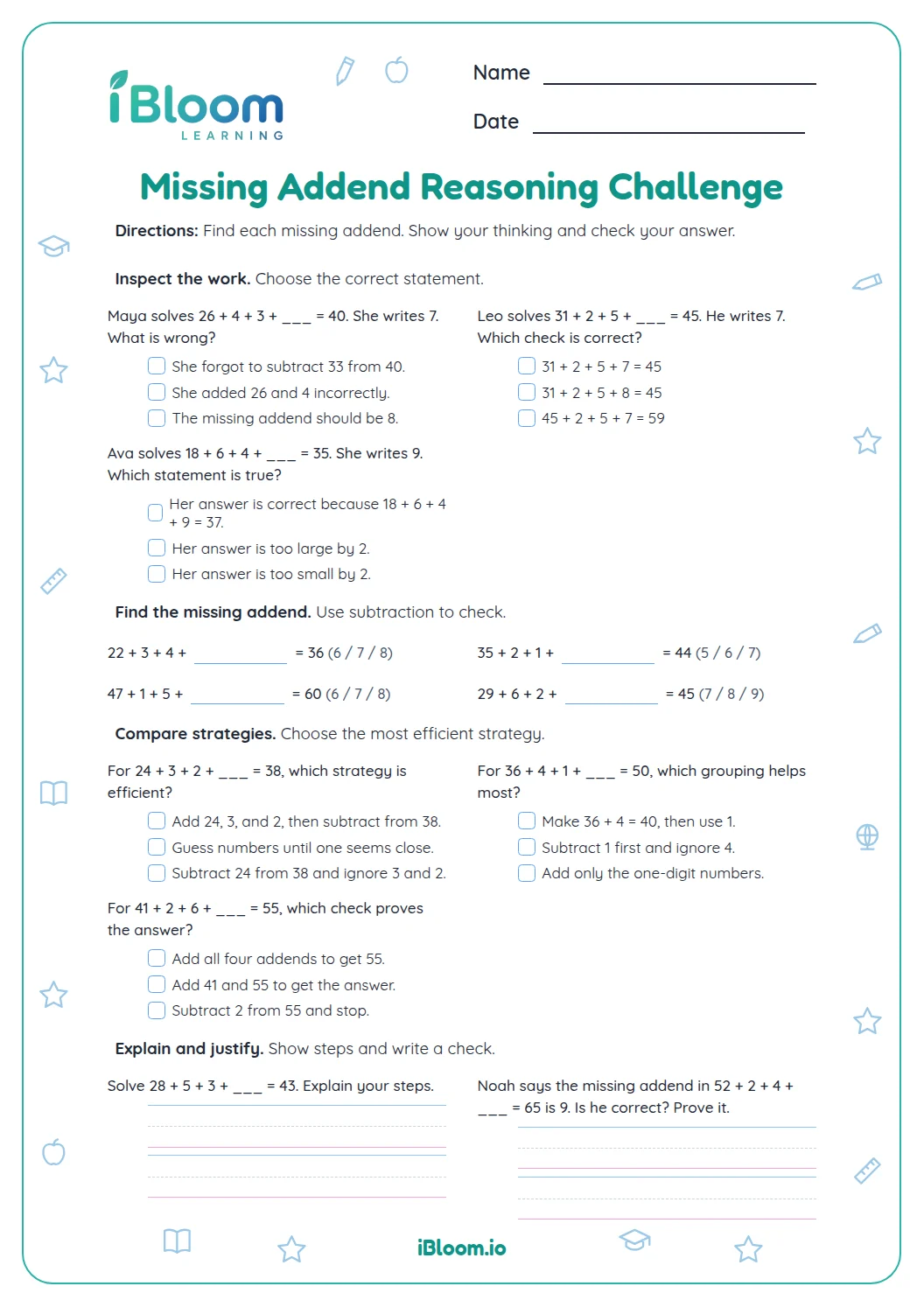
This free Grade 2 worksheet practices finding one missing addend in a sum of four numbers: one two-digit number and three one-digit numbers. All totals stay within 100. Part A uses smaller known totals, Part B crosses tens, and Part C includes larger two-digit addends. In Part D, students find one more missing addend and write a check with all four numbers. The twenty questions support Common Core 2.NBT.B.5 by connecting addition and subtraction. A separate answer key gives the missing numbers and a model check.
Aligned to 2.NBT.B.5
What is an addend in these equations?
An addend is one of the numbers being added. In each question, four addends make the total on the right of the equals sign. Three addends are printed; the blank stands for the fourth.
Every missing number is one digit. The printed two-digit addend stays visible, which helps students keep track of the tens while they combine the smaller numbers.
How can students find the missing part?
Combine all three known addends before finding the difference from the total. Students may count up from that known sum or subtract it from the total.
- 126 + 4 + ___ + 1 = 36
- 226 + 4 + 1 = 31
- 336 − 31 = 5
- 4Check: 26 + 4 + 5 + 1 = 36.
What makes Part C more demanding?
Part C keeps the same four-addend structure but starts with 67, 72, 58, and 83. The smaller numbers may carry the total across a ten, so children must retain the original tens while counting on.
In 58 + 7 + 5 + ___ = 79, the known numbers total 70. Nine more reach 79. A child who writes 21 has subtracted only 58 and still needs to account for 7 and 5.
How to use this worksheet
- 1Locate the total to the right of the equals sign.
- 2Circle or point to the three printed addends.
- 3Add those three numbers, grouping any convenient pair first.
- 4Subtract the known sum from the total, or count up to it.
- 5Write the missing digit and add all four numbers again to check.
Mistakes to check
The mistake
Subtracting only the two-digit addend from the total.
The fix
Combine all three printed addends first; each contributes to the total.
The mistake
Putting the known sum in the blank.
The fix
Ask how much more is needed to reach the total; the blank is only one part.
The mistake
Skipping an addend when the blank changes position.
The fix
Touch each number in order when checking, including the new number in the blank.
Common Core alignment
Use addition and subtraction within 100 to find a missing addend.
On this sheet: Students combine known addends, find the difference from the total, and check by adding all four numbers.
Show the official wordingHide the official wording
Fluently add and subtract within 100 using strategies based on place value, properties of operations, and/or the relationship between addition and subtraction.
What to practice next
Make more practice
Further reading
Questions parents and teachers ask
How many addends are in each question?
Each equation has four addends: one two-digit number and three one-digit numbers. One of the one-digit addends is missing. For example, 12 + 2 + ___ + 1 = 18 has three printed addends and needs 3 in the blank to make the total.
Can my child count up instead of subtracting?
Yes, counting up from the known sum is a valid way to find the missing number. In question 5, the printed addends make 31. Counting from 31 to 36 takes five more, so the missing addend is 5. Check by adding all four numbers.
Why does the blank move between questions?
The moving blank encourages students to read every addend instead of following a fixed visual pattern. The equation still means that all four numbers combine to make the total. Students can add the three known numbers in any order, then find the part that remains.
Are the missing answers always one digit?
Yes, every blank on this sheet takes one digit. The two-digit addend is already printed, and each total is under 100. If a child gets a two-digit answer, have them check whether they included all three known addends before subtracting from the total.
How should I use the answer key?
Use the key after your child has checked each completed equation by adding all four numbers. If an answer differs, ask for the sum of the three printed addends first. That intermediate step helps distinguish an addition slip from a mistake in finding the difference.