








About this worksheet
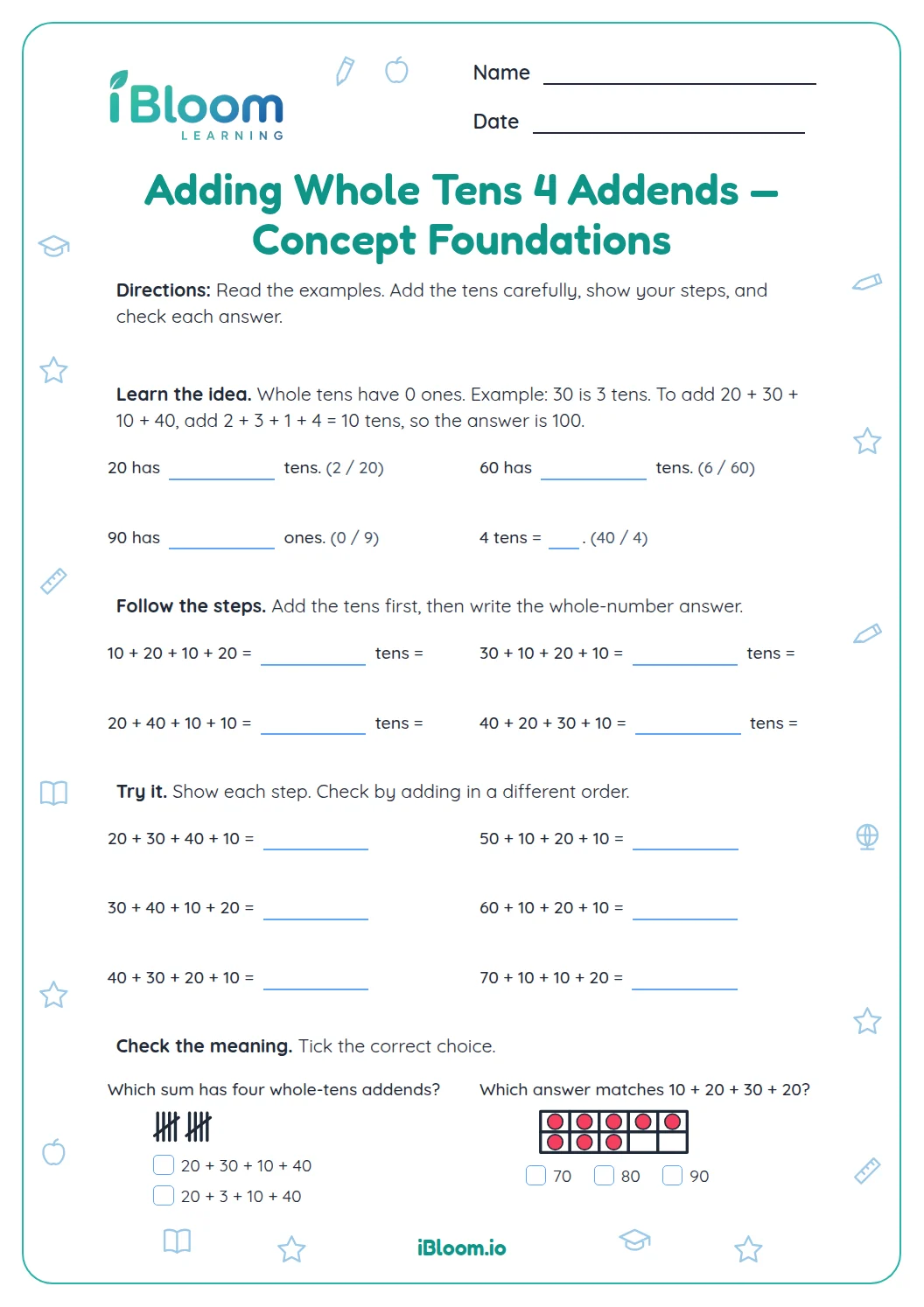
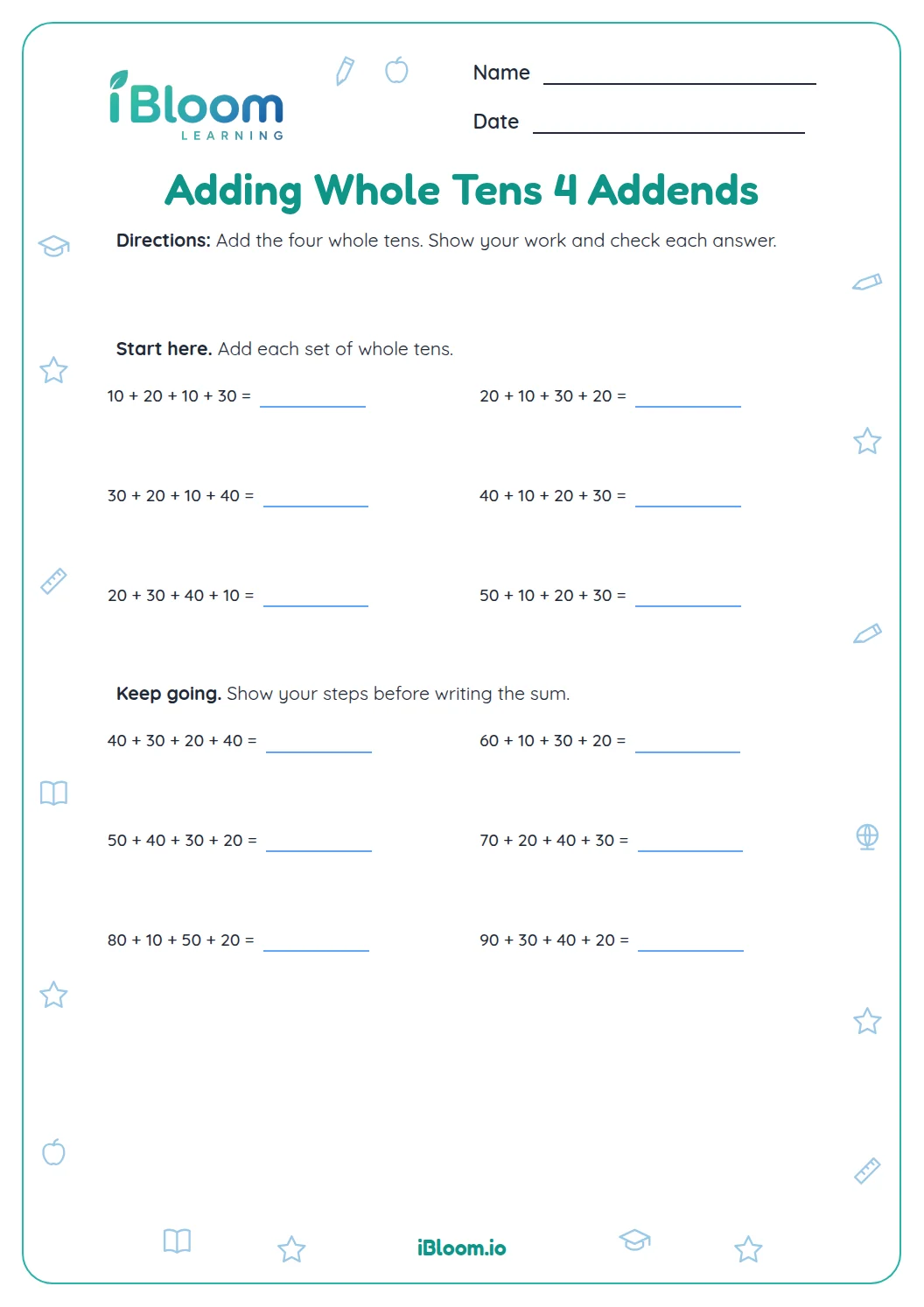
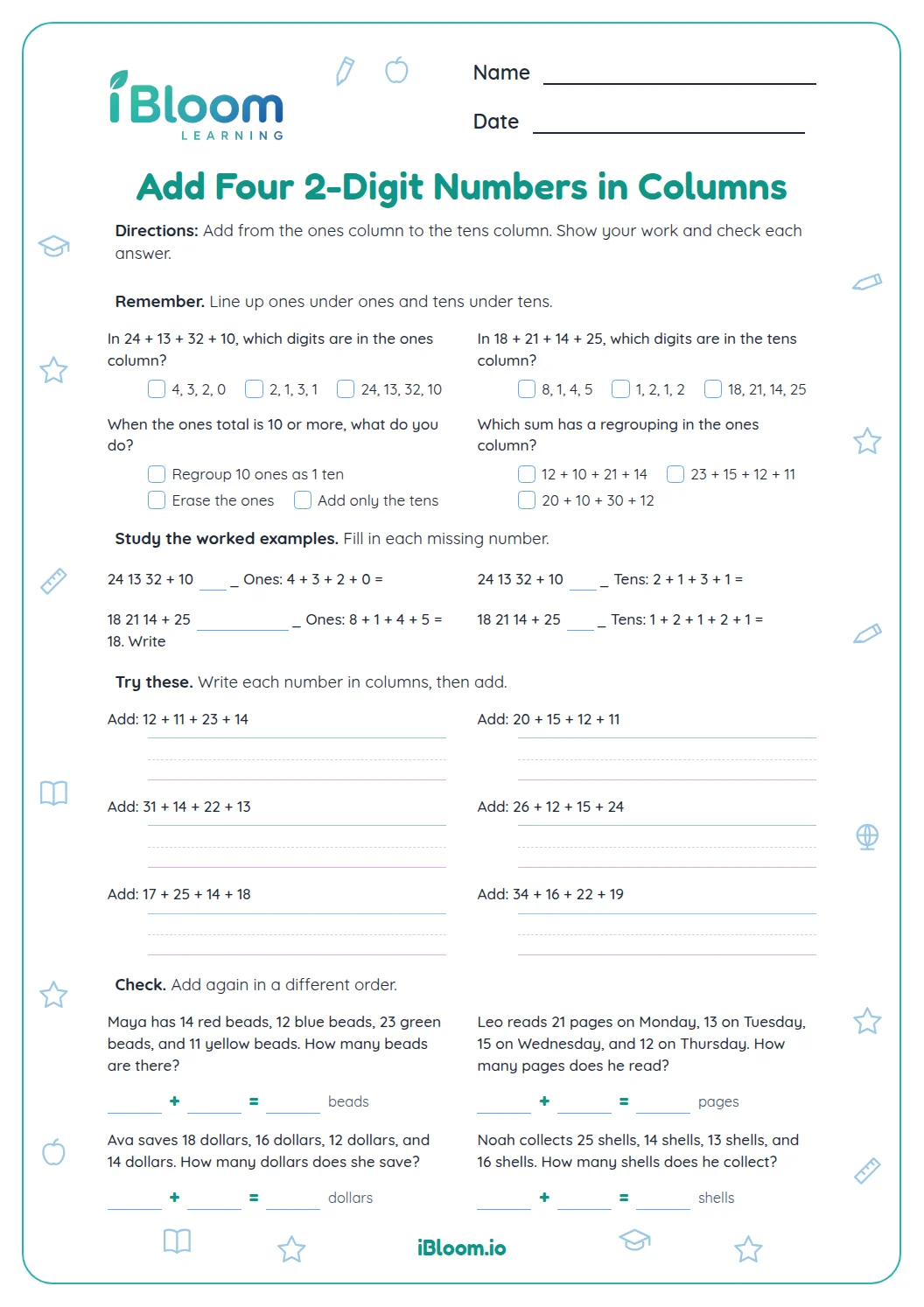
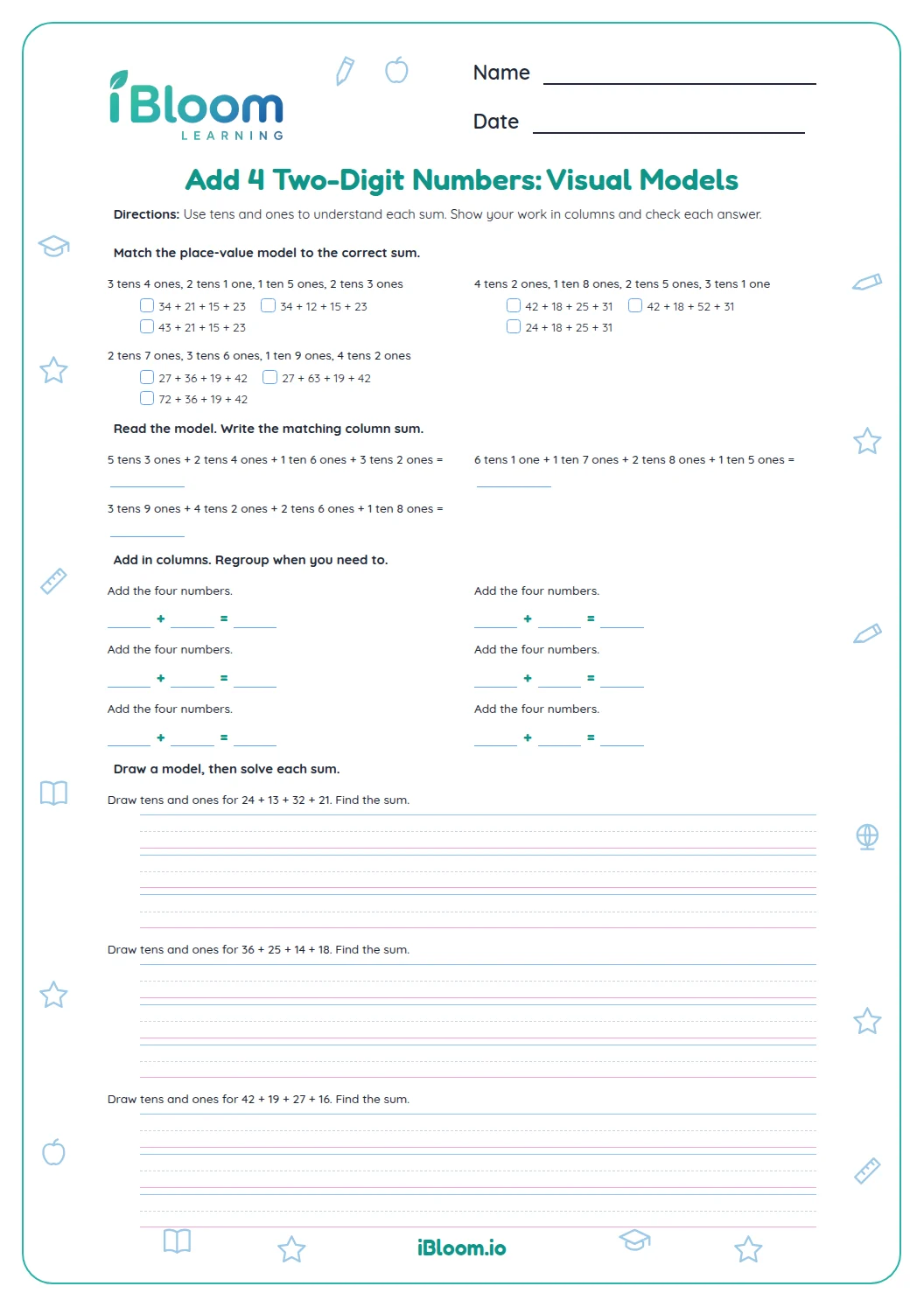
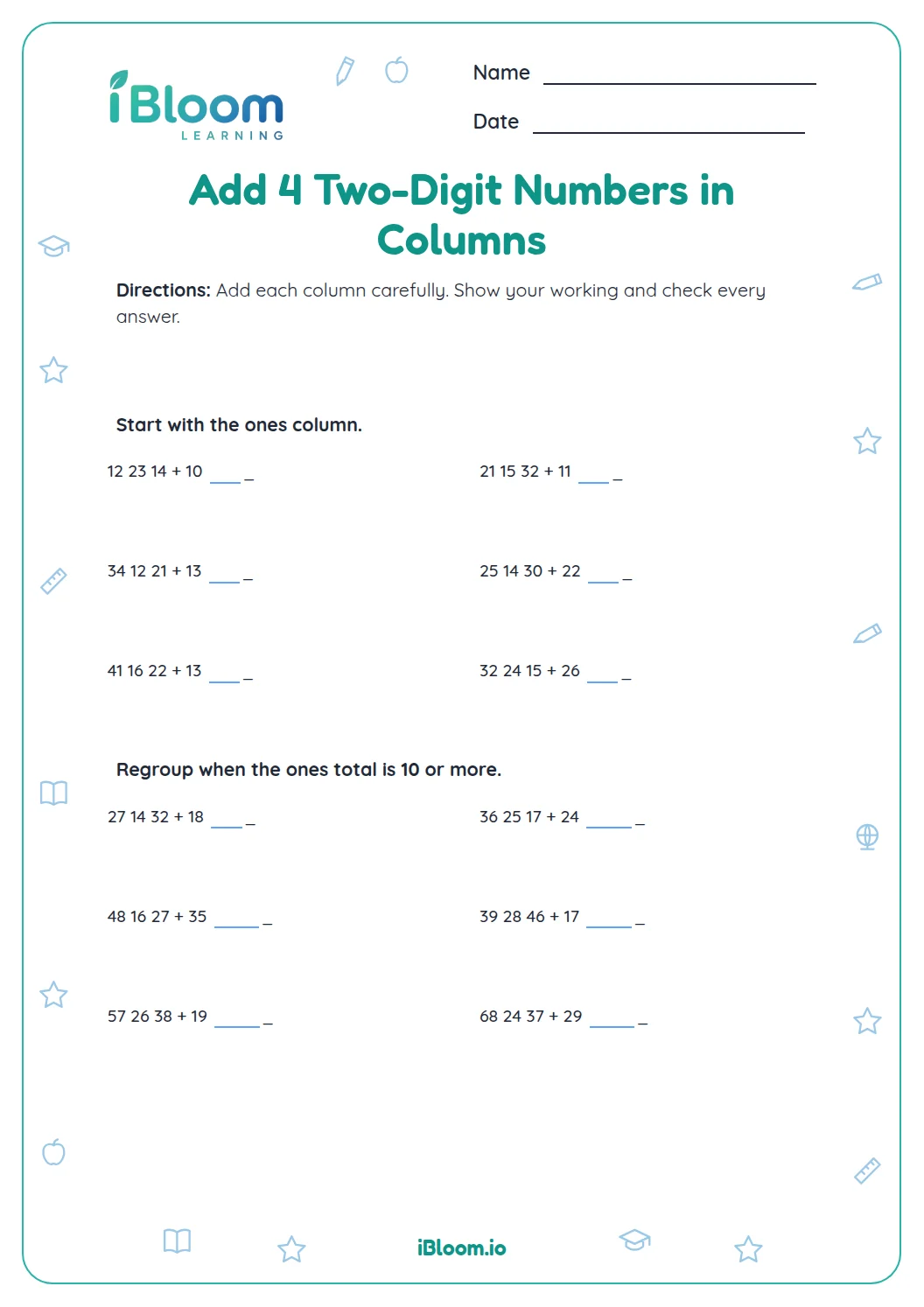
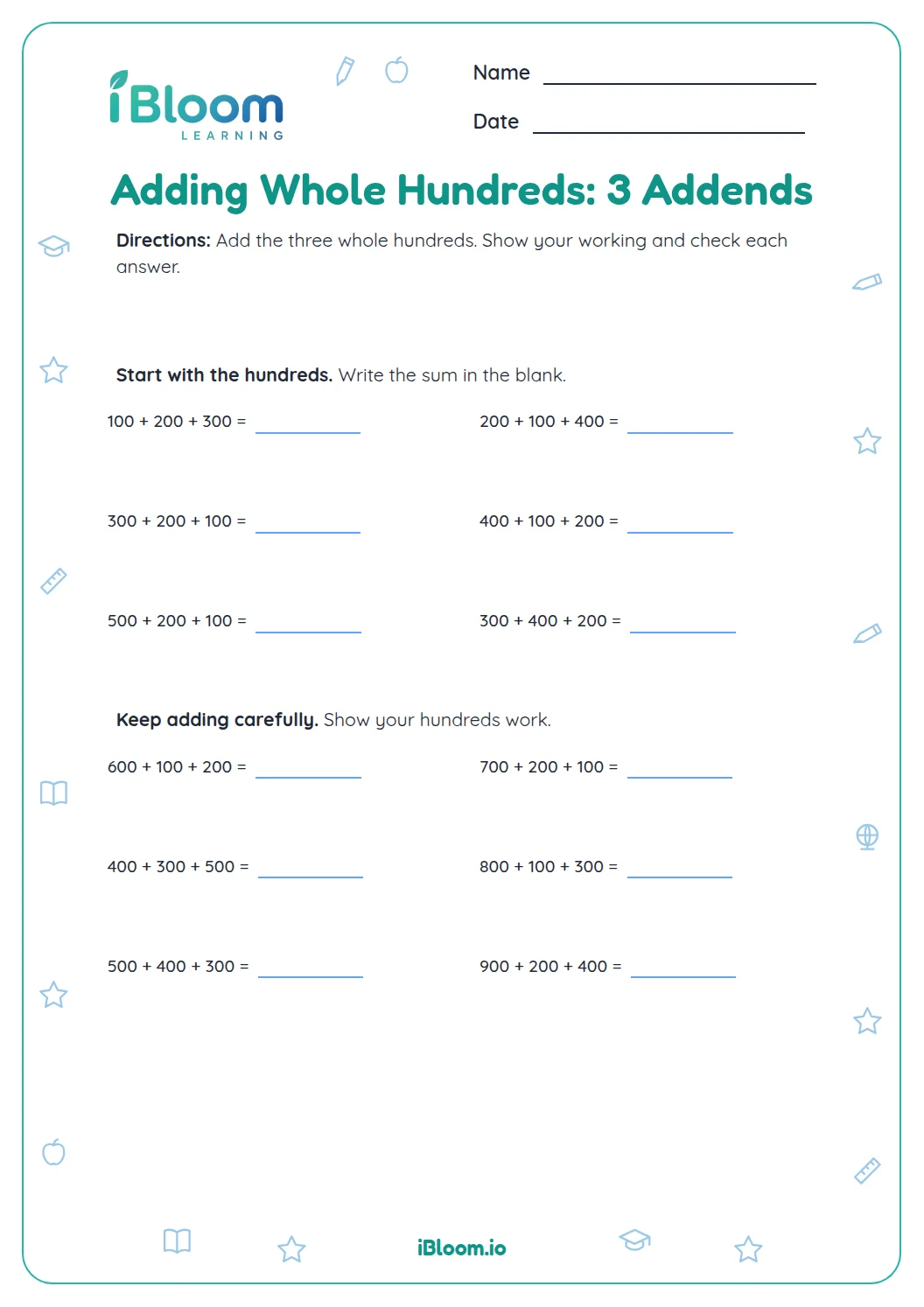
This free printable worksheet gives Grade 2 children story problems that need four groups of whole tens added together. In Part A they pick the equation that matches a story, in Part B they add the four groups and write the total with its unit, and in Part C they work backward to find a missing group. It practices Common Core 2.NBT.B.6, adding up to four two-digit numbers with place value. The totals run from 70 to 100, and a two-page answer key shows every answer.
Aligned to 2.NBT.B.6
What does adding four whole tens look like in a story?
A whole ten is a number such as 10, 20 or 30. When a story has four groups of tens, children can think of each group as tens: 20 is 2 tens, 10 is 1 ten, 30 is 3 tens. Adding the tens digits is a small fact, and the answer is that many tens.
This sheet uses everyday groups children can picture: beads, muffins, balloons, fruit, shells and pages. Because the numbers are all whole tens, children can focus on the idea of adding four groups and on what the total means in the story.
How can children add four tens without counting one by one?
One way is to count on by tens: start at 20, add one ten to get 30, another ten to get 40, then three more tens: 50, 60, 70. Another is to add the tens digits: 2 + 1 + 1 + 3 = 7, so 7 tens, or 70. A third is to pair the groups: in question 5, 30 + 20 is 50 and 40 + 10 is 50, so the total is 100.
Each strategy uses place value, which is what 2.NBT.B.6 asks children to do. Let your child pick one and explain it aloud.
- 1Emma sees 20 red, 10 blue, 10 green and 30 yellow balloons.
- 2Tens: 2 tens + 1 ten + 1 ten + 3 tens = 7 tens
- 37 tens is 70.
- 4Answer: 70 balloons
What is on this worksheet?
Part A shows three stories with four groups each. Children choose among three equations. The wrong choices leave one group out or take one away, so they have to match every group in the story. Part B has four stories to solve with a unit to write, such as 70 balloons or 100 pieces.
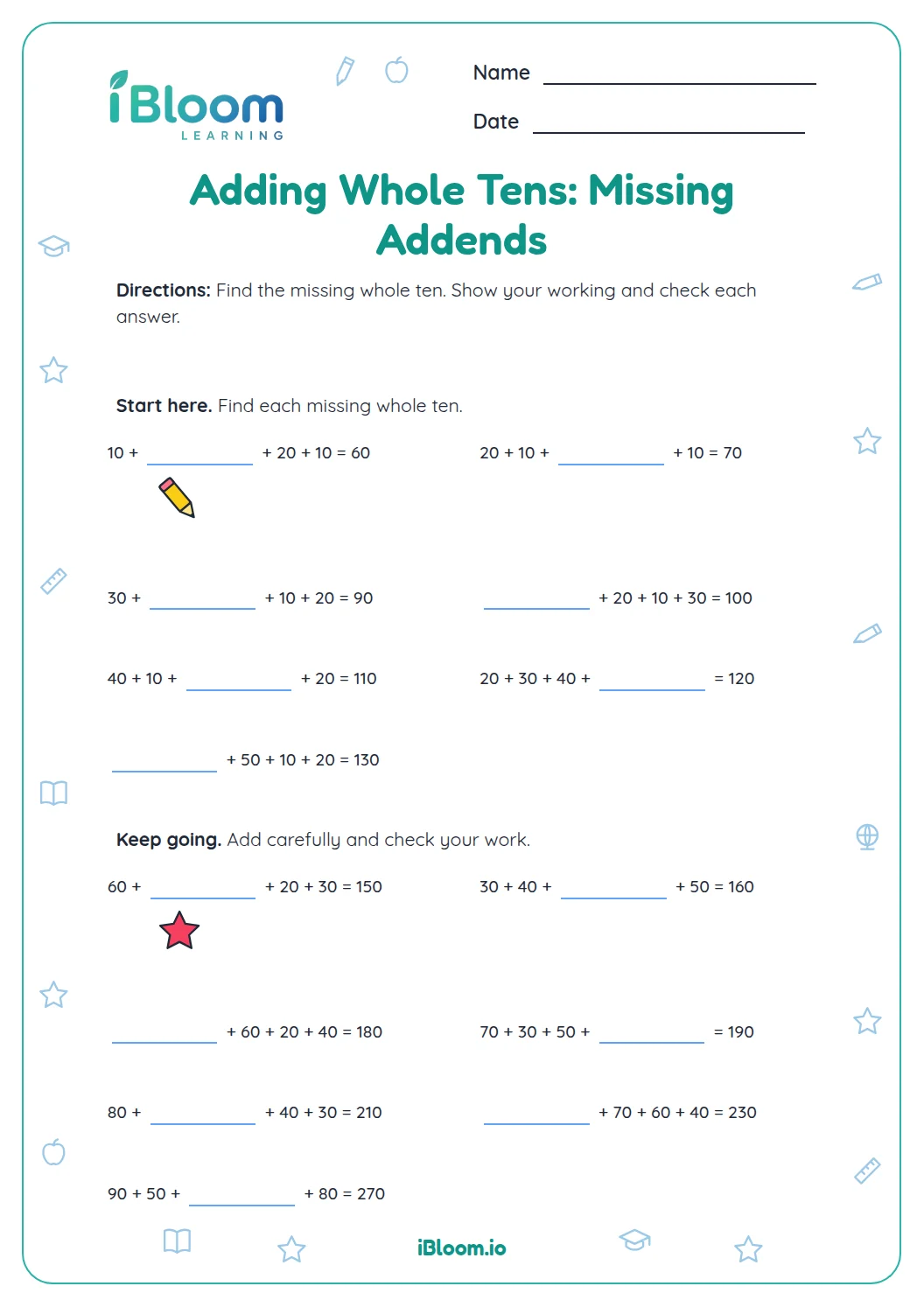
Part C works backward. In question 8, the piles 20, 30 and 10 make 60, so the last pile has 30 stickers to make 90. In question 9, 30 + 20 + 40 is 90, so the last class read 10 books to make 100.
- Part A: 3 questions, pick the matching equation
- Part B: 4 stories, add four tens and name the unit
- Part C: 2 missing-group questions
Why does the answer need a unit?
A number alone, like 70, does not answer a story. The unit tells what was counted: 70 balloons, 80 pages, 90 items. Writing it makes children go back to the question and check what they were asked to find.
How to use this worksheet at home or in class
- 1Read question 1 aloud and ask your child to find each group of tens in the story.
- 2Let your child pick the equation and explain why the other two do not match.
- 3In Part B, ask for a strategy first: counting by tens, adding tens digits or making a bigger ten.
- 4Have your child write the total and the unit, such as 70 balloons.
- 5For Part C, say the total is already known and ask what is still needed.
- 6Check with the answer key and ask your child to say how they know the total makes sense.
Common mistakes and quick fixes
The mistake
Leaving one group out and adding only three numbers, such as 20 + 10 + 10 = 40 for the balloons.
The fix
Have your child cross off each group in the story as they write it in the equation, then count that there are four.
The mistake
Writing a total that is off by ten, such as 60 balloons because 2 + 1 + 1 + 3 was added as 6.
The fix
Count on by tens with fingers up for each ten: 20, then 30, 40, then 50, 60, 70. Then check the tens digits again, one group at a time.
The mistake
Writing the total with no unit.
The fix
Ask, "70 what?" and have your child finish the sentence from the story, such as 70 balloons.
Common Core alignment
Grade 2 children add up to four two-digit numbers using place value, and whole tens make that place value easy to see.
Add up to four two-digit numbers, such as 20 + 10 + 10 + 30.
On this sheet: Every story adds four groups of tens, and Part C finds the missing group that makes the total.
Show the official wordingHide the official wording
Add up to four two-digit numbers using strategies based on place value and properties of operations.
What to practice next
Make more practice
Further reading
Questions parents and teachers ask
What does adding whole tens with four addends mean?
It means adding four numbers that are all multiples of ten, such as 20 + 10 + 10 + 30. Children can think of each as tens, 2 + 1 + 1 + 3 = 7 tens, and the answer is 70. This sheet uses story problems so the numbers mean something.
How big are the totals on this sheet?
The totals run from 70 to 100: 70 balloons, 80 pages, 90 items and 100 pieces of fruit, and the missing-group stories make 90 and 100. Every group is 10, 20, 30, 40 or 50, so children can add the tens digits and only need to know that 10 tens make 100.
What are the answers to the missing-group questions?
Question 8 is 30 because 20 + 30 + 10 is 60, and 90 − 60 is 30. Question 9 is 10 because 30 + 20 + 40 is 90, and 100 − 90 is 10. Children can also count up by tens from the known groups to the total.
How can my child check a total?
Add the groups again in a different order, or count by tens a second time. For Emma's balloons, 20 + 10 + 10 + 30 is 70, and 30 + 20 + 10 + 10 is also 70. If the two totals match, the answer is probably right. Also check that the unit fits the story.
Can my child use a hundred chart or base-ten blocks?
Yes. A hundred chart lets children jump down by tens, and ten-rods in base-ten blocks make each group visible. Use them as a first step, then ask your child to say the tens digits aloud. The goal is to move toward adding tens in their head.
Is there an answer key, and how long does the sheet take?
Yes. The two-page answer key shows the matching equation for Part A, each total with its unit for Part B and the missing group for Part C. Plan on about 20 minutes. If your child tires, do Parts A and B in one sitting and Part C in another.