



About this worksheet
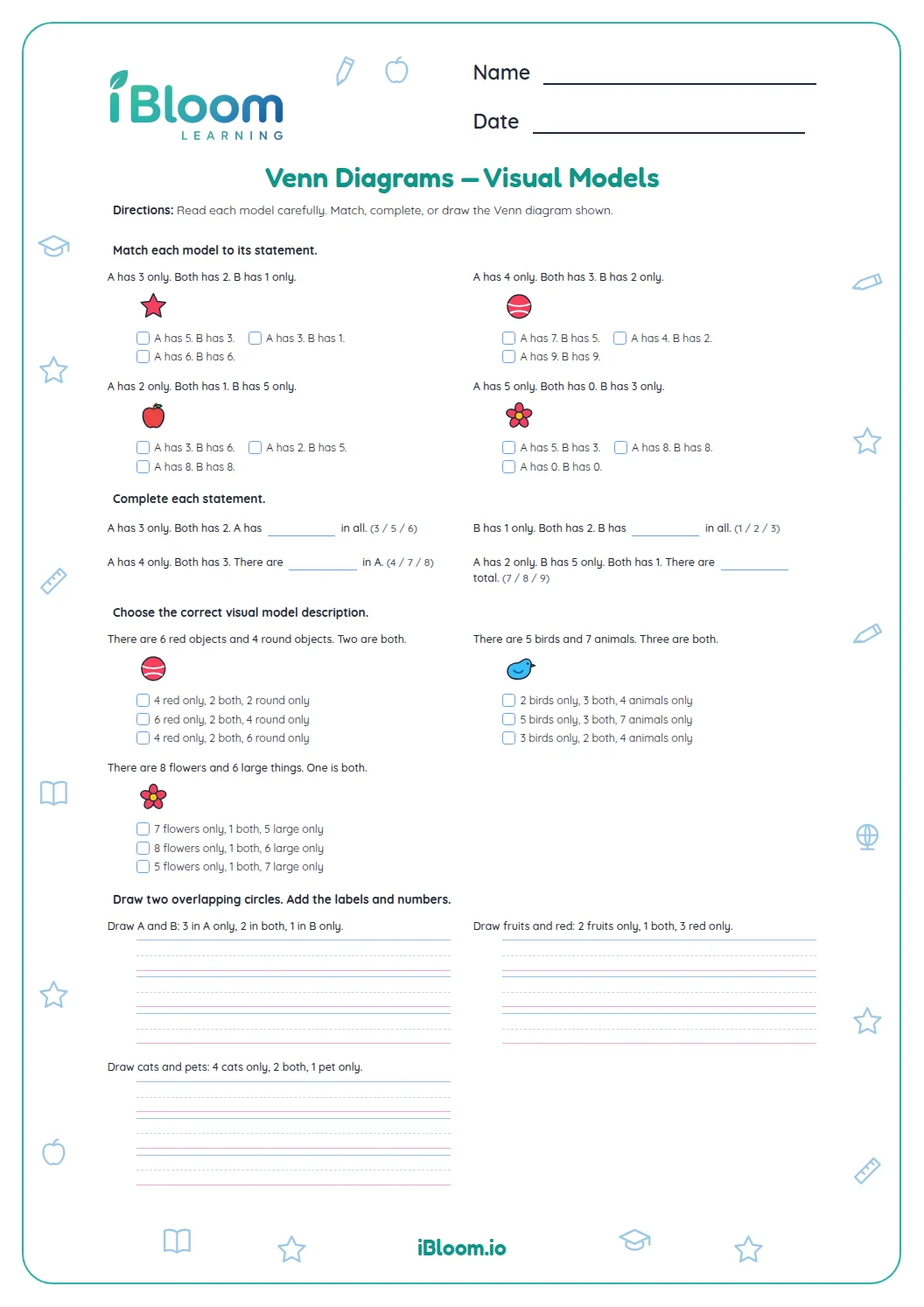
This Grade 2 printable introduces Venn diagrams with familiar objects and clear set labels. Learners decide whether each object belongs in set A, set B, both, or neither. The 15 questions move from simple region choices to more examples, including a final bird classification. The answer key shows the intended region for every choice.
How do the four regions work?
Each circle represents a set named by a rule. An item goes in a circle if it matches that rule. The overlap is for items matching both rules; an item matching neither rule stays outside both circles.
For example, a toy car belongs in both “has wheels” and “can roll.” A ball that rolls but has no wheels belongs in the “can roll” set only.
What will learners sort?
Parts A and B ask learners to classify familiar examples from two clues. Part C gives one final region question about a bird and two category labels.
- Part A: choose a region for each example
- Part B: classify more familiar objects
- Part C: check one final two-clue example
How to use this worksheet
- 1Read the labels and directions before answering.
- 2Complete each part in order and use the clues in the question.
- 3Check the separate answer key after finishing.
Common mistakes and quick fixes
The mistake
Putting an item in the overlap when it matches only one label.
The fix
Check both labels separately before choosing a region.
The mistake
Placing an item outside after checking only one set.
The fix
Test it against both circle rules.
The mistake
Treating the overlap as a separate set unrelated to the circles.
The fix
Use it for items that belong to both labeled sets.
What to practice next
Make more practice
Questions parents and teachers ask
What belongs in the overlap?
An item belongs in the overlap when it matches both circle labels. In the worksheet example, a toy car has wheels and can roll, so it belongs in both sets. Ask the learner to check each label separately before choosing a region.
What goes outside both circles?
An item goes outside both circles when it matches neither rule. Read each set label and test the item against both clues. In the worksheet, a book does not have wheels and is not sorted as something that can roll.
Is an answer key included?
Yes. The separate answer key gives the intended region for each multiple-choice question. For each item, test both labels before marking a region or choosing an answer. Learners can review both clues to confirm the category for each object.
Can a different item fit a set?
The final question has a clear answer from its two labels. Learners can also make up new examples and explain whether each belongs in A, B, both, or neither. For this page, use the printed examples to practice the four possible regions.
How should learners check a region choice?
Check the item against set A and set B one at a time. If both statements are true, choose the overlap; if only one is true, choose that circle; if neither is true, place it outside. This check works for every region question.