


About this worksheet
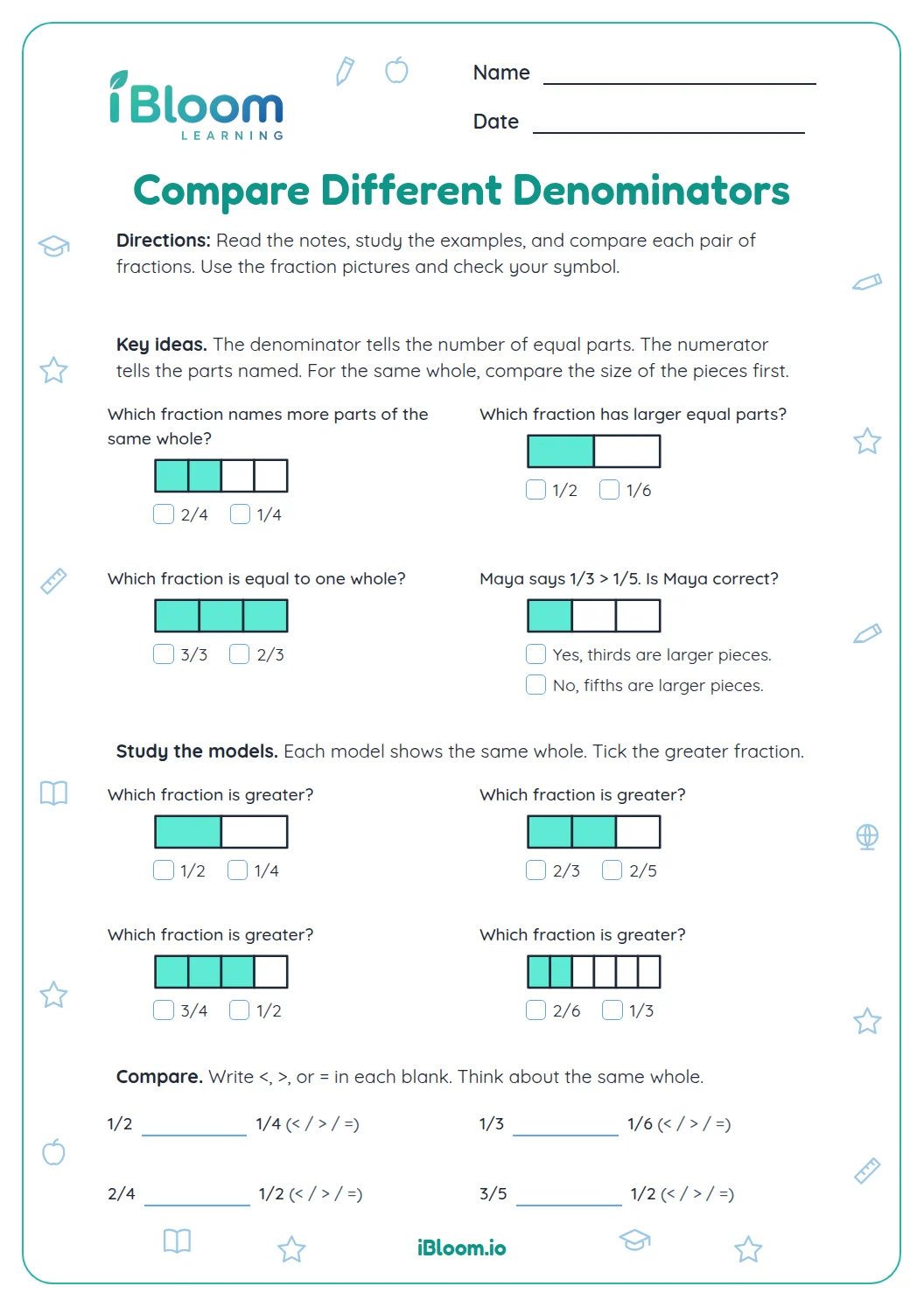
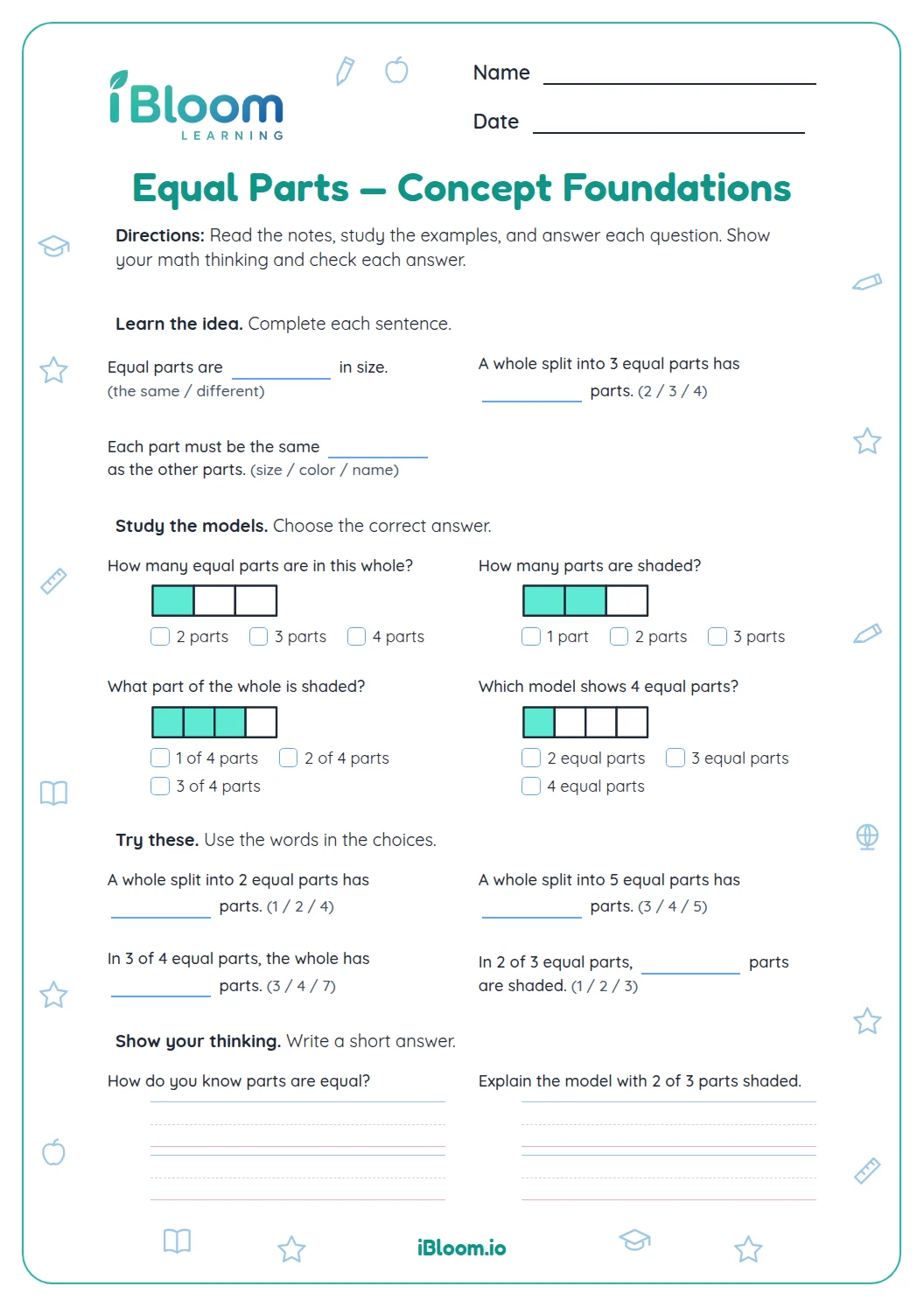
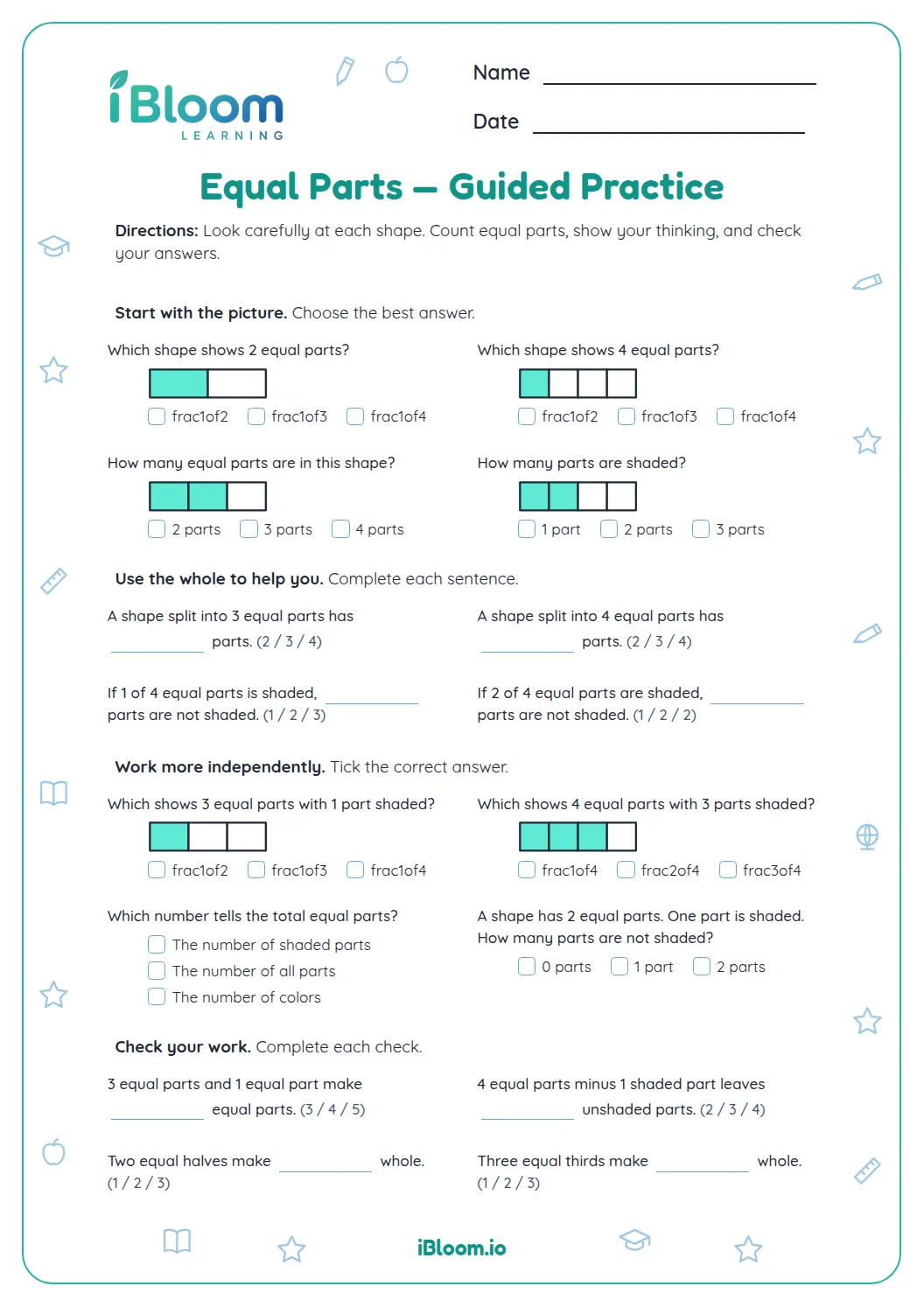
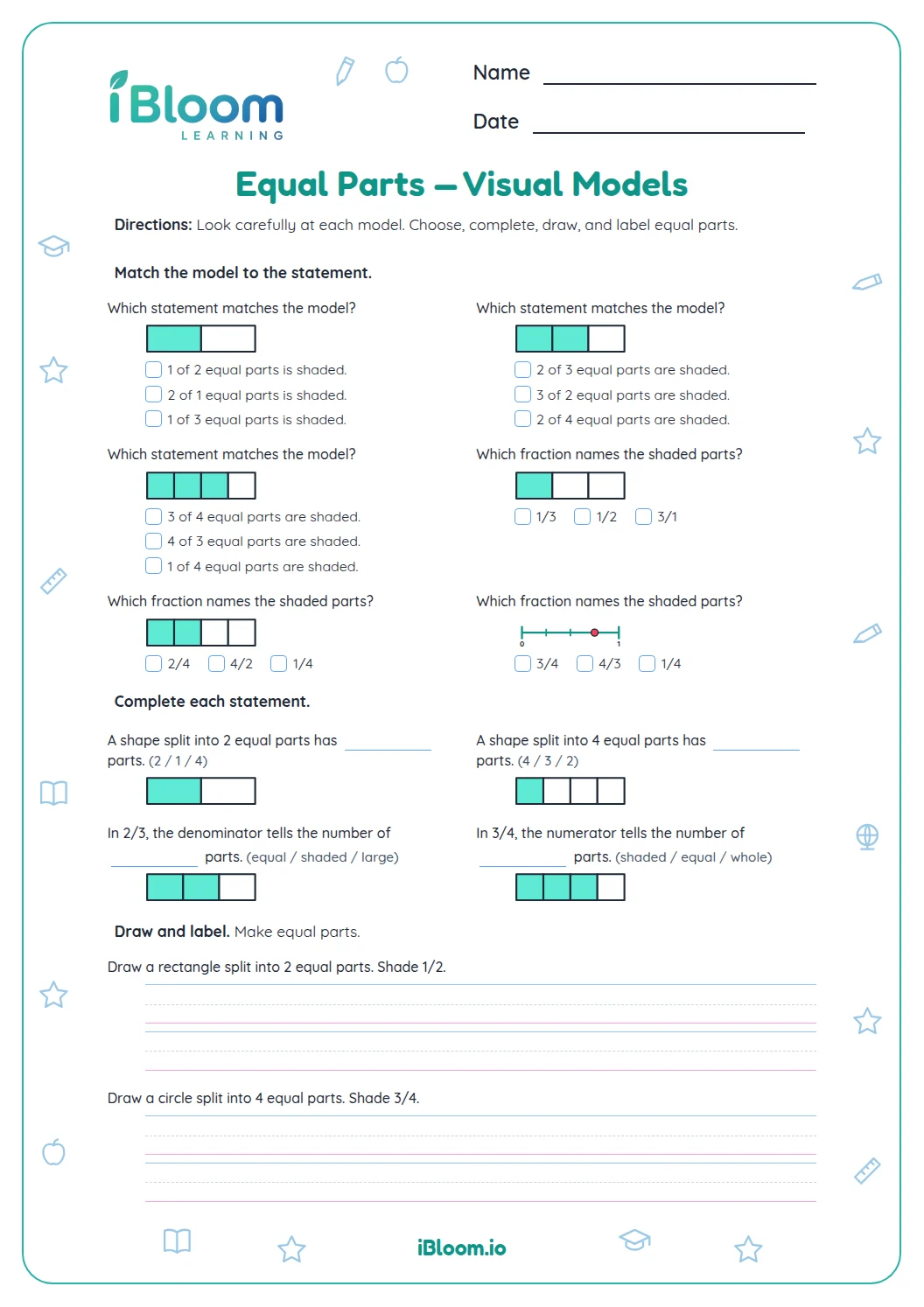
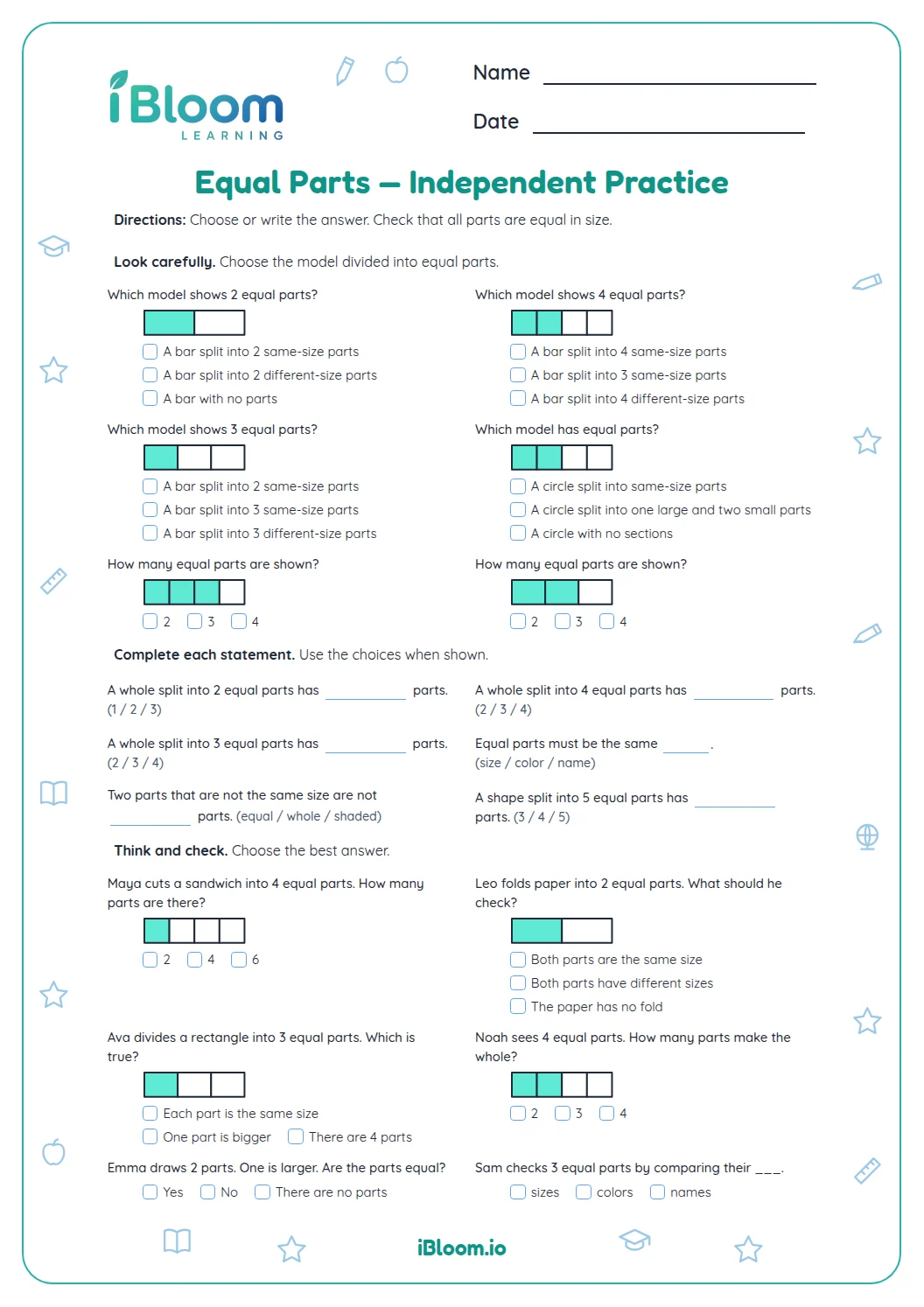
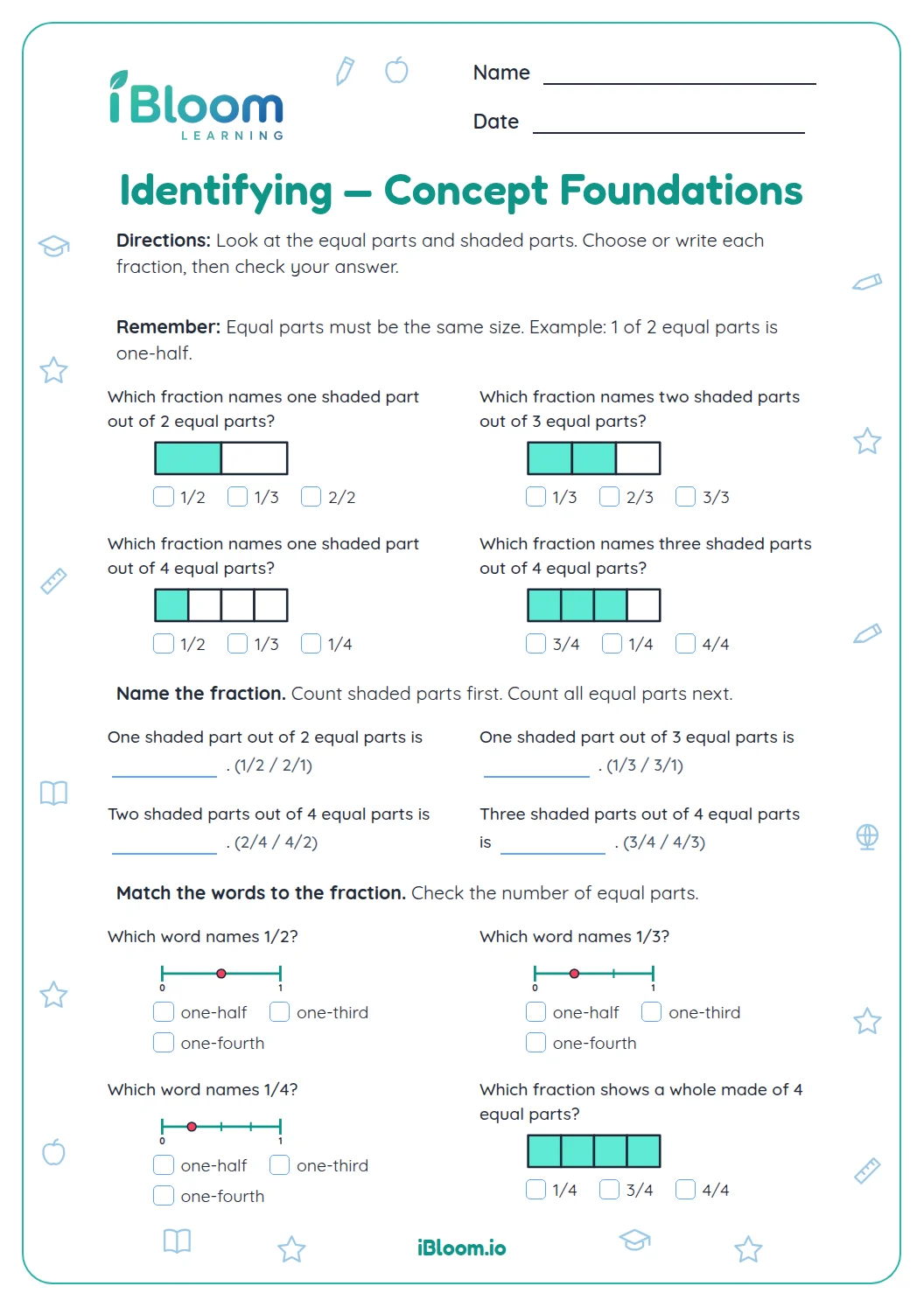
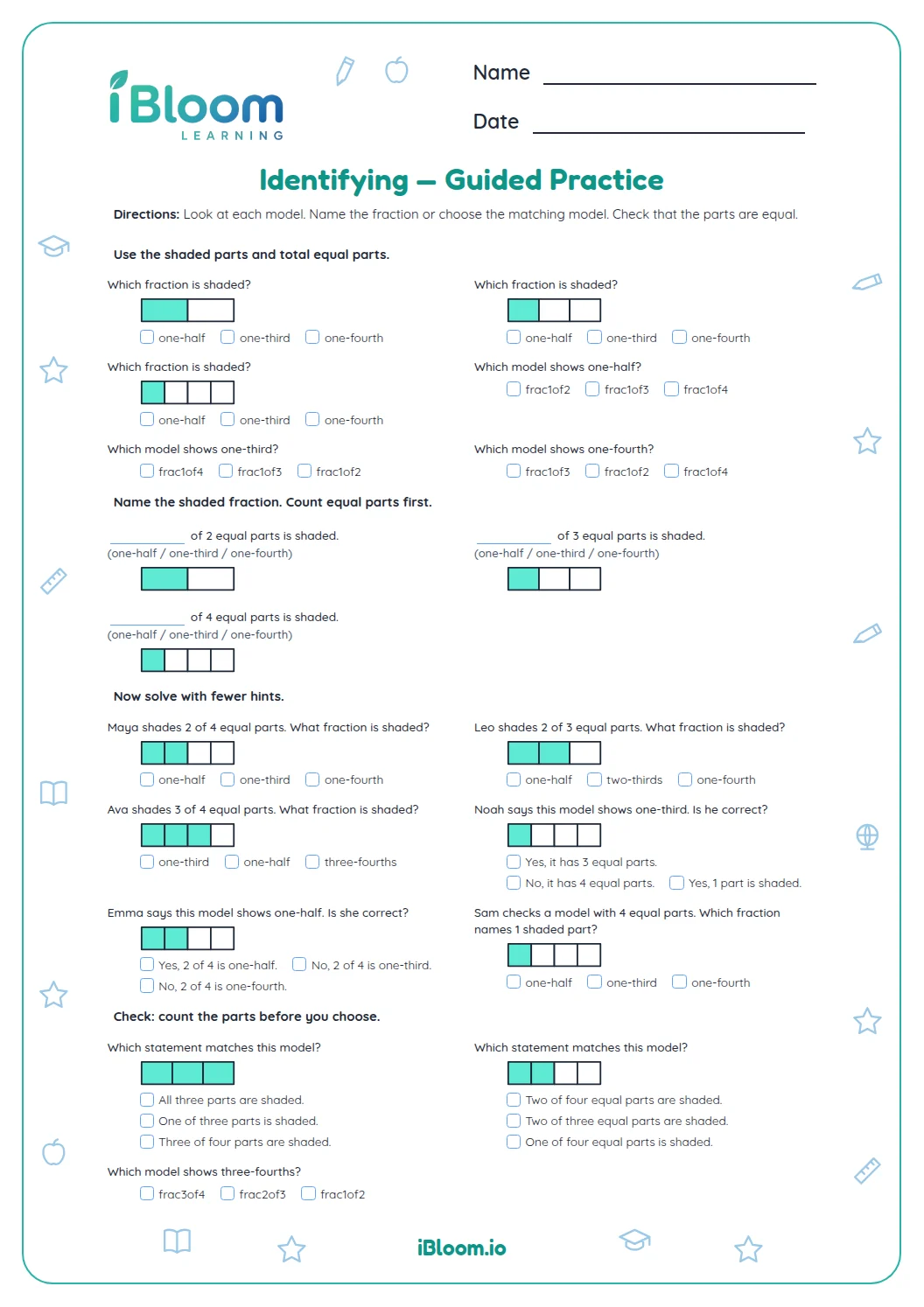
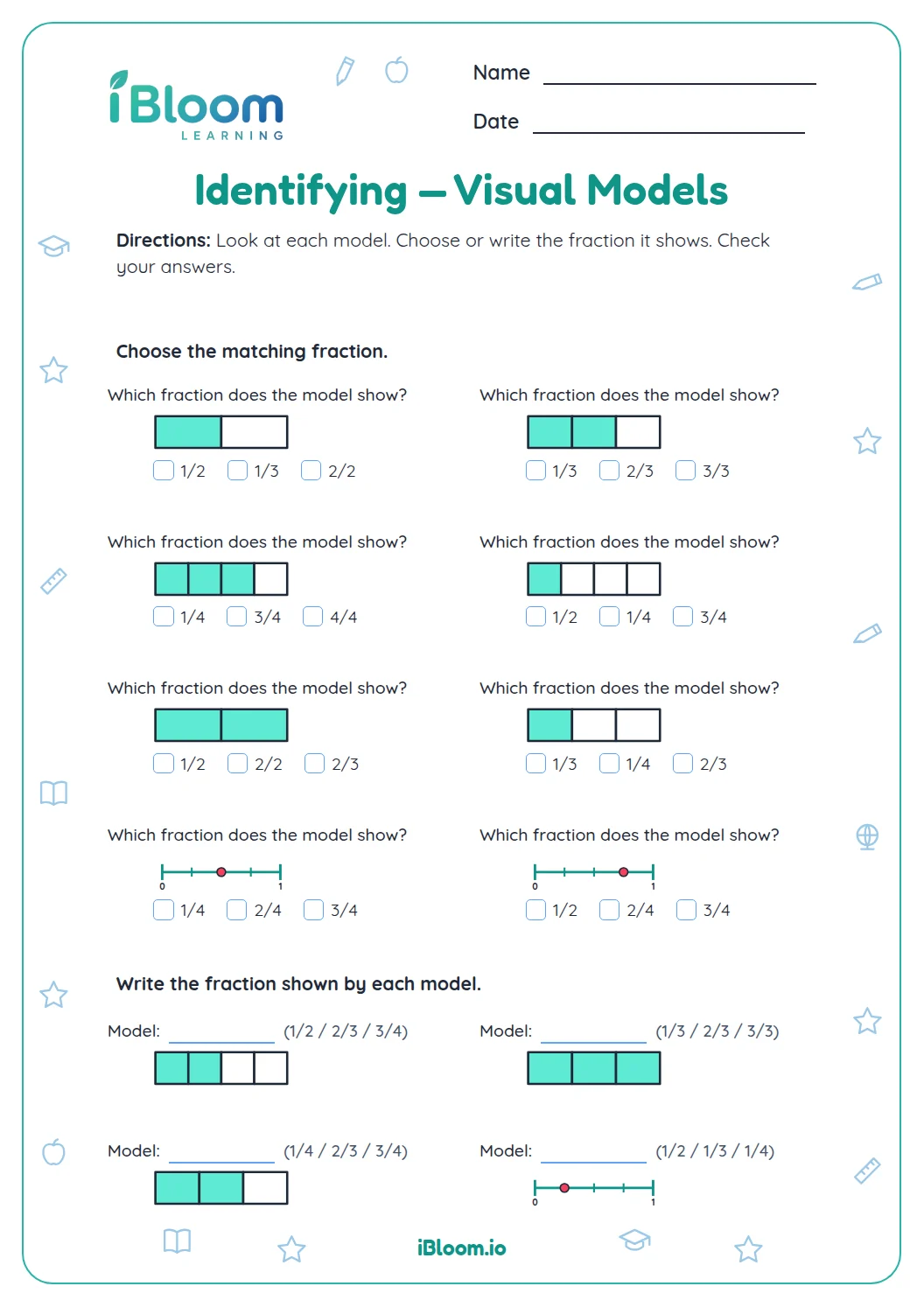
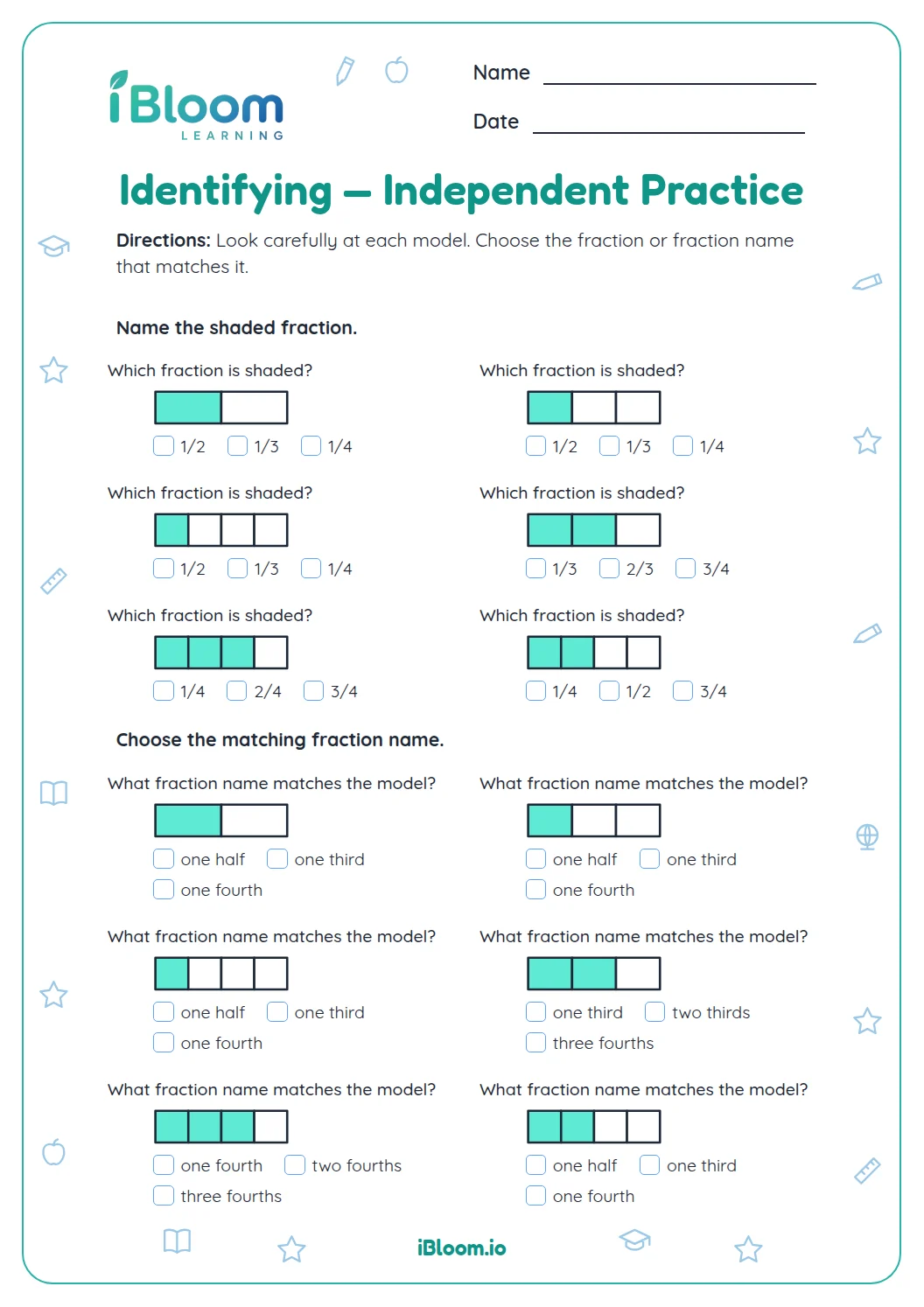
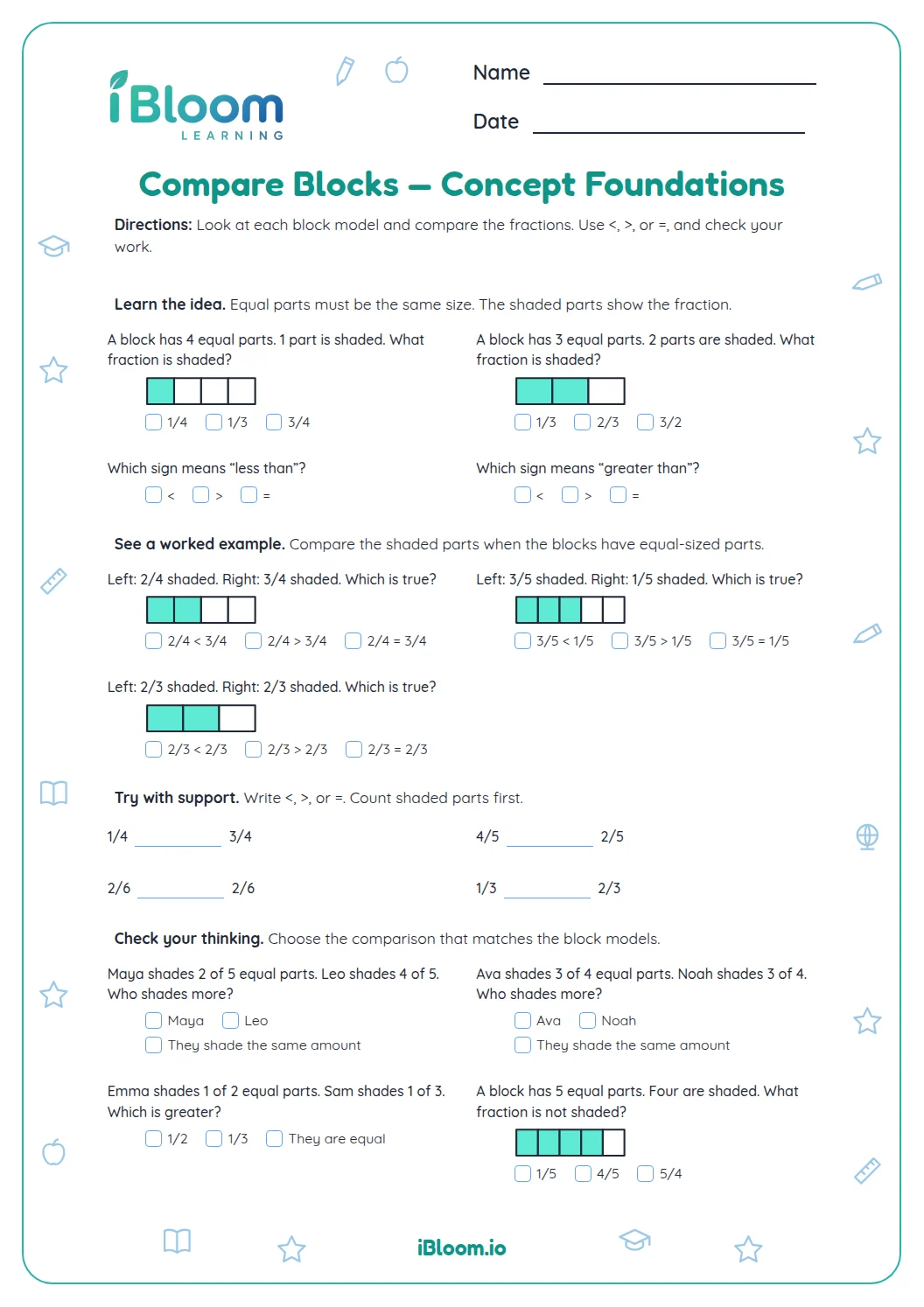
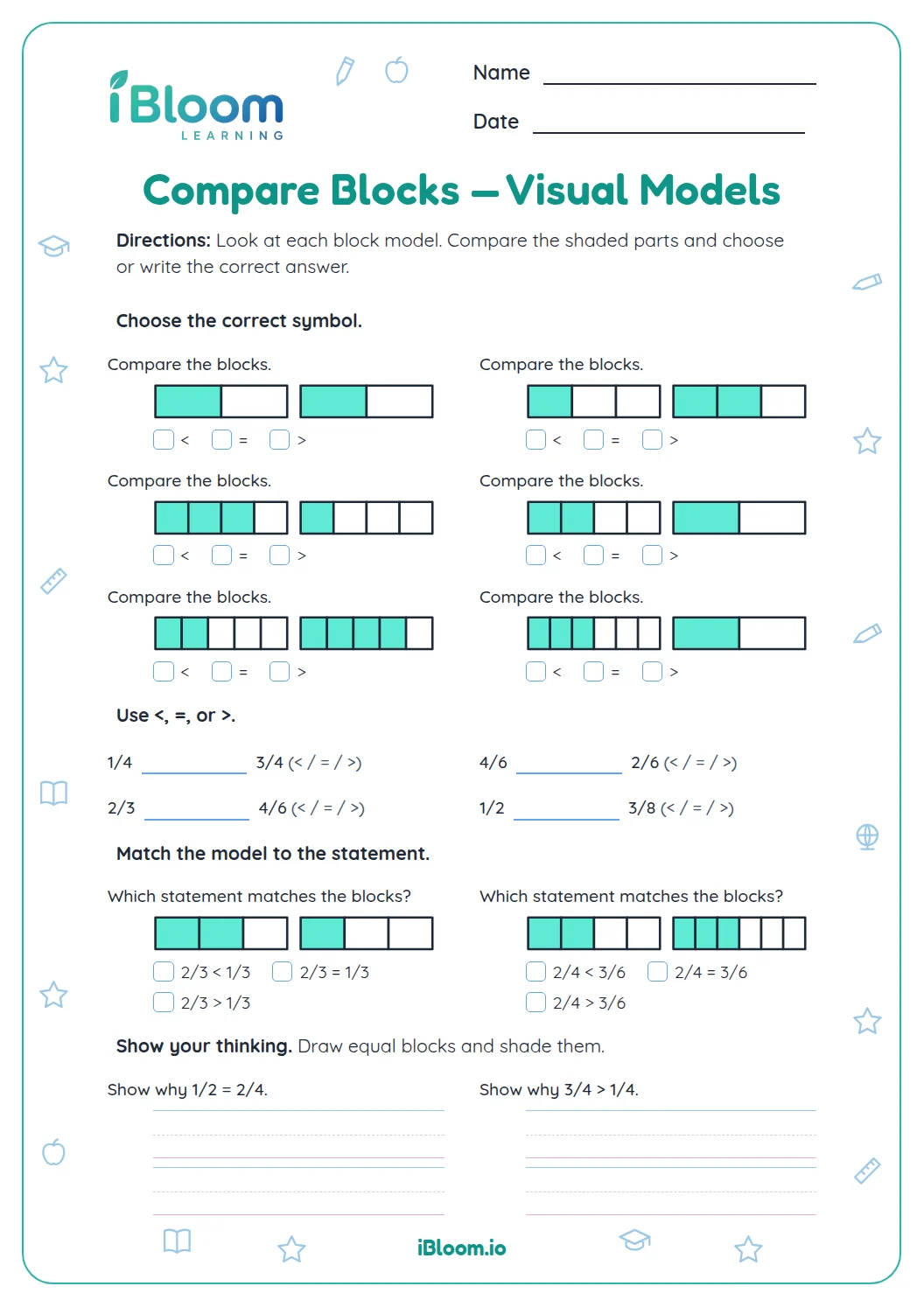
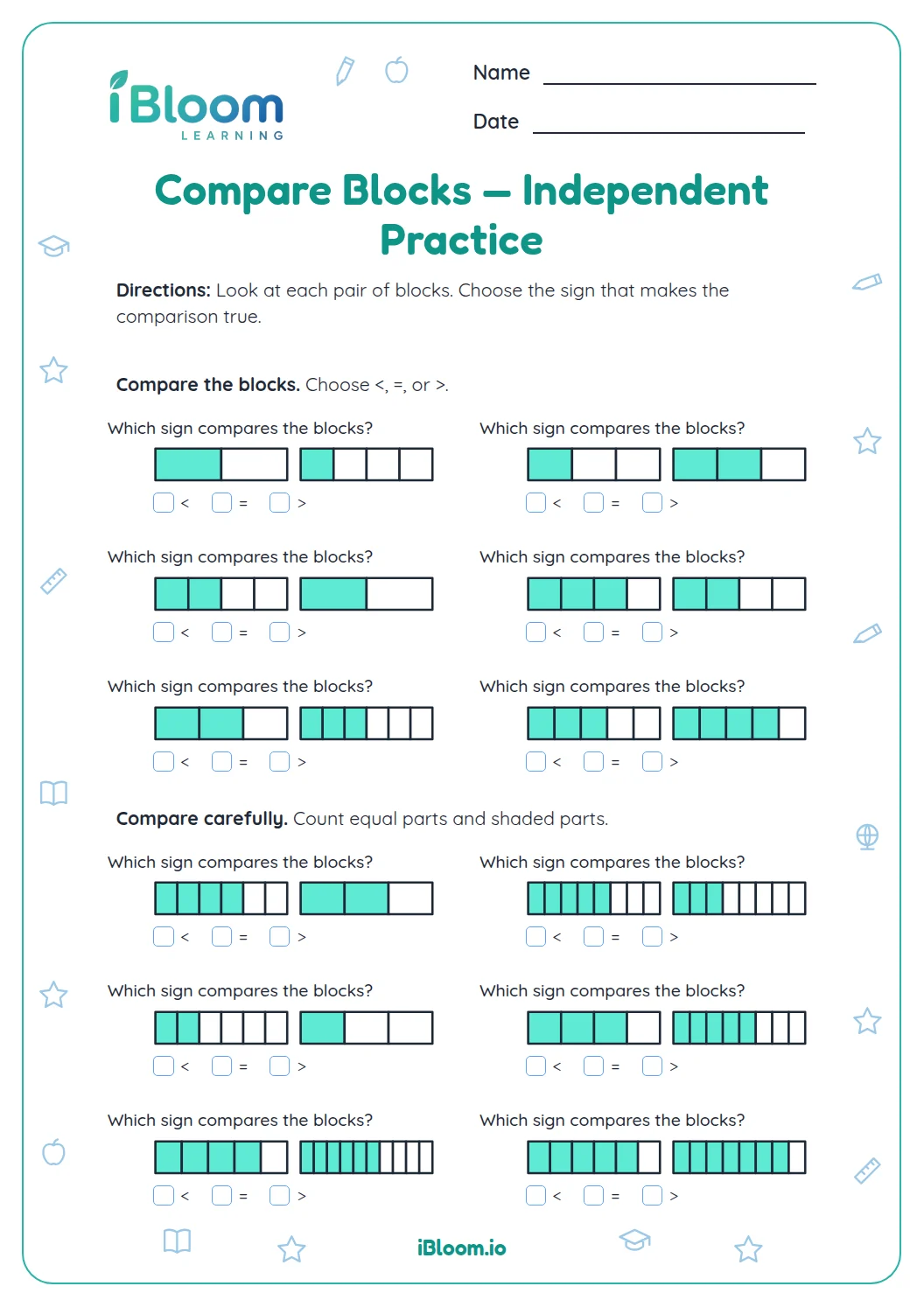
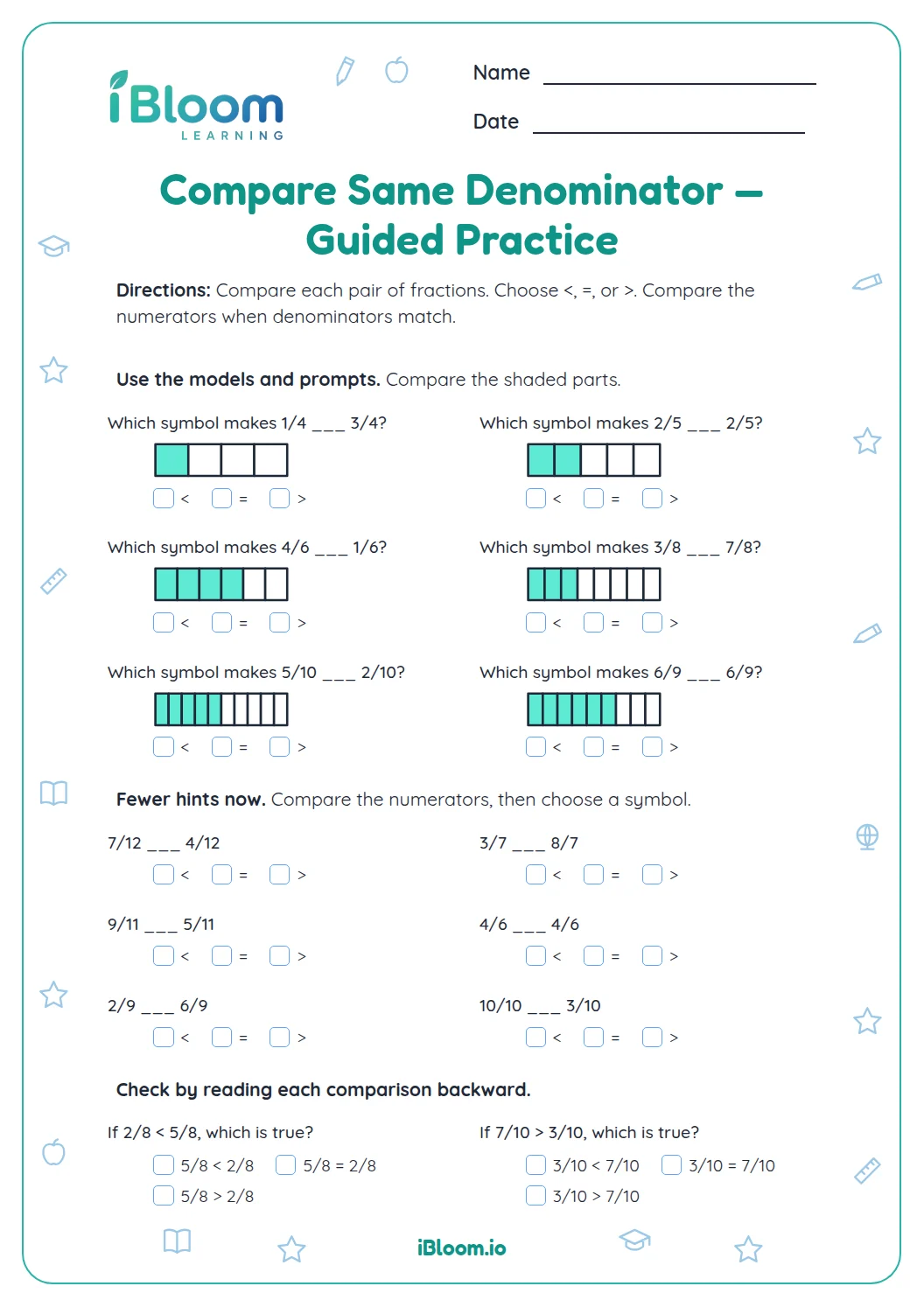
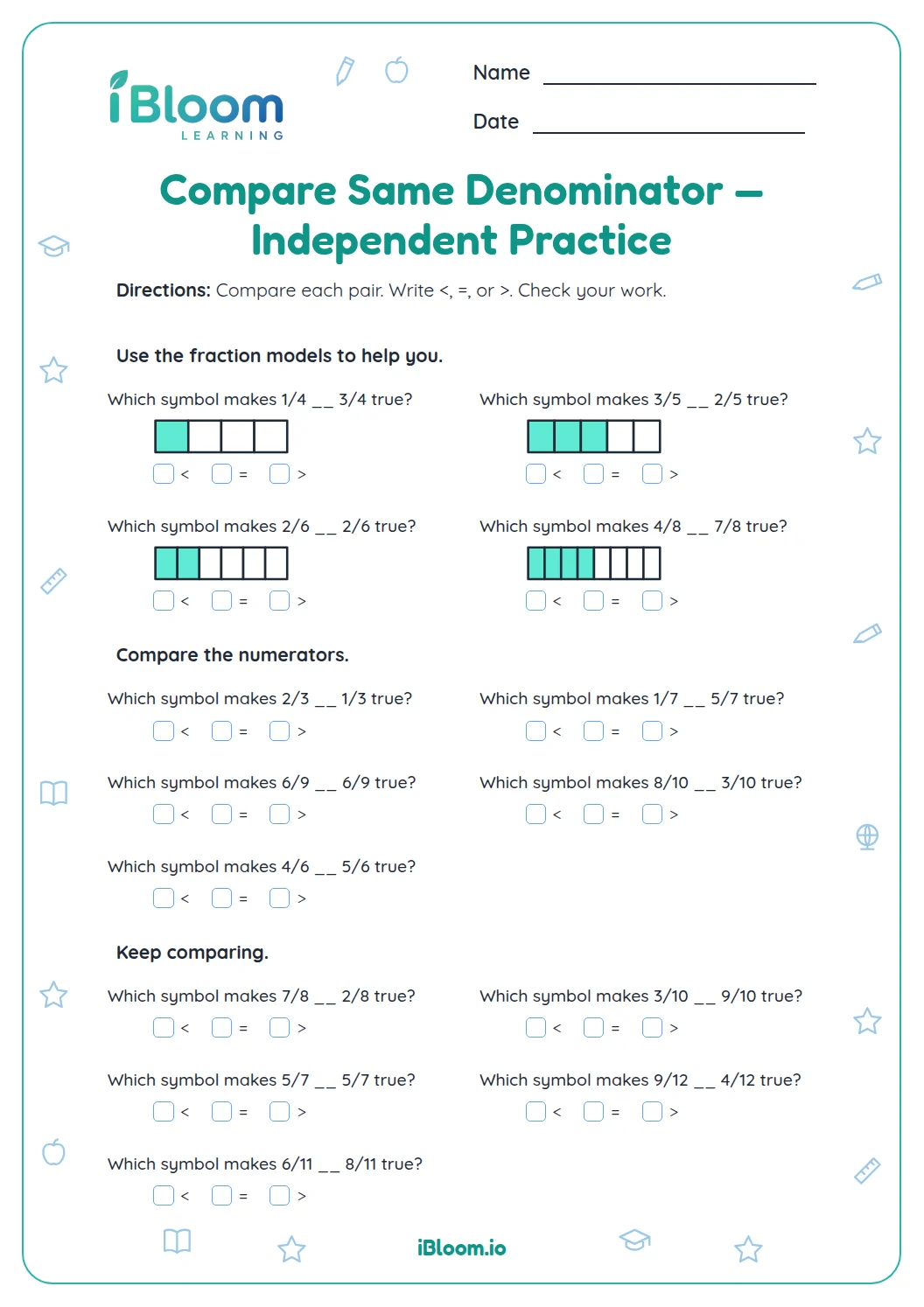
This free printable worksheet helps Grade 2 children reason about which fraction of the same whole is bigger when the parts are different sizes. Part A uses a shaded circle, bar and square showing halves, thirds and fourths. Part B gives a pie story with different cuts and a classmate's mistake to find. Part C asks for >, < or = between fractions such as 1/2 and 1/3, and Part D asks children to explain their thinking in writing. It practices CCSS 2.G.A.3, describing equal shares as halves, thirds and fourths, and 3.NF.A.3.d, comparing fractions by reasoning about their size. The answer key is on its own page.
Aligned to 2.G.A.3 and 3.NF.A.3.d
Why is 1/4 smaller than 1/2 when 4 is bigger than 2?
This is the biggest surprise in fractions. The bottom number tells how many equal parts the whole is cut into, not how big the pieces are. Cut a pizza into 2 parts and each part is large. Cut the same pizza into 4 parts and each part is smaller, so 1/4 is less than 1/2.
Question 5 puts this mix-up in front of children. Zoe says 1/4 is more than 1/2 because 4 is more than 2. Children find the mistake: a fourth is a smaller piece.
- 1Mia ate 1/2 of a pizza. Leo ate 1/4 of a pizza the same size.
- 2Picture 2 big slices and 4 small slices.
- 3One big slice is more than one small slice.
- 41/2 is greater than 1/4.
- 5Answer: Mia ate more
Why must the wholes be the same size?
Fractions can only be compared when they come from wholes of the same size. Half of a giant pizza is more than half of a tiny one. Every comparison on this sheet says the wholes are the same: a pizza, a bar or a square the same size, or two pies the same size.
That is also why 2/4 and 1/2 match in question 3. The square shows 2 of 4 equal parts shaded, which covers exactly the same area as one half of the square.
What is on this worksheet?
There are 9 questions in four parts. Every fraction is a half, a third or a fourth, plus whole numbers written as 2/2, 3/3 and 4/4.
- Part A: 3 shaded models (circle, bar, square) to compare with a half or a fourth
- Part B: a pie story about 2 slices and 4 slices, plus Zoe's mistake
- Part C: 3 comparisons with >, < or = (1/2 and 1/3, 2/2 and 4/4, 3/3 and 3/4)
- Part D: 1 written explanation with space to write
- Answer key on a separate page
What about fractions that make a whole?
Question 7 asks children to compare 2/2 and 4/4. Both name one whole: two halves or four fourths of the same thing. So they are equal, even though the numbers look different.
Question 8 compares 3/3 with 3/4. Three thirds is a whole, while 3/4 is one fourth short of a whole, so 3/3 is greater. Drawing the two bars side by side is a good way to check.
How to use this worksheet at home or in class
- 1Warm up with paper or real food. Fold a strip in half and another strip of the same size in fourths. Lay them side by side and ask which parts are bigger.
- 2Do question 1 together. Ask: "How many slices is Mia's pizza cut into? And Leo's?"
- 3Let your child finish Part A alone, using the shaded models.
- 4In Part B, ask your child to draw a quick sketch of Ana's and Ben's pies if they are unsure.
- 5For Part C, say each fraction as words first, like "one half" and "one third," then compare the sizes.
- 6In Part D, ask your child to explain out loud before writing. Then check with the answer key.
Common mistakes and quick fixes
The mistake
Thinking the bigger bottom number means the bigger fraction, so 1/4 looks bigger than 1/2.
The fix
Cut two equal paper strips, one into halves and one into fourths, and hold up one piece of each. The fourth is shorter.
The mistake
Saying 2/4 is different from 1/2 because the numbers are different.
The fix
Shade 2 of 4 parts on a bar and 1 of 2 parts on a bar the same size. Both cover the same amount.
The mistake
Choosing 3/4 as greater than 3/3 because 4 is bigger than 3.
The fix
Remind your child that 3/3 is a whole. Then ask whether 3 fourths fill the whole bar.
Common Core alignment
The sheet practices the two standards below.
Name equal shares as halves, thirds and fourths, and see two halves make a whole.
On this sheet: Every question uses halves, thirds or fourths of the same whole, and Part C shows 2/2, 3/3 and 4/4 as whole amounts.
Show the official wordingHide the official wording
Partition circles and rectangles into two, three, or four equal shares, describe the shares using the words halves, thirds, half of, a third of, etc., and describe the whole as two halves, three thirds, four fourths. Recognize that equal shares of identical wholes need not have the same shape.
Compare fractions by their size and write the result with >, < or =.
On this sheet: Parts A to C compare fractions of the same whole, such as 1/2 and 1/4, with models, reasoning and the symbols >, < and =.
Show the official wordingHide the official wording
Compare two fractions with the same numerator or the same denominator by reasoning about their size. Recognize that comparisons are valid only when the two fractions refer to the same whole. Record the results of comparisons with the symbols >, =, or <, and justify the conclusions, e.g., by using a visual fraction model.
What to practice next
Make more practice
Further reading
Questions parents and teachers ask
Can second graders compare fractions?
Yes, when they use models and the same whole. Second graders can see that 1/2 of a pizza is more than 1/4 of the same pizza by picturing the slices. This sheet uses only halves, thirds and fourths, with shaded drawings and a short story, so no rules or common denominators are needed.
Why is 1/3 bigger than 1/4?
A whole cut into 3 equal parts has bigger parts than the same whole cut into 4 equal parts. So one third is larger than one fourth. Question 2 shows this with a bar: the bar is already split into thirds, and children compare 1/3 with 1/4 of a bar the same size.
What are the answers to Part C?
1/2 > 1/3, 2/2 = 4/4, and 3/3 > 3/4. The first compares unit fractions: fewer parts means bigger parts. In the others, 2/2, 4/4 and 3/3 each name one whole, so 2/2 equals 4/4 and 3/3 is more than 3/4. The answer key shows all 9 answers, and the written one is a sample answer.
Why does every question say the same size?
Because fractions can only be compared when the wholes match. Half of a small pizza can be less than a fourth of a giant one. Each question on this sheet uses the same pizza, bar, square or pie, so children can focus on how many equal parts the whole is cut into.
How can I help if my child thinks 1/4 is bigger than 1/2?
Use real food or paper. Cut one sandwich into 2 equal pieces and another the same size into 4. Ask which one you would rather eat. Let your child hold both pieces. Seeing the bigger piece in their hand is far more convincing than telling them the rule.
How long does the worksheet take, and is there an answer key?
Most second graders finish in about 15 minutes, a little longer if they sketch the pie story or talk through each question. Yes, there is an answer key on a separate page. It shows every answer, and the written explanation in Part D appears as a sample answer.