


About this worksheet
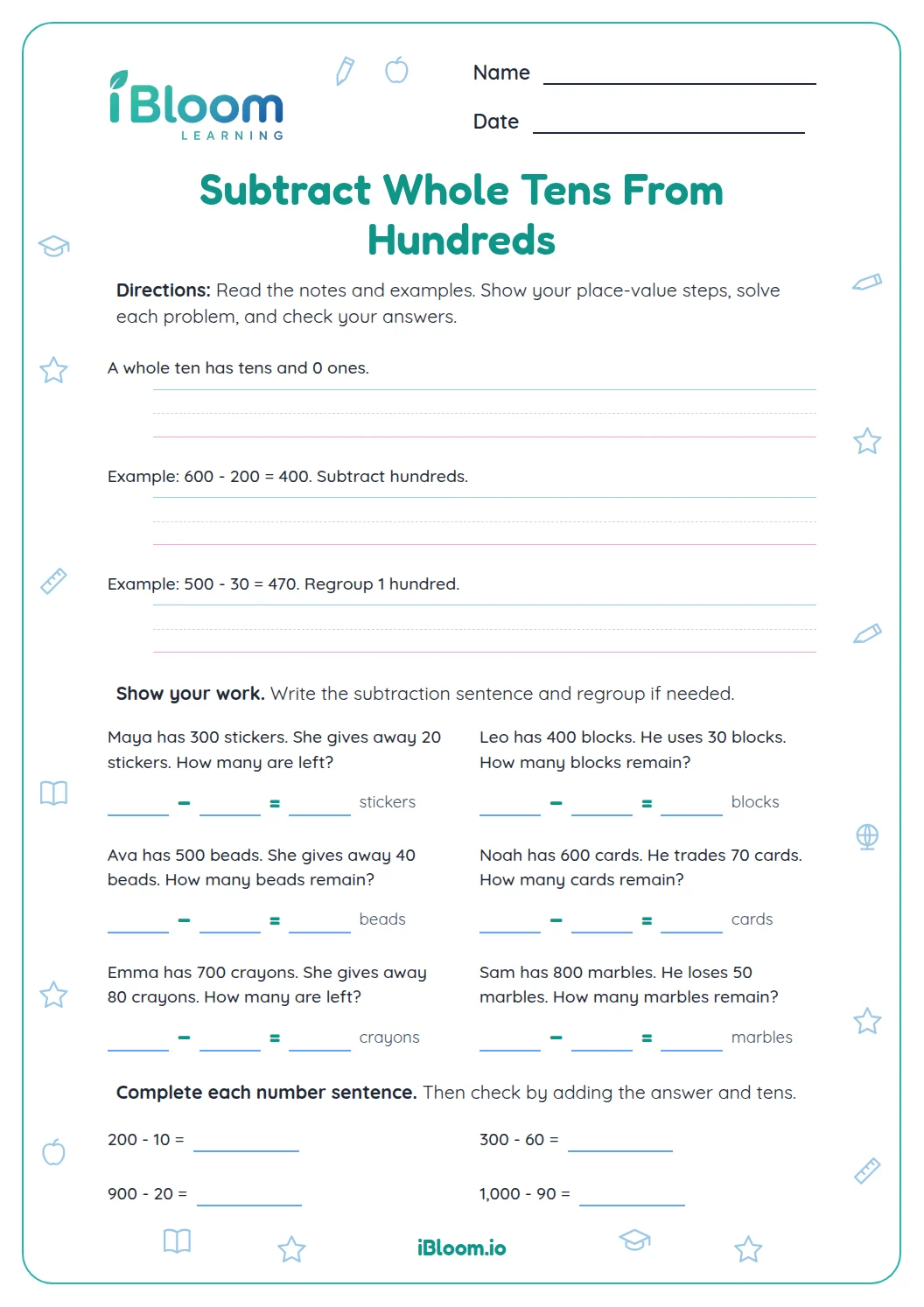
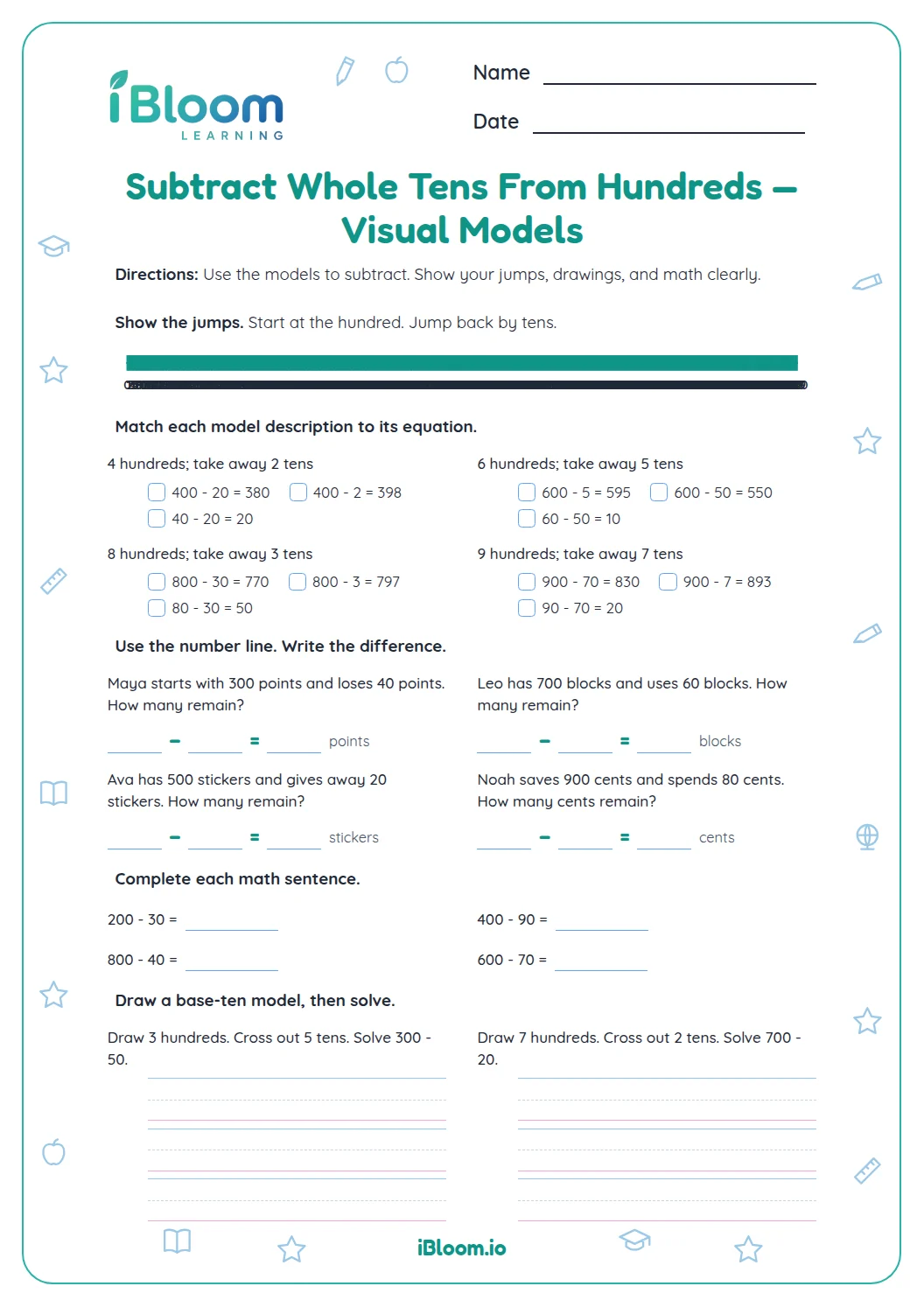
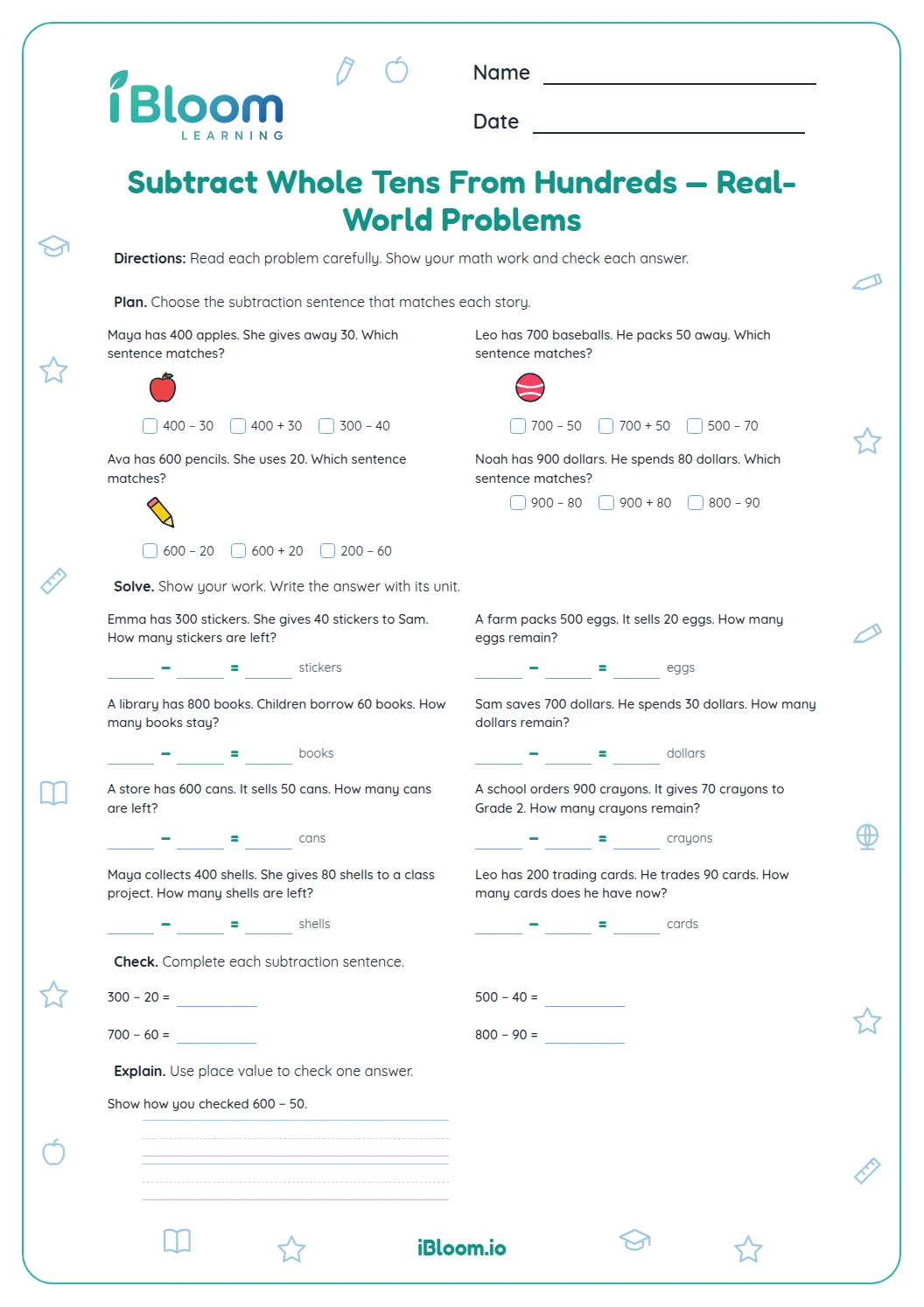
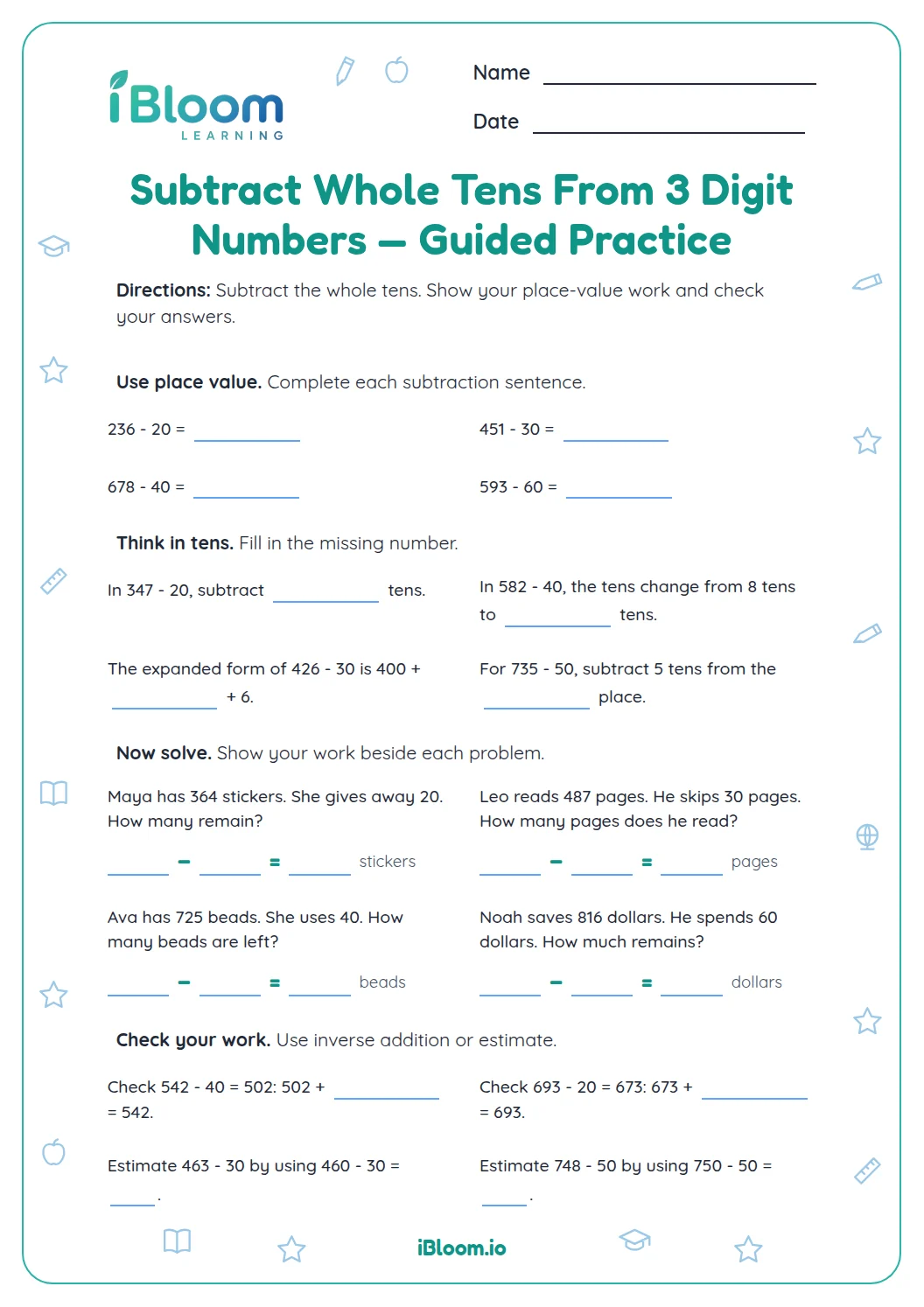
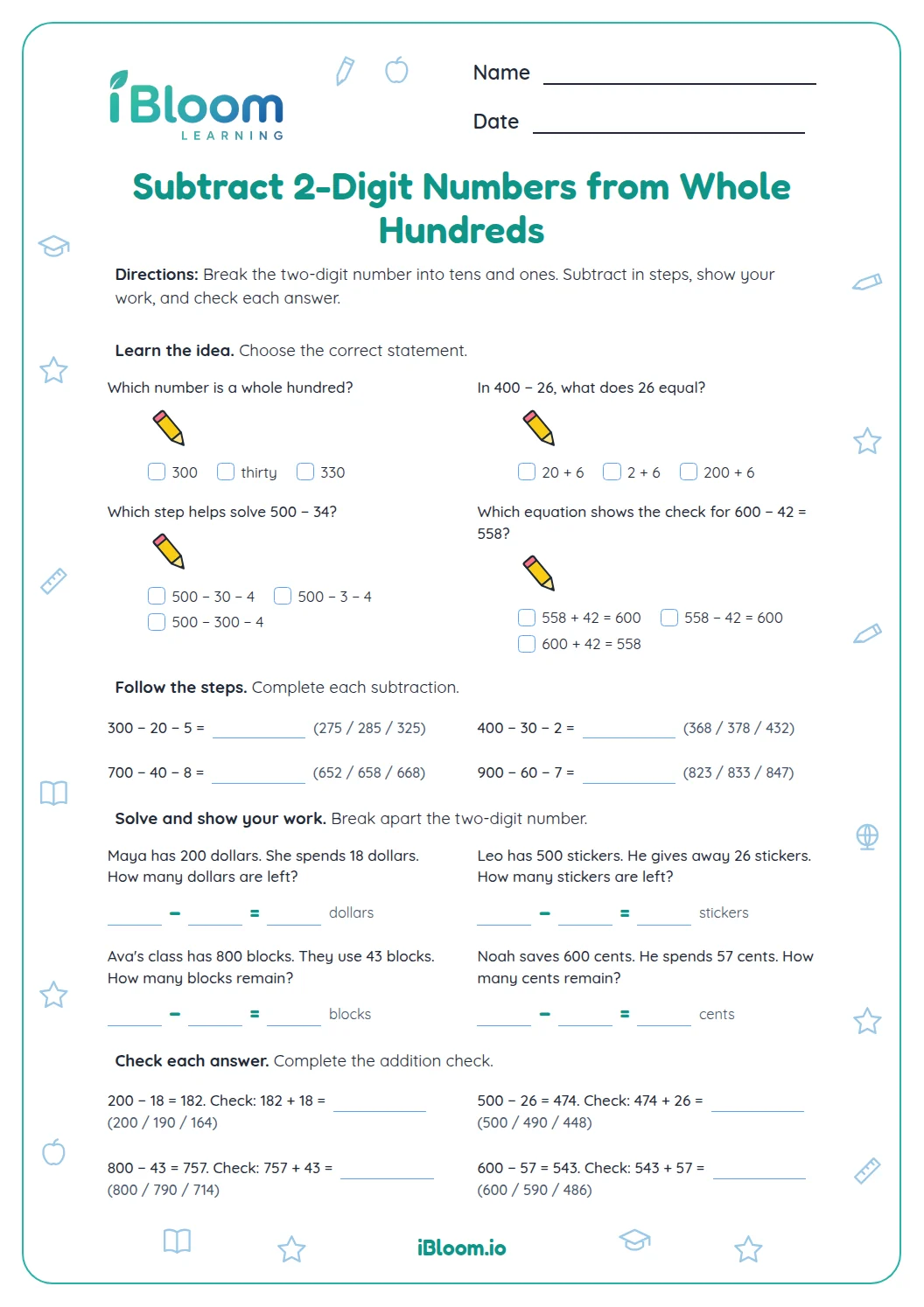
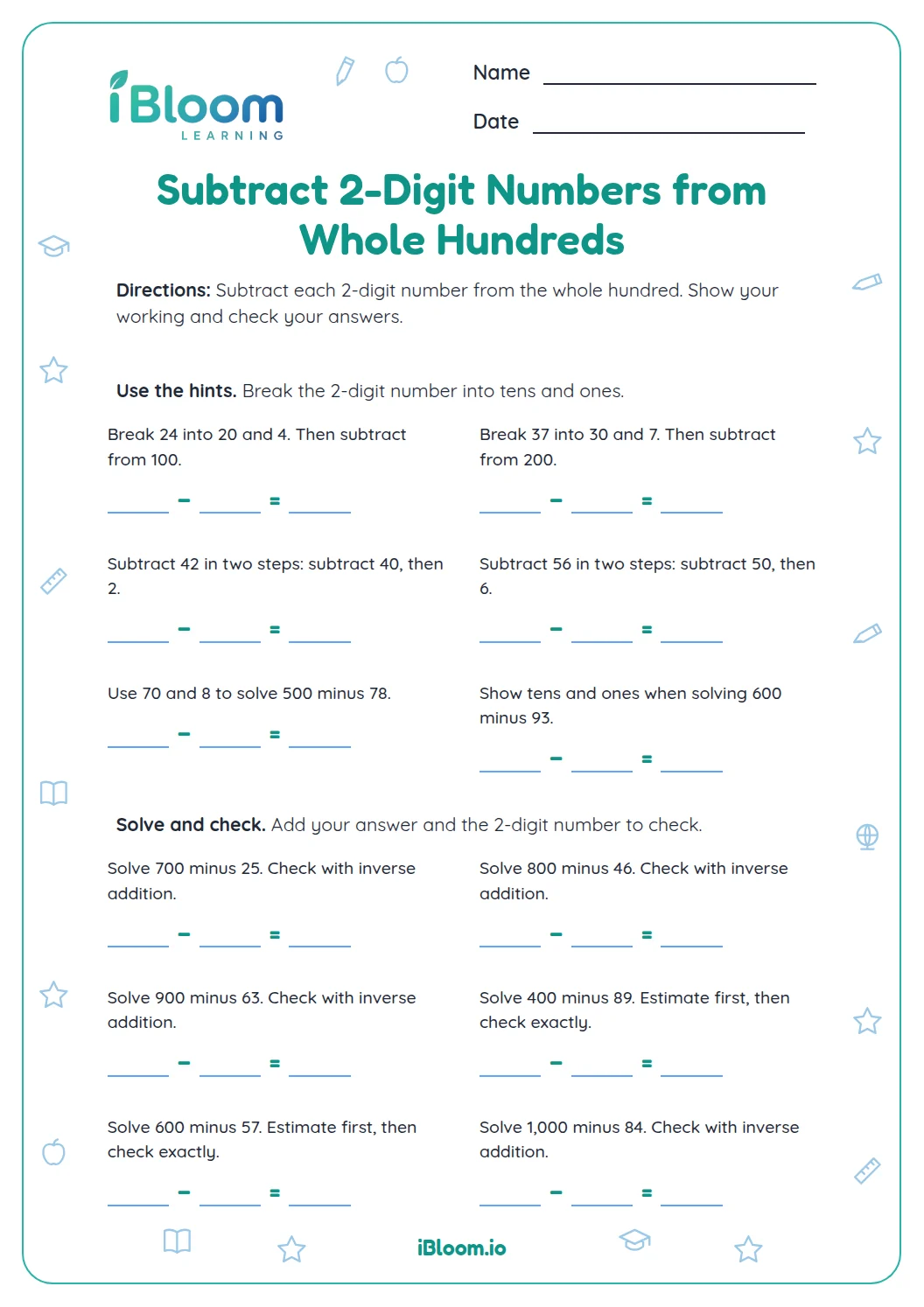
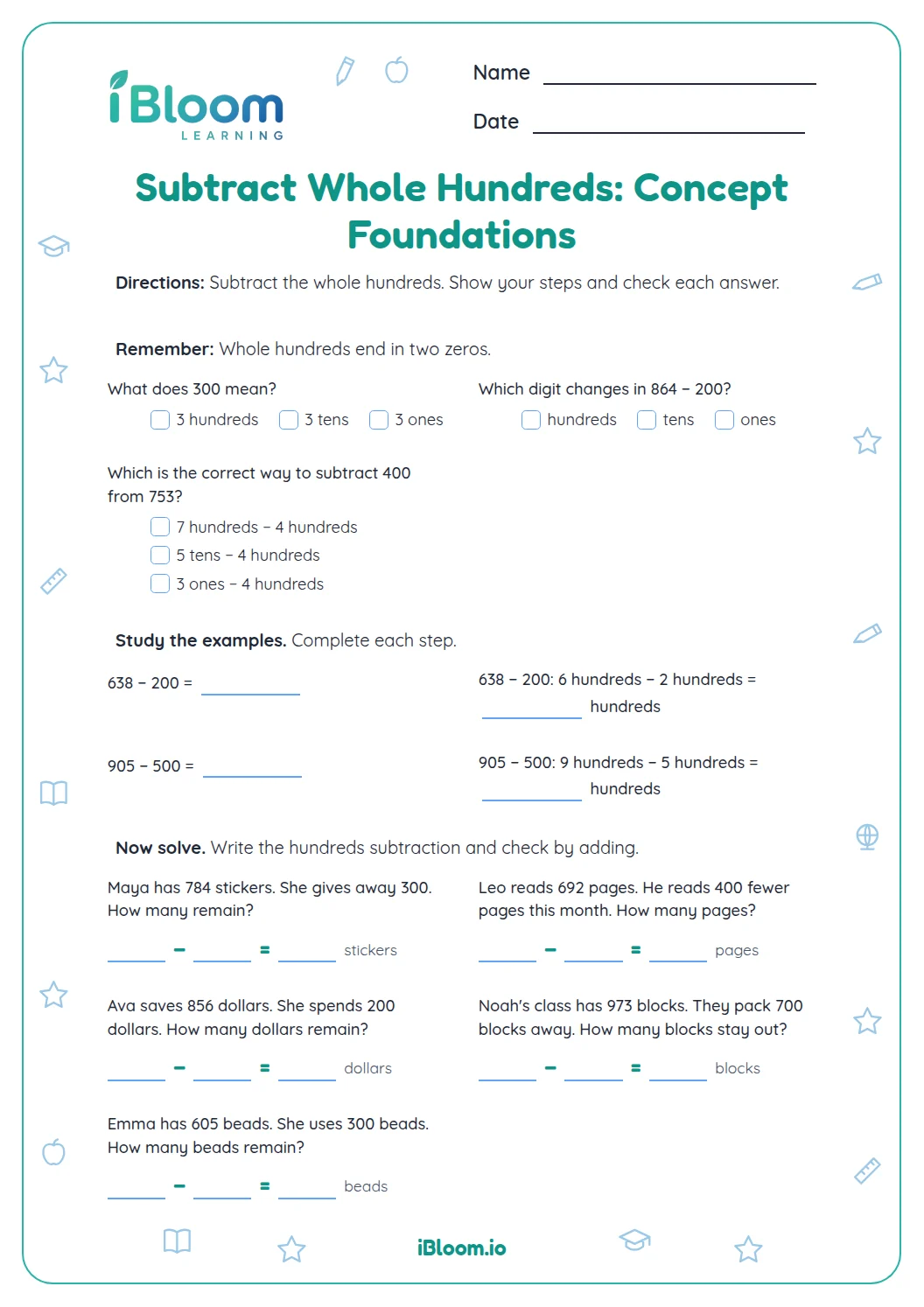
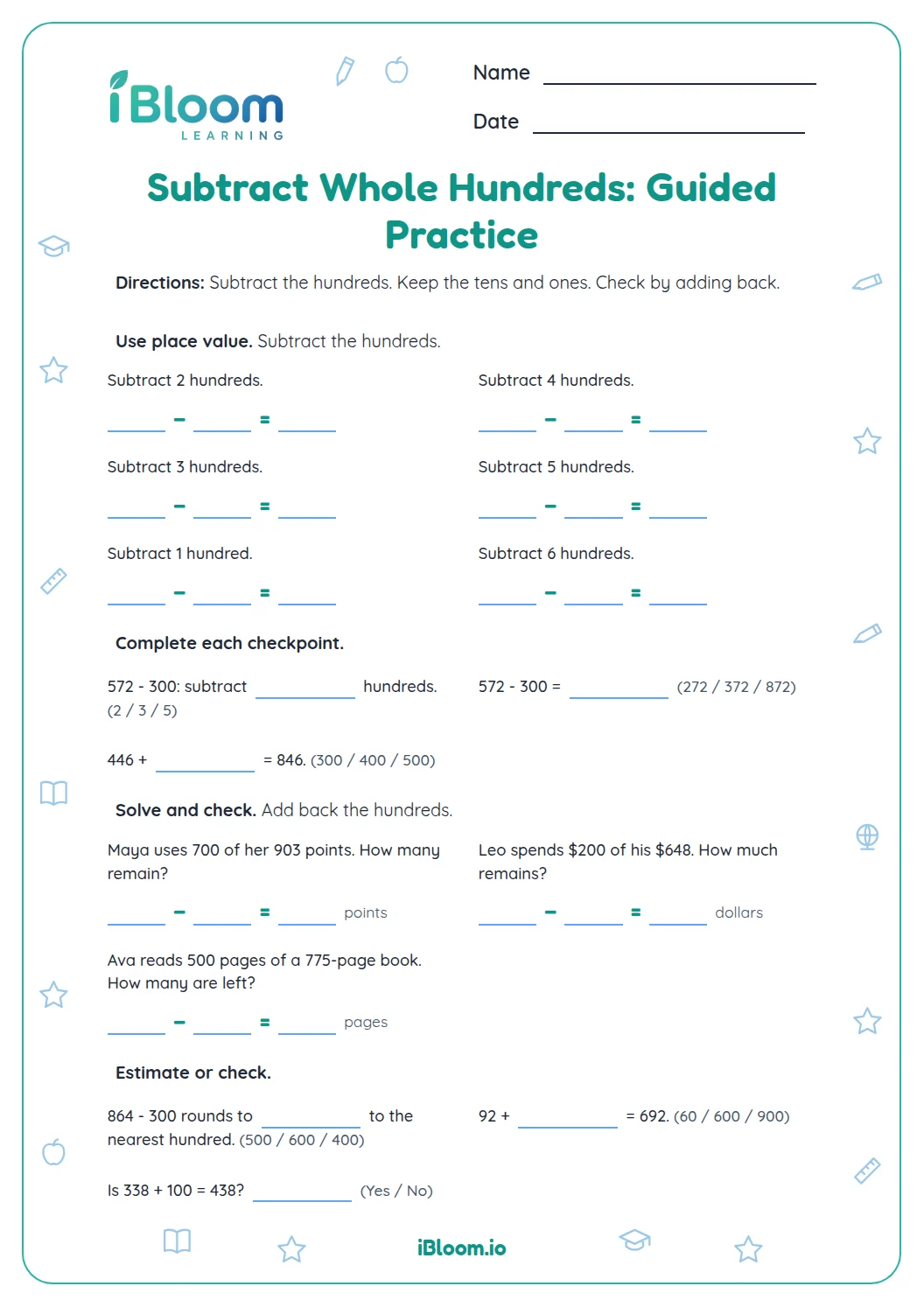
This Grade 2 worksheet builds reasoning around subtracting a multiple of ten from a whole hundred. Students solve direct equations, connect hundreds and tens in Part B, then apply the same skill in short word problems. The answer key includes labeled answers for the story problems and a correction for the reasoning check.
Aligned to 2.NBT.B.7
What kinds of subtraction are included?
Part A asks for six differences between a whole hundred and a multiple of ten. Part B connects the subtraction to tens and hundreds. Part C applies the same skill in four short situations, and Part D checks one place-value claim. Students can use place-value reasoning or write an equation.
- Part A: 6 direct subtraction equations
- Part B: 5 place-value reasoning prompts
- Part C: 4 word problems
- Part D: 1 place-value reasoning check
How can place value make this subtraction easier?
Rename hundreds as tens when it helps. For 500 − 70, think of 500 as 50 tens. Then 50 tens − 7 tens = 43 tens, or 430. In the printed expression, keep the value of the units clear: 43 tens is 430.
- 1200 − 60 = ___
- 2Think: 20 tens − 6 tens = 14 tens.
- 314 tens is 140.
How can you check a subtraction answer?
Add the amount taken away to the difference. For 600 − 20 = 580, check 580 + 20 = 600. If the sum returns to the starting hundred, the subtraction is consistent. In a story problem, also name what the number counts.
How to use this worksheet
- 1Read each number and name its place-value units.
- 2Solve Part A by subtracting the tens from the hundreds.
- 3In Part B, use tens as the unit when the prompt asks for a decomposition.
- 4For Part C, write an equation before solving the story.
- 5Check by adding the amount removed to the difference.
Common mistakes and quick fixes
The mistake
Subtracting the digits 5 − 7 in 500 − 70 and writing a negative result.
The fix
Rename 500 as 50 tens, then subtract 7 tens.
The mistake
Treating 70 as 70 hundreds instead of 7 tens.
The fix
Say the value of each digit: 7 tens is 70.
The mistake
Giving a story answer without a label.
The fix
Add the item being counted, such as “430 books,” to the numerical answer.
Common Core alignment
This practice connects the worksheet tasks to the listed Common Core skill.
Subtract whole tens from hundreds by using place value.
On this sheet: Parts A and B use hundreds and tens; Part C applies the same subtraction in short situations.
Show the official wordingHide the official wording
Add and subtract within 1000, using concrete models or drawings and strategies based on place value, properties of operations, and/or the relationship between addition and subtraction; relate the strategy to a written method. Understand that in adding or subtracting three-digit numbers, one adds or subtracts hundreds and hundreds, tens and tens, ones and ones; and sometimes it is necessary to compose or decompose tens or hundreds.
What to practice next
Make more practice
Further reading
Questions parents and teachers ask
What does subtracting whole tens from hundreds mean?
It means subtracting a number such as 30, 60, or 90 from a whole hundred such as 200 or 700. The difference may be another hundred or a number between hundreds. The worksheet practices the calculation directly, with place-value reasoning and short word problems.
How many questions are included?
There are 16 questions in four parts: six subtraction equations, five place-value prompts, four story problems, and one reasoning check. Every item involves taking a multiple of ten away from a whole hundred. The answer key has two pages for checking calculations and labeled responses.
How can I solve 500 minus 70?
Think of 500 as 50 tens. Subtract 7 tens from 50 tens to get 43 tens, which is 430. You can also subtract 70 from 500 on paper. Either way, check by adding 70 back to 430; the result should be 500.
Why can a child subtract 70 from 500 even though 5 is less than 7?
The digits 5 and 7 represent different place values in 500 − 70. The 5 stands for 5 hundreds, or 50 tens; the 7 stands for 7 tens. Subtract 7 tens from 50 tens to get 43 tens, or 430.
How should we check a word problem?
First write the subtraction equation using the quantities named in the story. Then calculate and label the answer with the thing being counted, such as books or cans. Add the amount removed back to the remaining amount to see whether it matches the starting total.