





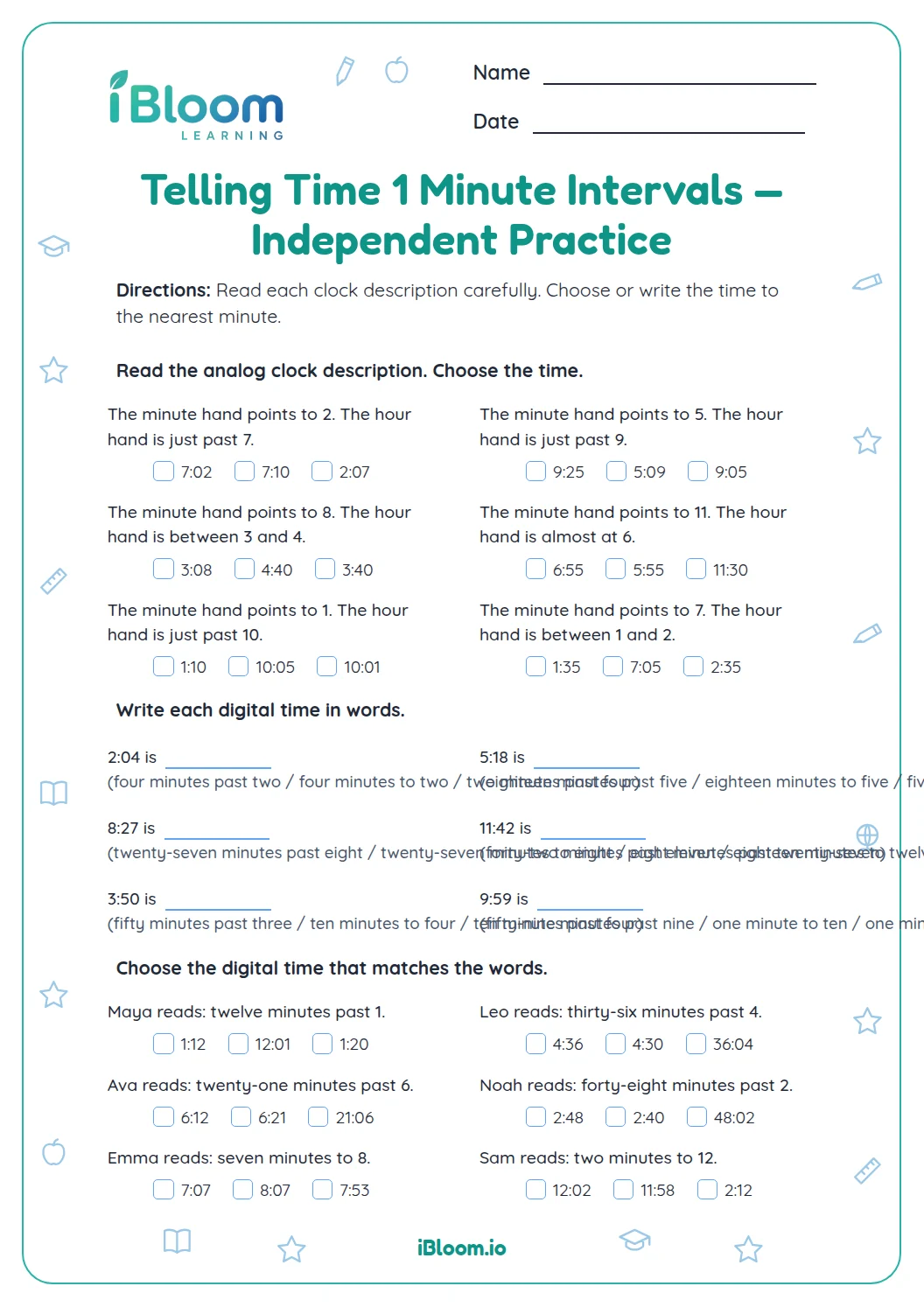
About this worksheet
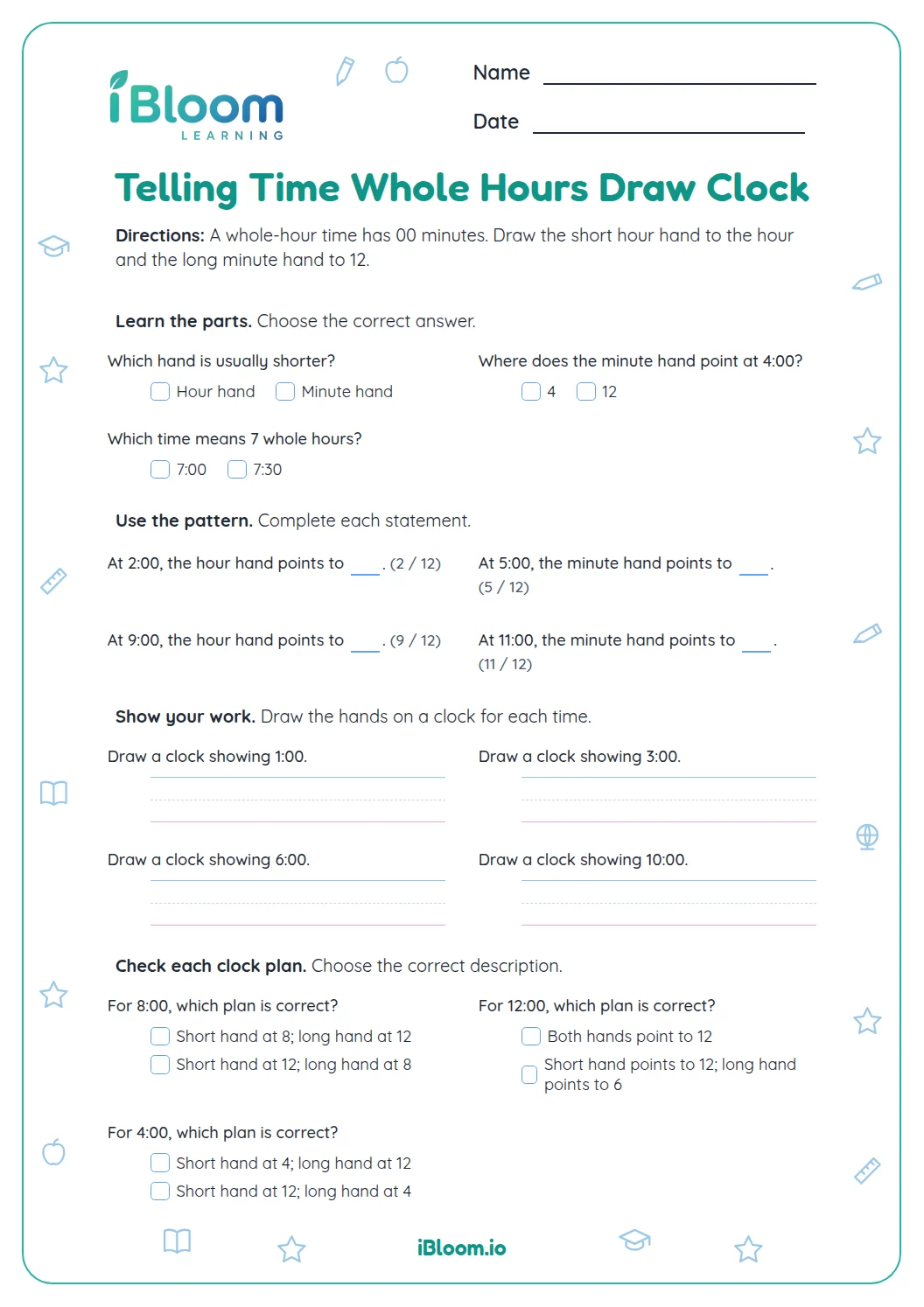
This Grade 2 printable helps children read analog clocks to the hour. Twelve clock faces cover every hour from 1:00 through 12:00, with three answer choices for each clock. Two short questions reinforce the roles of the hour and minute hands. Children check the minute hand at 12, then read the shorter hour hand. The practice supports CCSS 2.MD.C.7, and the answer key is included.
Aligned to 2.MD.C.7
How do you read a whole-hour clock?
For a whole hour, the minute hand points to 12. The shorter hour hand points to the number naming the time. Part A shows the first six hours, then Part B continues through 12:00.
Which hand should you read first?
Start with the longer minute hand. Once it points to 12, look at the shorter hour hand to name the hour. The final two questions reinforce which hand shows minutes and which hand shows hours.
- 1The long hand points to 12.
- 2The short hand points to 4, so the time is 4:00.
How to read each clock
- 1Find the longer minute hand.
- 2Check whether it points to 12.
- 3Find the shorter hour hand.
- 4Read the number that the hour hand points toward.
- 5Choose the matching time and check both hands.
Common mistakes and quick fixes
The mistake
Reading the long minute hand as the hour hand.
The fix
Compare hand lengths first; the shorter hand names the hour.
The mistake
Choosing the number under the minute hand.
The fix
At a whole hour, the minute hand points to 12 every time.
The mistake
Reading the hour hand before checking the minute hand.
The fix
Check the longer hand first, then name the hour shown by the shorter hand.
Common Core alignment
Children read and represent whole-hour times on analog clocks.
Read and represent whole-hour times on analog clocks.
On this sheet: Children read six analog clock faces and draw hour and minute hands for six more whole-hour times.
Show the official wordingHide the official wording
Tell and write time from analog and digital clocks to the nearest five minutes, using a.m. and p.m.
What to practice next
Make more practice
Further reading
Questions parents and teachers ask
Which times are shown?
The sheet shows every whole-hour time from 1:00 through 12:00. There are 12 analog clock faces, and each question asks the child to choose the matching digital time. Two final questions check knowledge of the hour and minute hands.
What should the minute hand show at a whole hour?
The minute hand points to 12. The hour hand points to the number naming the hour, such as 7 for 7:00. Reading the longer hand first helps children see that zero minutes have passed in the current hour.
How does the worksheet help children read a clock?
Each clock-reading question includes an analog clock face and three digital time choices. Children can check the longer minute hand first, then read the shorter hour hand and select the matching time. Two questions review the hand roles.
What is the main clock-reading step?
Check the minute hand before naming the hour. If it points to 12, the time is a whole hour; the shorter hand then tells which hour. This same check applies to all 12 clock-reading questions in the first two parts.
Is there an answer key?
Yes. The separate key marks the correct digital time for each clock and answers the two questions about hand roles. Children can point to the minute and hour hands on the clock models as they check their responses.