






About this worksheet
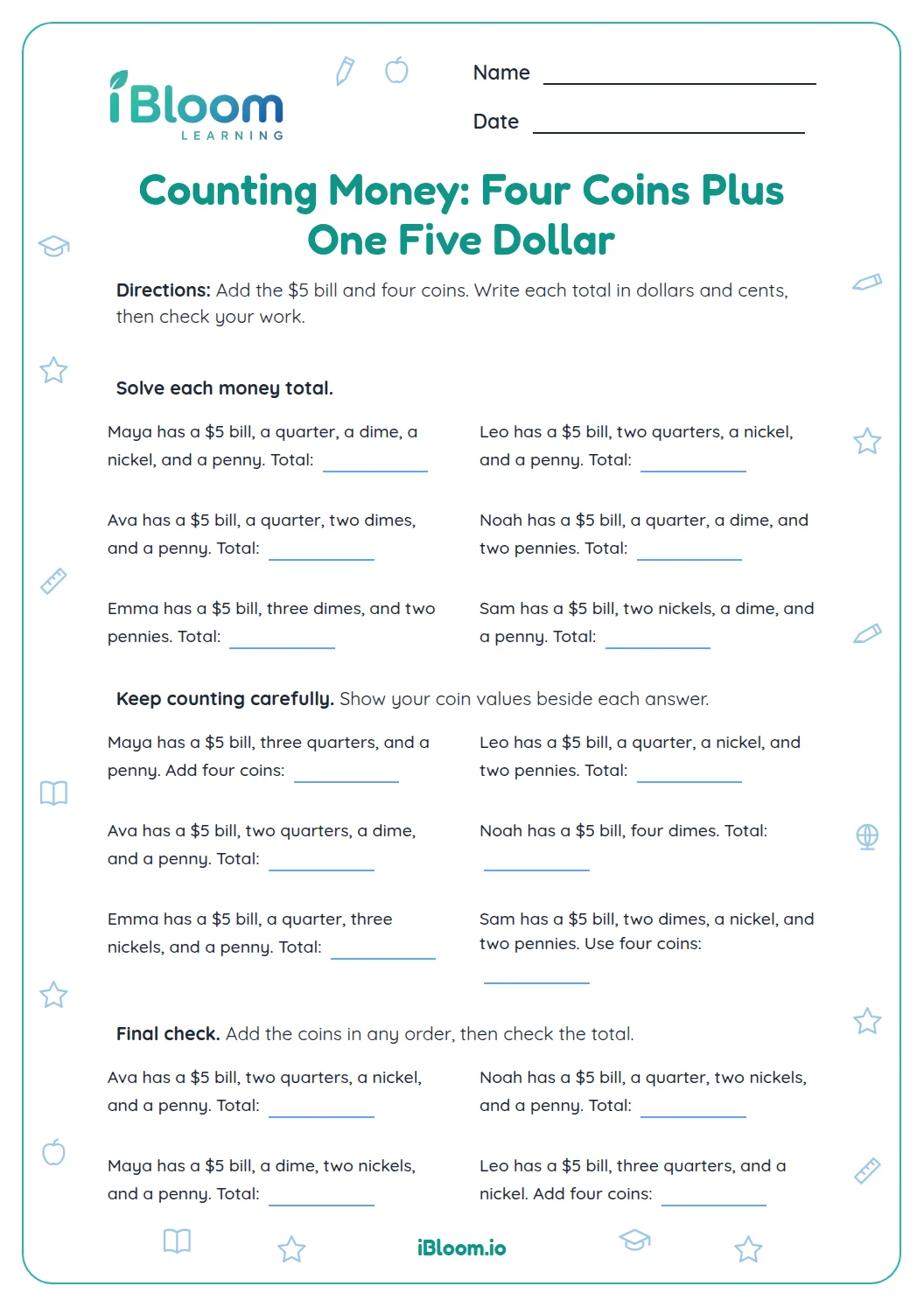
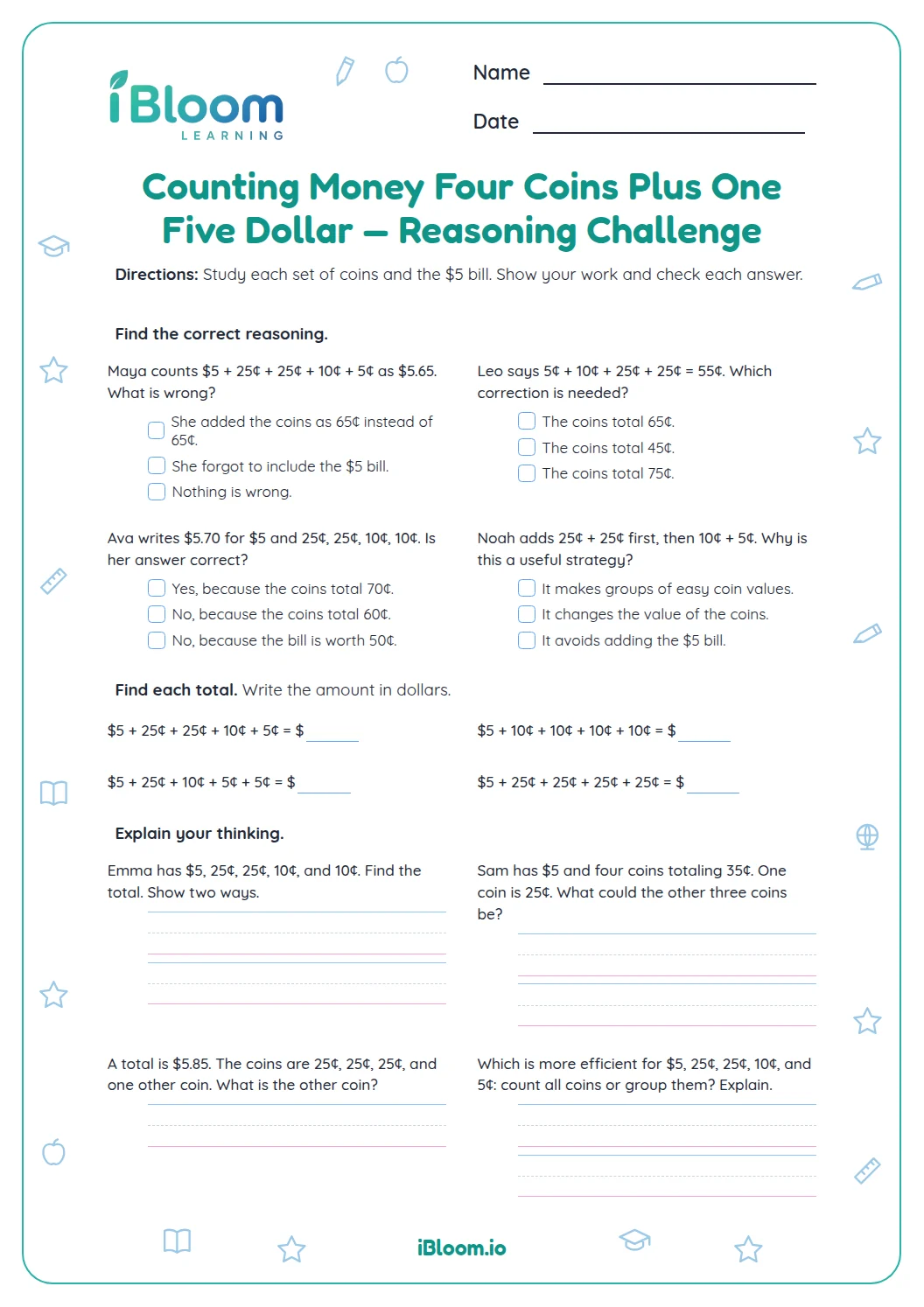
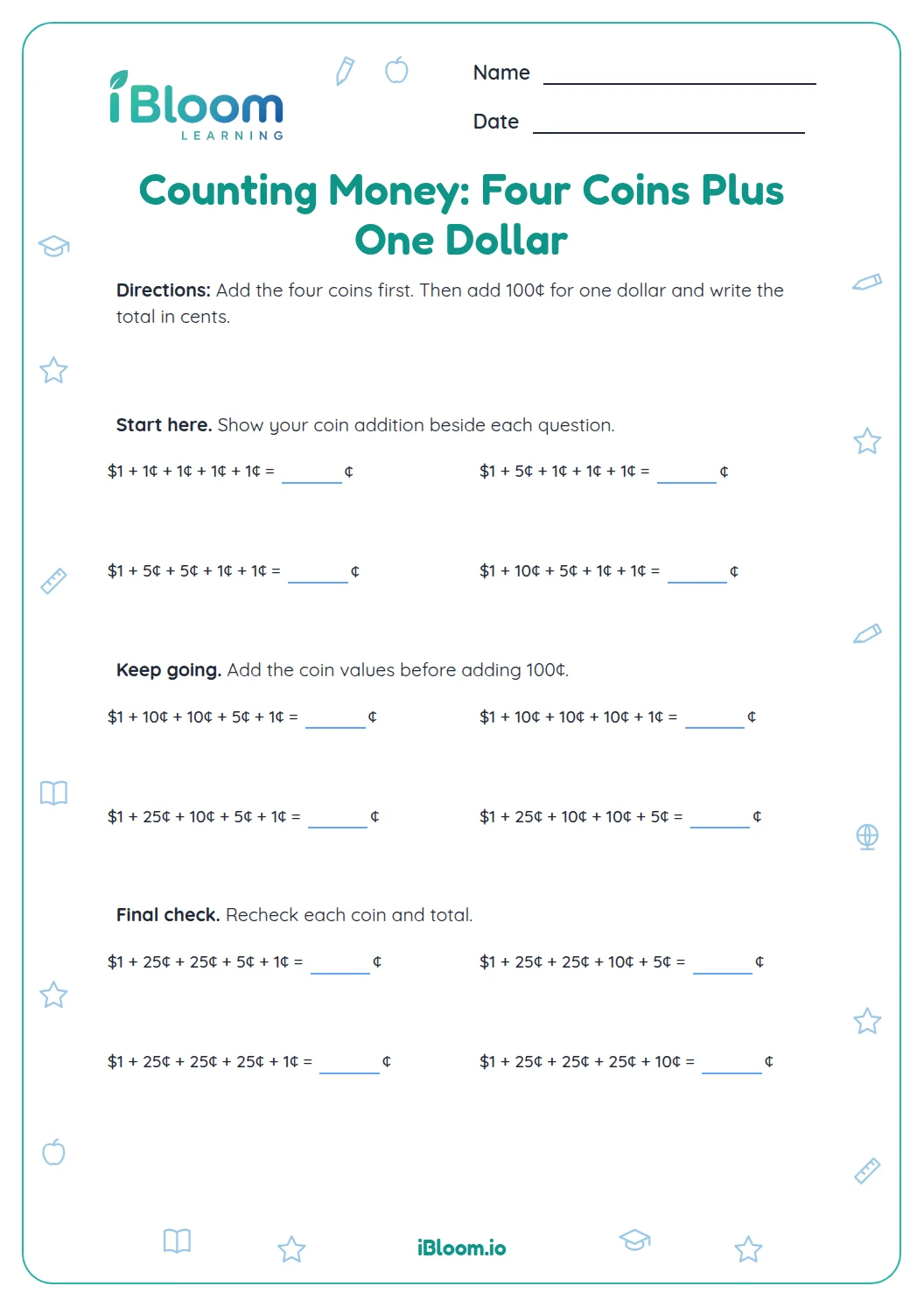
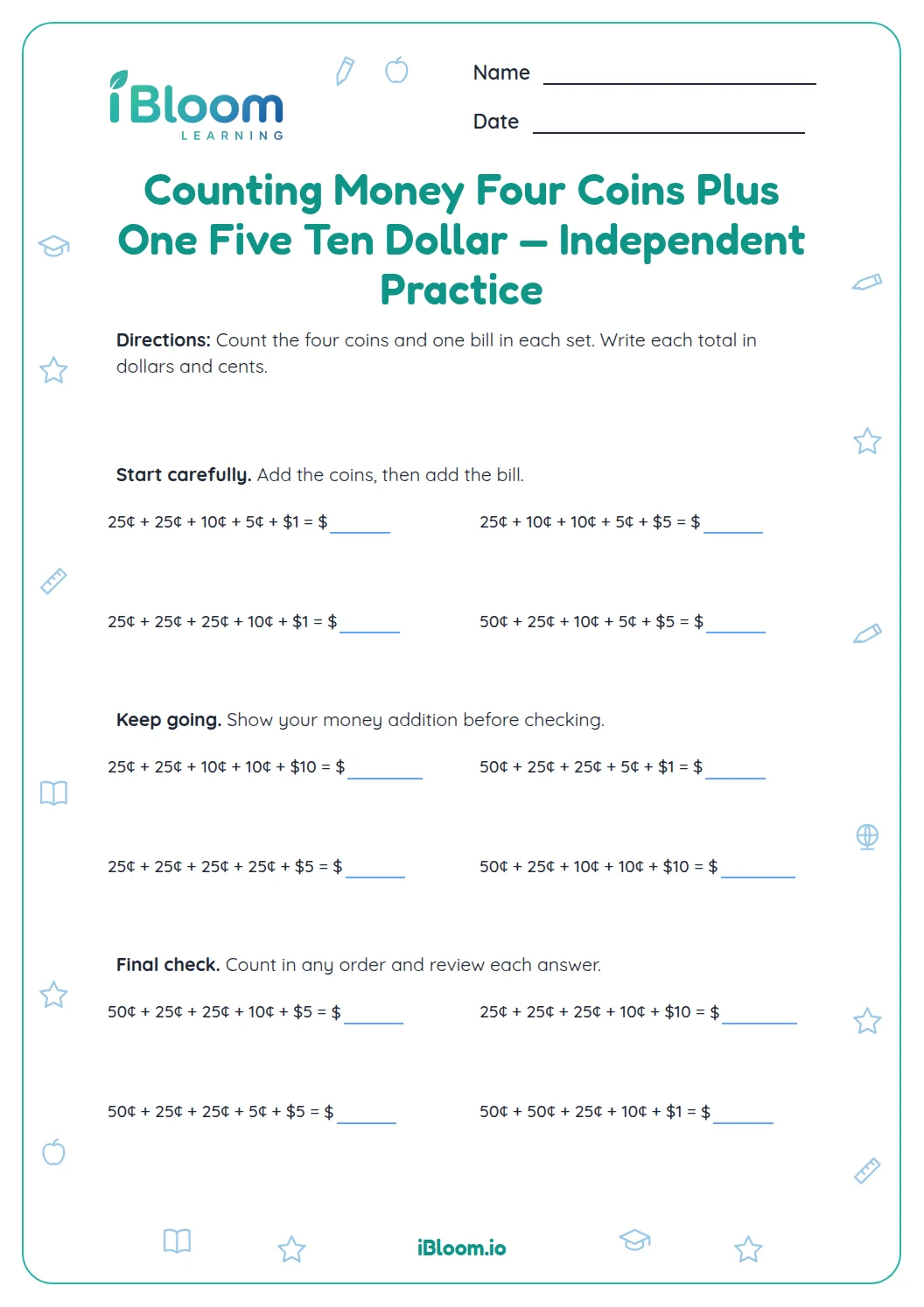
This free printable Grade 3 money worksheet combines a $5 bill with exactly four US coins in every question. Questions 1–4 show coin sets; questions 5–14 name the coins in short stories. Students count the cents, add the bill and record the total in dollars. The practice supports Common Core 2.MD.C.8, solving money problems and using money symbols correctly. Pennies, nickels, dimes and quarters appear in varied combinations, including four quarters that make another dollar. A separate key lists all fourteen totals.
Aligned to 2.MD.C.8
How do you combine a bill with coins?
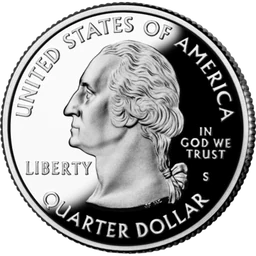
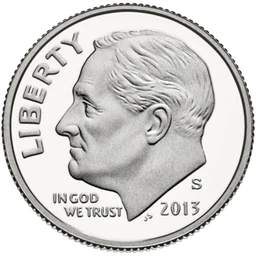
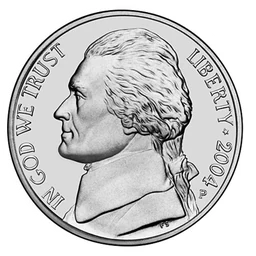
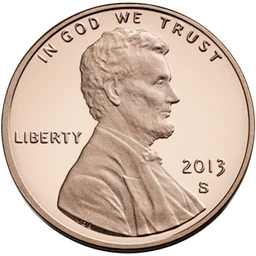
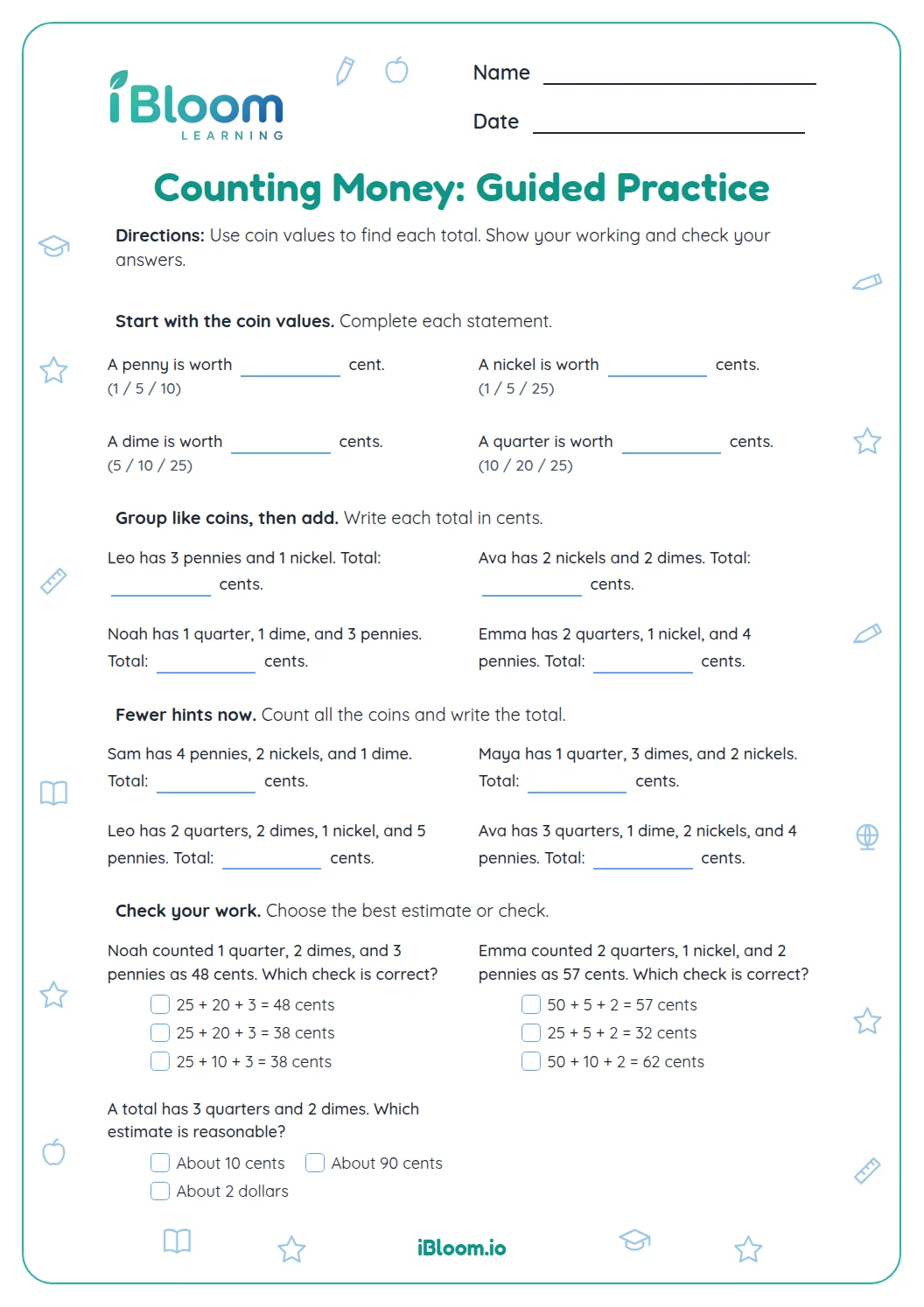
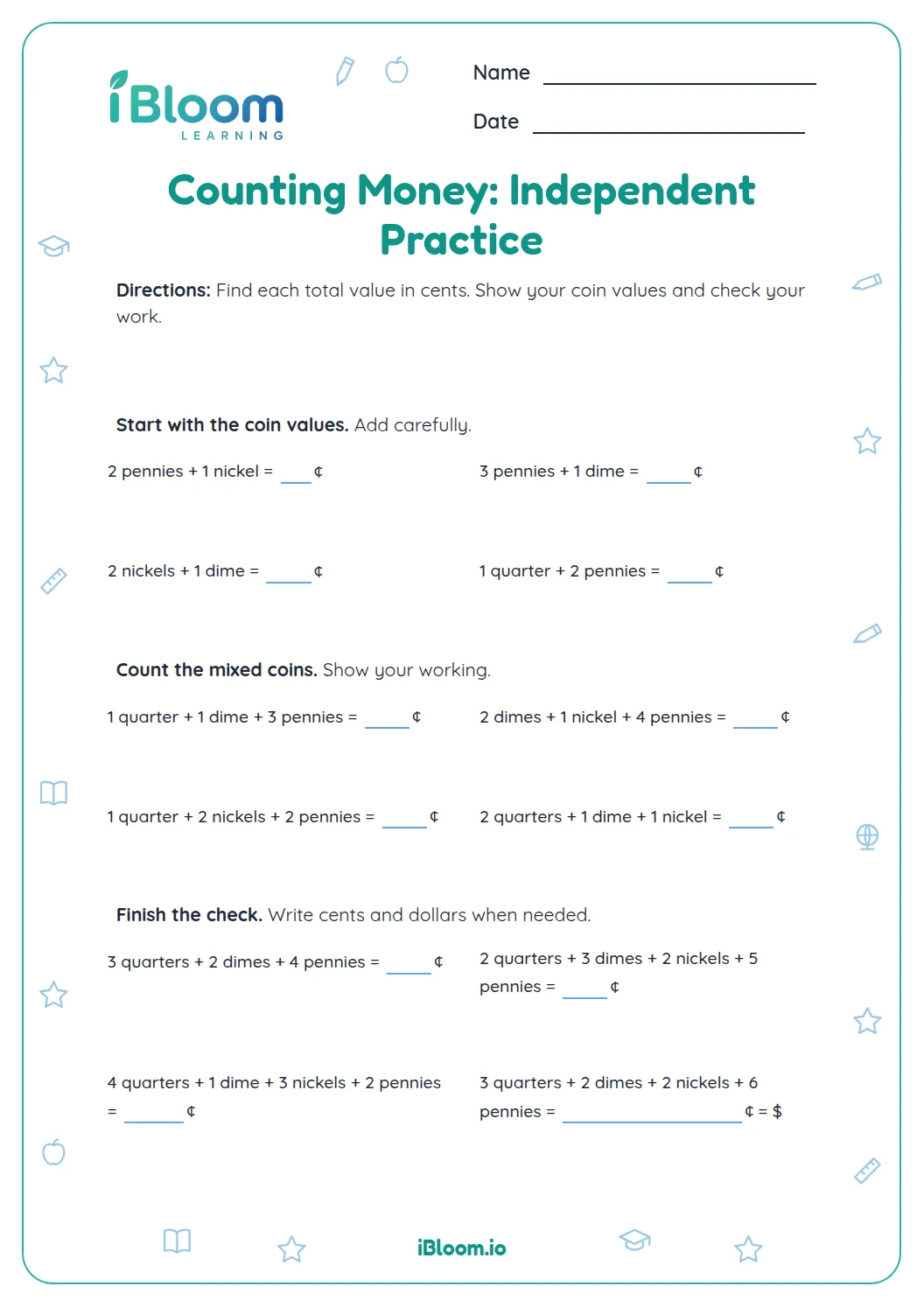
Start with the coin values. A penny is 1¢, a nickel is 5¢, a dime is 10¢ and a quarter is 25¢. Add the cents, write their value in dollars, then add $5. For example, 41¢ is $0.41, and $5 + $0.41 = $5.41.
- 1Question 1: a $5 bill plus a quarter, dime, nickel and penny.
- 225¢ + 10¢ + 5¢ + 1¢ = 41¢.
- 3$5 + $0.41 = $5.41.
Why does $5.04 need a zero?
Money written in dollars uses two places after the decimal point to show cents. Four pennies make 4¢, written as $0.04. With a $5 bill, the total is $5.04. Writing $5.40 would mean five dollars and forty cents.
Money written in dollars uses two places after the decimal point to show cents. Four pennies make 4¢, written as $0.04. With a $5 bill, the total is $5.04. Writing $5.40 would mean five dollars and forty cents. Question 5 practices the small-cent example; question 6 shows four quarters making $1.00.
What changes in the money stories?
Questions 1–4 show the coins as pictures. Questions 5–14 name the coin values in short stories. Every question uses one $5 bill and four coins, so the arithmetic routine stays consistent.
Ask children to say the coin subtotal before giving the total. That makes it possible to distinguish a coin-value mistake from a dollars-and-cents writing mistake.
Check a total by subtracting $5. For question 1, $5.41 − $5 = $0.41, which matches the 41¢ coin subtotal.
How to use this worksheet
- 1Review the four coin values aloud.
- 2Work through question 1, counting the coins from largest value to smallest.
- 3Finish the four picture totals and check the cents places.
- 4Read each Part B story and verify that it describes four coins.
- 5Say the coin subtotal, add $5, and compare with the answer key.
Mistakes to notice and fix
The mistake
Counting a nickel as 10¢ because it is larger than a dime.
The fix
Use the coin identity and value, not its size: nickel 5¢, dime 10¢.
The mistake
Writing $5.4 for a $5 bill and four pennies.
The fix
Four pennies are 04 cents. Write $5.04 with two cents places.
The mistake
Writing $5.100 for a $5 bill and four quarters.
The fix
Exchange 100 cents for one dollar. Five dollars plus one dollar is $6.00.
Common Core alignment
Combine a $5 bill with four US coins and record the total in dollars.
On this sheet: Coin pictures and six short money stories ask for totals using dollars and cents.
Show the official wordingHide the official wording
Solve word problems involving dollar bills, quarters, dimes, nickels, and pennies, using $ and ¢ symbols appropriately. Example: If you have 2 dimes and 3 pennies, how many cents do you have?
What to practice next
Make more practice
Further reading
Questions parents and teachers ask
Are there exactly four coins in every problem?
Yes, each of the fourteen questions combines exactly four coins with one $5 bill. The first four items display the coin sets, while the next ten name them in short stories. Some sets repeat a coin type, so count both the number of coins and their total value.
Does the sheet show a picture of the bill?
The $5 bill is named in each question, and Part A shows the four coins as pictures. Children add the stated bill value to the pictured coin subtotal. Part B uses written coin names, giving children practice moving from coin identification to reading and solving money stories.
Why are four pennies written as 04 cents in a dollar total?
The cents part needs two places when writing dollars and cents. Four pennies are four cents, so the total with a $5 bill is $5.04. The zero holds the tens-of-cents place. Writing $5.40 would change the amount to five dollars and forty cents.
What happens when the coins make a whole dollar?
Trade the hundred cents for one dollar before recording the total. In question 6, four quarters make 100¢. Adding that dollar to the $5 bill gives $6.00. The two zeros show that no additional cents remain after the coins have been combined into a dollar.
Can children use real or play coins?
Yes, real or play US coins can help children check the pictured and written sets. Build each set with exactly four coins and place a paper label marked $5 beside it. Count the cents first, then say the full amount before writing it with a dollar sign.