


About this worksheet
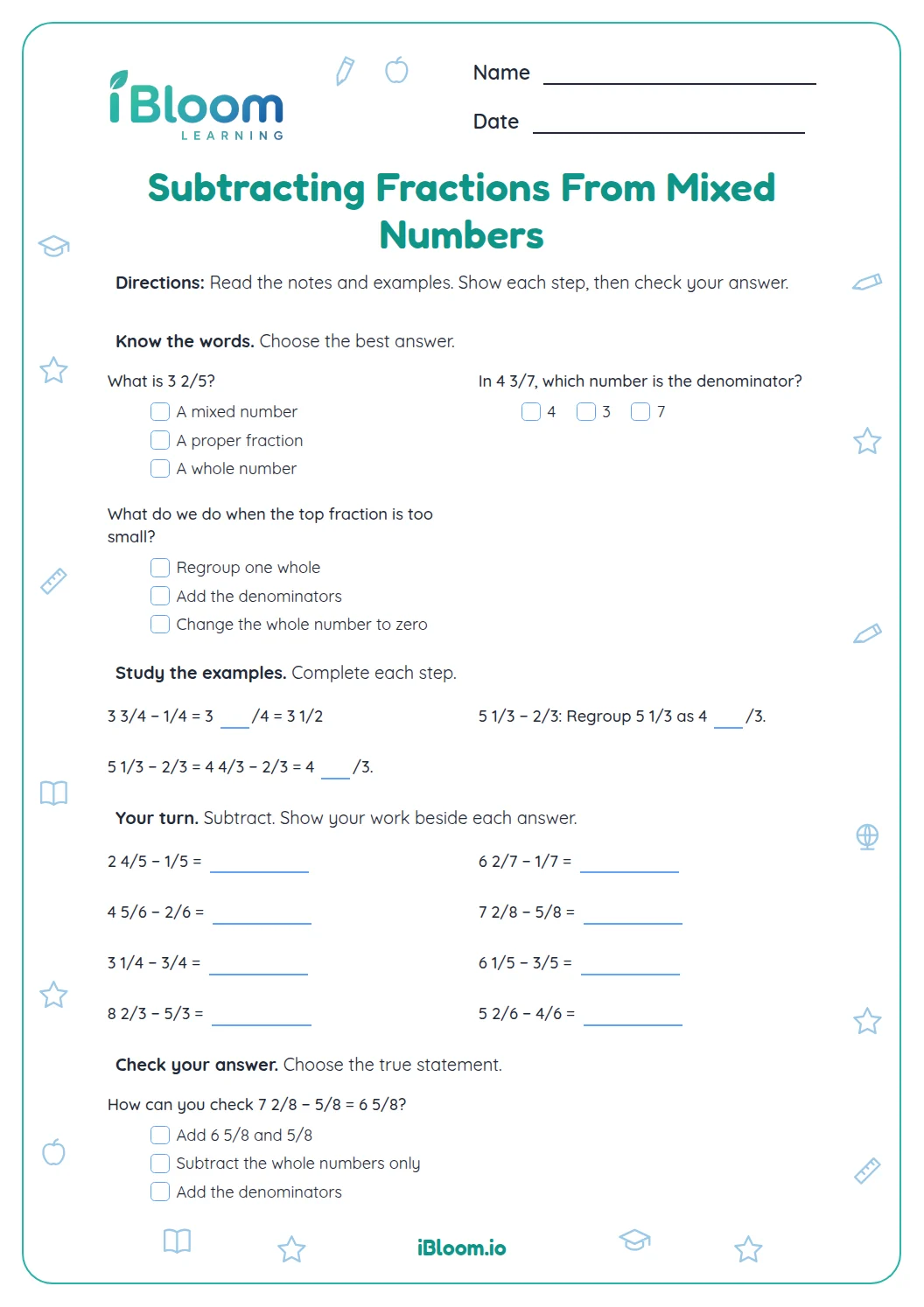
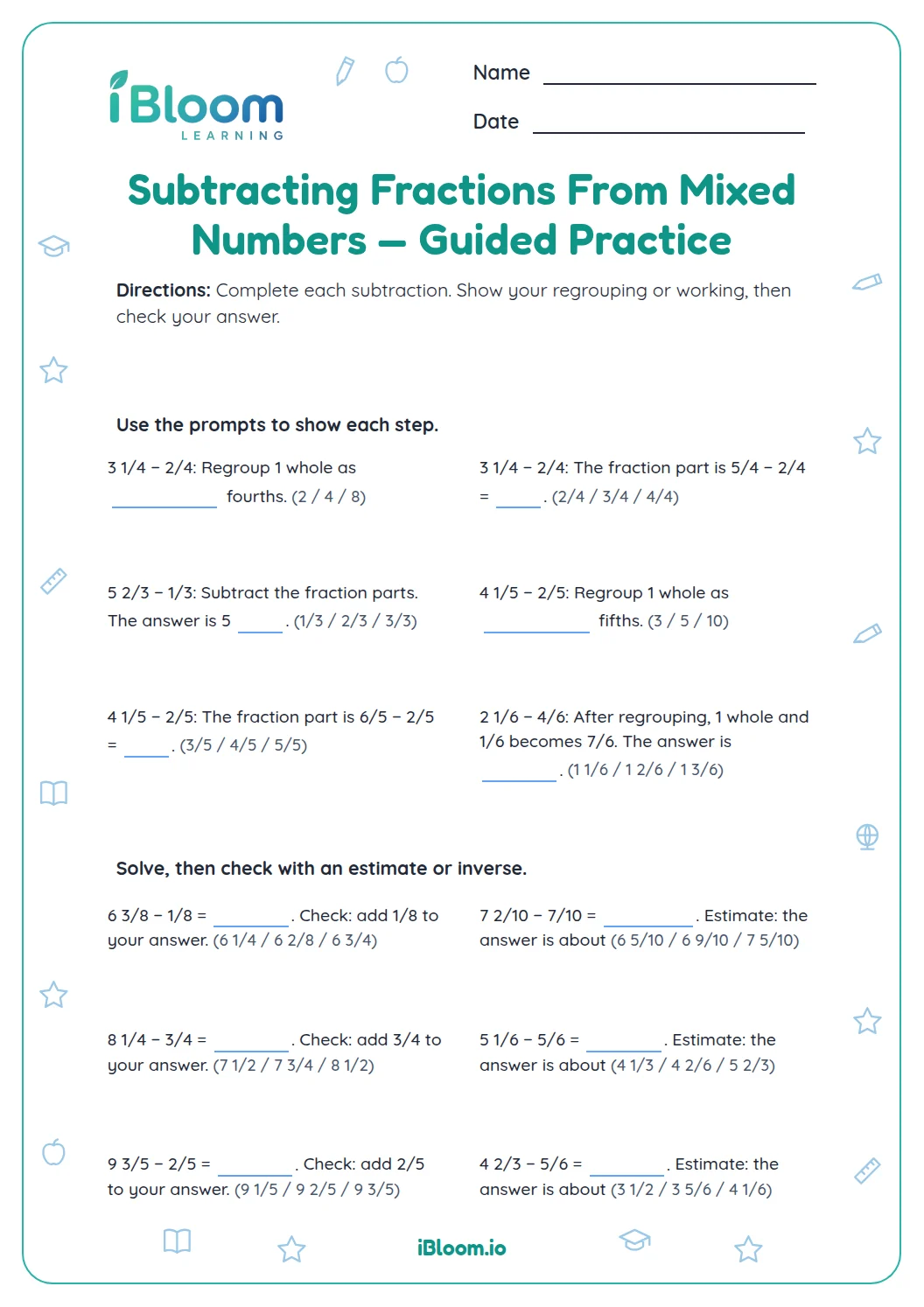
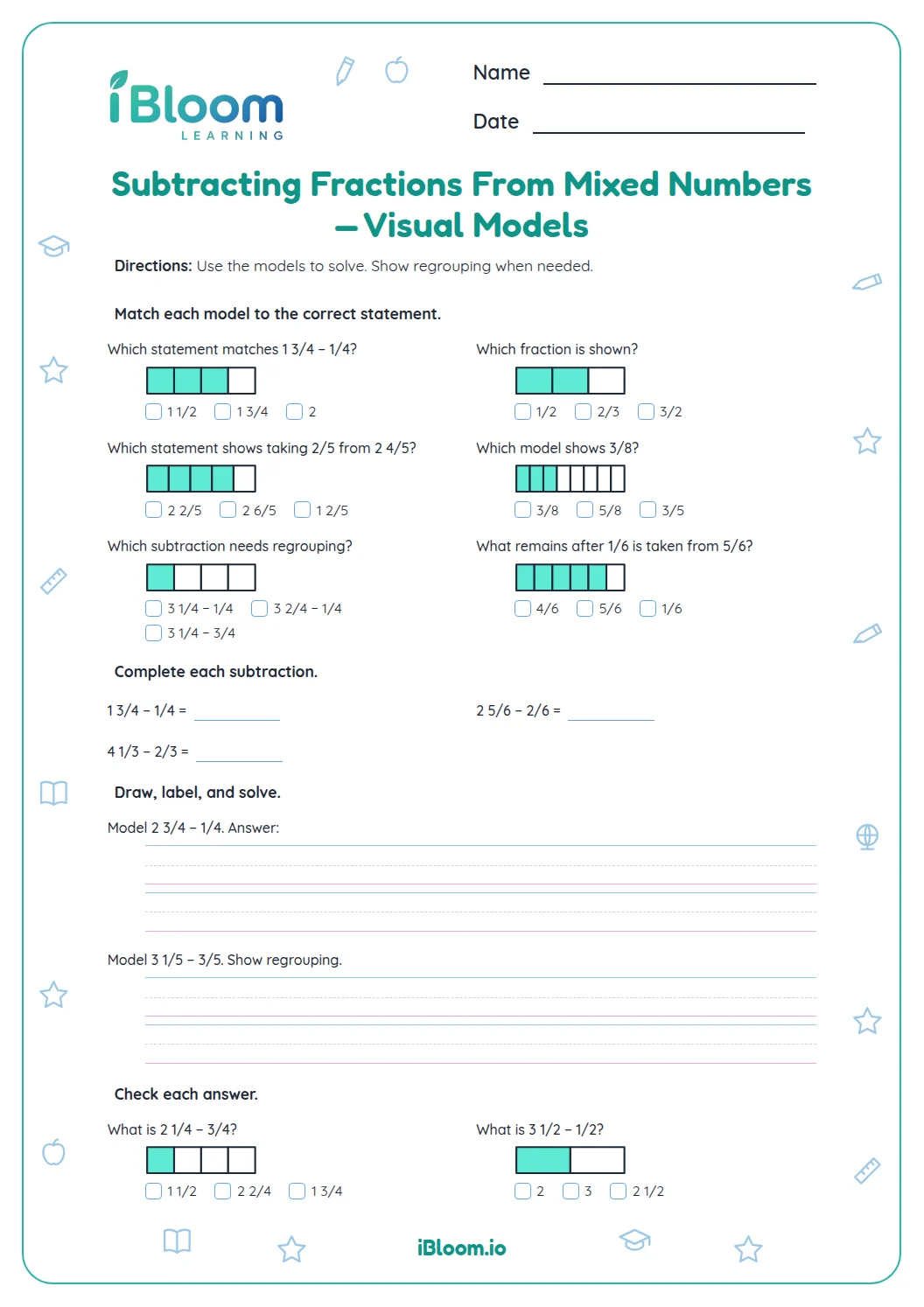
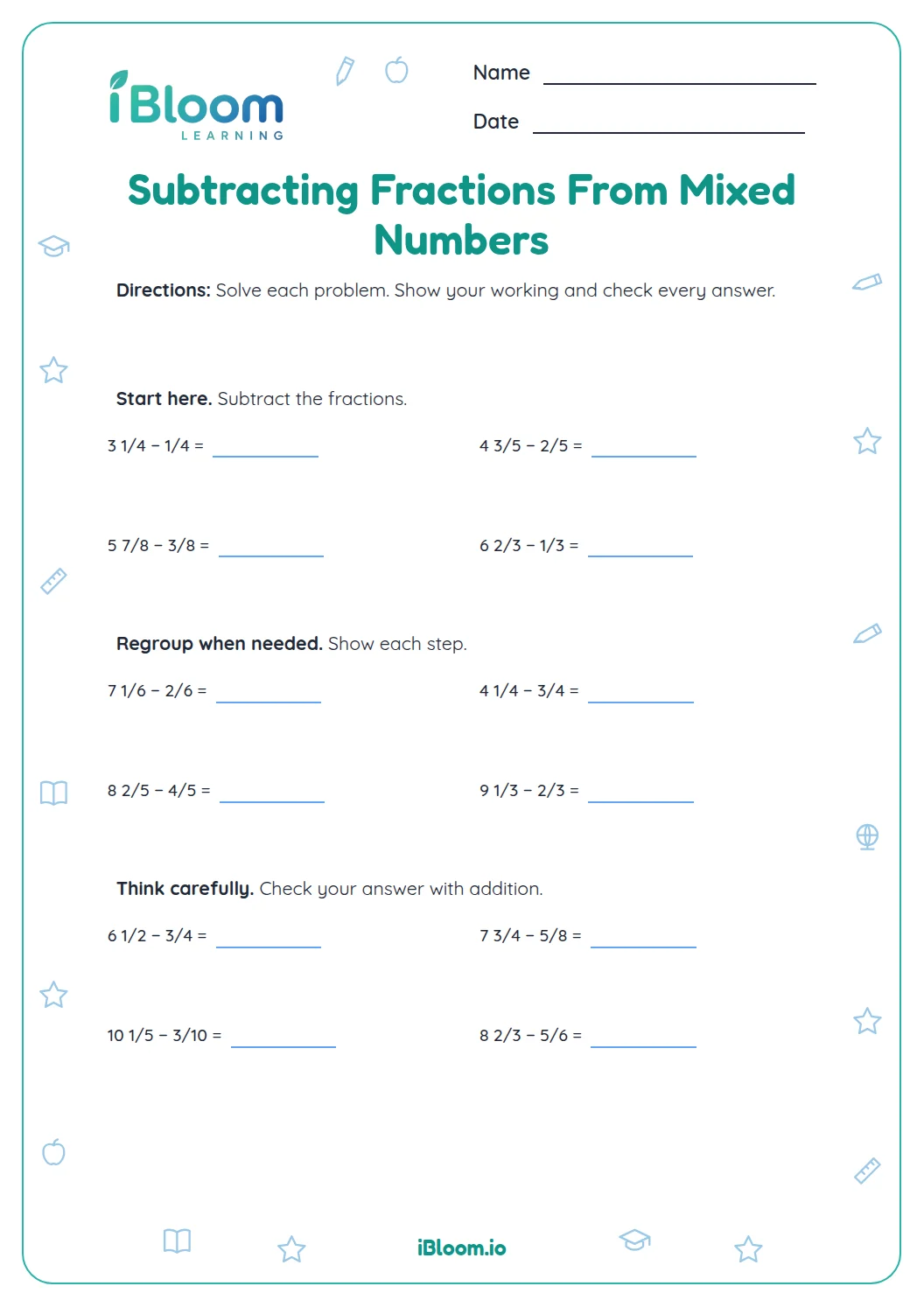
This Grade 4 challenge builds from mixed numbers whose fractional part can be subtracted directly to problems that require renaming a whole. It includes an error check and comparison so students reason about whether a difference makes sense. The 14 questions use halves, thirds, fourths, sixths, and eighths.
Aligned to 4.NF.B.3.c
When does a mixed number need regrouping?
If the fraction in the first number is large enough, subtract the fractional parts and then the whole numbers. When it is too small, rename one whole as fractional parts first.
For 2 1/4 − 3/4, rename 2 1/4 as 1 5/4. Then 5/4 − 3/4 = 2/4 = 1/2, so the answer is 1 1/2.
What reasoning does the sheet ask for?
The worksheet moves from direct subtraction to regrouping, then asks students to check a proposed answer and compare two differences. The mix encourages students to reason about how much remains after a fraction is subtracted.
- Part A subtracts fractional parts directly.
- Part B includes regrouping and equivalent fractional parts.
- Part C asks students to check an error and compare two differences.
How can students simplify a fraction in the answer?
For q7, rename 2 1/4 as 1 5/4. Then subtract 3/4 to get 1 2/4, or 1 1/2.
After subtracting, reduce the fractional part when its numerator and denominator share a factor. For example, 2/4 becomes 1/2. Keep the whole-number part, and check the result by adding the amount subtracted back to the difference.
Curriculum alignment
This page uses Grade 4 mixed-number subtraction in a scaffolded practice format.
Add and subtract mixed numbers with like denominators.
On this sheet: Every problem subtracts fractions and mixed numbers with denominators 2, 3, 4, 6, or 8.
Show the official wordingHide the official wording
Add and subtract mixed numbers with like denominators, e.g., by replacing each mixed number with an equivalent fraction, and/or by using properties of operations and the relationship between addition and subtraction.
What to practice next
Make more practice
Further reading
Questions parents and teachers ask
When should a student regroup in mixed-number subtraction?
Regroup when the fraction in the first mixed number is smaller than the fraction being subtracted. Rename one whole using the same denominator, then subtract the fractional parts. Keep any remaining whole numbers and simplify the fractional answer when possible.
How can students check a mixed-number difference?
Add the difference to the number that was subtracted. The sum should match the starting mixed number. Estimating also helps: subtracting a positive amount must leave less than the starting number, and the size of the difference should fit the quantities in the problem.
Which denominators appear on this worksheet?
The practice uses halves, thirds, fourths, sixths, and eighths. In each subtraction, the fractional parts have like denominators or can be renamed with an equivalent fraction. Students can use a sketch or equivalent fractions to check a regrouped result as needed.
What does the reasoning section ask students to do?
Students check a proposed answer and compare two subtraction expressions. These items ask them to explain how taking away a larger amount affects the result. Students can verify a result by adding the amount taken away back to the difference and checking whether it matches the starting mixed number.
How can students simplify a fraction in the answer?
After subtracting, reduce the fractional part when its numerator and denominator share a factor. For example, 2/4 becomes 1/2. Keep the whole-number part, and check the result by adding the amount subtracted back to the difference. Students can also check the mixed-number size as a final step.