






About this worksheet
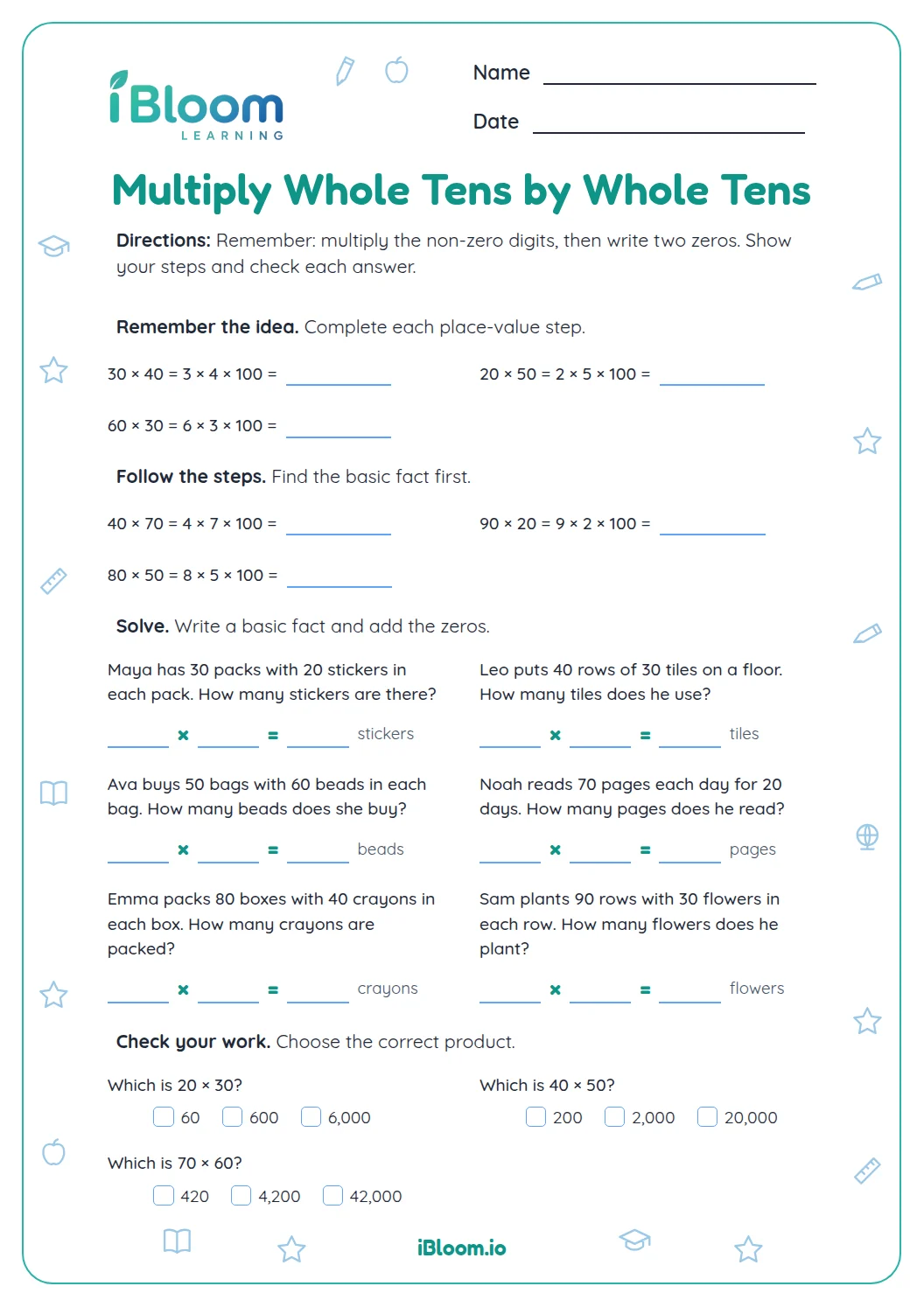
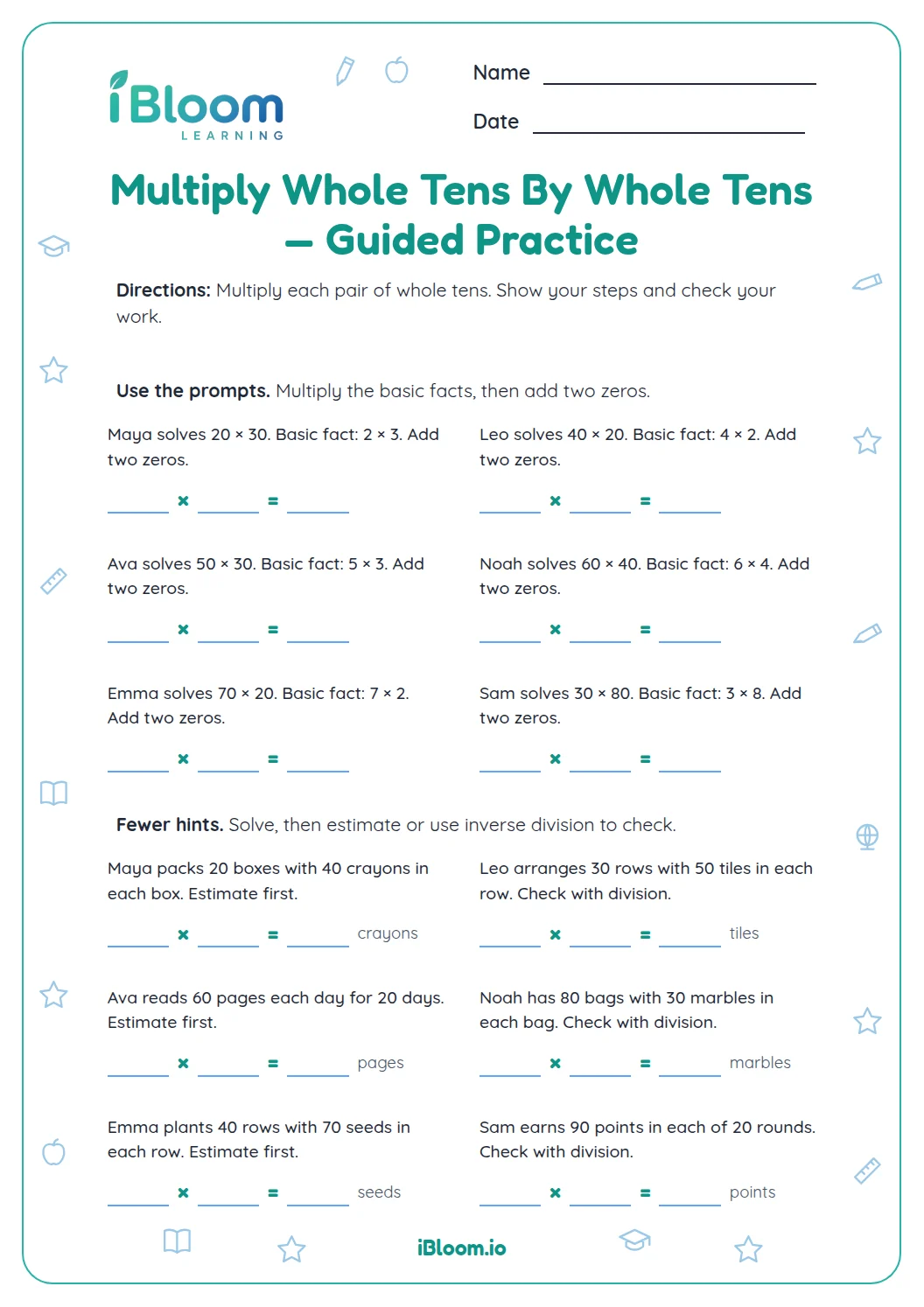
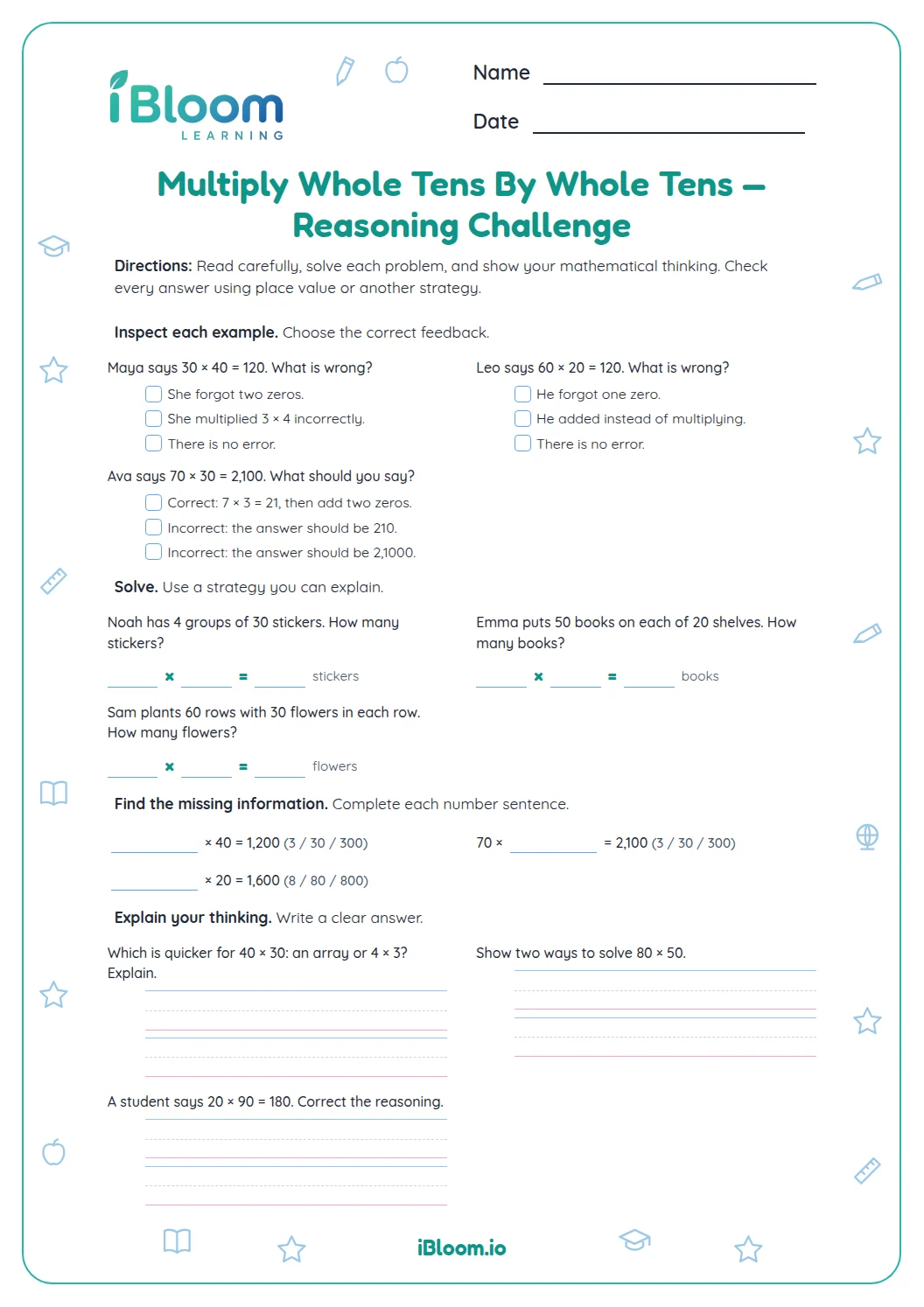
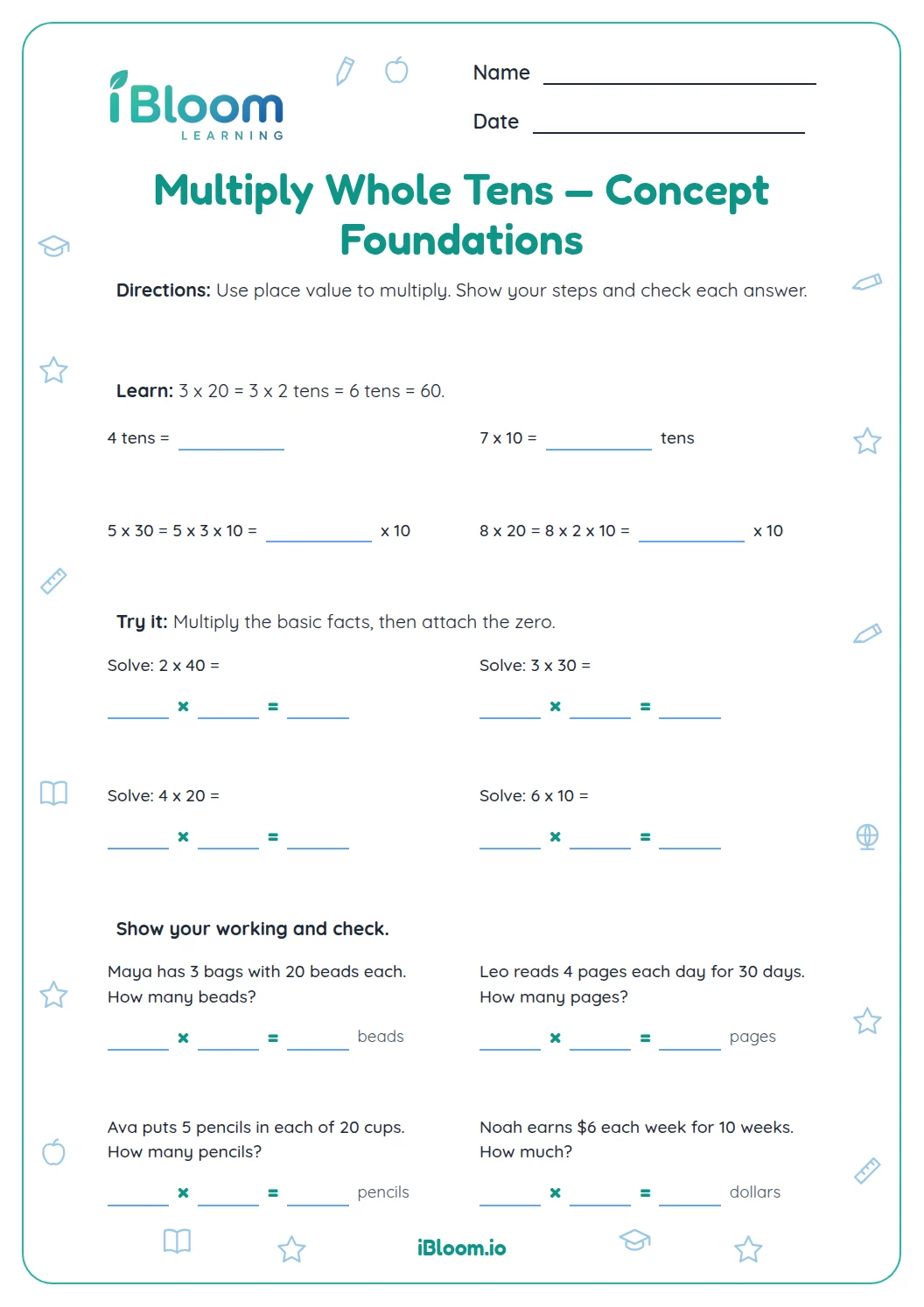
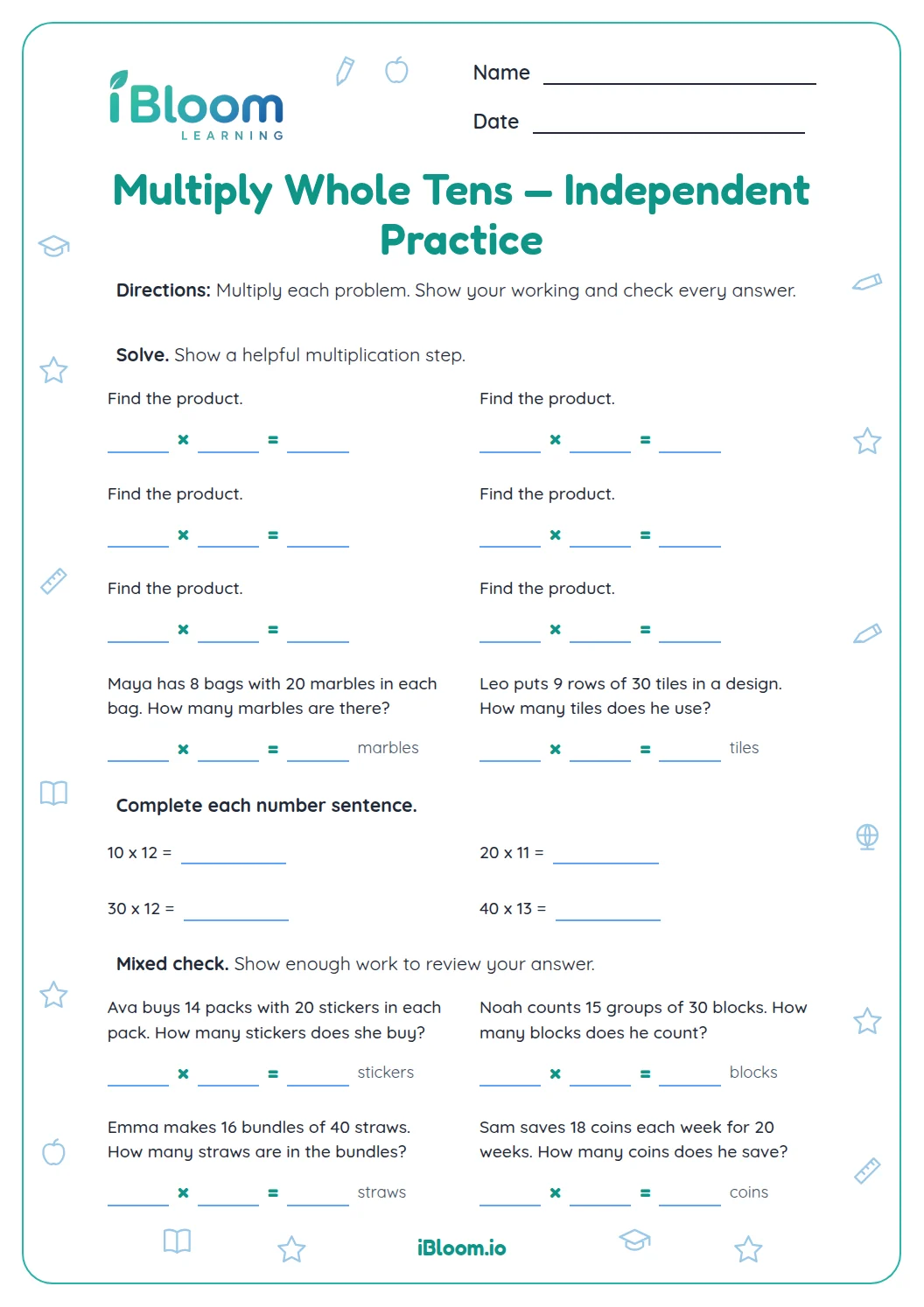
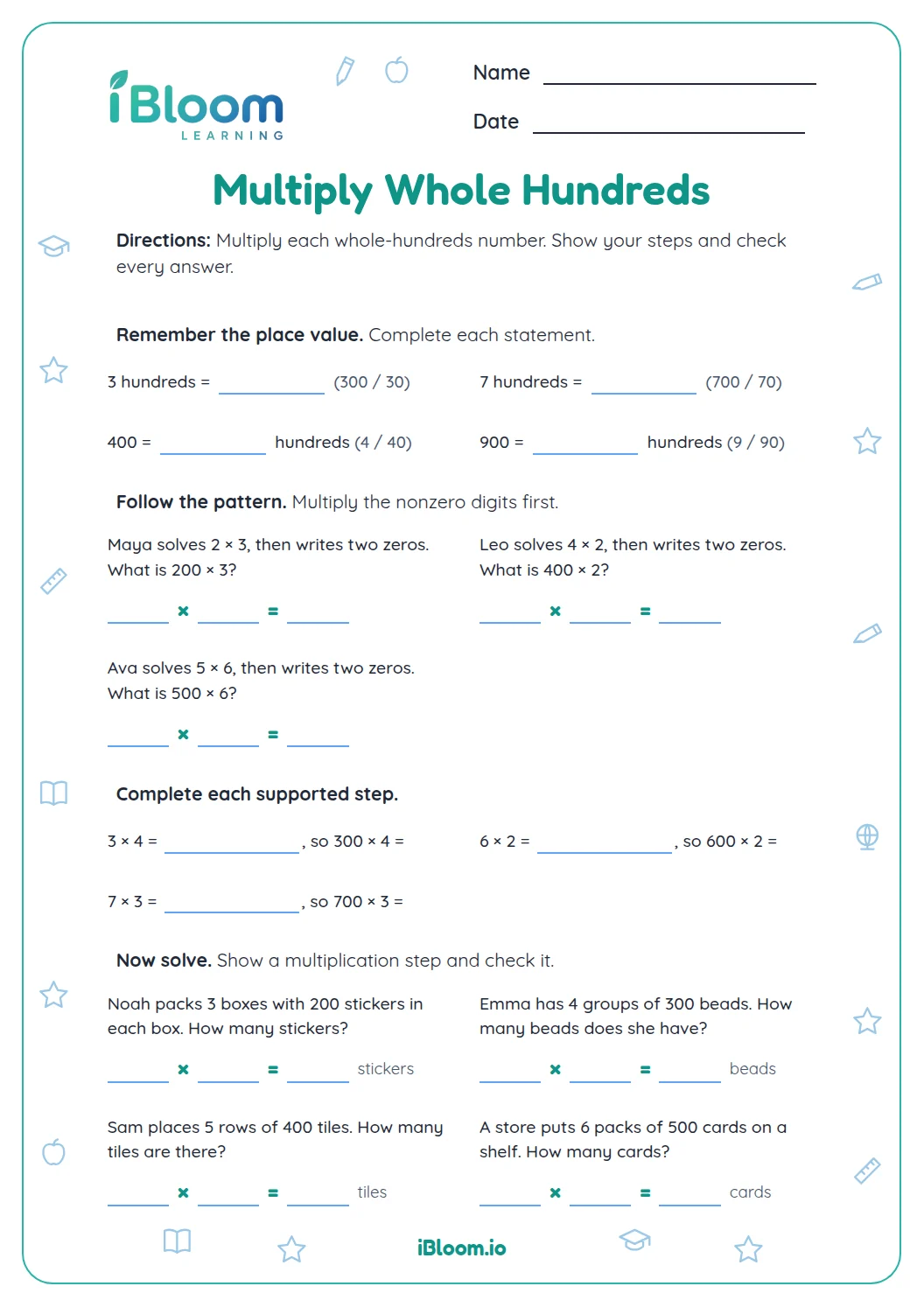
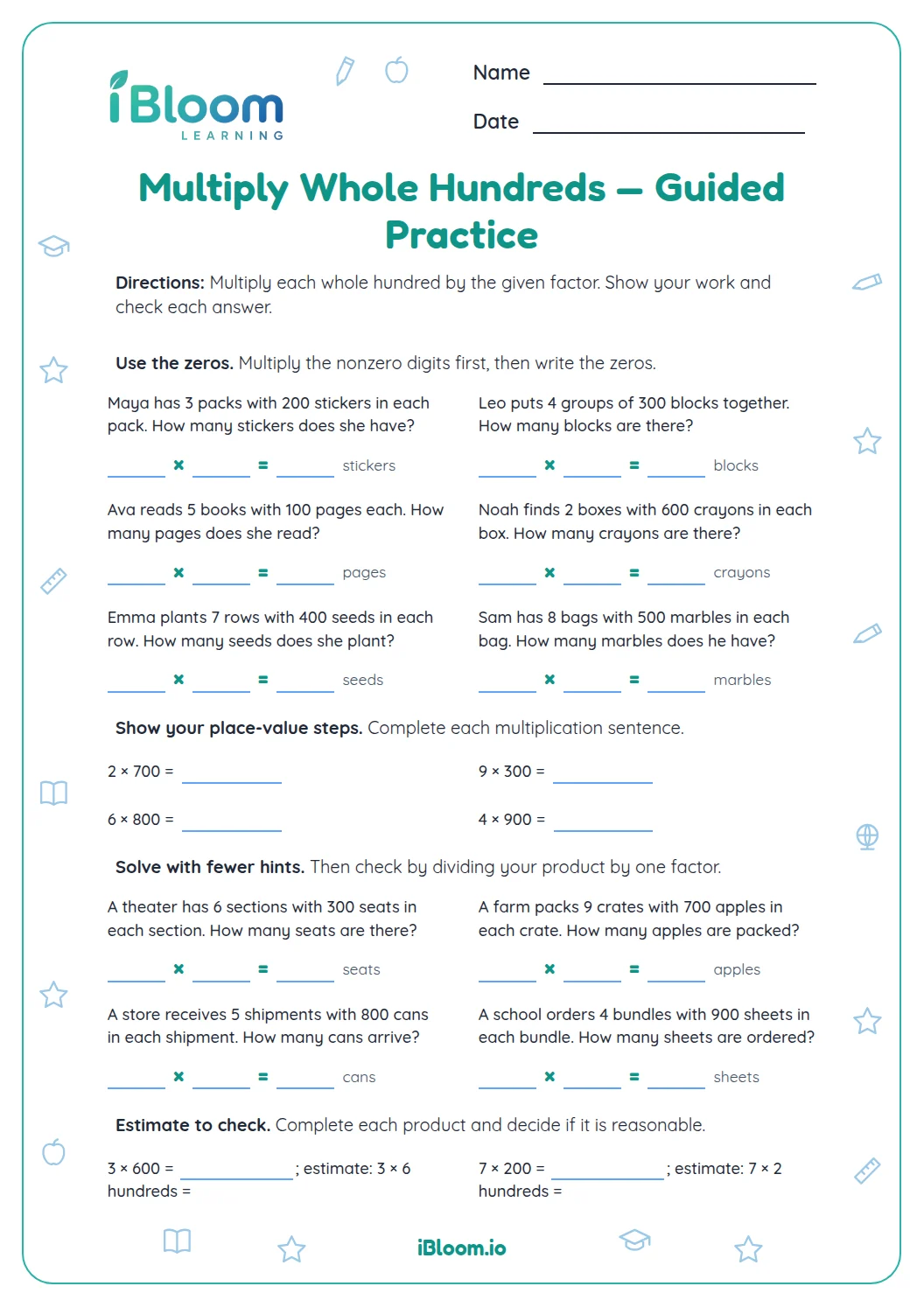
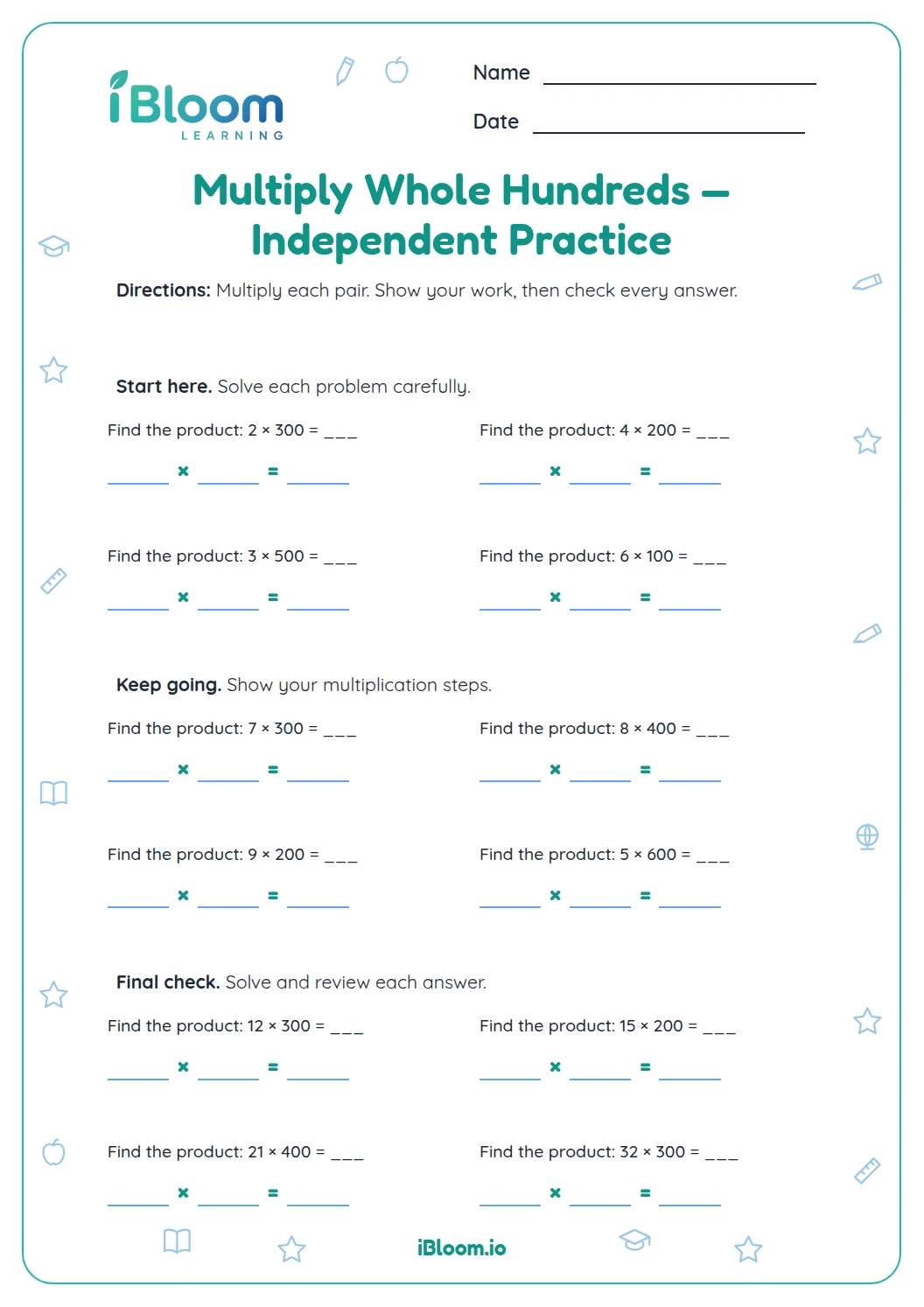
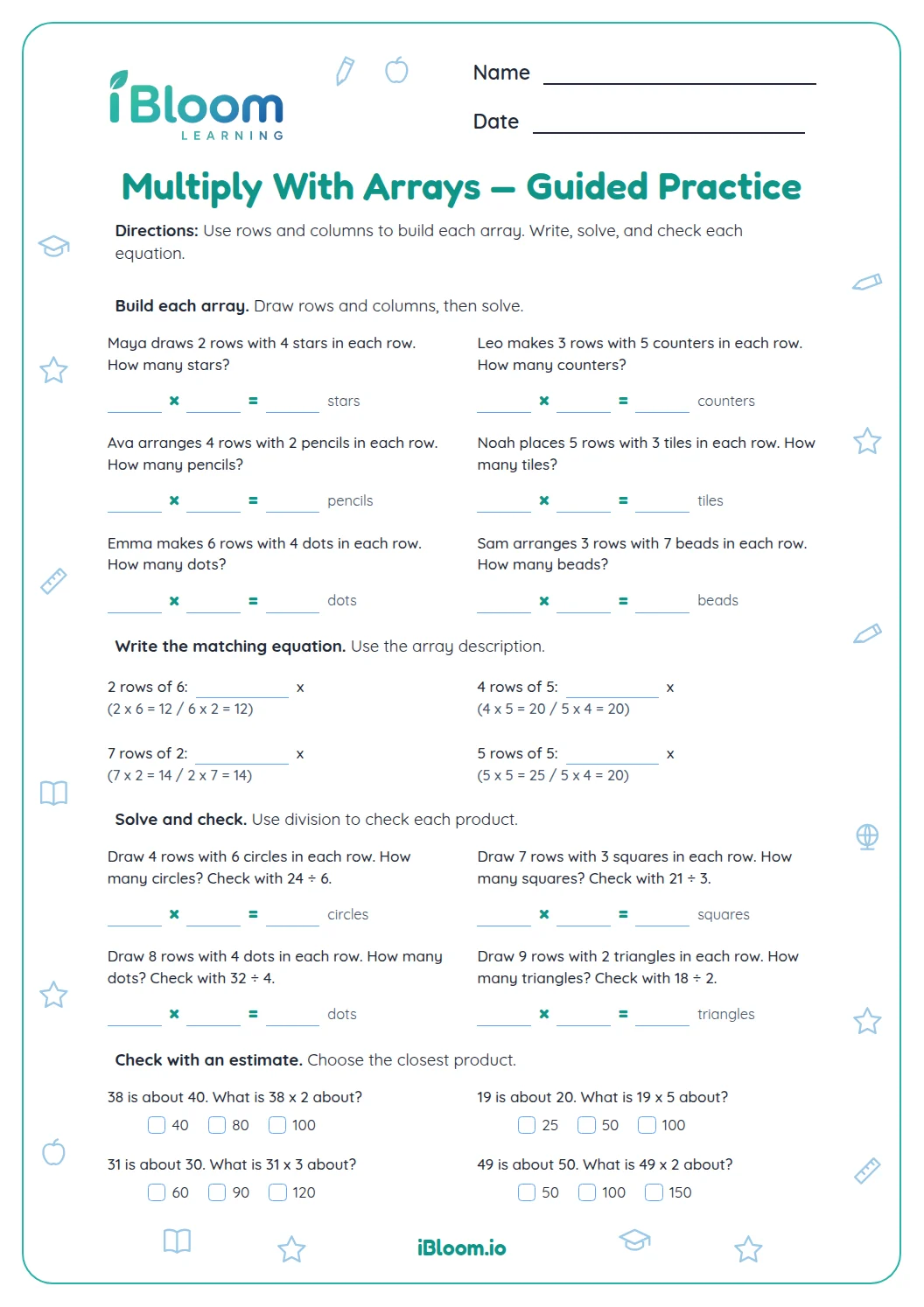
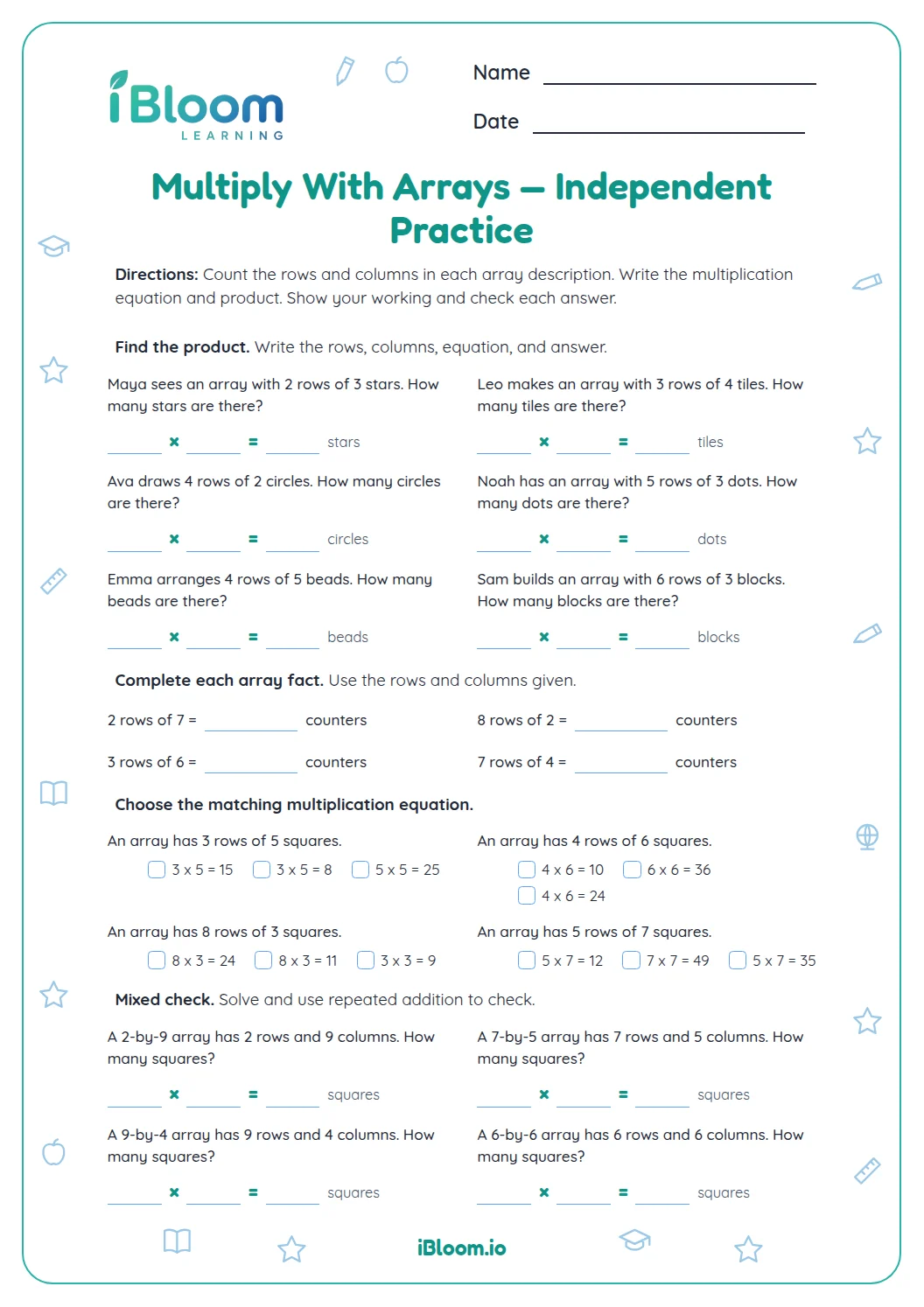
This Grade 3 printable turns equal-group situations into multiplication equations with whole tens. Students identify the number of groups and the amount in each group, then find the total. The 16 story problems use contexts such as boxes, rows, trays, and seats, with a separate answer key. The work practices interpreting multiplication as equal groups under CCSS 3.OA.A.1.
Aligned to 3.OA.A.1
How do equal groups become an equation?
The number of groups is one factor; the number in each group is the other. Multiply the factors to find the total.
- 130 boxes × 20 pencils = 600 pencils
- 2There are 30 equal groups of 20.
How can you check a whole-tens product?
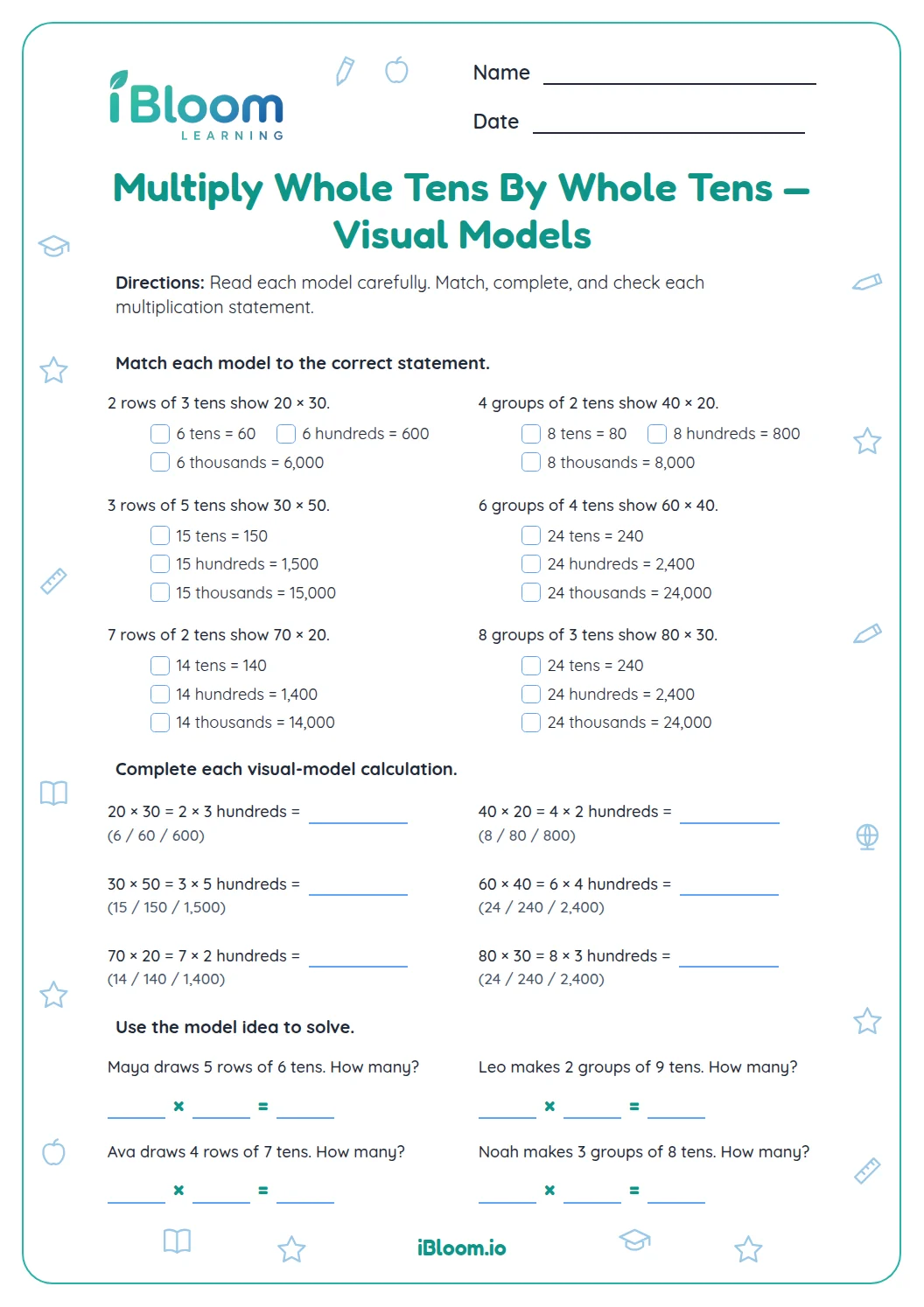
Multiply the nonzero digits, then account for the tens in each factor. Check that the product is reasonable for the story.
- 140 rows × 30 seats = 1,200 seats
- 24 × 3 = 12, then two tens places give 1,200.
How to use this worksheet
- 1Read the model or direction at the start of each part.
- 2Work through the questions in order, showing steps where useful.
- 3Reread each answer in the context of its question.
- 4Use the answer key to check and correct your work.
Common mistakes and quick fixes
The mistake
Using the number in each group as the number of groups.
The fix
Label each factor from the story before multiplying.
The mistake
Forgetting a factor’s tens place.
The fix
Estimate first, then check the product’s size.
The mistake
Writing a product without its story unit.
The fix
Name what the total counts, such as seats or pencils.
Common Core alignment
This worksheet gives focused practice with the standard below.
Interpret multiplication as equal groups and find products of whole tens.
On this sheet: Interpret multiplication as equal groups and find products of whole tens.
Show the official wordingHide the official wording
Interpret products of whole numbers, e.g., interpret 5 × 7 as the total number of objects in 5 groups of 7 objects each. For example, describe a context in which a total number of objects can be expressed as 5 × 7.
What to practice next
Make more practice
Further reading
Questions parents and teachers ask
What does “equal groups” mean?
Equal groups contain the same number of items in each group. A story with 20 pencils in each of 30 boxes can be represented by 30 × 20, or 30 groups of 20 pencils. This gives students a chance to explain the choice, check the relevant detail, and connect the answer with the skill practiced on this printable.
How do students decide which factors to use?
Find how many groups there are and how many items each group contains. Those two quantities become the factors in a multiplication equation. Check the story wording to identify each factor. This gives students a chance to explain the choice, check the relevant detail, and connect the answer with the skill practiced on this printable.
Why are the factors whole tens?
Every problem uses amounts such as 20, 30, or 60. Students can multiply the nonzero digits and use place value to account for the tens, then check whether the product is reasonable. This gives students a chance to explain the choice, check the relevant detail, and connect the answer with the skill practiced on this printable.
How many word problems are included?
There are 16 real-world problems in one sequence. Each presents an equal-group situation and asks students to write a multiplication equation and find the total. This gives students a chance to explain the choice, check the relevant detail, and connect the answer with the skill practiced on this printable.
Is an answer key included?
Yes. The separate answer key lists the total for each story. Students can compare the product with the equation they wrote and confirm that the answer matches the quantity being counted. This gives students a chance to explain the choice, check the relevant detail, and connect the answer with the skill practiced on this printable.