




About this worksheet
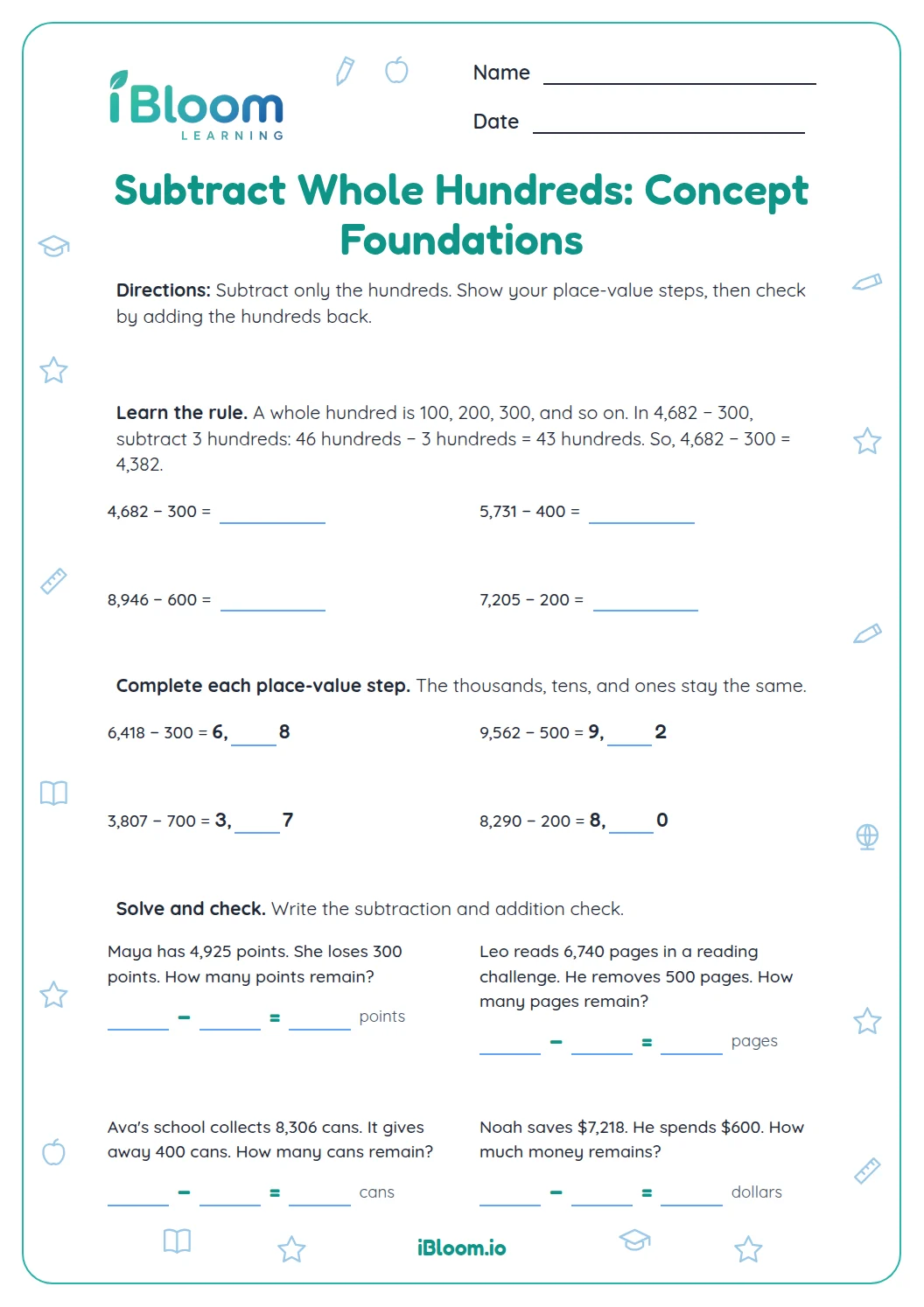
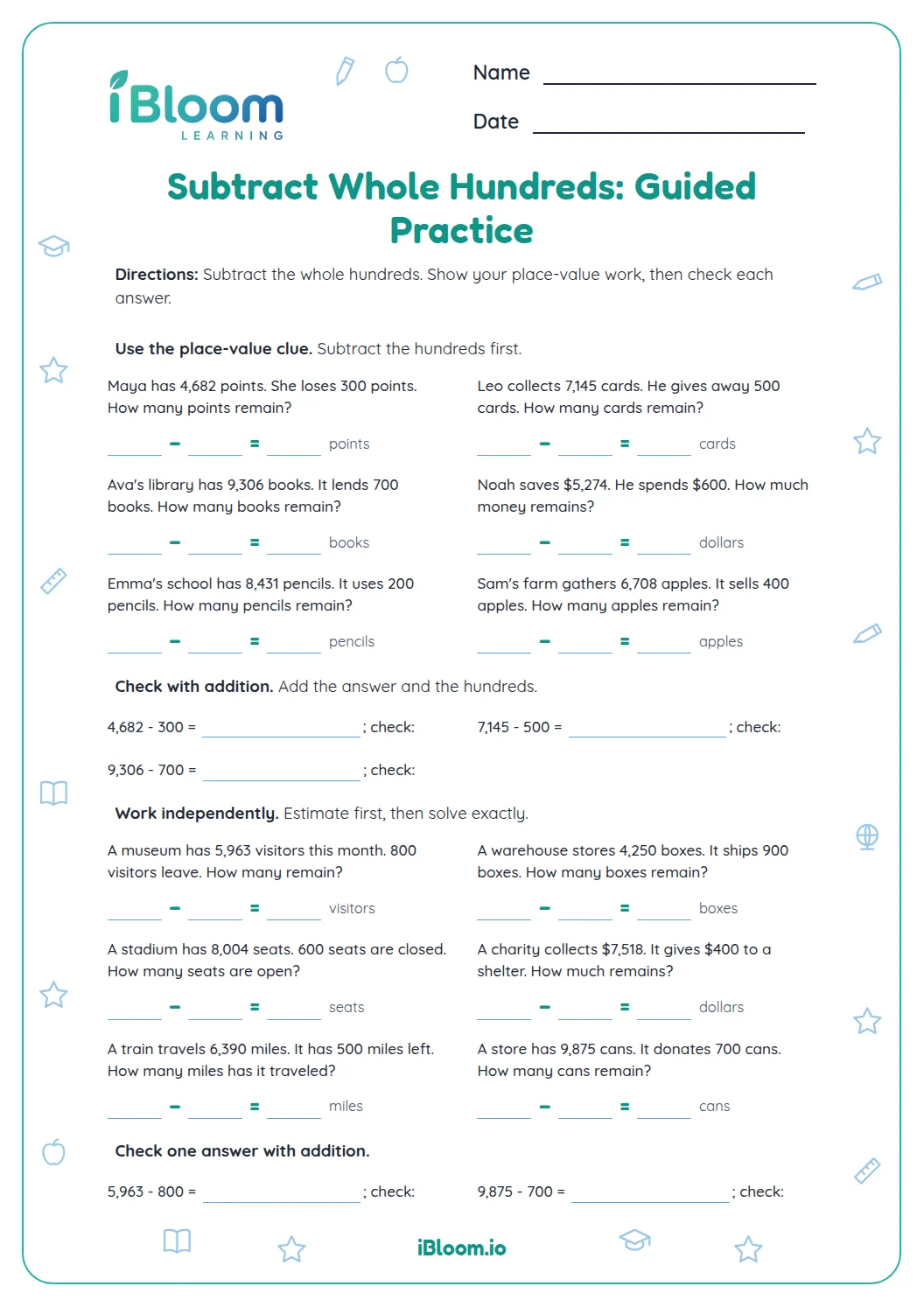
This Grade 3 subtraction worksheet gives students 14 real-world stories with four-digit starting amounts. Each story removes a whole number of hundreds, such as tickets refunded or boxes shipped. Students write a subtraction equation and find what remains, connecting the operation to the situation while keeping place values organized. The problems include room for working. A separate answer key lists each difference for checking.
How do you find what remains?
When a story says some items leave, are sent, or are sold, subtract that amount from the starting amount. Keep the hundreds and the remaining digits in their place-value columns.
- 15,846 books − 300 books
- 2Subtract 3 hundreds from 8 hundreds.
- 35,846 − 300 = 5,546 books
What changes when you subtract a whole hundred?
Subtracting 300 changes the hundreds digit by three hundreds when there are enough hundreds. The thousands, tens, and ones stay the same in examples such as 5,846 − 300.
What is on the worksheet?
All 14 items are real-world stories with four-digit starting amounts and a whole-hundred subtraction. Each gives space to write an equation and its answer.
How to use this worksheet
- 1Find the starting amount and the number that leaves.
- 2Choose subtraction because the story removes or corrects an amount.
- 3Subtract the hundreds while keeping the other place values in order.
- 4Write the equation before recording the answer.
- 5Check by adding the amount removed back to the remainder.
Common mistakes and quick fixes
The mistake
Adding the amount that leaves.
The fix
Ask whether the story says more arrive or some go away.
The mistake
Changing the tens or ones digits by mistake.
The fix
Subtract hundreds in the hundreds place and keep other places aligned.
The mistake
Dropping a zero from the hundred being subtracted.
The fix
Write 300, 400, or 700 with its zero before subtracting.
What to practice next
Make more practice
Questions parents and teachers ask
What number skills does this sheet practice?
Each story starts with a four-digit amount and removes a whole number of hundreds. Students translate the situation into subtraction and find the remaining amount, keeping the thousands, hundreds, tens, and ones in place. Examples include books, visitors, bulbs, apples, cans, trail repairs, and notebooks.
How many story problems are included?
There are 14 real-world subtraction problems, each with room to write an equation and solve. Settings include books, visitors, bulbs, tickets, boxes, trail repairs, and school supplies. The answer key lists the differences in question order. The extra set gives students more chances to apply the same place-value strategy.
Do answers stay four digits?
All 14 answers remain four-digit numbers. Students can check each difference by adding the amount removed back to the result and seeing whether it returns to the original four-digit amount. For example, 6,442 + 300 returns to 6,742.
Why write an equation for each story?
An equation shows the relationship between the starting amount, the amount removed, and what remains. It also gives students a way to check that they chose subtraction for the story rather than addition. Students can also check the answer by estimating whether the amount should be a little or several hundred less.
Can students solve without regrouping?
Yes. Each subtraction removes fewer hundreds than the starting number contains, so regrouping is not needed. Students still need to keep the thousands, tens, and ones digits in their correct places. The hundreds digit decreases by the stated number of hundreds while other place values stay fixed.
Is there an answer key?
Yes. A separate key lists the 14 differences in question order. Students can check the number and then include the matching item, visitor, meter, ticket, or other unit from the story when they explain their result. It also lets students verify their equations after completing the extra practice items.