



About this worksheet
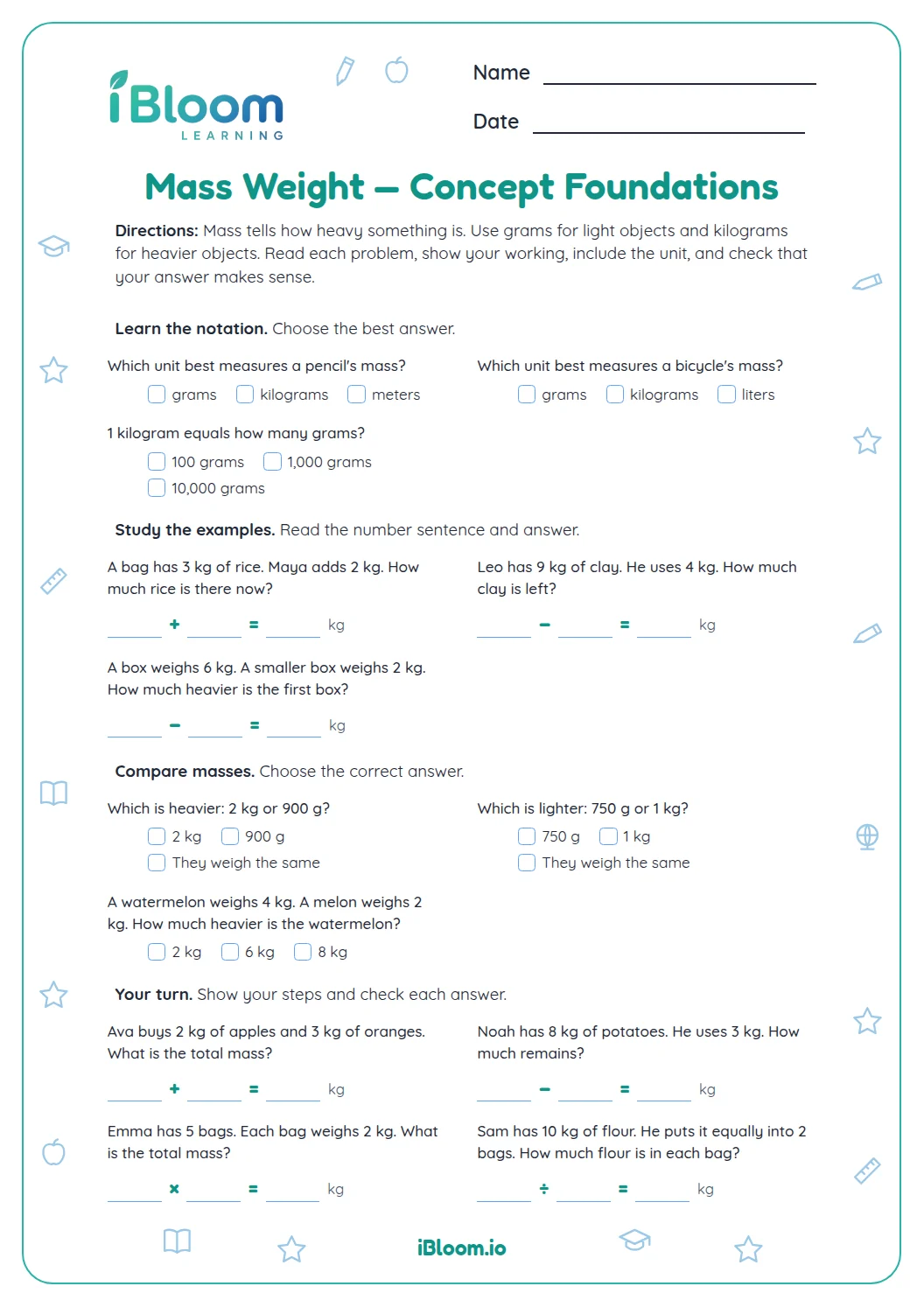
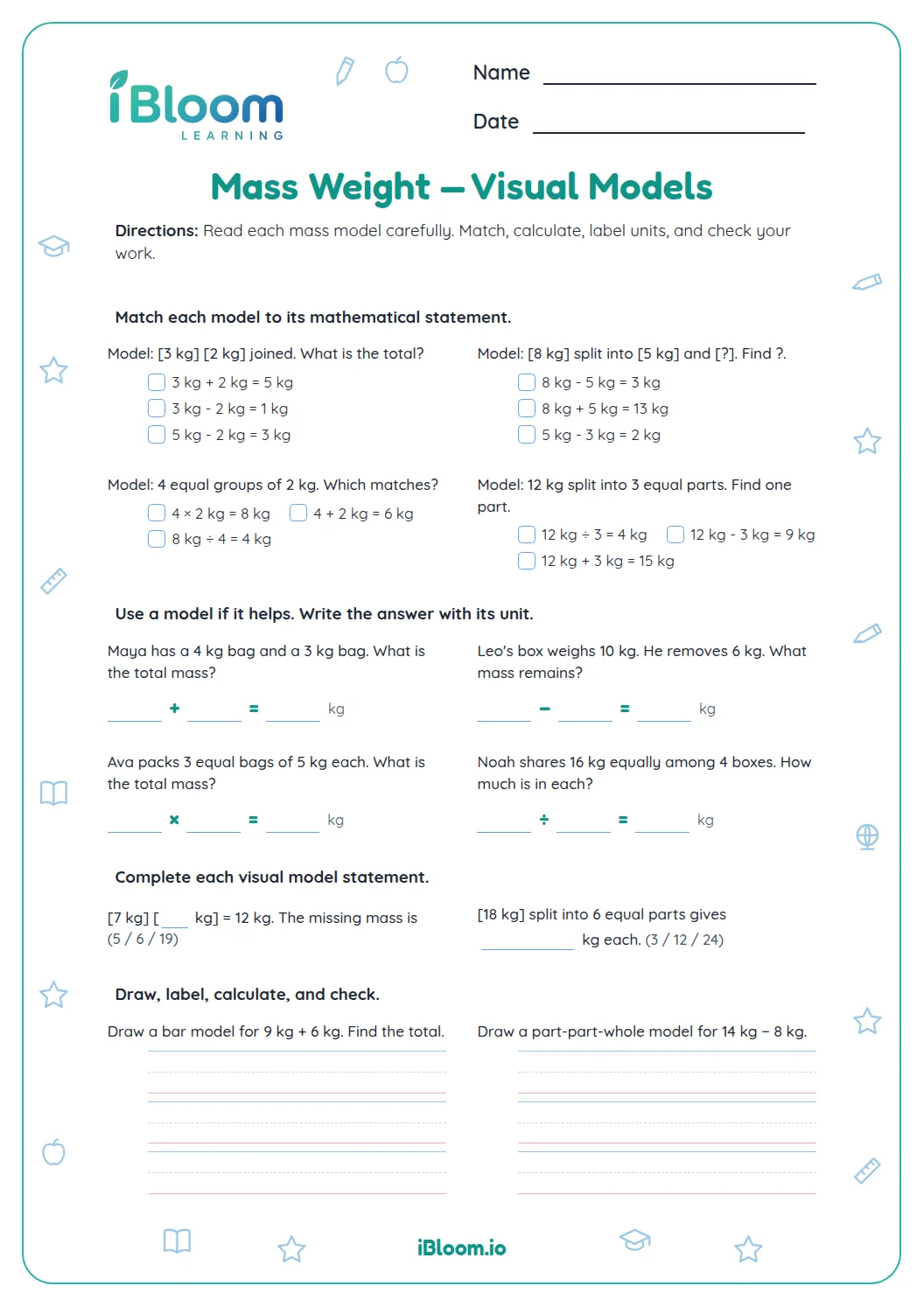
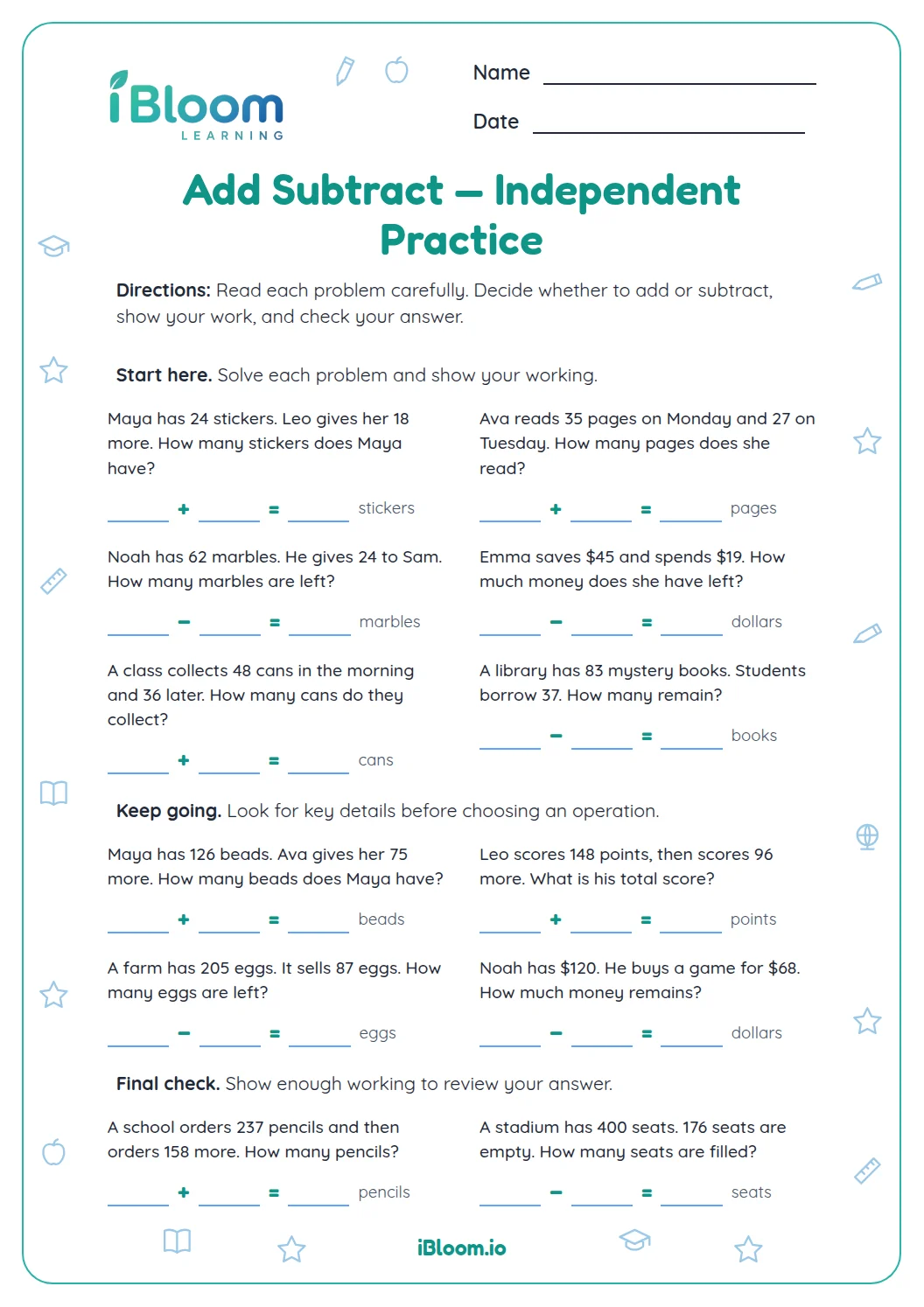
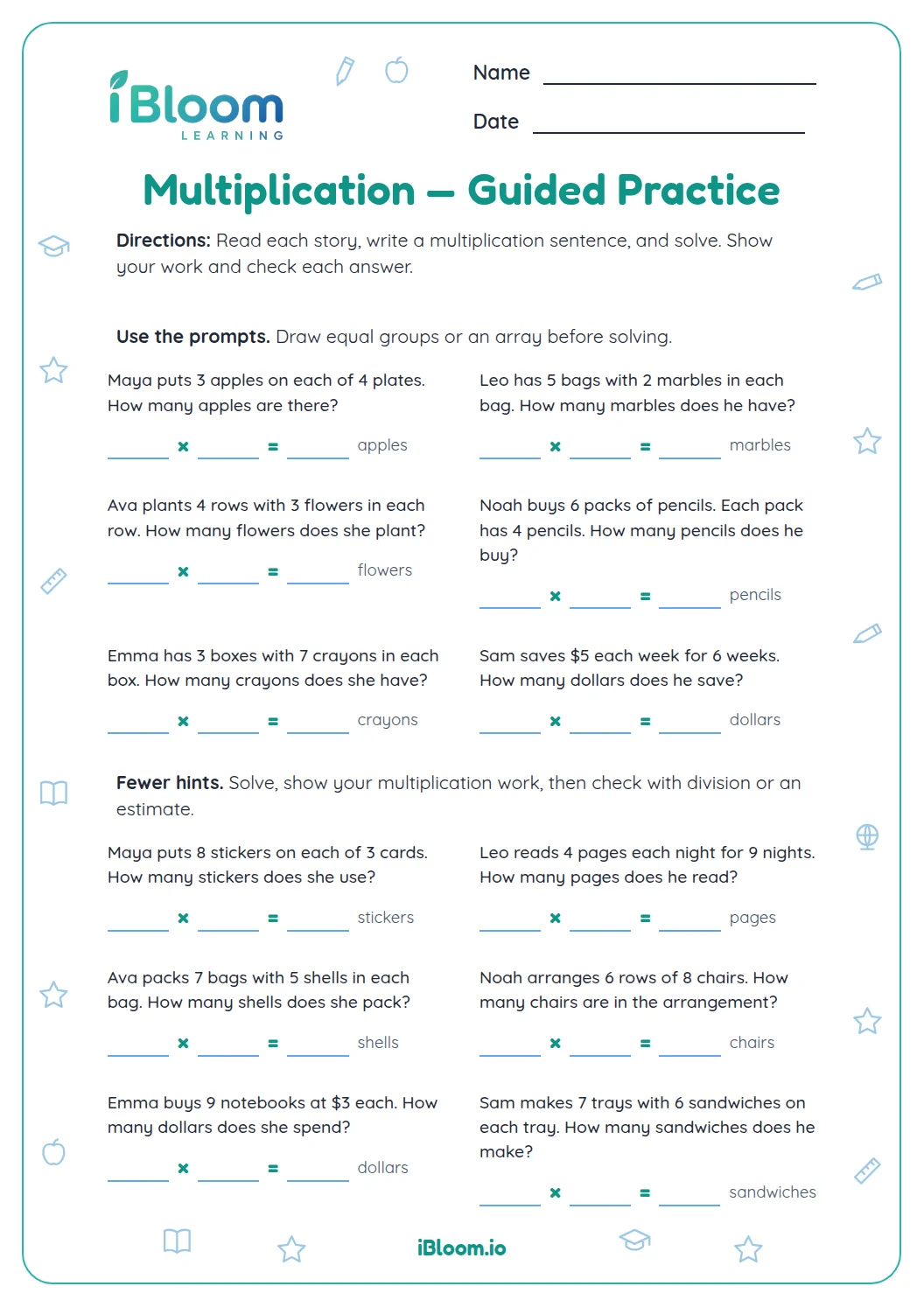
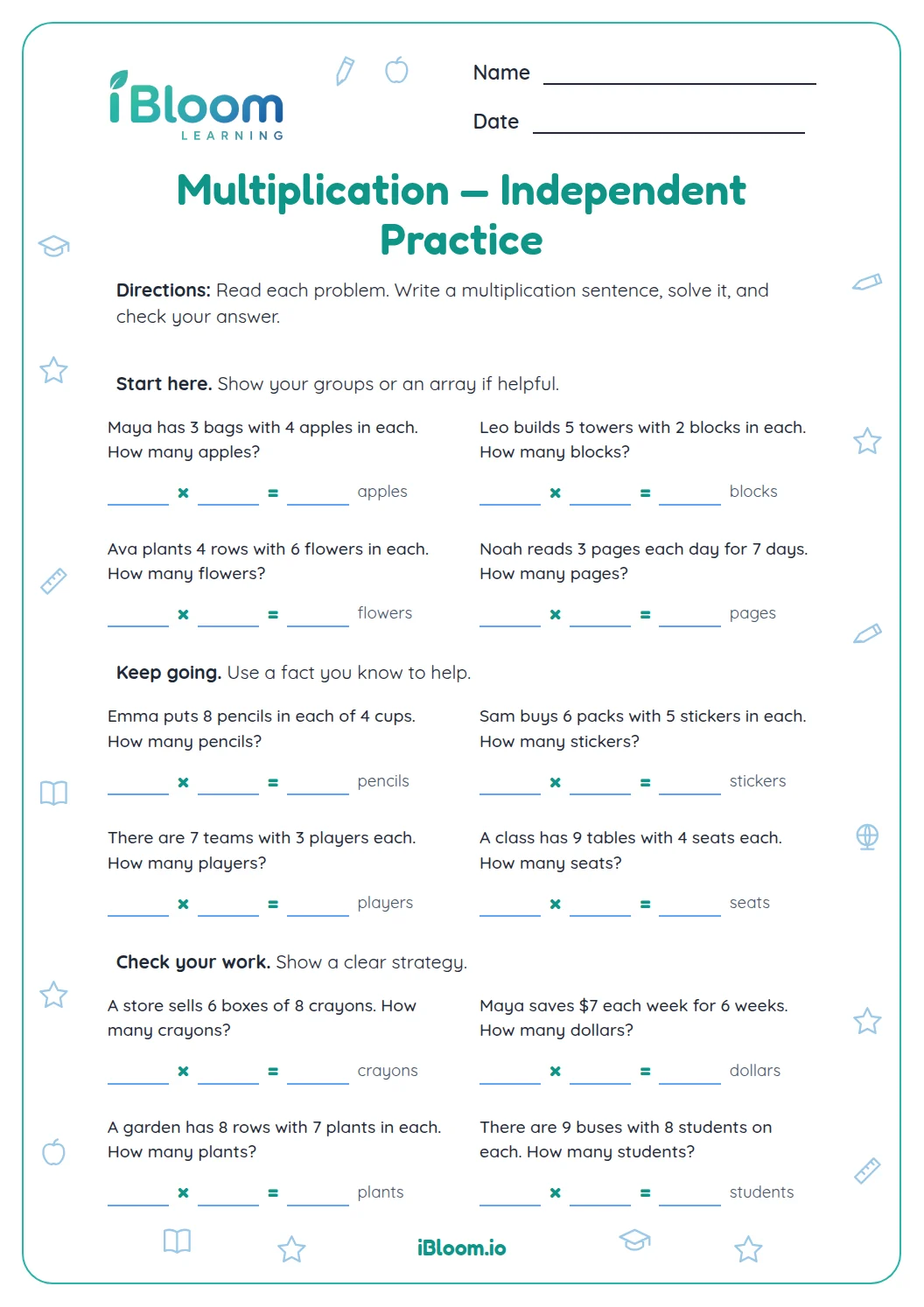
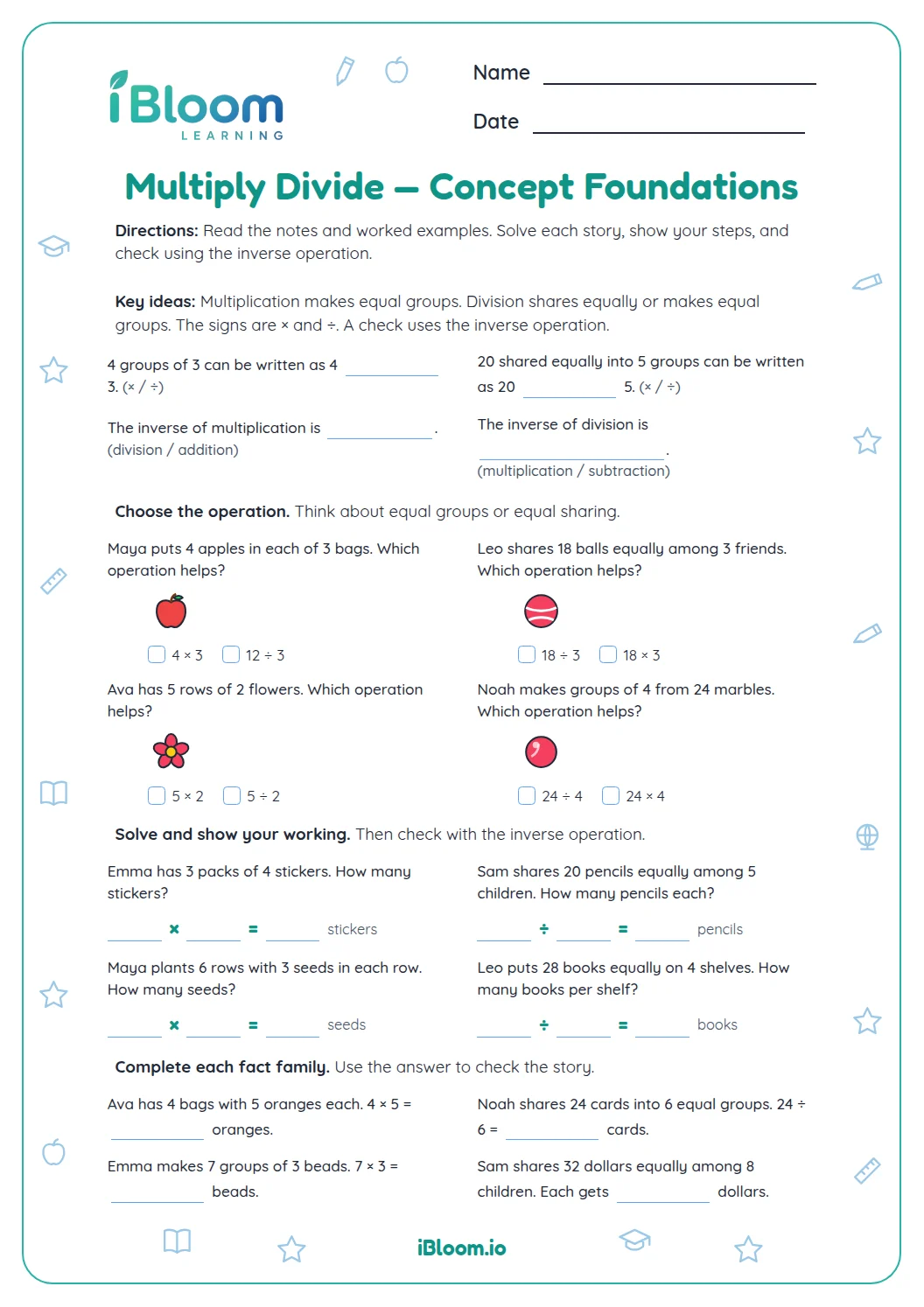
This Grade 3 worksheet gives students independent practice solving word problems about mass. The situations use grams or kilograms and ask students to add, subtract, multiply, divide, or combine steps. Each item includes working space for an equation and a short answer with its unit. Students read the quantities carefully, choose an operation, and check whether the result makes sense in context. The set practices CCSS 3.OA.D.8 through one- and two-step word problems.
Aligned to 3.OA.D.8
How should students read a mass problem?
Underline the quantities and their units, then notice what changes: a mass may be combined, reduced, arranged into equal groups, or compared. The words alone do not always name the operation, so ask what the question wants to know.
How does an equation organize the steps?
Write an equation that matches the story before calculating. For a two-step situation, show both operations in order and label the final answer with grams or kilograms.
- 1Start with 900 g
- 2Add 350 g, then remove 125 g
- 3900 + 350 − 125 = 1,125
- 4Answer: 1,125 g
- 5The unit stays grams throughout.
How can students check whether a result makes sense?
Estimate before calculating or use the inverse operation. If mass is added, the total should be greater; if some is removed, the remainder should be smaller. For equal sharing, multiply the group result to check the starting total.
How to use this worksheet
- 1Read the full situation and identify what is unknown.
- 2Mark each mass and its unit.
- 3Write an equation that matches the action in the story.
- 4Calculate and label the result with g or kg.
- 5Check with an estimate or inverse operation.
Common mistakes and quick fixes
The mistake
Adding when the story asks how much greater one mass is.
The fix
Compare the two quantities by finding the difference.
The mistake
Dividing but reporting the total instead of one group.
The fix
Check what one share or group should represent.
The mistake
Dropping the unit from the final answer.
The fix
Copy the unit from the quantities in the story.
Common Core alignment
Solve one- and two-step word problems using multiplication or division.
On this sheet: The worksheet includes one- and two-step mass contexts solved with the four operations.
Show the official wordingHide the official wording
Solve two-step word problems using the four operations. Represent these problems using equations with a letter standing for the unknown quantity. Assess the reasonableness of answers using mental computation and estimation strategies including rounding.
What to practice next
Further reading
Questions parents and teachers ask
Does this worksheet convert grams to kilograms?
The problems use grams or kilograms as stated in each situation. Students solve with the quantities in the given unit and include that same unit in the answer, keeping attention on the word problem rather than changing or converting measures.
How many problems are on the sheet?
There are 16 independent mass word problems. They include addition, subtraction, multiplication, division, and two-step reasoning, with a separate answer key that shows the correct result and unit for every item. Students can also estimate whether their answer should be more or less than the starting quantity.
What does the equation workspace help students do?
The workspace gives students room to represent the story with numbers and an operation before calculating. For a two-step item, students can write the operations in sequence and label the final mass with its unit. The work area supports showing a calculation before entering the short answer in its box.
How can a student check a multiplication or division answer?
Use the inverse operation. If 960 grams is shared among four bowls and each gets 240 grams, multiply 240 by 4 to return to 960 grams. This confirms that the equal groups match the starting total. Students can check a subtraction by adding the removed amount to the remainder.
Why should students write g or kg in the answer?
The unit tells what the number measures. A result of 375 without a unit is incomplete in a mass problem; writing 375 g connects the calculation to the story and tells exactly what the answer describes. The answer key includes units to make checking the finished response easier.