



About this worksheet
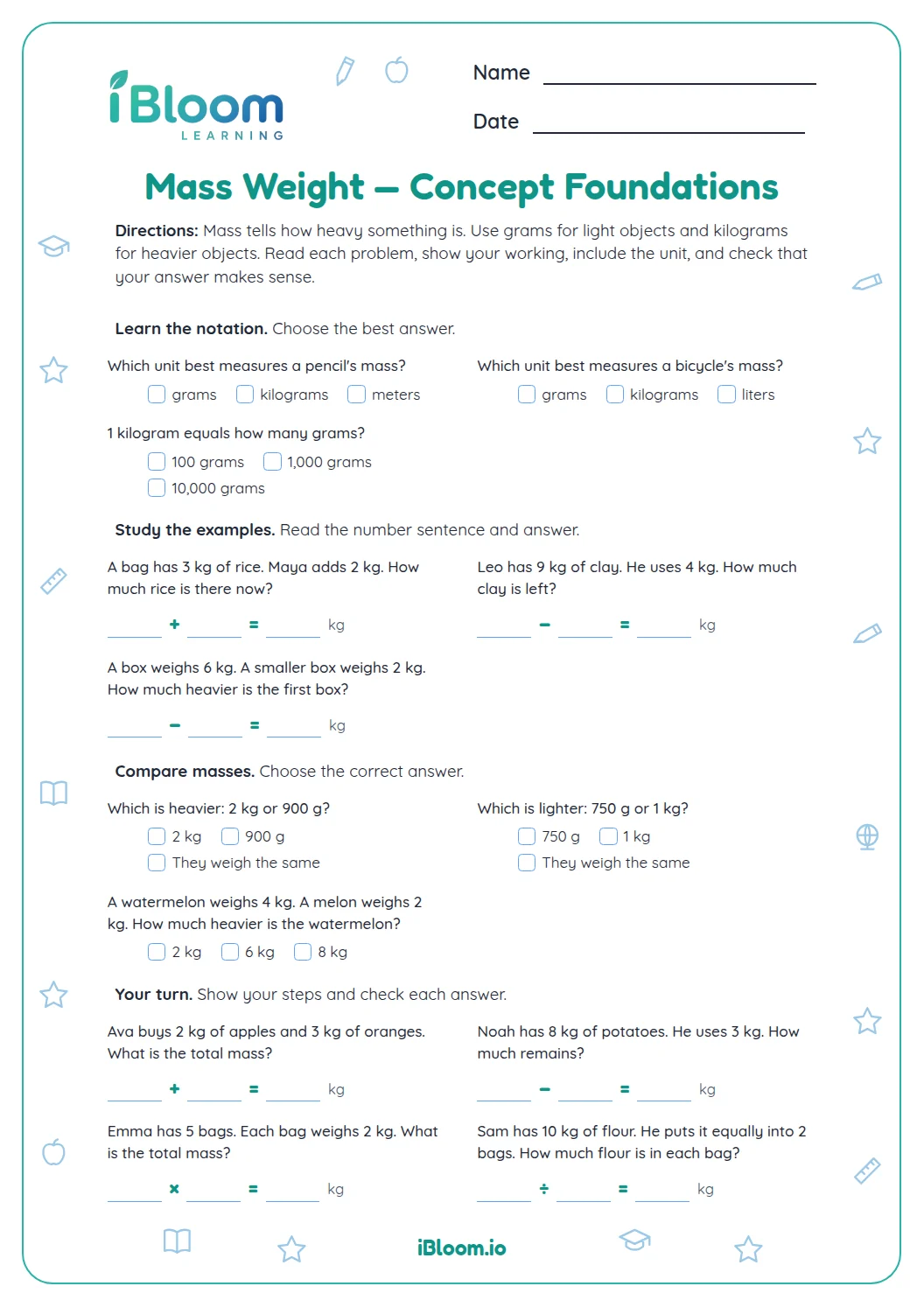
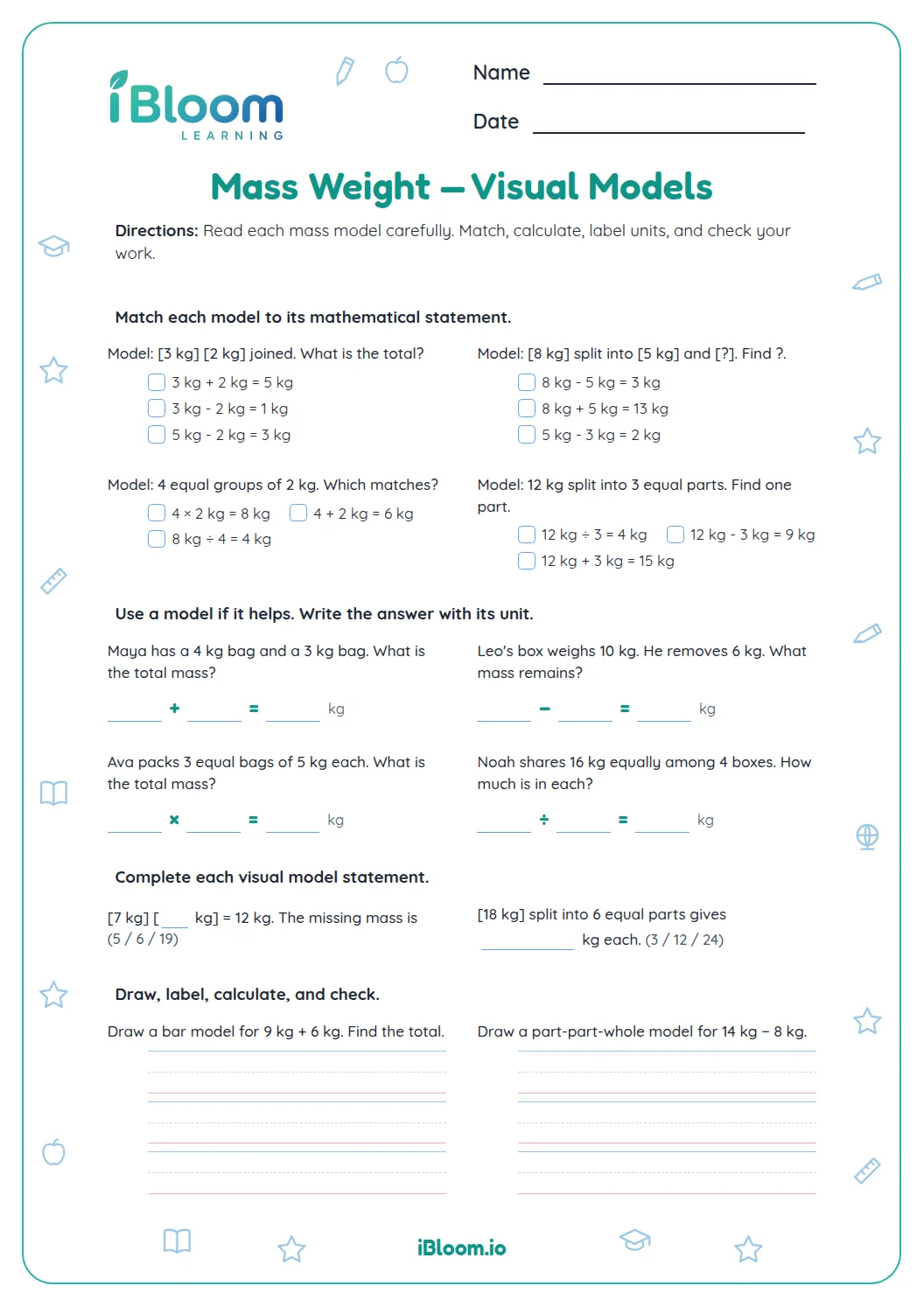
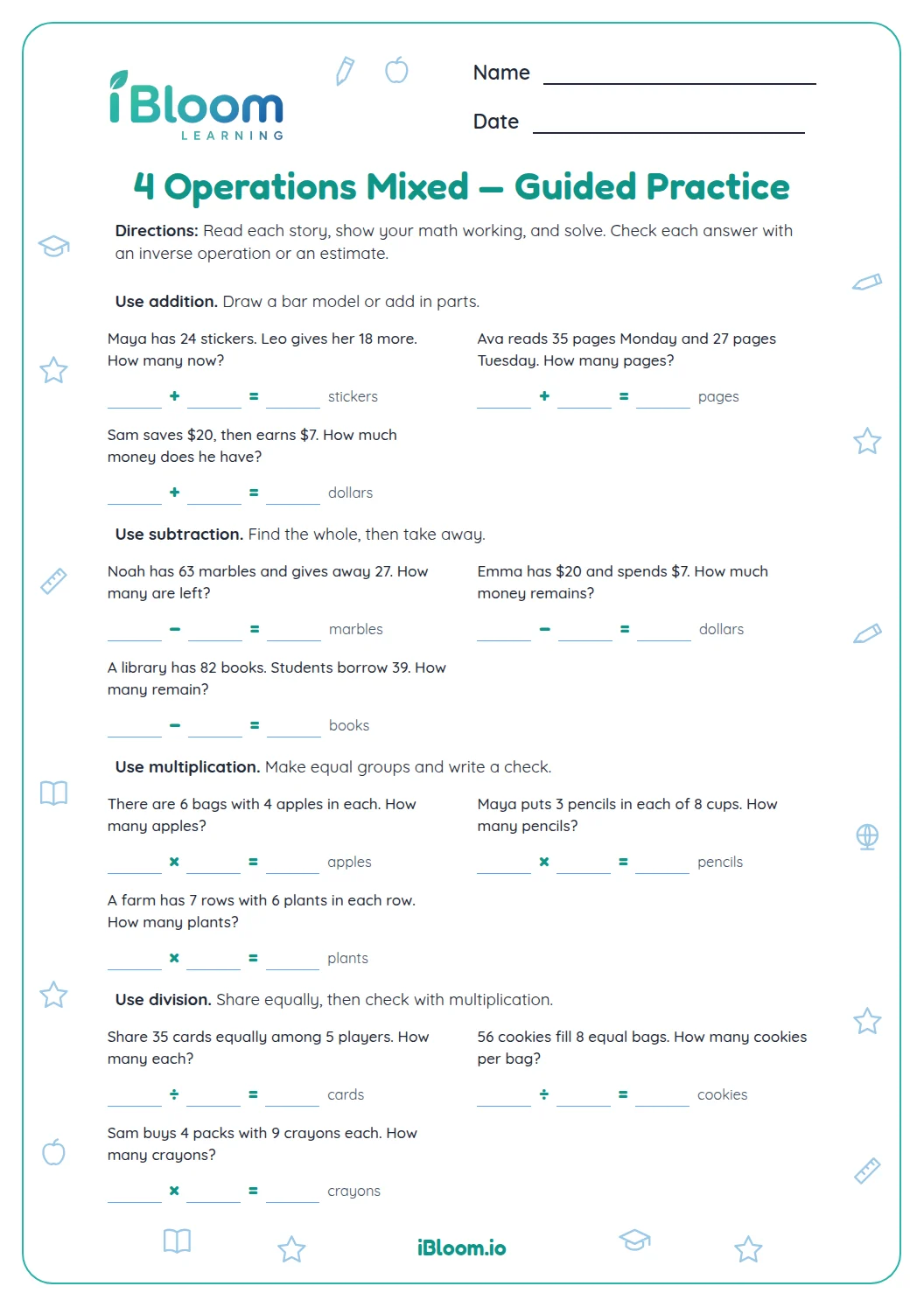
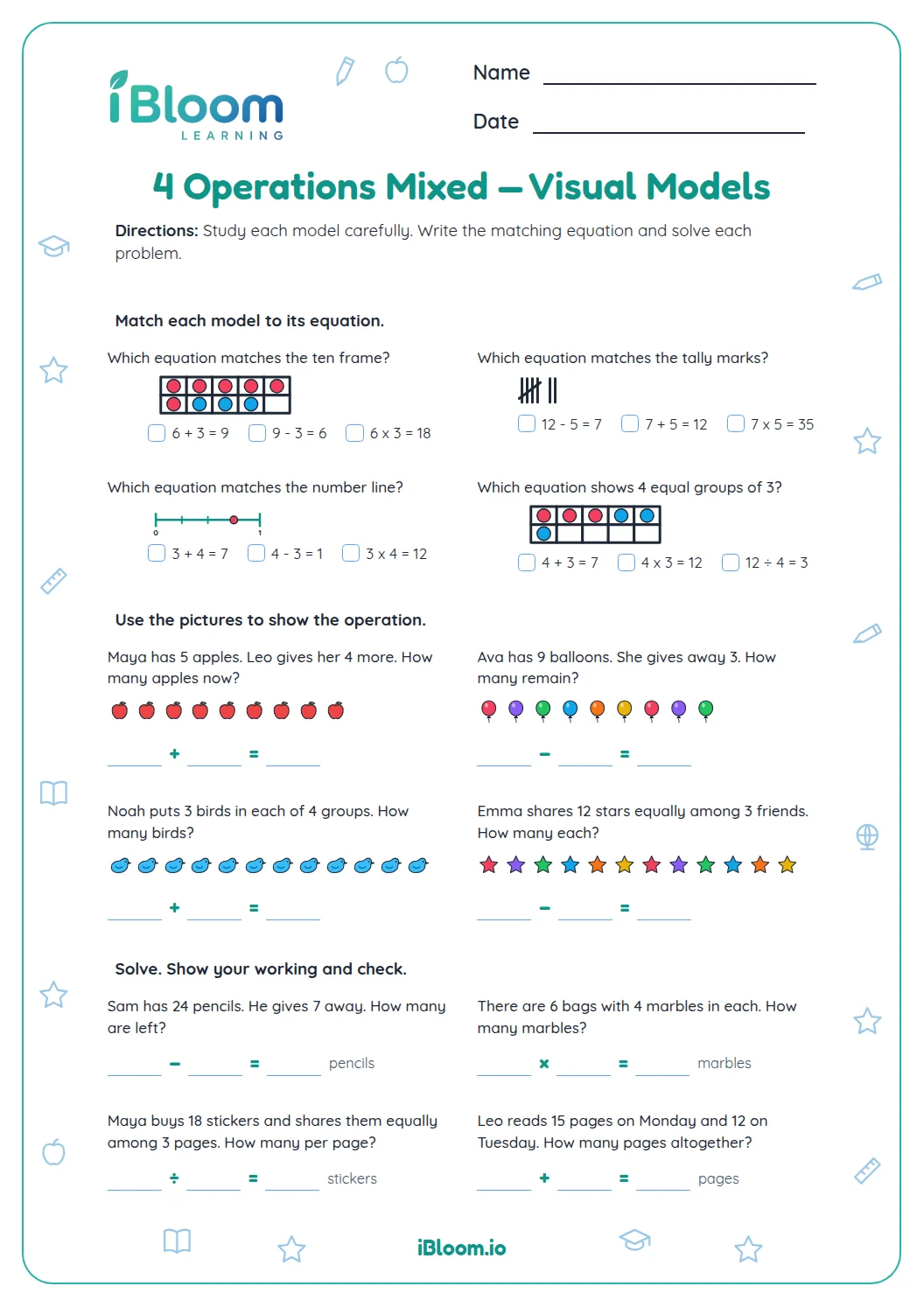
This free printable Grade 3 worksheet gives students 16 one-step word problems about mass. Children combine or subtract amounts, find the mass of equal groups, and divide a total mass into equal shares. The situations use grams or kilograms, with matching units within each problem. Part A focuses on totals and differences, Part B on equal groups, and Part C mixes all four operations. Students write equations and include units. The sheet practices Common Core 3.MD.A.2 and includes a separate answer key.
Aligned to 3.MD.A.2
Which mass units do students use?
The sheet uses grams, written g, and kilograms, written kg. A problem about flour gives 250 g and 150 g, so the answer stays in grams. A problem about equal boxes gives 3 kg per box, so its total stays in kilograms.
Have children circle the unit in the question before calculating. This helps keep a number such as 18 tied to its meaning: 18 kg of supplies, rather than 18 boxes.
How do equal groups change the calculation?
When the mass of each equal group is known, multiply to find the total mass. When the total mass and the number of equal groups are known, divide to find the mass in each group.
Question 6 gives a total of 36 kg of pet food and six bins that receive equal masses. Each bin receives one sixth of the total.
- 136 kg of pet food is shared equally among 6 bins.
- 236 ÷ 6 = 6
- 3Each bin gets 6 kg.
- 4Check: 6 × 6 = 36 kg in all.
What makes the last part a mixed review?
Part C changes the operation from one problem to the next. Students add oats, compare a backpack and a lunch bag, multiply the mass of equal bags, and share clay into equal pieces. No operation is printed for them.
Each answer can be checked against the situation. A combined mass should exceed either starting mass. An equal share should be smaller than the total, and a difference should describe how far apart two masses are.
Solve and check each mass problem
- 1Read the whole question and say what mass you need to find.
- 2Circle the given masses and their units.
- 3Choose an operation from the situation, then write an equation in the working space.
- 4Calculate and include g or kg in the final answer.
- 5Check with the inverse operation or compare the answer with the starting amounts.
Mistakes to watch for
The mistake
Adding 36 and 6 when 36 kg is shared among six bins.
The fix
Six is the number of equal shares. Divide 36 by 6 to find the mass in each bin.
The mistake
Writing 9 kg for six boxes of 3 kg each.
The fix
There are six equal groups of 3 kg. Use 6 × 3 = 18 kg.
The mistake
Giving 6 as a final answer without a unit.
The fix
Reread the mass unit in the problem and write 6 kg for the pet-food share.
Common Core alignment
Solve one-step mass problems with addition, subtraction, multiplication and division in grams or kilograms.
On this sheet: Twelve everyday problems use masses in matching units and ask students to choose an operation and find a mass.
Show the official wordingHide the official wording
Measure and estimate liquid volumes and masses of objects using standard units of grams (g), kilograms (kg), and liters (l). Add, subtract, multiply, or divide to solve one-step word problems involving masses or volumes that are given in the same units, e.g., by using drawings (such as a beaker with a measurement scale) to represent the problem.
What to practice next
Make more practice
Further reading
Questions parents and teachers ask
Which operations appear on the worksheet?
Look at what happens to the mass: joining amounts calls for addition, removing or comparing calls for subtraction, equal groups call for multiplication, and equal shares call for division. For example, 36 kg shared among 6 bins is 36 ÷ 6 = 6 kg per bin.
Do the problems use grams or kilograms?
They use both grams and kilograms. Every problem keeps its mass measurements in one unit, so students can carry that unit into their answer. For example, the flour problem uses grams, while the pet-food sharing problem uses kilograms. Ask children to include g or kg after each result.
How much working should students write?
An equation and a labeled answer are enough for each one-step problem. The working space lets students record how they combined the numbers. For the pet-food problem, write 36 ÷ 6 = 6, then give 6 kg as the answer. An optional multiplication check can confirm the share.
How do I explain the backpack comparison?
Subtract the smaller mass from the larger mass. The backpack has a mass of 5 kg and the lunch bag has a mass of 2 kg, so the backpack is 3 kg heavier. Check by adding the difference to the smaller mass: 2 + 3 = 5.
What is included in the answer key?
The answer key gives a final mass for each of the 12 problems, including the correct unit. Check the child’s equation as well as the result to see which operation was chosen. If an answer is wrong, reread the situation before repeating the calculation with the same numbers.