
About this worksheet
This worksheet gives students practice connecting a circle’s diameter to the distance around it in familiar settings. Each problem names a real object and a whole-number diameter. Students use π≈3 to produce a whole-number estimate and include the unit. This is an early introduction to the Grade 7 circumference formula, simplified for Grade 4 arithmetic.
Aligned to 7.G.B.4
What is on this worksheet?
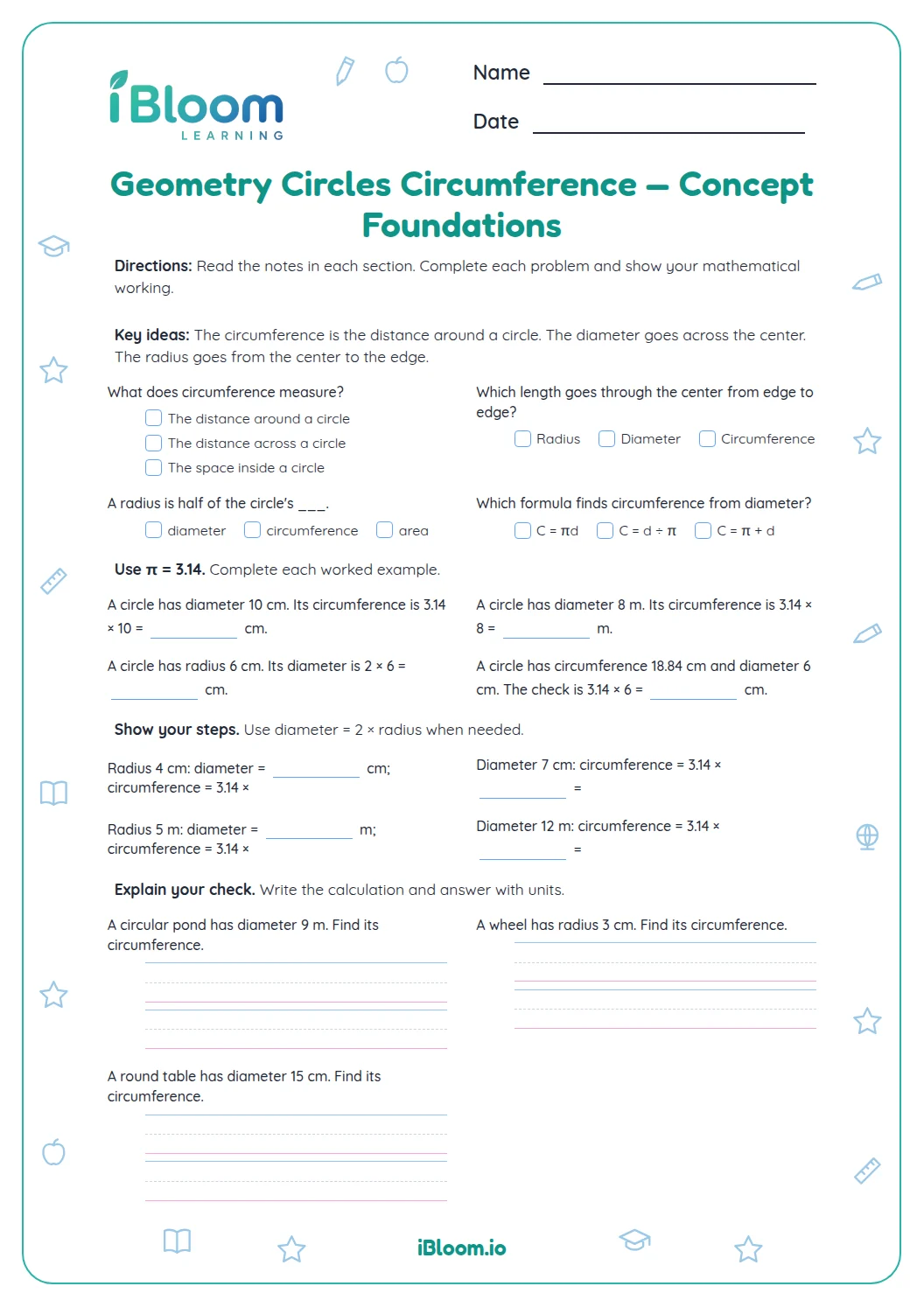
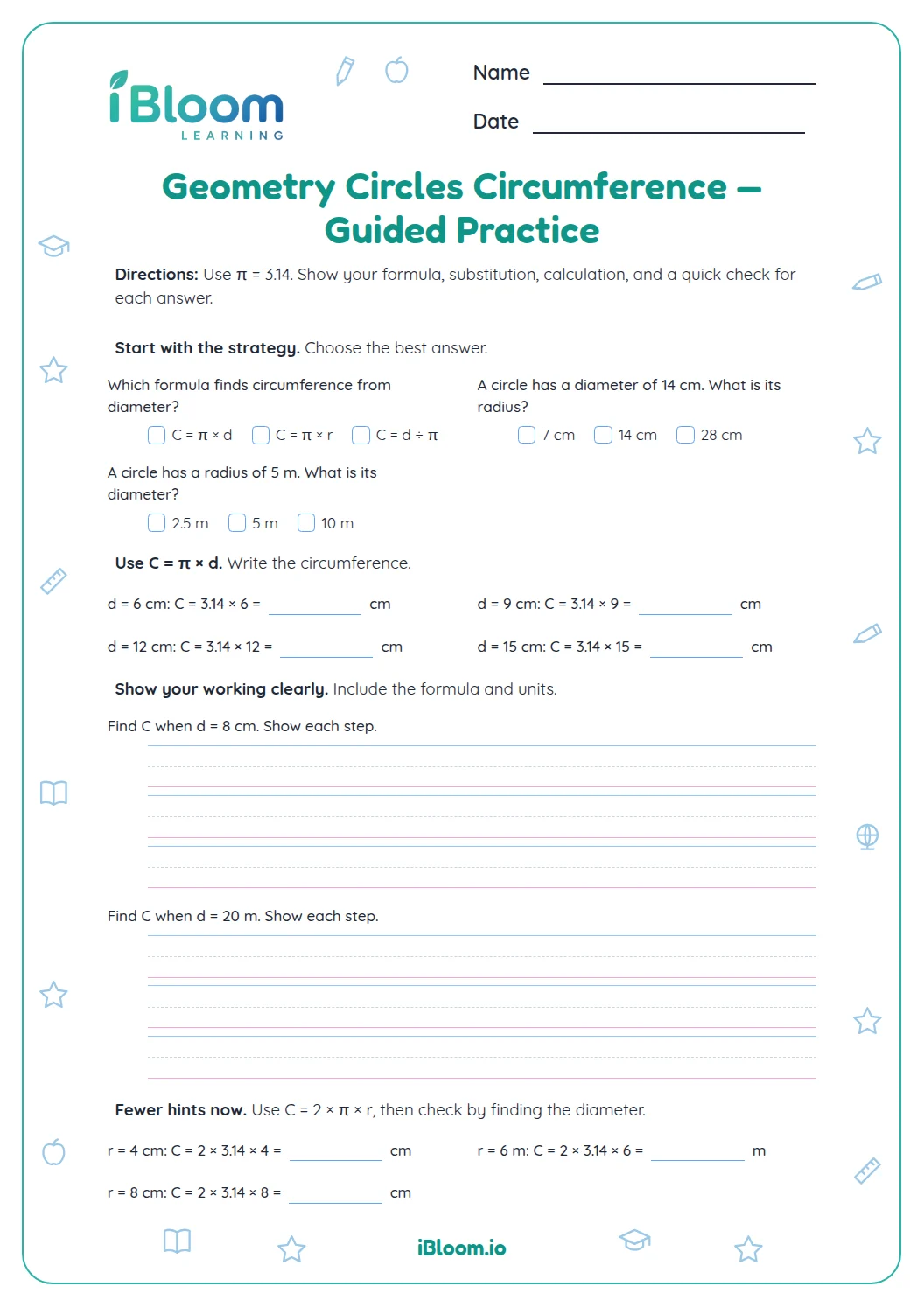
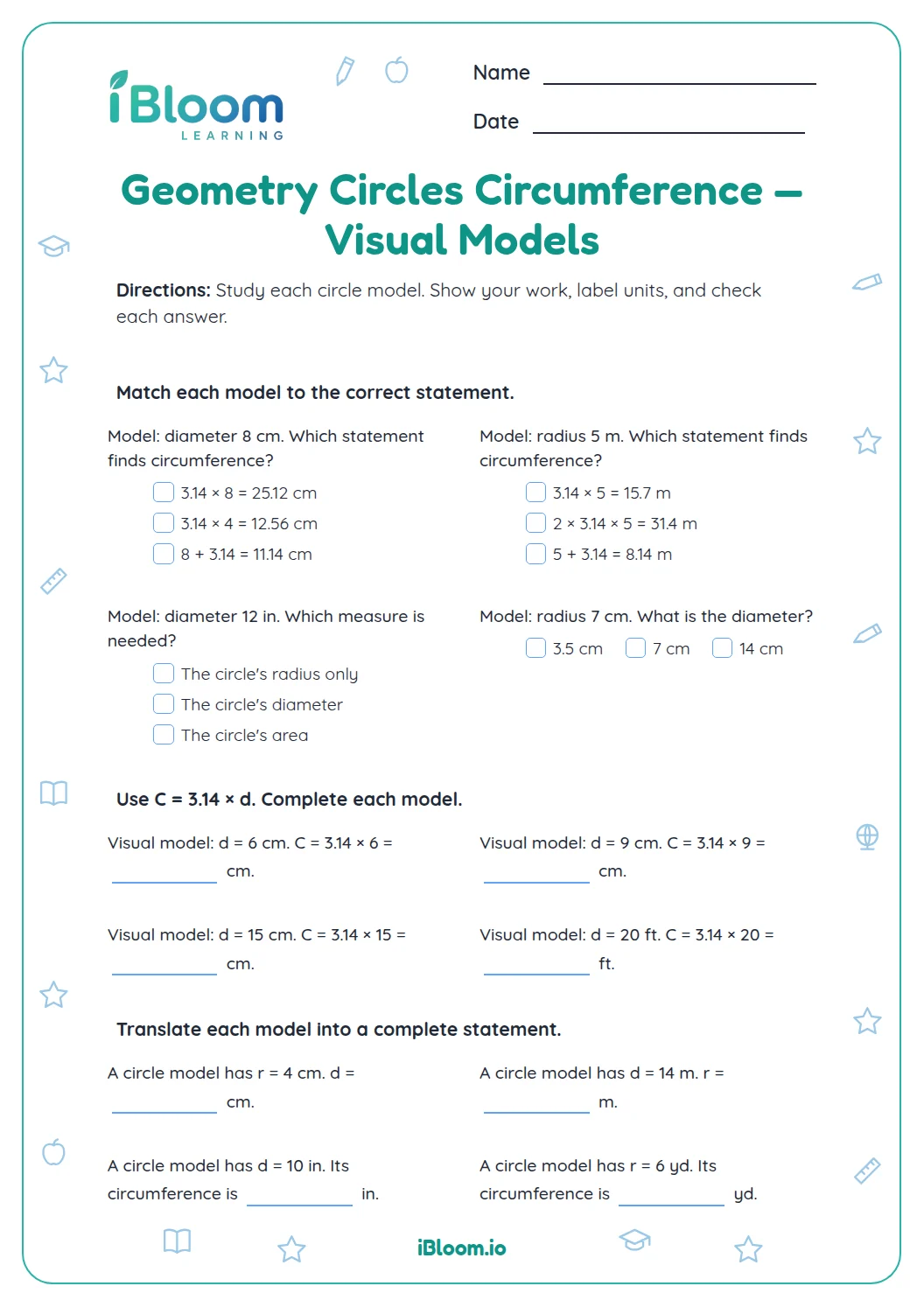
Fourteen real-world problems ask students to find a circle’s circumference from its diameter or radius. Use π ≈ 3.14, show the multiplication, and include the unit given in each problem.
- Use C = πd when the diameter is given.
- Use C = 2πr when the radius is given.
- The key gives the circumference with matching units.
How are diameter and circumference related?
The diameter measures straight across the circle through its center. The radius runs from the center to the edge, so it is half the diameter. Circumference measures around the edge. Multiply a diameter by 3.14, or double a radius and then multiply by 3.14.
- Circle around once: that length is circumference.
- Measure across the center: that length is diameter.
- Multiply the diameter by 3 for this worksheet’s estimate.
How can I check a circumference answer?
For a plate with diameter 20 cm, multiply 20 by 3.14: C = 62.8 cm. Check that the answer is a little more than three diameters and that the unit stays centimeters.
How to use this worksheet
- 1Mark whether the given measure is a diameter or radius.
- 2Choose C = πd or C = 2πr.
- 3Substitute the given value and use π ≈ 3.14.
- 4Multiply carefully and write the unit from the problem.
- 5Check that the result is a little more than three diameters.
Common mistakes and quick fixes
The mistake
Using the diameter itself as the circumference.
The fix
The edge wraps around more than three times the diameter; multiply by 3 here.
The mistake
Doubling the diameter instead of multiplying by 3.
The fix
Use the factor given in the directions: π≈3.
The mistake
Changing feet to inches even though no conversion is requested.
The fix
Keep the unit printed beside the diameter in the answer.
Curriculum alignment
The activity practices the skill named in its title. The standard below describes the closest Common Core connection.
Use circle circumference formulas to solve mathematical and real-world problems.
On this sheet: Students use diameter and radius formulas to calculate circumferences in real-world settings.
Show the official wordingHide the official wording
Know the formulas for the area and circumference of a circle and use them to solve problems; give an informal derivation of the relationship between the circumference and area of a circle.
What to practice next
Make more practice
Questions parents and teachers ask
How do I find circumference from diameter?
Multiply the diameter by 3.14 for the estimate used on this sheet. For example, a 20-centimeter diameter gives 20 × 3.14 = 62.8 centimeters. Keep the same unit as the diameter and check that the answer is a little more than three diameters.
How do I find circumference from radius?
Double the radius to find the diameter, then multiply by 3.14. You can also use C = 2πr directly. For a radius of 5 meters, 2 × 3.14 × 5 = 31.4 meters. Both methods give the same circumference.
Why do some problems give radius and others diameter?
A circle measurement may be given from center to edge or all the way across the center. The worksheet mixes both forms so students must identify the given measure before choosing a formula. Radius is half the diameter, which helps check the setup.
Should students include units?
Yes. Each problem gives a unit such as inches, feet, meters, or centimeters. Circumference is a length, so the answer uses that same unit. The answer key includes units to make this check clear and keep the measurement meaningful.
Are the answers exact?
The worksheet tells students to use π ≈ 3.14, so answers are estimates based on that rounded value. The calculations are exact for the stated approximation. A calculator using a longer value of π may show a slightly different result.
What does the answer key show?
The key lists a circumference for each of the 14 questions and keeps the units from the prompts. Students can compare their multiplication and check whether they used diameter or radius correctly before correcting a solution. It supports checking each step.