
About this worksheet
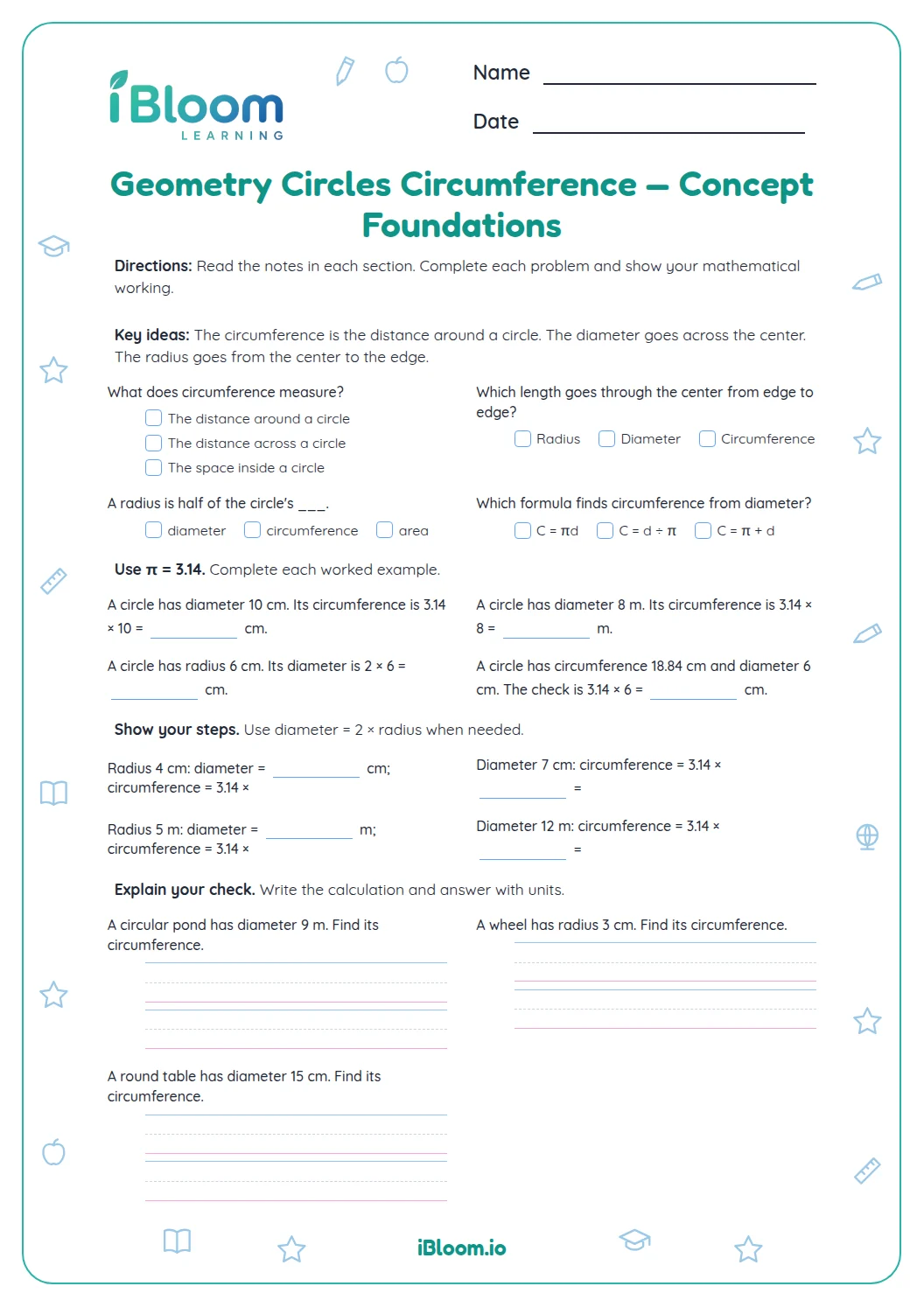
This printable circle worksheet gives Grade 4 learners independent practice with circumference. Three opening choices review circumference, diameter and radius. Six calculations use stated diameters or radii, followed by four short problems about a hoop, a mat, a pond and a lid. Every calculate uses π = 3.14, so children work with whole numbers and label their answers in centimeters or meters. The circumference-formula work connects to Common Core 7.G.B.4. A separate answer key shows all fourteen answers. Review the vocabulary and the approximation before children begin.
Aligned to 7.G.B.4
What is circumference?
Circumference is the distance around a circle. The diameter crosses the circle through its center, from one side to the other. A radius runs from the center to the edge and is half the diameter.
Part A checks these three ideas before children calculate. They need the vocabulary because Part B mixes diameter and radius measurements.
How do you calculate from a radius?
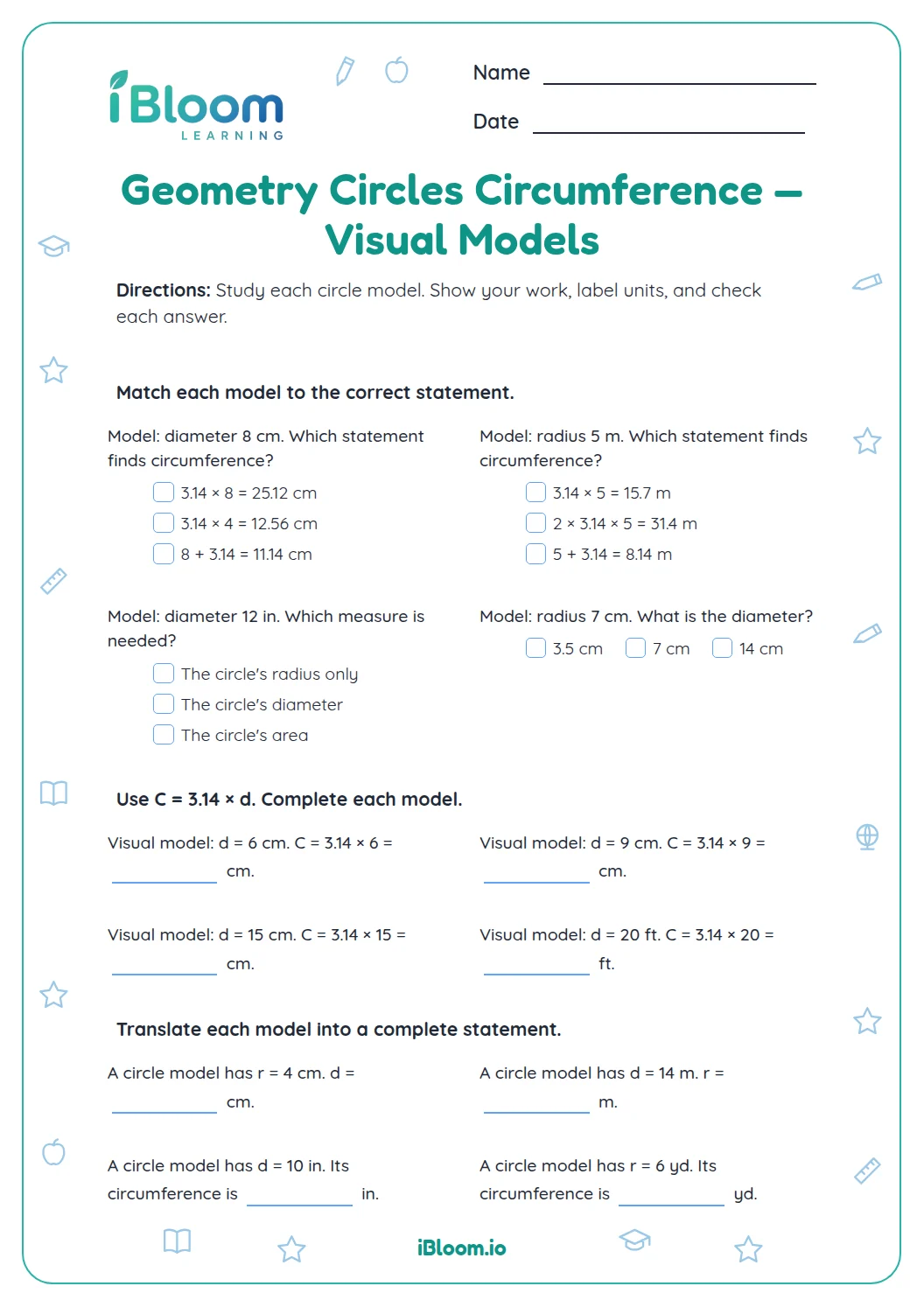
Double the radius to get the diameter. Then multiply the diameter by 3.14 to calculate circumference. In question 7 the radius is 2 cm, so the diameter is 4 cm and the circumference is 12.56 cm.
- 1Radius = 2 cm
- 2Diameter = 2 × 2 = 4 cm
- 3Circumference = 3.14 × 4 = 12.56 cm
Why does the sheet use π = 3.14?
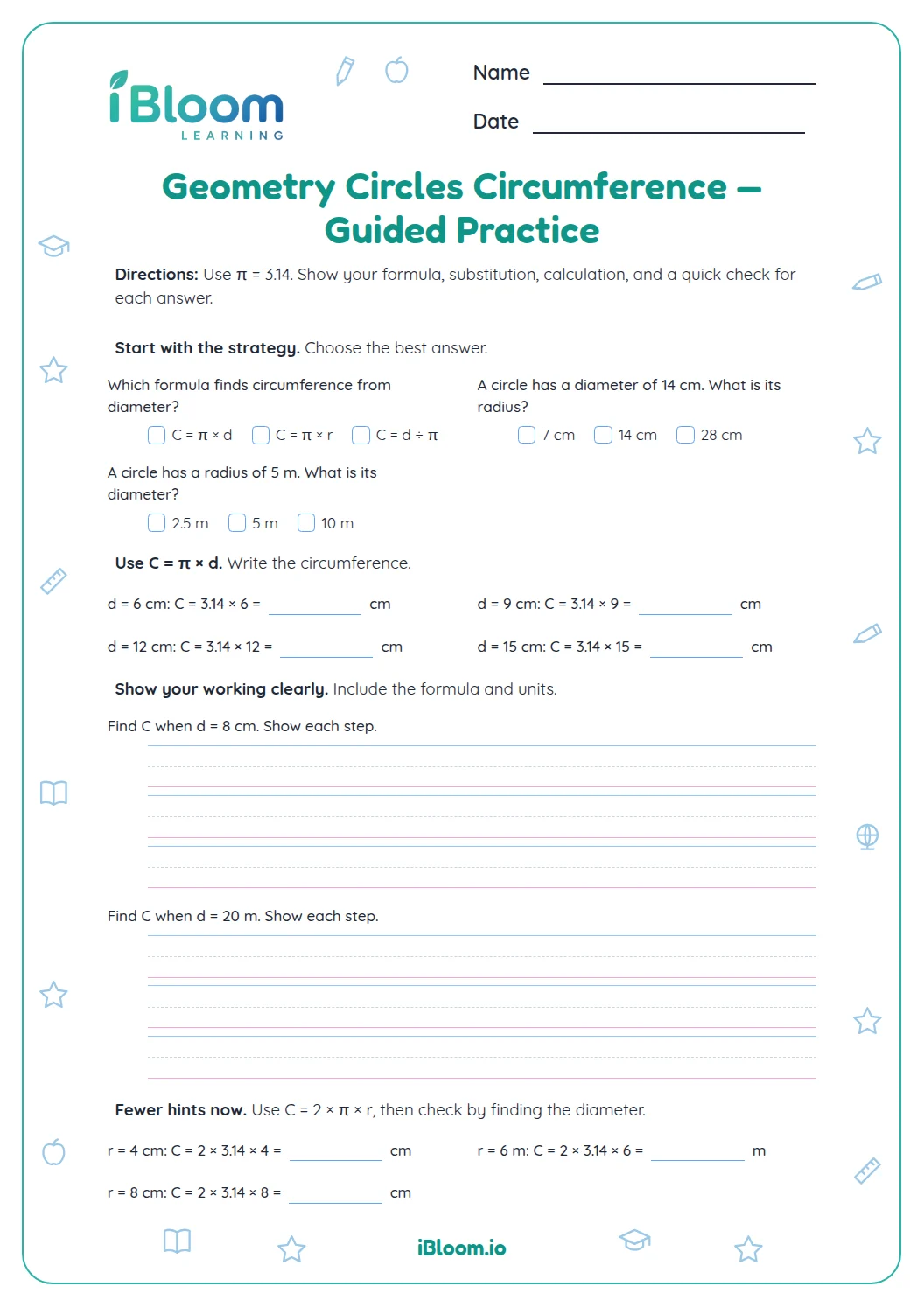
The formula is C = π × d. Use π = 3.14 for the calculations on this worksheet. The circumference values are given to the nearest hundredth when needed.
Use the same value throughout the applied questions. The hoop and lid give diameters, while the mat and pond give radii. Keep cm or m with each final answer; circumference measures length.
How to use this worksheet
- 1Review the words circumference, diameter and radius before starting.
- 2Read the direction to use π = 3.14 for every calculate.
- 3Complete Part A, then mark each given measurement as a radius or diameter.
- 4For every radius, work out the diameter first; then multiply by 3.
- 5Solve the four word problems and check both the number and the unit against the key.
Mistakes to notice and fix
The mistake
Multiplying a radius by 3 and calling the result the circumference.
The fix
Double the radius first. A radius of 2 cm gives a diameter of 4 cm and circumference of about 12.56 cm.
The mistake
Using 3.14 in some questions and 3 in others.
The fix
Follow the stated approximation, π = 3.14, for every answer on this sheet.
The mistake
Labeling the circumference in square centimeters.
The fix
Circumference is a distance around an edge. Use cm or m, matching the given length.
Common Core alignment
Use the circumference formula to calculate the distance around a circle.
On this sheet: Students use C = π × d with π = 3.14 to calculate circumferences.
Show the official wordingHide the official wording
Know the formulas for the area and circumference of a circle and use them to solve problems; give an informal derivation of the relationship between the circumference and area of a circle.
What to practice next
Make more practice
Further reading
Questions parents and teachers ask
Should my child use 3 or 3.14 for pi?
Use 3 for every calculation on this worksheet. The directions deliberately choose π = 3.14 so the arithmetic uses whole numbers. Explain that the resulting circumference is approximate. Using 3.14 would produce a different calculate, so check that the child follows this sheet’s stated convention.
How are radius and diameter different?
A radius reaches from the center of a circle to its edge, while a diameter crosses through the center from edge to edge. The diameter is twice the radius. Question 7 gives a radius of 2 cm, so children calculate a diameter of 4 cm first.
What should children write in the calculation blanks?
Write just the number in Part B because the unit is already printed after each blank. For example, question 4 gives a diameter of 4 cm, so the blank is 12. In Part C, children include the length unit in the answer box after their working.
Why is the answer to the pond problem 30 m?
The pond has a radius of 5 m, so its diameter is 10 m. Multiplying that diameter by 3 gives an calculated circumference of 30 m. A response of 15 m uses the radius directly and misses the step of doubling it before calculating.
Can this page be used for independent practice?
Yes, after children know the three circle terms and the two calculation steps. The opening choices check vocabulary, and the following questions use the same approximation throughout. Keep the separate answer key aside while they work, then ask them to explain any correction involving a radius.